Homeland is the place where every person was born and raised, the place where their umbilical cord blood was shed, the peaceful abode where our ancestors lived. Our Uzbekistan is considered to be such a heavenly land.
Every person in the world expresses their deep love for their country in different ways. Some work hard to develop their homeland, while others mobilize their talents and skills for the sake of the place where they were born and raised.
When we think of the homeland, we imagine a place where our childhood memories are concentrated, where our loved ones lived, and where the breath of mother earth breathes. Do you know why the homeland is compared to a mother? Because, just as a mother takes care of and raises her child with love, the homeland also protects, honors, nourishes, and shows love. When our athletes sing our anthem from the heart on the vast fields and raise our flag high, I am very proud of my country, Uzbekistan.
Many poets have described the homeland as a unique and sacred place in a number of their stories and poems. In particular, let us pay attention to these lines of the famous poet and enlightener Sidqi Khandayliqi:
“Is homeland rare? The place where I was born, the place where I live, the place where I hang out, play and laugh..”
My soul is the Homeland, my body is the Homeland, my eyes are the Homeland,
Forget it, I’ll go to the cemetery when I see it.
The words of our first president, Islam Karimov, filled with boundless love for our homeland, will conclude my speech:
“Of course, the world is vast, there are many countries in the world, but our unique country, Uzbekistan, is unique in this world. This beautiful country, this sacred land is dedicated only to us!”
Born in 2010 in Bukhara region; currently, he has completed 9th grade and is entering 10th grade.
• He is very interested in reading books, writing poems, articles, and preparing projects.
• Winner of various science Olympiads,
• Participated in a number of programs such as ‘The FXB Climate Advocates Program’ and ‘Shape the Future Challenge’.
• Participant of Zakovat Club, Ibrat Debate, Neo Kitobkhon competitions
• Holder of more than 50 certificates, vouchers, diplomas
• National Certificate of Mother Tongue (63); CEFR (55)
• The article “Preserving the Green Planet – the Duty of Each of Us” was published in Italian in the newspaper “Alessandria News Media” and was also covered in detail on Google.
INNOVATIVE APPROACHES TO ENGAGING STUDENTS IN ACTIVE LEARNING: PROJECT-BASED LEARNING AND PROBLEM-BASED TEACHING METHODS
Qodirov Farrux Ergash o‘g‘li
Head of the Department of Mathematics and Information
Technology in Education
Shahrisabz State Pedagogical Institute
Boboqulova Durdona Sanjar qizi
2nd-year student, Mathematics major
Shahrisabz State Pedagogical Institute
Abstract: This article explores innovative methods of engaging students in active learning in higher education — namely project-based learning and problem-based teaching methods. These methods are designed to foster independent thinking and the development of practical skills. Project-based learning provides opportunities to solve real-life problems, while problem-based learning enhances students’ analytical and critical thinking abilities. The study highlights the role of these approaches in improving the effectiveness of education. As a result, it is confirmed that innovative methods play an important role in improving the quality of professional training.
Keywords: Innovative pedagogical technologies, project-based learning, problem-based learning, active learning, independent thinking, practical skills, higher education, learning effectiveness, interactive learning, professional training
—
Introduction: In modern higher education, actively engaging students in the learning process is considered a crucial pedagogical task. Innovative pedagogical technologies are regarded as the main tools for improving the quality of education and for developing not only the theoretical knowledge but also the practical skills of young specialists. In particular, project-based learning and problem-based teaching methods are recognized as effective approaches to fostering independent thinking, creativity, and critical reasoning in students.
Project-based learning is a form of education that organizes students’ activities around solving real-life problems, allowing them to apply theoretical knowledge in practice. This method makes the learning process interactive, contextual, and engaging, enabling a deeper understanding of the subject. Problem-based learning, on the other hand, is a pedagogical approach that encourages students to identify, analyze, and seek solutions to problems independently. Through this method, students develop logical reasoning, decision-making, and systematic thinking skills.
Today, along with the above-mentioned approaches, digital technologies and interactive tools are widely introduced to increase the effectiveness of the learning process, which in turn contributes to raising the quality of education to a new level. Therefore, studying the pedagogical foundations, practical significance, and effectiveness of innovative approaches in engaging students in learning is considered one of the urgent issues.
Problem Statement: In modern higher education institutions, improving the quality of the learning process, ensuring high student engagement, and developing their independent thinking, creativity, and practical skills are urgent challenges. Traditional teaching methods often fail to sufficiently motivate student activity, which leads to a decrease in educational effectiveness.
For this reason, enriching the educational process with innovative pedagogical technologies — especially project-based and problem-based learning methods — is of great importance. Project-based learning directs students toward solving practical problems, increases their responsibility, and creates opportunities to apply knowledge in real-life situations. Problem-based learning, meanwhile, motivates students to develop self-management, critical, and logical thinking skills.
Therefore, identifying the effectiveness of these approaches in the learning process and examining their impact on students’ activity, academic performance, and creative potential is of both scientific and practical significance.
Research Methods: This study employed a combination of qualitative and quantitative research methods. First, to establish a theoretical foundation, scientific literature, articles, and practical manuals in the fields of pedagogy, psychology, and educational technology were analyzed.
Second, to study the implementation of project-based and problem-based teaching methods in higher education institutions, surveys, interviews, and observations were conducted. Surveys explored the attitudes of students and teachers toward the new pedagogical methods, their participation in the learning process, challenges, and successes. Interviews provided insights into teachers’ approaches and difficulties in applying these innovations in practice.
In addition, experimental learning groups were organized, in which students’ knowledge, skills, and engagement were assessed when project-based and problem-based learning methods were applied. Statistical tools — including descriptive statistics, correlation analysis, and comparative methods — were used to analyze the data. These tools ensured the objectivity and reliability of the research and allowed for the scientific evaluation of the effectiveness of innovative pedagogical approaches.
Research Results and Discussion: The results of the study showed that project-based learning and problem-based teaching methods are significantly more effective in engaging students in learning than traditional methods. In the experimental group, students’ academic performance and independent learning skills improved noticeably.
Project-based learning not only directed students toward theoretical knowledge but also enabled them to solve real-life problems, fostering their creativity and critical thinking abilities. Problem-based learning had a positive effect on the development of logical reasoning, analytical ability, and independent decision-making skills among students.
Survey and interview results confirmed that most students considered these methods interesting and motivating, and that their activity and participation in the learning process increased. Teachers also acknowledged the effectiveness of these approaches in improving educational quality, while emphasizing the need for professional development and methodological support in their implementation.
Furthermore, the study revealed that successful application of project-based and problem-based learning requires revising curricula and assessment systems, adapting learning materials, and using modern digital tools. This ensures that the educational process becomes more interactive and tailored to students’ needs.
Overall, the findings demonstrated that the widespread integration of innovative pedagogical technologies is a key factor in improving educational quality, enhancing student engagement, and developing practical skills. Therefore, systematic implementation of project-based and problem-based learning methods, along with continuous teacher training, should be a priority to make the learning process more effective.
Conclusion: The results of this study demonstrated that project-based and problem-based teaching methods are highly effective in actively engaging students in the learning process. These methods promote independent thinking, creativity, and the development of practical skills, preparing students to solve real-life problems.
Innovative pedagogical approaches play a crucial role in improving educational quality, encouraging student participation, and enhancing the interactivity of the learning process. The research also revealed that successful implementation of these methods requires revising curricula, integrating modern technologies, and improving teachers’ professional skills.
Therefore, systematically expanding the use of project-based and problem-based learning in higher education makes the learning process more effective and modern, while significantly contributing to the preparation of highly qualified professionals.
References:
Abdullayev, B. (2020). Innovative Pedagogical Technologies: Theory and Practice. Tashkent: Teacher Publishing.
Karimov, M. (2021). Project-Based Learning Methodology. Tashkent: Science.
Rasulova, N. (2019). Problem-Based Learning Methods and Their Effectiveness. Journal of Pedagogy, 3(12), 45-52.
Sobirov, T. (2022). Interactive Methods in Higher Education. Tashkent: University Press.
Tashkent State University. (2023). Innovations in the Educational Process: Scientific Collection. Tashkent.
UNESCO. (2018). Innovative Pedagogies for Powerful Learning: Toolkit for Educators. Paris: UNESCO Publishing.
Zokirov, A. (2020). Methods of Developing Critical Thinking in Education. Scientific Bulletin, 4(7), 78-85.
A second-year student in the Astronomy program at Termiz State University
Annotation:
This article explores the internal structure of Saturn, the second-largest planet in the Solar System. It examines the composition and characteristics of its core, metallic hydrogen layer, molecular hydrogen envelope, and atmospheric features. Special attention is given to the processes influencing Saturn’s internal heat, magnetic field, and rotation. The study also discusses current scientific models and data obtained from space missions, which contribute to a deeper understanding of the planet’s formation and evolution
Kalid so’z:
Keywords: Saturn, internal structure, core composition, metallic hydrogen, planetary science, gas giants, atmosphere, magnetic field.
The Internal Structure of Saturn
Saturn is the second-largest planet in the Solar System, with a diameter of approximately 120,536 km and a mass about 95 times that of Earth. It belongs to the class of gas giants.
1. Core
Saturn is believed to have a solid core at its center.
Estimated diameter: around 25,000 km.
Composition: iron, nickel, oxygen, silicates, and ice mixtures.
Estimated temperature: ~11,700 °C.
2. Metallic Hydrogen Layer
Located above the core.
Under extreme pressure and temperature, hydrogen takes on a metallic form. The planet’s strong magnetic field is generated by movements within this layer.
3. Molecular Hydrogen Layer
Composed mainly of molecular hydrogen mixed with helium.
Temperature increases with depth.
4. Atmosphere
Main composition: 96% hydrogen, 3% helium, with traces of methane, ammonia, and other gases.
Cloud layers are divided into three main zones from top to bottom:
Ammonia ice clouds Ammonium hydrosulfide clouds
Water ice clouds
5. Heat Source
Saturn emits about 2.5 times more heat than it receives from the Sun.
This is due to the Kelvin–Helmholtz process (gravitational compression) and helium rain.
6. Research
Voyager 1 and Voyager 2 (1979–1981) provided the first comprehensive data about Saturn.
Cassini–Huygens (2004–2017) gathered highly detailed information about Saturn, its rings, and moons.
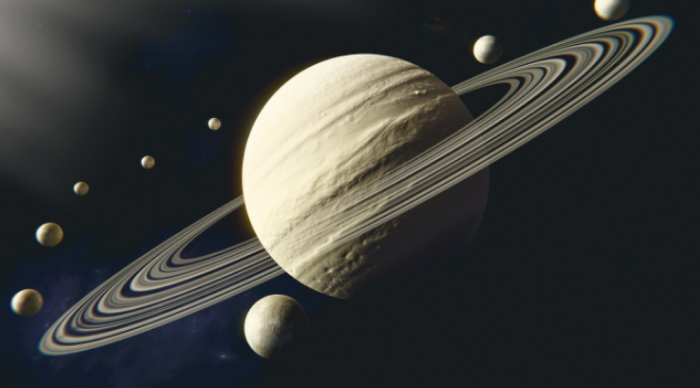
Saturn or Zuhal (Arabic) — one of the nine major planets of the Solar System; the sixth planet from the Sun in terms of distance. Its astronomical symbol is ♄. The average distance from the Sun is 9.58 astronomical units (1,429.3 million km). In terms of size, it ranks second after Jupiter. Due to its orbital eccentricity of 0.056, this distance decreases at perihelion and increases at aphelion. Saturn completes one full revolution around the Sun in 29 years and 167 days. Its rotation period at the equator is 10 hours 14.5 minutes, increasing toward the poles, as on Jupiter. Saturn’s average radius is 58,000 km, and at the equator it is close to 60,000 km. Its density is 0.72 g/cm³ (about 0.13 of Earth’s density), and its mass is 5.681 × 10²⁷ g (95.28 times that of Earth). It is composed mainly of hydrogen and helium. The inclination of Saturn’s equator to its orbital plane is 26°45′. Elongated dark belts along the equator and white spots can be observed on its surface.
Spectroscopic studies have shown that Saturn’s atmosphere is mainly composed of hydrogen (H₂) and methane (CH₄); later, acetylene (C₂H₂) and ethane (C₂H₆) were also discovered. Infrared observations indicate a temperature of about 95 K. Saturn emits regular radio waves and has its own magnetic field. Even at such low temperatures, methane and ammonia remain in a gaseous state in its atmosphere. Saturn was first observed by Galileo in 1610.
Saturn’s most remarkable feature is its ring system, which lies in the plane of its equator. The rings are mainly composed of three distinct concentric parts: the innermost S ring, the middle V ring, and the outer A ring. All rings are almost transparent, allowing the stars behind them to be seen. The gap between the A and V rings is called the Cassini Division. The rings are a few kilometers thick, have a diameter of about 250,000 km, and are roughly 100 million years old. As early as the beginning of the 20th century, it was established that the rings are not solid, but consist of numerous solid particles orbiting Saturn according to Kepler’s laws. Their infrared spectra are very similar to those of ice and frost.
Saturn has 22 known natural satellites. The largest among them are Mimas, Enceladus, Tethys, Dione, Rhea, Titan, Hyperion, Iapetus, Phoebe, and Janus. Titan, with a diameter of 4,850 km, is one of the largest satellites in the Solar System (larger than the Moon). Titan possesses an atmosphere composed of methane and hydrogen. Of Saturn’s moons, only Phoebe moves in a retrograde orbit relative to the others.
Saturn is the sixth planet from the Sun and the second largest in the Solar System. Along with Jupiter, Uranus, and Neptune, it belongs to the class of gas giants. It is named after the ancient Roman god Saturnus (Unicode: ♄).
Saturn is composed mainly of hydrogen, with small amounts of helium and other elements. The region near its core consists of rock and ice, surrounded by metallic hydrogen. Its outer atmosphere is generally uniform in appearance, although persistent storms sometimes occur. Winds on Saturn can reach speeds of up to 1,800 km/h, which is much faster than those on Jupiter. Saturn has a magnetosphere weaker than Earth’s but stronger than Jupiter’s.
Saturn is famous for its rings, which are made primarily of ice particles mixed with dust. Many moons orbit the planet — about sixty are currently known. Titan, Saturn’s largest moon and the second largest in the Solar System (after Ganymede), is larger than Mercury and is the only natural satellite in the Solar System known to have a dense atmosphere.
Foydalanilgan adabiyotlar:
1. Mamadazimov, M., and A. B. Narbayev. “An e-learning guide for students of the 11th grade of secondary education and secondary special, vocational education institutions.” (2018).
2. Bahramovich N. A. STRUCTURE AND DIDACTICAL POSSIBILITIES OF THE ELECTRONIC TRAINING MANUAL ON ASTRONOMY DEVELOPED FOR PUPILS OF THE 11TH GRADES OF SECONDARY SCHOOLS BASED ON MEDIA EDUCATION //Archive of Conferences. – 2020. – Т. 5. – №. 1. – С. 40-42.
3. Narbaev A. B. Advantages of using media technology in astronomy teaching //Journal of Innovations in Pedagogy and Psychology. – №. 2. 4. Narbaev A. B. METHODS OF USING MEDIA EDUCATION AND TELECOMMUNICATION TECHNOLOGIES IN TEACHING THE TOPIC” VISUAL MOTION OF THE SUN AND STARS” //Central Asian Problems of Modern Science and Education. – 2020. – Т. 2020. – №. 1. – С. 119-125.
4. Ksanfomaliti L. V., Planeti otkritie zanovo, M., 1978; Kulikovskiy P. G., Spravochnik lyubitelya astronomii, M., 1971; Silkin B.I., V mire mnojestva lun, M., 1982; Mamatazimov M., Quyosh sistemasi haqida ocherklar, T., 1984
Homeland… This word is precious and sacred for every person. It embodies the land where we were born and raised, the memory of our ancestors, Uzbek traditions, language, and culture. The Homeland is our past, our present, and our future. Its praise is a feeling eternally sealed in every heart.
The praise of the Homeland is not only words spoken with the tongue but emotions flowing from the heart and manifested in our every action. Praising the Homeland means loyalty to one’s country, dedication to its prosperity, preserving national values, and living with a sense of Uzbek pride and honor.
Uzbekistan is our beloved Homeland. It is famous worldwide for its beautiful nature, rich history, unique culture, hardworking and hospitable people. Our ancient cities – Samarkand, Bukhara, Khiva, Shahrisabz – have for centuries been centers of science, culture, and craftsmanship. These cities have produced great scholars, thinkers, poets, and scientists whose priceless legacy remains a source of pride for us today.
During the years of independence, Uzbekistan has achieved great successes. Fundamental changes have been made in political, economic, social, and spiritual spheres. Our national values have been restored, religious freedom ensured, and our language has been granted the status of the state language. Significant achievements have been made in education, science, culture, and sports. Uzbekistan has found its place in the international arena and established friendly relations with many countries around the world.
Today, Uzbekistan is stepping into a new stage of development. Large-scale reforms are being implemented, our economy is growing, and the standard of living of our people is rising. We face great tasks ahead: to make Uzbekistan one of the most developed, prosperous, and flourishing countries in the world, and to leave a worthy legacy for future generations.
To accomplish these tasks, each of us must contribute. We must master our professions, work honestly, seek knowledge, develop ourselves, remain loyal to our country, preserve our national values, and live with a sense of Uzbek pride and honor.
The praise of the Homeland is the foundation of our unity, harmony, peace, and solidarity. We must be proud of being the children of one land, support one another, and work together for the prosperity of our country. Only then will we achieve our goals and turn Uzbekistan into one of the most developed nations in the world.
In conclusion, praising the Homeland is a feeling eternally sealed in every heart. Preserving it and showing it through our actions is our sacred duty. Uzbekistan is our beloved Homeland — may its praise forever echo in our hearts!
Ozodbek Narzullayev Student of Grade 11, School No. 45, Koson District, Kashkadarya Region
The sun was shining brightly, it was the middle of summer…
I woke up early and was sweeping the yard. My grandmother was sitting and watching me.
“My girl, you studied all night, you didn’t sleep at all. You should rest a little!” she said with concern.
“It’s okay, Grandma, if I go one night without sleep, nothing will happen. God willing, I’ll pass the entrance exams, and then I’ll have plenty of time to rest.”
“If your parents were alive, they would have helped you,” she said sadly.
Just then, my stepmother woke up and came out.
“Ugh… what an unpleasant morning. Hey, Malika, did you iron your brothers’ shirts?”
“Not yet… I haven’t finished.”
“What a useless girl your mother gave birth to! When will you ever do things properly? You can’t do anything right—only know how to eat and sleep,” she shouted.
“Why do you keep scolding her, daughter-in-law? Leave her be. She’s already struggling so much,” Grandma defended me.
“Don’t interfere! It’s all your fault—spoiling her like this!” my stepmother retorted.
—
That’s how my days passed—my stepmother never stopped scolding me. My grandmother, however, helped me in every way she could and wished for me to be an educated, learned girl. I never gave up; I did my best.
I believed that one day I would become a great person and free both myself and my grandmother from this darkness. I lived with that determination.
If I managed to finish the housework one day, I wouldn’t finish my lessons; if I finished my lessons, the housework would remain. My stepmother’s temper worsened day by day. Not only me—she would even scold and quarrel with my grandmother. Every day, she found an excuse to say:
“When will I get rid of this witch of an old woman? She hasn’t died yet, and I haven’t been freed from her!”
Since my stepmother was the only one working in the house, our household wasn’t in good shape. She spent most of her earnings on herself and her two sons. To buy books and notebooks for my studies and medicine for my grandmother, I sometimes went to the evening market to sell small goods. Somehow, I managed.
One morning, while making breakfast, I was putting the kettle on when my stepmother said:
“Hey, Malika. Why are you so slow? Here—this is my most expensive dress. Iron it carefully, understand?”
Then she looked at me mockingly:
“Why are you staring like that? Right, you’ve probably never even seen clothes like these.”
I stayed silent and started ironing. While I was ironing, my grandmother said:
“Malika, dear, your tea must be boiling—go check on it.”
In my hurry, I left the iron on the dress without realizing it, and the dress got burnt.
What followed was chaos and shouting that’s hard to describe. My stepmother was so furious that she practically lifted the whole house with her screaming. I was standing in the kitchen trembling so hard that I didn’t even notice I had spilled boiling water on my own hand.
Still yelling, she came at me with fury in her eyes. She had always looked for a reason to hurt me, and now she had found one. She dragged me into the room where I had been ironing. Without thinking twice, with her eyes red with rage, she pressed the hot iron onto my right hand.
“That’s for defying me and burning my dress on purpose!” she shouted.
The pain was unbearable—I screamed and cried, writhing in agony.
—
Well, those days passed, but…
The questions Why? For what? What was my fault? still haunted me.
Years went by—it’s been two or three years since that incident. I entered university. God willing, I wanted to become a lawyer. Now I’m in my third year, living in the dormitory in Tashkent, far from my grandmother’s love. I miss her terribly. I call her occasionally from my friend’s phone, but I still miss her deeply—I haven’t seen her for almost eight months.
When we talk, she always says:
“I’m fine, my dear. I take my medicine on time. Don’t worry about me. Focus on your studies. You must become the lawyer I always dreamed of. Don’t think about me.”
But I knew my stepmother was still making her life miserable. I constantly worried—was she healthy? Was she eating properly? Was the house peaceful? These thoughts disturbed me even in class.
What could I do? If I went home, I’d fall behind in my studies. Oh God, please give me patience…
—
Finally, I finished my third year. Now I was in a taxi on my way home—so happy, so excited to see my grandmother again and feel her love. Not even the difficulties of the long journey could spoil my mood.
After two days of travel, I finally arrived at my street. I ran from the corner in excitement—but for some reason, the front of our house was full of people. The men wore traditional coats and skullcaps.
I was puzzled—what was happening here?
Then I heard someone say, “She has passed away, my girl.”
Those words were enough to make me lose myself. Everything blurred before my eyes, and the only thing I could hear was that sentence repeating in my head. I couldn’t say a word—I just sank to my knees at the gate.
When people tried to bring me back to my senses, I suddenly ran inside…
This cruel world had not only taken my parents from me—it had taken my grandmother too. I could only imagine how much pain she endured without me…
—
Years passed. I fulfilled my grandmother’s wishes and my own dreams. Perhaps they were her last will—of that, I have no doubt.
Now, I work as a judge in the Tashkent city court. I believe there are two main reasons why a girl would choose such a profession:
«First, repeated encounters with injustice in her life.
Second, a strong sense of pride in her homeland»
I had both reasons. And besides, this was my greatest goal—my duty to my grandmother and my country.
Today, as I sit by my grandmother’s grave, I recall the events of the past, one by one.
“Grandma… I’m here! Your beloved granddaughter has come to you as a judge. Forgive me for leaving you alone. I couldn’t save you from that place. But now, I will not allow such things to happen again. No child’s life will be like mine. I promise—and I will do everything to keep that promise.”