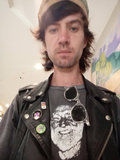
Music from Texas Fontanella

VTIAGGIARE PER CONOSCENZA
Quando viaggiamo lontano, osserviamo molte cose
Come un aquilone che vola alto, legato con uno spago
Questo era un modo per essere sani, ricchi e saggi
Le persone vanno a dormire presto per viaggiare a lungo e si alzano presto
Nei tempi antichi, la conoscenza non era libresca
Il saggio viaggia giorno e notte, a differenza di un pigro
Ibn Battuta, Vasco D’Gama e il famoso Gulliver
Tutti erano fonti di conoscenza, tutti erano viaggiatori
Viaggiare in treno è sempre stato affascinante per me
Mi piace osservare fiumi, colline e pianure che si muovono
Viaggiare con tutti i membri della famiglia è una benedizione
Andare in vacanza d’estate e tornare durante i monsoni
Viaggiare ci insegna a prenderci cura gli uni degli altri
Sviluppa lo spirito di squadra, il senso dell’amore e della cura
La vita è anche un lungo viaggio pieno di gioia e dolore
Fallo ora, se vuoi; chi ha visto il domani?
Originally composed English:
……
TRAVELLING FOR KNOWLEDGE
When we travel far, we observe lots of thing
Like a highflying kite, which is tied with string
This was a way to be healthy, wealthy and wise
People sleep early to travel long, and early rise
In ancient times the knowledge was not bookish
Wise man travels day and night, unlike a sluggish
Ibn Battuta, Vasco D Gama and famous Gulliver
All were sources of knowledge, all were traveler
Travelling has been fascinating to me by trains
I enjoy watching moving rivers, hills and plains
Travelling with all family members is like a boon
Go in summer vacation and return in monsoon
Travelling teaches us to take care of each other
It develops team spirits, sense of love and care
Life is also a long journey full of joy and sorrow
Do it now, if you wish; who has seen tomorrow
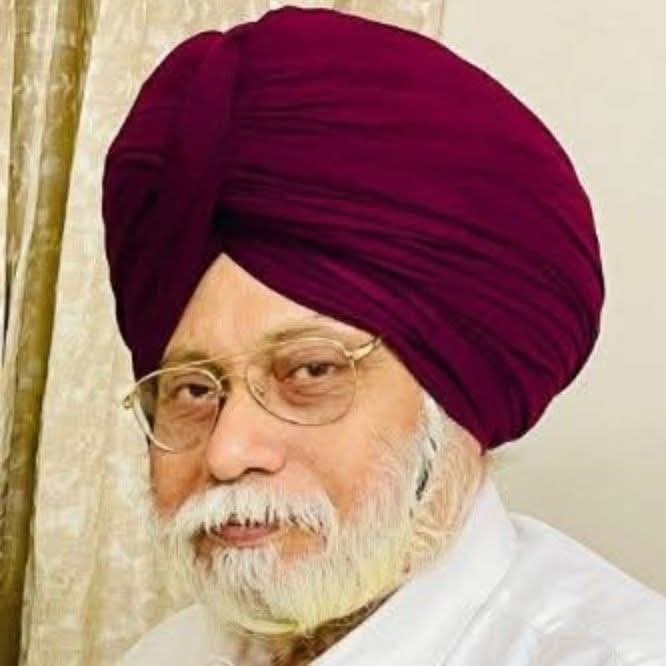
Dr. Perwaiz Shaharyar
Editor, NCERT, New Delhi, INDIA
The esteemed and Hon’ble global poetess Maria Miraglia translates from English to Italian language the poem of Dr. Perwaiz Shaharyar.
She is the Literary Director of the Pablo Neruda Cultural Association and Founder of the World Foundation for Peace. She is an intellectual, high-caliber academician and highly meritorious translator by her passion for literature and culture. She is a multilingual translator especially for poetry, which has been her all time favourite.
POETRY AS A PROPHETARY
(Prophetaries, Poetaries, Comedaries…these words are used in the manner of Monasteries).
Doctors use appliances
And medicines
To cut and paste
Body parts in an attempt
To restore health
Of their patient.
Men suffer as much in body
As in their minds
Which too need surgery
For which they visit
Hospitals called Prophetaries
Where skill doctors heal patients with words.
Many patients go to Poetaries
Where Poets hold mushairas
And big dramas are played
To effect catharsis
So that men emerge from this experience
Fully catharised
Their mental balance restored.
Some Comediaries also offer
‘Sukoon’ (peace) to tortured souls
Who laugh their viles away
The magic wand of satire and pun
Makes the evil spirits
On the run
Leaving men happy and asmile.
Poems are surgical strikes
From the skies like lightning.
In their flash things can be seen better
And the thunder drowns the pain
Of the surgery
Which proves to be a waterloo
For the bivouacs of Evil
Sea
To express your pain
And your joy in the salt water..
Like a fairy of good luck
He will listen to you.
She will weave coral and shells
She will make a festive wreath.
And it will take the pain away
In the abyss
But the wish
He will bring it to you.
With foams
And fast waves
To talk to the sea
As if someone were yours
He will receive sorrows and joys.
He will travel them.
And like a little child’s desires
He will make them happen.
It will bring loved ones closer to you.
Will hide secrets
To love the sea
He has the ability to make children,
Andres
To learn not to fear responsibility
To care about the family
But respect the sea.
More than your life
Because when he becomes stubborn
A ship turns upside down
And then
Only the Virgin Mary can redeem us
I’d rather have the sea as a friend…
To make me laugh
To move forward
And she
Melodically to sing
In every white-clad wave that breaks on the pier…
To talk to the sea
When are you?
You won’t be alone.
She knows from experience
A man is without a voice
But he cares.
And he knows
That time is turning back
And all wounds will close.
Good things will come.
And people will love each other.
When the ship reaches land.
©®Eva Petropoulou Lianou
“”””””
Visit
YouTube
Poem recitation
Sea
Dimitris Fileles
Vice President of Pen Greece
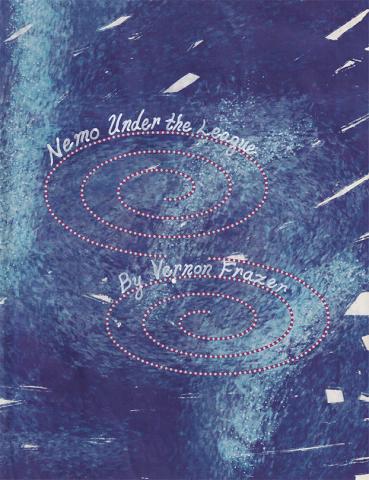
Vernon Frazer’s concrete poetry collection “Nemo Under the League” recalls Jules Verne’s underwater sea exploration journey in its title. Like Captain Nemo, Frazer’s poems probe lesser-explored and lesser-mapped areas: aesthetics and the subconscious. Black, white, and grey text, text boxes, lines and shapes appear on the page with the focus more on the aesthetic effect of each composition than on the literal meaning of the words.
The phrases and their arrangement on the page may seem random at first glance. However, there’s usually a directionality to pieces, such as “Blocking the Inevitable” which guides viewers’ eyes to the right, and “Reflection Locked in Reflection,” which follows a diagonal or elliptical path to suggest light bouncing off a mirror.
Sometimes the images evoke clip art, as in “Desire After the Elms,” or comic books, traffic lights, or even soup cans, as in “Career Moves.” Or even art deco motifs, as in “Birthing an Ungiven Given.” The text will occasionally relate to the title or presumed theme of the poem (such as “hordes of insufficient data” in “Finding a Reaction” and “overblown deduction guides tax the patience excessively” in “In Charge of What Follows”) but tangentially, creating the effect of a composition inspired by the idea rather than the linear development of a thought.
At times, while reading, I speculated on what colors and shades Frazer would choose had he decided to incorporate colors. Sometimes my mind suggested possible shades of deep blue, or vivid orange, or light green. The monochromatic feel works, though, to focus attention on the words themselves as the artwork rather than splashy colorful shapes.
In some pieces, “Flayed Nerve Endings Frayed” and “Reeling Toward the Reel” text itself forms into oval egg shapes or curlicues. Elsewhere, words appear in mirror images of themselves, vertically, diagonally, penetrated by arrows. Words become not just representatives of images or ideas, but as images and design implements themselves, while remaining readable.
The very last poem in Frazer’s collection, “The Transverse Clatter Balcony,” ends with text cascading down to the end of the lower right of the page. It reads “the last word … cast overboard … definition matter … soaked … in the lumbago sea with Carthage.” Words and meaning are not impermeable or permanent here, but forms of matter subject to the weathering of time, nature and history.
I recently came across Dr. Leonard Shlain’s The Alphabet Versus the Goddess: The Conflict Between Word and Image, in which the cultural anthropologist argues that the development of abstract, linear, alphabet-focused language rewired human brains and changed ancient societies. These changes brought about modern technologies but also fostered war, competition and hierarchy, religious extremism, legalism, and the subjugation of women and the natural world. As an author himself, Dr. Shlain advocates, not for the eradication of books and alphabets, but for greater balance between holistic, image-focused understanding and reductionist, linear ways of making meaning.
Vernon Frazer’s Nemo Under the League represents an effort at re-calibrating that societal balance by integrating words and images inextricably. It’s worth a read, or a perusal!
How do you match up the words you use to their backgrounds? Is there a pattern, or do you choose what feels right each time?
It seems different each time, but I probably work with several patterns that I’ve acquired from doing the work.
Even in these pieces, which involve composition, improvisation always plays a role at some point, directing me to choose what, basically, feels right at the time I’m writing it. During improvisational thinking, more elaborate plans do emerge: I can see a full page design or pattern of several pages at times.
What makes a word interesting to you? Sound, shape, length?
Sound is probably the foremost. Sometimes I feel like a jazz musician whose instrument is language. Generally, when I have difficulty finding the right phrase, I choose the one that sounds the most musical to my ears. It almost always turns out to be the best choice. Sometimes working with the shape of a letter or word leads to a phrase, a verse or a visual pattern.
Would you ever work in color? What inspired you to choose a black, white, and gray color scheme?
My equipment and the economics. My old color printer used an ink cartridge for every page I printed and the cost of printing a color book would make the sale price too high. Over the years, technology changed many things, as we all know. Ten or fifteen years ago, I talked about trying to do this work in color but my life didn’t make it a priority. When I joined the C22 Poetry Collective a few years ago, their aggressive experimentation led me to try it. So, I wrote a color book called SIGHTING I did that’s online, but not yet officially published. It’s officially coming out May 7.
When words occur to you, how do you decide whether to put them into a concrete poem or free verse?
More my mood in the moment, I’d say. When I feel I’m starting to stagnate, I’m more likely to do a concrete poem or a multimedia video to relieve my dissatisfaction. Those are the most demanding, after all. Sometimes I write textual poems because I don’t want to meet a more demanding challenge. Nothing is entirely easy, but some days I want to work in a different way, say, strictly with text and either a projective or left-margin pattern. Each method plays a role in my life.
Do you have any other writers or artists who have inspired or influenced you? Anyone whose work you find especially interesting?
I have many influences and hope I’ve made something of my own from all that I’ve learned. Jack Kerouac started me as a writer at 15. William Burroughs and Joseph Heller’s Catch-22 shaped my prose style. Until age 36, I aspired to be a novelist. But Charles Olson was an early influence at 15 and a major influence on my poetry until about 1988, when my style changed considerably. Peter Ganick introduced me to language and visual poetry. I absorbed many writers he published. My writing began to reflect the experimental work bassist Bertram Turetzky exposed me to in the mid-60s, when I studied bass with him. Peter’s publications revived those interests. Then, Steve McCaffery and bp Nichol influenced my work around 2002. I’ve read and absorbed many others; I was a literary omnivore.
Vernon Frazer’s Nemo Under the League is available here from the publisher.
Unbreak His Heart
He used to think
That he’d need
To find a woman
To unbreak his heart
But now he knows
That only he
Can do that.
Taylor Dibbert is a poet in Washington, DC. He’s the author of, most recently, “Takoma.”
Potato Popo
They give him 30 days in San Ber’dino
– Frank Zappa, San Ber’dino
“The suspect’s head looks like a potato,” types a patrolman.
The AI surveillance of San Ber’dino porches
train on adversarial images of potatoes,
earthy spuds with loam nuggets in their clogged pores,
roots creeping and skins greening
during their pantry stowaway concealments.
Every potato is a precious snowflake individuality incarnate.
Albert’s potato-shaped-universe could bang big over and over
and every time a different holographic mass would unfold
from the same unevenly distributed infinite premise.
The engineers who programmed the surveillance doorbells
used the same algorithm God did: deus machina, code is law.
The AIs try to generate the suspect’s potato.
They instead create inflationary suspicions mapped by reticulating splines.
San Ber’tato streets ravel like knitting around porch AI.
The Riemann-Gauss asymptotes of suspects arrive in police blotters
in batches of infinitude.
San Par’tato police BOLO infinite no-knock warrants,
wake the judges at 3am to cut a potato stamp like a grade schooler.
The judge’s inkpad runs dry.
With starchy stamps and fingerpaints he authorizes
the generative algorithms into creation.
The Popo pop potato people throughout the Pan-Par’tato suburbs.
One for the chair will fry. Another scallops a scapegoated caseload casserole.
One baked gives up his dealer. Many are mashed, hugging their ribs.
The suspect is still not drawn from the deck of possible perps.
The suspect is hidden in the precinct 52 Factorial
the faces of the public stare at curbside handcuffs, at spud-gun gunpoint.
The Pot’tato Popo having transformed the city of San Ber’dino
into the lumpen image of their search algorithms.
Terry Trowbridge’s poems are in Pennsylvania Literary Journal, MasticadoresUSA, Poetry Pacific, Carousel, Lascaux Review, Carmina, untethered, Progenitor, Miracle Monocle, Orbis, Pinhole, Big Windows,Muleskinner,Brittle Star, MathematicalIntelligencer, Journal of HumanisticMathematics, New Note, Hearth and Coffin, Beatnik Cowboy, Delta Poetry Review, Stick Figure, miniMAG, and 100+ more. His litcritis in BeZine, Erato,Amsterdam Review, Ariel, British Columbia Review, Hamilton Arts & Letters, Episteme, StudiesinSocialJustice, Rampike, Seeds, and The/t3mz/Review. His Erdösnumber is 5. Terry is grateful to the Ontario Arts Council for his first 2 writing grants.