Maori warriors flattened the lands won through bloodshed
and named it the South Island.
When the giant bustard flapped its wings,
the roots of the grassland trembled even in the wind.
On New Zealand’s earthquake island, isolated at 00:02,
three white-faced cows.
This tiny island of earth, where everything collapsed leaving only just enough,
is it God’s planned ark?
Counting toward infinity, then snap, short by the number 3.
Into that very plan, God drags the three cows.
The crumbling and cracking vast land is no longer a pasture for the cattle.
Like those times, excluded from the game of hopscotch at dusk,
the abandoned herd of cows.
The cows, puzzled by the suddenly narrowed field, comfort one another.
The cows can no longer go up
nor go down; nibbling on grass, they are peaceful for now.
The cows do not know God,
yet calmly, they rub their flanks together and graze.
That silent endurance of the cows.
Every crack in the world is a tear shed by God.
Seventeen-Year-Old Miss Marco Polo Sheep
By Yeon Myung-ji
Miss Marco Polo Sheep of the Pamir Mountains loved almond blossoms
and was an aspiring singer
who sang along to K-POP.
An aspirant,
what a beautiful occupation.
Riding the rhythm on the breath of the wind,
an aspirant walking the grassland.
She loves the wild goat
that endured the winter, tightly chewing on festuca grass.
The beasts of winter
must be winter aspirants.
The ghost of the snow mountains, the snow leopard,
must be a snow aspirant.
When you lie face down on the grassland, the grass sways,
and when you flip over the back of a stone, fish swim—
the aspirants of nature.
Only when a river flows from the belly
does the voice break through, says Miss Marco Polo Sheep.
Even if bitten on the nape and blood flows,
the song of the idol goat cannot be given up.
The pop song, which claimed that when the snow melts,
the leopard would melt too,
was plagiarism anyway.
The moonlight darkens,
and the snow leopard of Pamir, a high and desolate land,
drags its long tail across the ridge—
the ghost of the alpine.
The aspirant of a fairy tale,
caught off guard by the seventeen-year-old Miss Marco Polo Sheep.
Profile Poet Yeon Myung-ji began her literary career in 2013 with the poetry collection 『Gashibi』, published in the Minerva Poetry Series.
Her published works include the poetry collections 『Sitting Like an Apple』 and 『Where would the House of the Sorry’ be? 』 the e-poetry collection 『Seventeen Marco Polos,』 and the travel essay 『Step by Step, Walking the Camino.』She has received the Tolstoy Literary Award, the Homi Literary Award, the Cheongsong Gaekju Literary Award, and the Aviation Literary Award. In 2025, she was awarded the Bronze Prize in Poetry at the Literature Asia Awards, Grand Prize Winner,9th Kim Myung-bae Literary Award.
Her poems have been translated and published in local languages in India, Pakistan, Kosovo, Italy, Egypt, the United States, and Belgium, Greece, UK, and Germany.
The War Inside the Voice: Leila Abdul‑Rauf Between Calls from a Seething Edge and Andros Insidium
by Alex S Johnson
Leila Abdul‑Rauf has long occupied a singular position in the experimental music landscape, moving fluently through noise, ambient, metal, thrash‑adjacent hybrids, folk‑metal permutations, and avant‑garde vocal architecture. Her recent work unfolds across two closely linked records: Calls from a Seething Edge, released on Cyclic Law in 2024, and the newer Andros Insidium, whose title she describes as a partly invented Latin construction—“andros meaning… the masculine,” while “insidium… I don’t even know if that’s real… sometimes you just got to make something up just to keep it interesting.”
Calls from a Seething Edge is the record that contains “Crimes of the Soul,” a song whose emotional and visual architecture anchors much of the conversation.
Abdul‑Rauf explains that the video was shot by her partner, Gregory Hagen, who “does make an appearance on both that record… Calls from a seating edge, which came out on cyclic law in 2024, and then… he also does a vocal appearance on Andros Insidium.”
The video’s pastoral core was filmed at “a local rose garden here in Oakland… such a hidden gem… a great place to just go and relax… watch the water fountains and all the birds… whatever’s lurking around there.”
That serenity is violently interrupted by war footage edited in by their friend Dave Brenner, who “kind of gave it the grit that… was true to the song.”
Abdul‑Rauf isn’t certain of the exact source of the footage—“you’ll have to talk to him about that”—but suspects “probably Gaza or Lebanon or a combination, Syria… all the recent bombings and things like that.”
The backdrop for Calls from a Seething Edge is explicitly geopolitical. Abdul‑Rauf describes 2024 as “sort of, like, the D‑day for all the… genocides going on,” a time when she began to feel “really… angry and vulnerable in a way that I hadn’t felt quite to that point,” especially in “this… hyper‑surveillance world that we’re living in.”
She became “really anxious… very on edge,” and war moved “to the forefront” of her thinking. Her day job at a psychoanalytic institute—“I do administration, but I’m around psychoanalysts all the time”—inflected the record’s conceptual frame.
For over a decade she has been immersed in a culture that insists, “don’t take everything at face value… really distill it… don’t make these flipped judgments… explore… the most horrible parts of ourselves.”
War, she notes, is “one of the most despicable things about humanity,” yet “going back to early humans, there’s always been war and violence of some kind.”
The record asks, without pretending to answer, whether war is something humanity can ever transcend: “Is war even something that we… can ever be above?… I like to think yes… but…”
One of the songs on Calls from a Seething Edge, “Failure to Fire,” draws on research from the Vietnam War. Abdul‑Rauf recounts studies suggesting that soldiers “weren’t… killing each other… enough,” which led to the use of gas to “incite more violence.”
She connects this to the premise of the film Jacob’s Ladder: “That was the whole premise for the movie Jacob’s Ladder, too… people don’t really want to kill each other… so they had to drug them.”
The song becomes a meditation on the gap between human reluctance and systemic coercion.
Sonically, “Crimes of the Soul” is built from deceptively simple materials. “The structure’s pretty simple,” she says. “I did very simple drum programming… some… deep growly synths… and lots of these lofty kind of vocals.” The second half introduces what sound like “high stringy synths,” but they are in fact trumpet parts “really stretched out… and playing back at different speeds.”
She took a treated horn part from “Summon,” the first track on Calls from a Seething Edge—“there’s another treated horn part at the beginning… that’s drop‑pitched”—and “put it in ‘Crimes of the Soul’ and sped it up… probably 3 or 4 different speeds.”
The result is a harmonic mesh that feels electronic but is “honestly just… acoustic horn, just trumpet… through a microphone… some reverb and some pitch shifting.”
Her approach to gear is deliberately minimal. “You’re very self‑sufficient as far as your gear,” I say.
“Not at all,” she replies. “I feel like I’m the antithesis of techie.” She insists on keeping “the gear as minimal as possible,” explaining, “I can’t wrap my head around these complicated setups with all these pedals… wires everywhere, I get nauseous when I see… I’m impressed when other people do it, but if I had to do it, I would just… freeze.”
The simplicity is in service of performance: she wants to “really get into the vocal performance, the horn performance… interact with the crowd,” especially now that there is “a lot more… challenging singing and… a lot more growling in the sets… a lot more visceral and immediate” than her earlier, more “down tempo” work.
If Calls from a Seething Edge is the war‑haunted, psychoanalytic record, Andros Insidium is the newer, parallel project where Abdul‑Rauf continues to push her voice and compositional strategies.
She notes that many listeners think she “now is going solo,” but clarifies that these projects have been running in parallel for years: “I’ve been doing my solo projects since 2012… Vastum started right before I joined Hammers… and then I started my solo project not much longer after that.”
On Andros Insidium, tracks like “Eros Anima” and “Fractured Body” carry some of her most overtly metal‑inflected and Halford‑inspired vocal lines. “There are a couple moments on… ‘Eros Anima’… where I just get my inner Halford out,” she says. “No one’s gonna say that when they listen to it, but… there’s some vocal melodies where that’s straight up the case.”
“Fractured Body” on Andros Insidium is repurposed from a Vastum song, “Corpus Fractum.” “I just… translated into English ‘Fractured Body’,” she explains. “Instead of the… guitar lead as the vocal lead… the rhythm guitars is the synth… did different drum part… shortened it… took, like, the intro of the Vastum song and made it its own song.”
The ending, built from “sound bites of glass breaking,” is a direct homage to Einstürzende Neubauten’s “Haster Luger”: “At the end of ‘Haster Luger’… there’s just, like, this endless… stream of broken glass. I was like, well, that’s… gotta… give my love to them there as well.”
Her influences form a dense, unconscious archive: “There’s… all kinds. There’s… Einsturzende Neubauten… a little Dead Can Dance, little Skinny Puppy… it’s all there back in… deep in the unconscious.”
One of her most important inspirations is Rob Halford: “I’m a huge Rob Halford fan. Anyone who knows me… knows that.” She has read “both of Rob’s memoirs” and K.K. Downing’s, calling them “all fantastic,” and still describes Judas Priest as “the best heavy metal band in the world.”
Abdul‑Rauf’s personal history adds further layers to her work. She grew up between two religious traditions: an Egyptian Muslim father, an imam, and an Irish Roman Catholic mother from New York.
She spent childhood weekends in a Sufi mosque in Soho, sitting through sermons, listening to the call to prayer, participating in dhikr: “You repeat God’s name… whirling around… almost passing out from these recitations.”
She recalls “all the call to prayer… it just kind of works its way in,” and notes that these sounds later resurfaced in her solo work.
Her band history is equally rich. Amber Asylum, Hammers of Misfortune, Vastum, Saros—each marks a different phase.
She describes joining Hammers after playing with Sigrid in Amber Asylum: “We had had a couple of years already… touring together… and then she invited me to join Hammers… I said, oh, okay, well, it’s Sigrid, I love playing with Sigrid.”
Hammers, she notes, is “John’s… basically his solo project brought to life in a band,” and her role was to “support… his ideas… guitar‑wise and vocal‑wise.”
Vastum, formed with Dan and others, continues: “At this point, it’s just me and Dan… we’ve been writing another record.” Her long partnership with Sam Foster—“the drummer of… Saros… who used to be in Weakling”—extends across projects: “He’s all over my last two solo albums… hand percussion… he’s done videos… all the photography… that’s all… he did all of that… that’s like an almost 25‑year relationship… he’s been such a big part of my life creatively.”
Touring has become increasingly strategic. Abdul‑Rauf outlines an upcoming East Coast solo tour with dungeon‑synth artist Vela Straz, describing the genre’s cosplay, masks, swords, chainmail, and 1980s keyboards: “It’s a whole thing.” The aesthetic appeals to her, and the economics make sense: “Touring with a band now is a total racket… too expensive… solo is more worth your while.”
Her sets now feature “a lot more growling… a lot more visceral and immediate” energy, even as she maintains dynamic range.
Her perspective on heavy music’s evolution is grounded in experience. She notes shifts in production—“hyper‑compressed guitar tones,” “drum triggers,” “homogenized growls”—and the explosion of global diversity in metal scenes, from blackgaze and shoegaze‑metal hybrids to internationalized extreme music.
She also gestures toward the intellectual currents behind punk and metal, mentioning Marxism, socialism, and situationism, and referencing a friend who “wrote a whole book on situationism in punk rock.”
When asked about advice for women in extreme music, Abdul‑Rauf answers with warmth and pragmatism: “Play with good people… collaborate with true friends… diversify creatively… avoid burnout.” She emphasizes the importance of long‑term artistic relationships: “If you play with good people, they’re gonna be in your life for a long time.”
Across Calls from a Seething Edge and Andros Insidium, Abdul‑Rauf’s work reveals an artist who moves fluidly between genres, cultures, histories, and emotional registers, creating music that is as intellectually rigorous as it is sonically visceral.
Her records are not simply fusions of influence; they are the lived expression of a life shaped by war, ritual, rebellion, psychoanalytic inquiry, and relentless creative curiosity.
CONTEXTUAL PROPHECIES I comb the air with tingling thoughts Spilling dynamic shots From archeology of many plots
I sit in streams of eloquent joy With butterflies, birds, flowers dancing like a toy Around and around in windy coil
I sometimes spit thrilling thunder To tackle those that plunders Our dreams of willing wonders
I crow in voices of the unheard Whose holy ambitions are disallowed shed By Pharaohs sending them to early bed
When you drink any air of anger In the veins of my ‘penful’ wander Something has harassed my pot of ponder
When I dance with psychedelic metaphors In milky streams of amorous lores’ An Eve may be cooing at my shores.
We vomit verses according to dictates of any wind Giving wings to anger or melody of the mind Speaking in tongues in view of what we see or find
We bring We ring We sing… ————————– (Written on 11 June 2010) ———————————
THE REASON FOR THE SEASON (THE IMMORTAL KING) Raise your voices to the four cardinal wings, All who know His worth praise and sing, As I do in this renaissance of the kindly king; I will rather be under His wing Than crave silver and gold, I will however, marry the king And frown at rusty riches untold, For on Calvary cross, gushed His blood Draining off my sins and sorrows flood; He is the light of my salvation beam In joy I will forever scream “Oh my lovely lord And gorgeous gracious God” Whenever I shed my clay To ever in paradise play Where there is no exchange of baton between night and day On your bosom oh Lord! Let me baby-like lay. ——————————– (Written on 18 November 2003)
—————————————-
Adjekpagbon Blessed Mudiaga, holds a B.Sc. in Mass Communication from the University of Lagos; an M.Sc. in the same discipline from the National Open University of Nigeria, Victoria Island, Lagos; and a PhD in view. He also bagged a Diploma in Theology from Emmaus Bible School, Dublin, Ireland. He is a multi-talented journalist, poet, playwright, novelist, songwriter, and the first Nigerian author in the history of Nigerian authors creative writers, whose book titled “Rhymes from the Nile” is the first that ever received a presidential award from Aso Rock, in 2007. He is an author of over 18 creative and academic books.
Some of his works have been read live by the British Broadcasting Corporation (BBC), Voice of America (VOA), China Radio International (CRI), Nigerian Television Authority (NTA 2 Channel 5), etc. He is a former member of the Royal Society of Literature (RSL), London; and former Publicity Secretary of Association of Nigerian Authors (ANA), Lagos Chapter.
He was a member of the Nigeria Union of Journalists (NUJ), Lagos Council until he relocated to Adamawa State in 2024. He is also a member of Tesol International Association (TIA), Virginia, U.S.A., as a certified Teacher of Teaching English to Speakers of Other Languages (TESOL).
Moreover, at present, he is the Chairman of the Association of Nigerian Authors (ANA), Adamawa State Chapter. He belongs to other academic and creative minds’ associations such as Africa-ELTA (English Language Teachers Association). He is the current President of Creative Writers Association of Nigeria (CWAN).
He is an Instructor in the Communications and Multimedia Design (CMD) Department of the American University of Nigeria (AUN), Yola, Adamawa State, Nigeria.
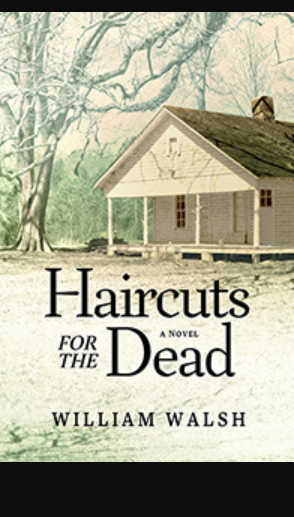
How can a novel titled Haircuts For The Dead (Mercer University Press, 2025) be an uplifting book? Well, in the lively and literate hands and imagination of William Walsh, it ultimately can be. It is the story of twenty-one-year-old Hannah Gardner as she tries to find a better place for herself, and a better understanding of herself by beginning a personal diary she entitles her Document of Life. At the beginning of Chapter 2, when the third-person narrator first introduces us to Hannah, at twenty-one, we are told:
Hannah Gardner, at twenty-one years old, had grown to be one who sought the truth in all things. She was a pursuer of answers, a yearner, and as she searched, she believed the answers she found in the real world contradicted what she had learned growing up on her family farm and in her Baptist church….Just give it to me straight, she thought.
Hannah would have been more at home with Transcendentalist diarists Emerson and Thoreau, who endeavored to find by journaling “what facts of moment lie in the memory” (Emerson) which might help them to better understand themselves and grow spiritually, than with her own family and society in her small town of Sundown. Yet the Transcendentalists were highly educated; by contrast, the only family member of Hannah’s who graduated from high school is her mother, who is from a rural Kentucky town. Hannah not only wants to better herself, she wishes her family as a whole could be something better. In her senior year, Hannah pays a student on the yearbook staff twenty dollars to add in her twin-brother Lucas, who dropped out in the tenth grade, “Lucas was photoshopped into a tuxedo using his tenth-grade photo.” This creates an unanticipated consequence when the publisher sends a yearbook to Lucas with a “$39.95, plus shipping” invoice, and the reader is treated to one of several absolutely comical examples of redneck idio[t]lect in the novel:
He wrote back on the invoice, “I ain’t never paying 4 this. I did not odor a yearbook. Never wanted 1 in the male. I don’t even go to school at your school. I will be go-in to school at Harvard next spring. See you on the flippitty-flop.” He never heard from them again.
In fact, despite the novel’s serious events and complications, many of its lines and scenes are laced with humor so that it is wonderfully seriocomic, and I believe it contains within its covers three different genres, all three of which have been known, in some of the Western literary canon’s greatest works, to incorporate humor: Bildungsroman (coming-of-age), picaresque, and Rough South.
Hannah Gardner is serious about striving to become a better person, and her Document of Life is a journey of discovery, of both what her past means for her and how she can self-improve for the future. Hannah has a lot of past trauma to process, as told in flashbacks by the third-person narrator, and as relayed to us in Hannah’s first-person Document. Especially notable for this is Chapter 1, “The Fishing Trip,” which is really a preface for the novel, and is a story from when Hannah was six years old. We are introduced to Hannah’s father Darnell Gardner, who wins a free entry into a youth fishing derby by scratching off “WINNER” on an insert in Today’s Fishing Youth Magazine. Darnell’s get-rich-quick scheme is to buy an old 1974 International Travelall wagon, pack his kids in it, drive to Ontario, and himself catch the largest fish and hand it off to one of his children who will then claim the $25,000 prize. He steals the $500 to buy the Travelall from his wife’s Mason jar, money she had saved up “for a new crown and to fill three cavities,” telling her, “You survived this long with those cavities, an’ look, a deal like this don’t come around often.” Lilith, his wife, who is very pregnant with her fifth child, stays behind, as does Hannah, the youngest daughter. Of course, Darnell’s scheme will be a bust, but while he is away, something that will pattern the rest of Hannah’s life occurs. Lilith calls a midwife, Myra, who lives off the farm but whose forebears were slaves on it, to come to her house and perform an abortion. Before the procedure, Hannah is told to go to the living room and watch tv but stays by the kitchen where her now drugged mother is sprawled on a large wooden table. The remarkable skill with which this chapter is written should make it part of any serious Georgia Literature anthology from now on. Hannah gets a blanket from her bed and dozes on the floor, waking later to a baby crying. “She jumped up on the kitchen floor and dropped her blanket around her ankles then dashed over to see her baby sister. It was supposed to be another boy. ‘What’cha gonna name her, Momma?’ Her mother squeaked a reply in Hannah’s ear.” Then, a few lines later:
As the baby cried for oxygen in the new world, Myra walked into the kitchen, held the child by her ankles up over her head, up to the height of the cabinets close to the ceiling, and without hesitation, released the baby. The newborn fell straight down, hitting her head on the stone floor. There was a thunk, then silence. “Girl, hand me that blanket she told Hannah.” Soon, Myra’s husband Grady will tell Hannah, “Come with me.” He shows her how to carry the shovel across her shoulder. “When it gets sore, switch shoulders,” he said. / “Kinda like Jesus?” / “Yeah, something like that.”
After endless walking, Grady digs the grave and puts the bundle in it, then kneels down to Hannah’s face: “You ever tell anyone about this, I’ll toss you in there with that baby. You understand?” Hannah nods. “You best forget this ever happened. You wanna tell someone, tell it to God.” Grady fills the grave and puts three stones on it. Hannah will spend the rest of her twenty-one years searching the woods of the six-hundred-acre Gardner farm for the three stones. When Darnell returns from the fishing trip, more broke than when he left, Lilith tells him the baby came and was stillborn: “I called the county and they came and got him. They took him away.”
As Walsh’s third-person narrator introduces us to the character of young woman Hannah, she is in a very public apostasy with the pastor’s wife in the after-church receiving line. Preacher Town’s wife resists engaging in Hannah’s Socratic Method: “’Why you gotta be like this, always questioning the Word of God?’ Laney scowled.” But Hannah goes on: “Why does God want us to be redeemed? Can’t he just get over it? If we never sinned, there wouldn’t be a need for redemption. It ain’t that complicated.” / “’Look, I’m not going to argue about this,’ Laney growled.” But Hannah continues: “‘Ain’t he supposed to embrace us unconditionally?….And for that matter, I think the Virgin Birth’s a lot of hooey….Did you know that hundreds of ancient cultures had the Virgin Birth long before Christians stole it for their own use?’ / ‘Where’d you hear this Nonsense?’ Preacher Towns asked. / ‘I read it in a book about myths.'”
Hannah’s demonstrance in front of her hometown church marks her parting from organized religion (though the Transcendentalists might have admired it). Her father doesn’t attend church, but hears about it, leaving her a voice mail: “I heard you pissed off the preacher yesterday. You got something on your mind?” Hannah doesn’t answer, but Hannah Gardner has a lot on her mind.
Through Hannah’s Document and the narrator, we get the story of Hannah’s farm, the Gardner farm, which was sold to the Airport Authority in 2019. Hannah begins her diary on a notepad while lying on a big flat rock by the farm’s pond, a beloved space much more sacred to her than the space inside her renounced church. Despite her family’s sale of the farm to the Airport Authority, who in turn sold it, it remains abandoned while its wooden structures continue to fall into disrepair, and its quiet isolation makes it kind of a Walden for Hannah. Much of the diary is about her father Darnell and mother Lilith, whom Darnell was awfully abusive towards, physically, verbally, mentally — to say Darnell is “flawed” as a husband and father would be like calling the Civil War “noteworthy” as a Southern event — as well as about her brothers Lucas and Wendell and sister Greta. There is no shortage of fathers who exert coercive control over their families in Southern fiction. It goes from Caldwell to Conroy in twentieth century Georgia fiction, and continues with William Walsh, as we see here, in the twenty-first. I see Haircuts For The Dead as being in the tradition of the Rough South genre, or as Harry Crews, one of the genre’s “fathers” is purported to have phrased it, “Grit-Lit” (or, even one of the less “literary” monikers like “Trailer-park Gothic”). Historically in Georgia, Rough South is a literature of poor whites, involving from lazy to depraved morals, lavish violence, and often grim humor and painful absurdity (think of the theft of hapless Joy-Hulga’s wooden leg by the con-artist Bible salesman — as he pretends to woo her — in Rough South matriarch Flannery O’Connor’s story “Good Country People”; or, the bold “roping” kidnap of an albino man off his front porch by TyTy and his two boys — to make him use his “ghostly powers” to find where they can dig for gold — in Rough South patriarch Erskine Caldwell’s novel God’s Little Acre). All of the disturbing Rough South elements are prominent in Haircuts. Yet, it is an ultimately, after severe trial, hopeful, even happy book. For comparison in the genre, I am reminded most of Kaye Gibbon’s novel Ellen Foster and her sequel novel The Life All Around Me by Ellen Foster. Like Hannah, Ellen Foster is trying to process the trauma of growing up with an awful father. Though, where Ellen’s father’s character is completely black — even forbidding Ellen to call for an ambulance when she finds her mother sitting at the kitchen table, staring at her husband and waiting to die, having, after incredible abuse from him, swallowed all her bottle of heart pills one by one — Hannah’s father’s character is more a dark grey. For example, Hannah recalls in her diary a time when her perennially unemployed father actually exerted himself to help her mother:
Momma had surgery once, a double by-pass to repair her malfunctioning heart. When the doctors said she needed surgery, Daddy got a job for three months working nights at The Butler Did It Cleaners. He cleaned offices five nights a week because they had health insurance for the whole family. The day after Momma’s surgery, Daddy quit. I will say this, when Momma was in bed recuperating, Daddy was not as mean as before….At Rent-A-Center, he rented a color TV for her. Lucas and Daddy somehow stole the satellite signal.
At the Susan Kendal Memorial Library, Hannah Gardner makes three discoveries that will be significant for her: she meets Margaret, the Assistant Librarian; working as a hairstylist since she was nineteen, Hannah sees a “Help Wanted” notice on the library’s community bulletin board from Grattan’s Funeral Home for a stylist: “$65 per haircut for women / $45 per haircut for men”; and Hannah finds the text of an historic diary believed to be from the 1850s by an unnamed woman on a wagon trail West from Pennsylvania. Hannah tells us this diary gave her the idea for starting her Document of Life, and Hannah soon begins transcribing the account of the unnamed woman, whom Hannah names “Sarah,” (the name Lilith whispered in six-year-old Hannah’s ear, as we will learn at the end of Haircuts) into her Document — which becomes a hopscotch of paragraphs at times: Hannah’s life/ Sarah’s life/ Hannah’s life, so that the two women almost merge. Hannah and Margaret become close friends, naming the “uptight” Head Librarian Ilene “Elvis,” so that Margaret can tell Hannah when she comes in, in code: “has left the building,” meaning they can relax their behavior, or “still here singing the blues,” meaning they can’t. Hannah likes discussing Sarah’s diary with Margaret in the library breakroom: “‘They caught a guy stealing food from the preacher’s wagon. Suits him right to be kicked off the trail,’ I said. / ‘I wonder what happened to him out there in the wilderness alone?’ Margaret asked me. / ‘They gave him a choice, either leave and be on your own or be turned over to the sheriff in the next town.'” Hannah will inquire about the funeral home job and take it “‘Do I have to touch dead people?’ / ‘You can wear gloves, like a surgeon.’… / Who would complain if I did a terrible job? Hannah thought.” She is barely making it financially, but the new funeral home job, with its higher salary, boosts her sense of well-being. Like Ellen Foster, who scrapes together, over years, $166 to offer to a lady who fosters children to take her in, Hannah is constantly striving to better her situation. Ellen’s foster mother refuses the money, giving it back to Ellen, and takes her in. Ellen’s foster mother never wounds her like all her family except her mama did, but loves her wholly without qualification. In a 1961 article for Vogue Magazine called “Love — In Other Words,” Harper Lee wrote: “Any act of love, however — no matter how small — lessens anxiety’s grip, gives us a taste of tomorrow, and eases the yoke of our fears.” Margaret and Hannah grow closer as friends, and Margaret suggests she could buy a new house and have Hannah as her roommate to help with the mortgage, greatly reducing the amount Hannah currently pays for rent. Hannah accepts. They cook and eat together, decide to sleep in the same room, watch movies together and read books — the more serious ones usually chosen by Margaret — as if picking from a rolodex of recognizable popular and literary culture. The friendship deepens into a Sapphic romance, and the sensitivity of Walsh’s narrative of this development is masterful. This growing love between Hannah and Margaret is what will allow Hannah — allow both of them, in fact — to heal, and it is what will bend the novel away from uncertainty toward hope. Reynolds Price wrote a 1986 essay for The New York Times titled, “Men, Creating Women,” in which he argues it should be natural for writers to create characters opposite the writer’s gender and still reach the “core” of their character to make them believable. However, he admits this facility is easier to theorize than to manifest. He believes the successes have come mostly from men: Tolstoy’s Natasha, Hardy’s Tess, with, notwithstanding Henry James whom he considers the master of this, a bit more success from American women authors, e.g., Ann Tyler, Toni Morrison, Joyce Carol Oates. When asked about reviewers’ praise for his own female characters, and questions of “how did you do it,” he says, “My reply was a resort to Flaubert’s famous and true canned answer when asked how he understood Emma Bovary — ‘Bovary is me.'” I bring this up because if Reynolds Price were still alive to read Haircuts, I believe he would consider William Walsh’s effort in this regard notable, maybe even masterful — William Walsh should probably be asked, “How did you do it?”
In Haircuts For The Dead Hannah Gardner’s life rattles and shakes with vicissitude (a lot like Sarah’s does on the grueling trail West). They are too many to enumerate here, but there are several “main highlights.” As already mentioned, she loses her beloved homeplace/ farm because her ne’er do well father can no longer support the family on what his wife Lilith makes cleaning houses, and so finally “cashes in.” When he receives the check for $3,745,000, Darnell doesn’t cash it right away: “He placed it in a small, gold frame that had housed a picture of Hannah’s Memaw, and then he carted the check around to everyone he knew to show off….” Darnell takes the check to show a former boss at Kmart who had fired him after three days: “‘Want to see what Easy Street looks like? It looks like this right here,’ Darnell said, holding the frame over his head like an Olympic medal. ‘Think about that while you’re sittin’ on the crapper.'” When Darnell does decide to deposit the check, at the bank he explodes with rage when Lilith refuses to sign the check to put in their joint account unless Darnell agrees to give her half to put in her own new account. She also makes her signature dependent on his signing divorce papers, which she produces and hands him. The quickly overwhelmed bank security guard calls the sheriff, who hates Darnell, and arrives to ask him, “Having Lady problems?” The bank manager tells Lilith, “You’ll have between $750,000 and $900,000 after taxes but that has to last your entire life. It’s your retirement.” To which the now restrained Darnell says, “Retirement? What the hell’s she gonna retire from? She ain’t never done nothing but clean houses and she’s not good at that.” Darnell will lose his half of the money within a year playing high-stakes poker games around the country in cities like Las Vegas and New Orleans, where he is treated like royalty while he has money. Lilith marries a man she meets at Home Depot and sinks her half of the money into a run-down restaurant he helps her renovate beside Lake Lanier, The Diamond Eye. Lilith offers to pay for Hannah’s apartment for a year after which Hannah will be expected to support herself. Hannah declines her mother’s offer and receives none of the money.
One day when Hannah was eleven, she packed a sandwich in a paper bag and went to search the farm’s woods for her baby sister’s grave. At the edge of the farm where an adjacent property was cleared for a development that was never built (a DNA match causing the developer to be suddenly arrested for his wife’s murder in Kansas City in 1988), Hannah climbs a favorite oak tree. A pickup drives through the clearing to park under the tree. A scared to breathe Hannah watches two men get out with a woman and brutally rape her. Years later on an eleventh-grade trip to a science fair, Hannah’s class stops at a Waffle House where Hannah recognizes the woman who was raped is their waitress: “I had to leave the Waffle House. I just couldn’t bear to stay there with my insides hurting so much. I sat on the school bus, slunk down but looking at her outside my window. I wanted to rush inside and scream, ‘I know what happened!'”
One Thanksgiving Hannah has to watch her father drown her pet pig Wilbur in the pond after Darnell ignores his wife’s asking him to go buy a turkey until the stores are all closed: “Daddy said he had a better idea, ‘We’re gonna have roasted pig this year.’ / At first, I wondered where he was going to get a pig, because we didn’t have any livestock on the farm except Wilbur, our pet.” Darnell’s eureka solution for holiday dinner takes over an hour while the children watch. Wilbur does not want to be drowned. “I wished for Wilbur to pop to the surface squealing and Daddy bobbing up, floating face down in the water and staring at the bottom like something down there was intriguing, like maybe he’d found Atlantis.” Eventually Darnell does drag Wilbur out dead and takes him to the barn and slaughters him, but the ordeal lands Darnell in bed for two weeks with pneumonia. The gruesomely absurd event gives Hannah two weeks of the happiest times in their house that she can remember.
Through all of this, though, Hannah has a resiliency, a vibrancy, an attitude which evokes other characters and novels — Candide, Huck and Jim — where a reader has the sense that this character will survive. I think in this sense Haircuts is like a picaresque novel. In the traditional Spanish picaresque, the picaro — if male — or in Hannah’s case, picara, is a protagonist who is resilient, clever, and does what is necessary to survive. The only time in the novel Hannah is almost “drowned” is after her encounter with the novel’s villain, Hawkshaw Bales. If “Hawk” suggests “predator,” that is surely intentional. Hannah encounters Hawkshaw Bales while alone at Lucas’s trailer. Bales, a local criminal, is parked outside in a Lexus when Hannah steps out of the trailer. Bales gets out and tells her, “Your brother owes me ten thousand dollars, and I’m here to collect.” To which she replies: “Lucas doesn’t have ten dollars to his name, let alone ten thousand. Take a look around. See that beat-up Oldsmobile? That’s all he owns, an’ it doesn’t run.” Bales, a muscular six feet two inches of hypermasculinity, never takes “no,” or “I don’t know,” as an answer from anyone. Hannah fires whip-snap rejoinders to everything he says or asks. Unfortunately for Hannah, Bales is intrigued by this spunky, slight female. Bales snatches her purse, looks at her address on her license, and types his number into her phone and calls himself. Hannah’s girl-power attitude and hot-lead words are defenseless against this, but she comes away from the encounter believing she has won: “‘Hannah, give me a call. I have your number, so maybe I’ll call you.’ / ‘Don’t bother Mr. Pushy. Besides, you’ll just lecture me about street names.’ / Bales chuckled, and as he walked away, said, ‘You sure don’t like anyone telling you what to do.’ / ‘Who Would?'” Hannah will underestimate Hawkshaw Bales’ depraved nature, and in an attempt to protect her brother Lucas will face Bales with her attitude of bravado again to her grave detriment — yet, in the end, all will be well. Like villain Bill Sikes in Oliver Twist, one of Charles Dickens’ great picaresques, Hawkshaw Bales will turn the plot in Haircuts For The Dead, but also like in Oliver Twist, fate will turn it back against him, and good will prevail. The Rough South milieu is often a “survival of the meanest.” Mississippi writer Larry Brown said in a 1991 interview: “Whatever good is in this world has to have teeth in it if evil will be dealt with.” Hannah is the strongest member of her family, and has no real power against Bales’ evil, but in the end she will actually gain something from it and him. Because of someone’s brief encounters with Hannah’s goodness, a deus ex machina will come to her aid like a Destroying Angel right out of a Stephen Hunter novel. Bales will not know what hit him, and Hannah and Margaret will never know who hit him, but they will be freed to have a happy and fulfilling life together.
Mikhail Bakhtin said, “A genre lives in the present, but remembers the past.” I think Haircuts for the Dead lives in the twenty-first century but remembers and continues Georgia’s literary past. Can a seriocomic novel be great? Well, I think Haircuts For The Dead is more serious than Faulkner’s picaresque novel The Reivers, which after all won a Pulitzer — and was Faulkner. I highly recommend William Walsh’s Haircuts For The Dead.
Steven Croft’s book reviews have appeared in Southern Literary Review, Synchronized Chaos, Misfit Magazine, Wilderness House Literary Review, and other places. An Army combat veteran, he lives on a barrier island off the coast of Georgia.
COGNITIVE AND PEDAGOGICAL FOUNDATIONS OF RAPID AND EFFECTIVE FOREIGN LANGUAGE LEARNING
Sobirova Husniyabonu Axrorjon qizi
husniya_0707@icloud.comFirst-year student, Uzbekistan State World Languages University, Faculty of Russian Philology, Tashkent, Uzbekistan
Abstract: This article analyzes the theoretical and practical aspects of rapid and effective foreign language learning. In the modern era of globalization, knowledge of one or more foreign languages has become an essential factor for an individual’s professional development and participation in international communication. The study examines the role of cognitive strategies, communicative methods, mnemonic techniques, and modern digital technologies in the language learning process. In addition, the research highlights important psychological factors that influence language learning efficiency, such as motivation, regular practice, the creation of a real communicative environment, and independent learning skills. The results of the study demonstrate that the integrated use of various pedagogical methods significantly improves the effectiveness of language learning and helps learners develop language competence in a relatively short period of time.
Keywords: foreign language learning, language teaching methods, mnemonics, communicative approach, language competence, cognitive strategies.
I. INTRODUCTION
The twenty-first century is characterized by rapid globalization and the expansion of international communication. In such conditions, knowledge of foreign languages plays a significant role in an individual’s academic, professional, and cultural development. As a result, learning foreign languages has become one of the most important educational priorities in modern society.
The process of learning a foreign language is a complex cognitive and psychological activity that involves memory, thinking, and speech development. Scientific research indicates that effective language learning requires not only memorization of grammatical rules but also the development of communicative competence.
Modern linguistic and pedagogical studies emphasize the importance of innovative teaching methods that help learners acquire language skills more efficiently. Particularly, the development of strategies that allow students to learn foreign languages quickly and effectively has become an important research topic in the field of language education.
The main objective of this article is to analyze the most effective cognitive and pedagogical strategies that facilitate rapid and efficient foreign language learning.
II. METHODOLOGY
This study is based on theoretical analysis, comparative analysis, and the generalization of scientific literature related to foreign language learning. Various modern teaching methods and psychological strategies used in language education were analyzed.
During the research, special attention was paid to several widely used approaches in foreign language learning:
The communicative approach focuses on developing learners’ ability to communicate in real-life situations. This method emphasizes practical language use rather than the simple memorization of grammatical structures.
The mnemonic method helps learners memorize vocabulary through associations, images, or short stories. This technique significantly improves long-term memory retention.
The immersion method involves exposing learners to the language environment through activities such as watching foreign films, listening to podcasts, and communicating with native speakers.
The audiovisual approach combines visual and auditory materials, such as videos, audio recordings, and interactive exercises, to improve language comprehension and pronunciation skills.
III. RESULTS
The results of the study indicate that the effectiveness of foreign language learning increases when different teaching methods are used in combination. The use of a single method may not be sufficient to achieve high levels of language proficiency.
For example, mnemonic techniques significantly improve vocabulary acquisition, especially at the early stages of language learning. By associating new words with images or stories, learners are able to remember them more easily.
The communicative approach also contributes greatly to the development of speaking skills. Through active participation in discussions, dialogues, and role-playing activities, learners gain practical experience in using the language.
Furthermore, modern technologies have significantly transformed the process of language learning. Online platforms, mobile applications, and artificial intelligence-based educational tools provide learners with new opportunities to practice languages anytime and anywhere.
IV. DISCUSSION
The success of foreign language learning largely depends on several important factors, including motivation, regular practice, and independent learning skills. Students who demonstrate high levels of motivation are generally more successful in acquiring language skills.
Another important factor is the creation of a real communicative environment. Exposure to authentic language materials, such as books, films, and conversations with native speakers, greatly enhances language acquisition.
Psychological factors also play a crucial role in the learning process. Many students experience fear of making mistakes, which prevents them from actively participating in communication. Modern pedagogical approaches aim to reduce this psychological barrier by encouraging students to practice language freely and confidently.
Therefore, teachers should create a supportive learning environment where students feel comfortable expressing themselves and experimenting with the language.
V. CONCLUSION
In conclusion, rapid and effective foreign language learning requires the integration of various pedagogical methods and cognitive strategies. Mnemonic techniques, communicative approaches, modern technologies, and consistent practice significantly improve the effectiveness of the learning process.
Moreover, motivation, independent learning skills, and the creation of a real communicative environment are essential factors that influence language acquisition. When these elements are combined, language learning becomes not only more effective but also more engaging and meaningful.
The results of this study confirm that innovative teaching strategies and modern technologies can greatly enhance the process of foreign language learning in the contemporary educational environment.
REFERENCES
Richards, J. C., & Rodgers, T. (2014). Approaches and Methods in Language Teaching. Cambridge University Press.
Nation, I. S. P. (2013). Learning Vocabulary in Another Language. Cambridge University Press.
Lightbown, P., & Spada, N. (2017). How Languages Are Learned. Oxford University Press.
Oxford, R. (2011). Teaching and Researching Language Learning Strategies. Routledge.
Krashen, S. (1982). Principles and Practice in Second Language Acquisition. Pergamon Press.
Ellis, R. (2008). The Study of Second Language Acquisition. Oxford University Press.
A stubborn brain stands in despair, Standing through the passage of centuries at a perilous pace; Mountains of time sell their voices in melodious tunes, While hungry eagles dwell within the brain’s very cells— Galileo’s spinning earth remains forever famished— Who will provide the food?
Those charged with providing sustenance are themselves without a livelihood— This is a conviction held with stubborn certainty. Not all planets speak falsehoods; Which planet will dare to embrace the truth? The vessel of truth loses its livelihood; The ship springs a leak and sinks—Tolstoy. Genius, the navigator, gathers fragments along unfamiliar paths; Human love congeals in the stratosphere, While ultraviolet rays battle against microbes. Virility seeks its own livelihood, trapped within the confines of a drawn circle.
I find myself famished for mothering marrow from things inside
yet I am a constant consumer of souring sorrows from things outside
thinking maybe I should pick a side
in the quiet corridors of the mind
the heart keeps secrets in its walls
in chambers deep where no one goes
sacred spaces unbound
as hills and valleys sing
a universe untold
conscious through the darkness
the truest version of me knows
as splendid silver wings unfold
the person held within my soul.
Jacques Fleury
Jacques Fleury is a Boston Globe featured and internationally published Haitian American poet, theater reviewer, educator, author of numerous books of essays, reviews, fiction, poetry and literary arts student through Harvard University. He was chosen among over 4, 000 competitors from 83 countries as the Recipient of the International Naji Naaman Literary Prize for Creativity (2026) and a Certificate of Participation for his “…esteemed contribution of poetry to the anthology Water: The Source of Life (Volume IV)” presented by La Fenetre De Paris. — Visit website for bio, books, CDs, essays, articles, short stories & poetry… http://www.authorsden.com/jacquesfleury