
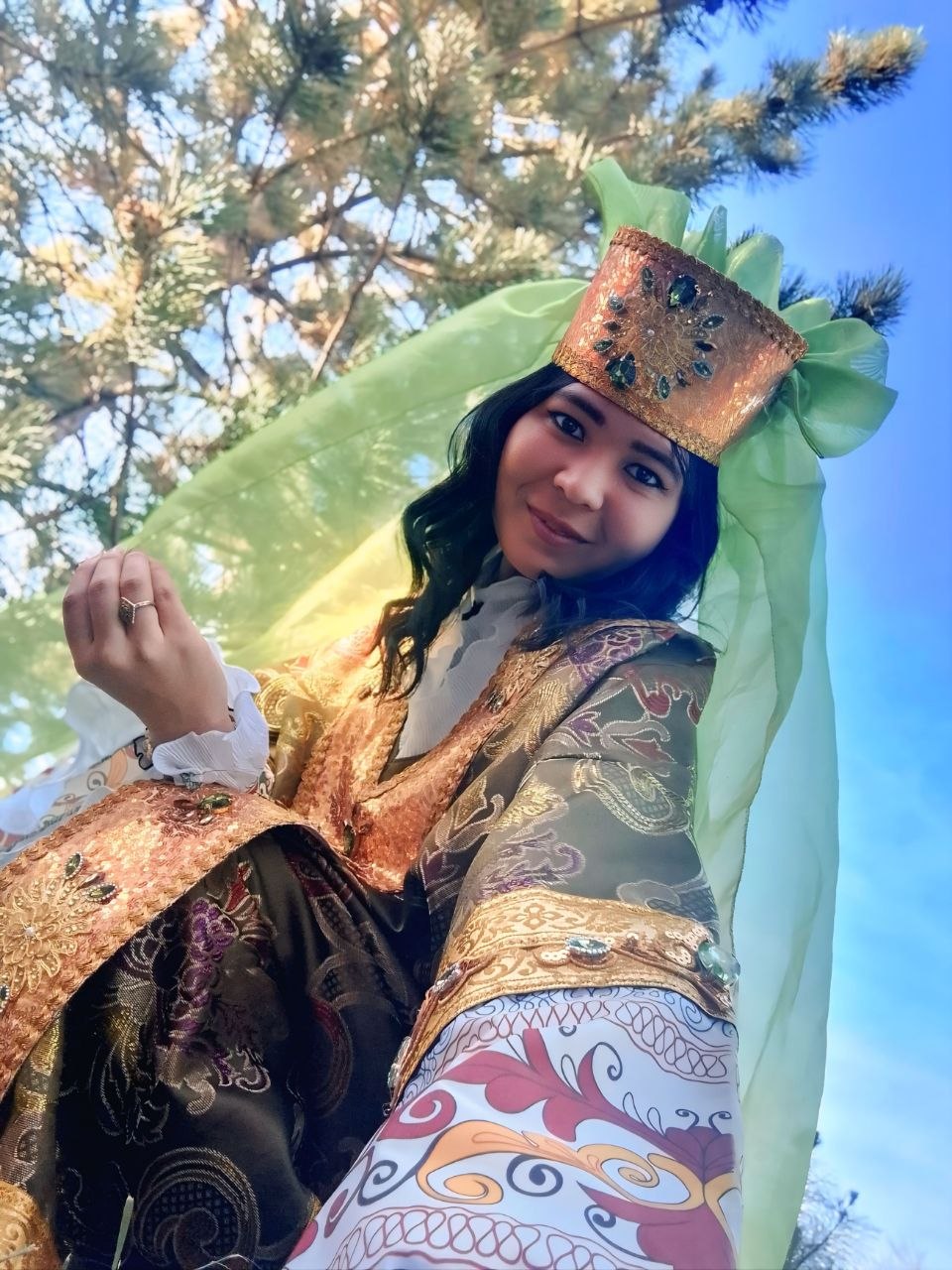
Essay from Abduxalilova Sevara

“Yusuf and Zulayho” in Durbek’s Interpretation

KDPI, Faculty of Social Sciences
Uzbek Language and Literature Department
1st-year student: Abduxalilova Sevara
abduxalilovasevara007@gmail.com

Abstract: This article presents an artistic analysis of Durbek’s work „Yusuf and Zulayha“. The work highlights the ideas of the harmony of divine and human love, patience, loyalty, and spiritual purity. Through the image of Yusuf, the author depicts the embodiment of beauty and perfection, and through the image of Zulaykha, the process of spiritual suffering and purification experienced on the path of love. The article analyzes the ideological and artistic characteristics of the work, the system of images, and its place in Eastern literature.

Keywords: Yusuf and Zulaykha, Durbek, love, patience, loyalty, divine love, artistic analysis, image, Eastern literature, spirituality.  

The theme of “Yusuf and Zulayho” is very popular in classical literature and has been written by many poets. Among the most famous Uzbek and Turkic versions, Durbek created his work in the 14th–15th centuries, specifically in 1409. In Eastern classical literature, works that artistically express the ideas of love, patience, and spiritual purity hold a special place, and Yusuf and Zulayho is one of them. This work is significant not only because it is based on religious narratives, but also because it deeply explores human psychology, different aspects of love, and moral values. In particular, Durbek’s interpretation stands out for its artistic maturity, system of characters, and strong national spirit. The widespread popularity of the work is mainly due to its profound interpretation of love.

In Eastern literature, many legends and narratives have developed around this plot. The spread of the story was greatly influenced by the Torah and the Qur’an. These sacred texts contain various stories, chapters, and details related to Yusuf (Joseph). In Balkh, Durbek composed the epic “Yusuf and Zulayho.” However, until the 1920s, the poet’s name was not recognized in academic literature. After the manuscript of his epic was discovered, Durbek’s творчество attracted the attention of literary scholars, and excerpts from the work were published. In later years, debates emerged within the academic community suggesting that the author of “Yusuf and Zulayho” might not be Durbek, but possibly Ulughbek or Hamidiy Balkhiy. In some recently published school textbooks, the author is even listed as unknown. Nevertheless, well-known literary scholars such as Bertels, Hodi Zaripov, F. Shamsiev, Oybek, M. Shayxzoda, O. Sharofiddinov, V. Zohidov, I. Sulton, H. Yoqubov, F. Karimov, A. Qayumov, A. Hayitmetov, N. Mallaev, S. Haydarov and others affirm that Durbek is indeed the author of the epic.

The story of “Yusuf and Zulayho” is one of the most famous love and moral epics in Eastern literature. It is distinguished by its religious, spiritual, and artistic qualities. Yusuf is portrayed as a handsome, sincere, and pure-hearted individual. He is the son of Prophet Yaqub (Jacob) and is described as wise and morally upright. Zulayho, on the other hand, is depicted as a wealthy and beautiful woman who falls in love with Yusuf at first sight. Overwhelmed by his beauty and character, she becomes deeply devoted to him. However, Yusuf preserves his faith and morality, resisting her temptations. Zulayho attempts to deceive him through cunning, but Yusuf escapes and maintains his purity. As the story progresses, Zulayho comes to understand true love, repentance, patience, and moral purity. The narrative teaches lessons of patience, ethical integrity, and genuine love.

The development of Zulayho’s love for Yusuf is interpreted in different ways. For example, in the prose work “Qissasi Rabguzi”, their meeting is described in two different versions. Rabguzi, having studied various narratives, does not strictly determine which version is authentic and therefore presents multiple interpretations. According to one version, Zulayho falls in love with Yusuf after meeting him by chance; in another, she falls in love after seeing him in a dream. Other versions emphasize Zulayho’s cunning as the cause of the conflict, while more dramatic interpretations introduce intermediary characters such as Nodir.

The love between Yusuf and Zulayho symbolizes divine love. Qul Ali, while describing Zulayho’s love for Yusuf, emphasizes that everything she hears or perceives echoes only the name “Yusuf.” He illustrates the ideal form of true love in the following lines:

After falling into hardship,
If she does not see Yusuf even for a moment,
She loses patience and hears no one’s words,
Whatever she says, she says only “Yusuf.”

If blood were taken from her body,
And a vein were cut by the surgeon,
Even if a drop of blood fell to the ground,
The earth itself would write “Yusuf.”

The study of the epic “Yusuf and Zulayho” holds an important place in literary history. The ancient roots of its plot, its connection to sacred texts, and its various interpretations in Eastern literature make it valuable not only as a literary work but also as a spiritual heritage. Writers from different periods—such as Rabguzi, Durbek, Jami, and others—have interpreted the story in their own ways, enriching its characters and details, and making it relevant and understandable for future generations. The main idea of the plot—patience, moral purity, and true love—continues to inspire readers even today. Therefore, “Yusuf and Zulayho” is not only a historical source but also a unique work that should be studied for understanding human values and literary thought.

References

  1. Rahmonov, N. (2005). History of Uzbek Literature (from ancient times to the first half of the 15th century). Tashkent. 
  2. Durbek. (1409). Yusuf and Zulayho (manuscript). Balkh. 
  3. Rabguzi, N. Qissasi Rabguzi, Book 2. 
  4. Bobojon, R. (2000). Yusuf and Zulayho. Tashkent: Gafur Ghulam Publishing House. 

  5. Jami, A. (1997). Yusuf and Zulayho. Tashkent: Gafur Ghulam Publishing House.
Essay from Doniyorbek G’ulomjonov

Technology and Artificial Intelligence in Language Learning

       Abstract

      The rapid advancement of technology and Artificial Intelligence (AI) has transformed the global educational landscape, particularly in the field of language learning. Digital platforms, adaptive algorithms, and intelligent tutoring systems now provide personalized learning experiences that were previously impossible in traditional classrooms. This article explores the evolution of language learning technologies, the impact of AI-driven personalization, immersive virtual environments, accessibility improvements, and ethical considerations. The study argues that while AI enhances efficiency and engagement, human-centered pedagogy remains essential. A balanced integration of technology and traditional instruction ensures sustainable and effective language education outcomes.

     Keywords

Artificial Intelligence, language education, adaptive learning, educational technology, NLP, digital platforms, e-learning, personalized instruction

    1. Introduction

In the digital era, technology influences nearly every sphere of human activity, including communication, business, healthcare, and education. Language learning has particularly benefited from technological innovation. Over the last two decades, the integration of Artificial Intelligence (AI) into educational systems has shifted traditional teacher-centered models toward more learner-centered approaches. Today, students can access interactive exercises, automated feedback, and immersive simulations through smartphones and computers. Such developments have made language acquisition more flexible, efficient, and globally accessible.

Artificial Intelligence refers to computer systems capable of performing tasks that typically require human intelligence, such as speech recognition, decision-making, and pattern identification. In language learning, AI analyzes learner behavior, tracks progress and adapts content accordingly. This paper examines the transformative role of AI technologies in language education and evaluates both their advantages and limitations.

     2. Evolution of Technology in Language Learning

Historically, language learning relied on printed textbooks, memorization techniques, and classroom lectures. Audio recordings and language laboratories later introduced listening practice, yet these tools still lacked personalization. With the development of the internet, online courses and multimedia materials expanded learning opportunities. The emergence of AI-based applications further revolutionized this process by introducing intelligent feedback systems.

Modern platforms use machine learning algorithms to assess learners’ strengths and weaknesses. These systems adjust task difficulty, recommend revision materials, and monitor long-term progress. Gamification elements such as points, levels, and achievement badges also increase motivation and engagement.

      3. Personalization and Adaptive Learning

One of the most significant contributions of AI is adaptive learning. Each learner has a unique cognitive style, pace, and objective. AI-driven systems analyze performance data and design individualized study paths. If a learner struggles with grammar structures, the system automatically provides additional exercises and explanations.

Spaced repetition algorithms strengthen vocabulary retention by scheduling review sessions at scientifically optimized intervals. Automated writing evaluation tools provide instant grammar and coherence feedback, enabling continuous improvement. This personalization increases efficiency while maintaining learner motivation.

      4. Immersive and Interactive Technologies

Virtual Reality (VR) and Augmented Reality (AR) technologies create immersive learning environments where students practice language in simulated real-world contexts. For example, learners may participate in virtual job interviews, travel simulations, or business meetings. Such contextual learning enhances communicative competence and cultural awareness.

Natural Language Processing (NLP) enables AI systems to evaluate pronunciation, fluency, and lexical diversity. Speech recognition tools provide immediate corrective feedback, supporting pronunciation development and confidence building.

      5. Accessibility and Global Impact

Technology democratizes education by reducing geographical and financial barriers. Students from rural regions can access high-quality language instruction through mobile applications and online platforms. This accessibility supports equal educational opportunities and promotes global academic mobility.

AI-powered systems also assist learners with disabilities through text-to-speech, speech-to-text, and translation technologies. Such inclusive design contributes to more equitable and diverse learning environments worldwide.

      6. Challenges and Ethical Considerations

Despite numerous advantages, AI integration presents challenges. Overreliance on digital tools may reduce meaningful human interaction, which remains essential for cultural and emotional aspects of communication. Additionally, data privacy concerns arise as platforms collect extensive user information.

Educational institutions must implement strong cybersecurity measures and transparent data policies. Teachers should guide students in responsible technology usage while maintaining a balanced blended-learning approach.

     7. Conclusion

Artificial Intelligence and digital technologies have significantly transformed language education by introducing personalization, adaptive learning, and immersive communication environments. These innovations enhance efficiency, motivation, and accessibility. However, technology should complement rather than replace human educators. A balanced integration of AI tools and traditional pedagogical strategies ensures sustainable and high-quality language learning outcomes in the modern world.

      References

1 Chapelle, C. A. (2003). English Language Learning and Technology. John Benjamins Publishing.

2 Luckin, R., Holmes, W., Griffiths, M., & Forcier, L. (2016). Intelligence Unleashed: An Argument for AI in Education. Pearson Education.

3 Godwin-Jones, R. (2018). Using mobile technology to develop language skills. Language Learning & Technology, 22(3), 1–17.

4 Holmes, W., Bialik, M., & Fadel, C. (2019). Artificial Intelligence in Education: Promises and Implications for Teaching and Learning. Center for Curriculum Redesign.

5 Kukulska-Hulme, A. (2020). Mobile-assisted language learning. The Oxford Handbook of Language Learning and Technology. Oxford University Press.

6 Reinders, H., & White, C. (2016). 20 years of autonomy and technology. Language Learning & Technology, 20(2), 143–154.

7 Stockwell, G. (2013). Technology and Motivation in English-Language Teaching and Learning. Palgrave Macmillan.

Essay from Rakhmonova Gulzoda Sodiq qizi

The First Step Toward the White Coat

Rakhmonova Gulzoda Sodiq qizi

A second-year student of Bukhara State Medical Institute named after Abu Ali ibn Sino

The mornings of Bukhara are unique. Especially on the days when a new chapter of life begins, those mornings feel even brighter, even more exciting. On one such morning, with endless dreams in my heart, I stepped for the very first time onto the grounds of the Bukhara State Medical Institute named after Abu Ali ibn Sino.

As I walked through the gates of the institute, the atmosphere around me immediately drew me in. Students in white coats, young people hurrying to their classes, and dedicated teachers who approached their work with seriousness — all of it conveyed one simple truth: this was not just an ordinary place of education; this was a sacred institution where future doctors, who would fight for human lives, are trained.

The moment I took my first step past the entrance, I paused. The grand building of the institute stood tall, as if proudly saying, “Welcome.” At that very moment, the thought deeply settled into my heart: I will study here. My eyes filled with tears — but they were tears of joy.

I did not come to this institution by an ordinary path. In the 2025–2026 academic year, after graduating from a medical technical school, I was admitted through an interview process based on the opportunities created for young people in our country, especially under the initiatives of our President. For me, this was not only an achievement but also a great responsibility and trust. From the bottom of my heart, I express my deep gratitude — this opportunity completely changed my life.

In truth, deep within my heart, the dream of studying at a medical institute had always lived. I imagined it many times: large lecture halls, students eager for knowledge, wise and experienced teachers… And one day, those dreams turned into reality.

My first days were not easy. A new environment, new subjects, complex terminology — all of this intimidated me a little. At times, I even wondered, “Did I choose the right path?” But every time, the kind yet demanding looks of our teachers guided me back to my path.

One day, during a practical lesson, our teacher said: — “Being a doctor is not just a profession; it is the art of entering the human soul.”

These words made me think deeply. From that day on, I began striving not only to study my lessons but also to understand people. Because a true doctor must be able to feel not only physical pain but also the pain of the human heart.

As time passed, I gradually adapted to this environment. Difficulties gave me strength, and every small success increased my confidence. I realized that I was no longer just a student gaining knowledge here, but a young individual confidently walking toward becoming a doctor who will help people in the future.

Today, as I look back at my very first step, my heart is filled with one feeling — gratitude. Because this institution taught me not only to dream but also to strive toward making those dreams come true.

From my very first days at the institute, I found a special source of inspiration. On social media, I had been following a highly qualified and accomplished professor, PhD Muslima Akhatovna. Deep inside, I used to think: “If only one day I could attend her classes and learn from her…” And finally, that dream came true. It is difficult to put into words what I felt at that moment — it was not just a lesson, but an inspiring encounter.

Muslima Akhatovna is not only a highly skilled specialist in her field, but also a true teacher who can find a way into the hearts of students. Each of her lessons is not just a lecture, but a meeting full of inspiration and motivation. Her love for knowledge, dedication to her profession, and sincerity inspire every student to follow in her footsteps.

I had admired her scientific potential and broad thinking through social media, but sitting in her class in person is a completely different experience. Every topic she explains leaves a deep mark in my heart and motivates me to learn even more. Muslima Akhatovna is not just a teacher who gives knowledge — she is a guiding star leading us toward our dreams. Her presence is a great blessing and a source of inspiration for students like me.

In addition, I would like to mention my teachers from Karakul Medical Technical School, who played an invaluable role in my first steps on the path of knowledge. Dedicated mentors like Oltiboyev Ravshanbek, Haqqiyev O‘ktam, and Hasanova Mehriniso greatly influenced me with their teachings, support, and belief in me. It is their knowledge and encouragement that today I am confidently moving toward my goals.

Now I look at life differently. Before, I only had dreams — now I live with clear goals. Because I have realized that dreams are just the beginning, while goals are the force that brings them to life.

Student life at the institute is an entirely new world. New classmates, a new environment, a new way of living… All of this has changed me. Sometimes lessons feel difficult, but I never stop trying. I know that behind every difficulty lies a new opportunity.

Since childhood, I used to tell my mother: “I will become your personal heart doctor,” because she often suffered from heart pain. Today, I understand that I want to become not only my mother’s doctor but a doctor for all mothers. My greatest goal is to become a skilled therapist-cardiologist — a doctor who welcomes every patient with a smile, who treats them not just as patients but as close and dear people, and who can give not only treatment but also hope to human hearts.

There is still a long road ahead of me. I have many goals. But I firmly believe in one thing: if a person strives sincerely, their dreams will surely come true. I have chosen my path — a path toward the white coat, toward serving humanity.

“The First Step Toward the White Coat” is only the beginning. Ahead lie many challenges and many achievements. But I believe that this path will lead me to become a true doctor.

Essay from Asalbonu Otamurodova

Why Can’t We Say “No”?

Why is it so difficult for us to say “no”? It’s an interesting question. Throughout our lives, we often believe that we are living for ourselves, when in reality, we may be living under the expectations of others without even realizing it. Naturally, we all have our own needs and desires, but so do the people around us.

If we fail to set boundaries with others—if we cannot say “no”—we will continue to live under their demands. This is not just an unfortunate situation; it can be deeply harmful. Let me tell you this: learn to set boundaries with the people around you, even if they are very close to you. Until you define those boundaries, you will gradually become a prisoner of others’ expectations, because they will always continue to demand more.

Only when you stop living for others will you truly begin to live for yourself. I once read in a book: “If you consider burning in fire to be natural, you will turn into ashes and come to believe you deserve every suffering.”

Be courageous. At this point in your life, your primary responsibility is to be able to say “no,” not to wait passively like a sacrifice. Never forget this. Living under the pressure of others’ expectations will only harm you and slowly extinguish your self-confidence.

Poetry from Noah Berlatsky

Archaic Torso of Apollo

After Rilke


He has no head. He has no eyes

to pin us with his godhead. But his torso

is itself a gaze in which there grows

from inside, like a covered lamp, a fire.


Without that rising surge, divinity

would not ravish you, nor would a lip

trace the gentle curve of thigh and hip

to the shadowed center of fertility.


Without it, the stone would seem a broken thing,

chipped, cracked, dead, a stone,

and would not glisten like a wolf’s dark mane,


and would not from its remnants blaze and singe

you like a god. Of all its parts, there is not one

that does not see you. Your life must change.


Poetry from Duane Vorhees

THE HAUL

The apostles

learned to equip

their gospel ship

with hooks cross-shaped

and Christ as bait.

And they employed

muscle and wit

to deploy nets

of iron strength

at untouched depths.

Mighty fishers,

they spent their catch

on wishers’ masts,

sinners’ anchors,

and sure harbors.

THELONIOUS STRAIGHT

The monk in

habit black attacked

attacked        attacked

his devil — devil grinned 

on four legs — — attacked —

blue monkish evangelist fanatic

he went afterafter his 

4legged infidel foe —

with fingers uncurled 

straight for the eyes, for their whites and 

for their blacks

until they scream in blind

NO CHASER

the unsquare monk

the monk melodious

prayed and prayed

mystic irre

ligious

prayed his round midnights with

out even a chaser of

sunny Cannonball blues

attackattacked, in bflat

solitude

YOUR GARDEN

is filled

with forget-me-nots

but I can’t

find

any rue.

HOMESICKNESS 

In my childhood

homesickness was a cheap stamp.

I was here

and Mom just over there.

When I was grown,

homesickness a boarding pass

and bride just beyond.

But then

homesickness became a tiny tomb.

I stayed outside

but Mom was deep within.

And now

Homesickness is a narrow strait.

I on one side

continents on the other.

–after Yu guangzhong

BL IN KI NG unedited by

Life starts when some man rams his Dodge

into some garage and guns the engine,

then gets lost somewhere between debacle and apocalypse.

Time unscrolls itself outside the windshield,

vibrates and alters again just beyond attention,

in constant motion from mist to liquid to real to uncongealed.

 Not every stage equates to hajj,

but no ride’s just road nor map nor engine

nor even mere pathway among all the altars and the crypts.

If life’s the shimmer between death and sex,

the interplay’s the thing! The strength is in the tension.

In our yinyang universe, concave shapes itself toward convex.

Poetry from Patricia Doyne

SEIZE THAT TROUBLEMAKER—

AND HER TORCH!

After the “No Kings” rally in LA,

signs and costumes milled around, blocked traffic–

until the cops showed up.

Picture this: riot-gear police

seizing blue-gowned, blue-faced Lady Liberty.

They confiscate her torch, then loop a chain

around her waist, cuff hands behind her back,

and march her off, one lawman on each side.

So—Liberty’s too dangerous? Too woke?

Welcomes the tired and poor, asylum-seekers?

Says no one– NO ONE– is above the law?

We the People came downtown today,

seeking solace, strength in shared resolve—

rejecting ICE, that preys on immigrants,

but won’t apply laws to rich pedophiles;

rejecting millions spent to build a ballroom

while health care’s cut, and hospitals shut down;

rejecting war with no goals, no way out,

while old bone-spurs plays golf at Mar-a-Lago;

rejecting loss of three-branch government,

while faux-king stamps his name on doors and dollars.

We twice elected this convicted felon

with track records of insurrection, racism, and rape.

He raised the cost of living, and attacks

free speech, free press, and now, the right to vote.

Eight million, coast to coast, reject this future.

and gather to share anger, fear, and strength.

But in the end, when all the chanting’s done–

there goes Lady Liberty in chains.

A zip-tied symbol of a vision lost.


Copyright 3/2026

Patricia Doyne