Lost Eagle

An eagle wants to soar the sky
Yet overwhelmed by the vastness high
Desire to be out of cage so free
Need to be warm and safe in a nest be
An eagle warmed by the golden sun
Yet rash and burns never been fun
Cravings for the sweetness of nectar
Detest the addiction with no holds bar
An eagle flying for desired goal
Yet struggle with currents running afoul
Fight routes twisting gone hayway
Lost in heaven's blind maze way
An eagle no different from the eaglet
An egg lain for business not nature set
Searching beyond reason's mystery
Yet know its wings has no sanctuary
An eagle forever wishing the sky
Yet caged in anchored from flying high
Desire surgeing wanting to be free
Quite contrarily needing the security in a nest be


Silent Lamb


Scorching wind lashed on the tattered skin
Not to cool but burn right down one's shin
Breeze unwelcomed, fiery ember's kin
On opened wound, awashed in biting hot gin
Light bouncing off a discarded serrated tin
Lazer torch slicing a rotten fleshy bin
Pricking a human bag thousands of a pin
Memories battled, all virtues and one great sin
Heavy log burdened a bloody shoulder
Naked heels on sharp path of crushed boulder
Passage unyielding, shaky feet flounder
Entertainment, for bloodlust to plunder
Sweat and blood to cool a disfigured face
Spittle and slaps, adornment of disgrace
Time and Death impatient in the race
Such a slow, grueling journey pace
So far and yet so near, the goal of a hill
A place where justice is vexed nil
Iron nails hammered flesh holes to drill
Sturdy post raised up, viewers had their fill
Thunder sounds the sky did rend
Shakes and quakes through the ground earth send
Angry insults and curses haters tend
Yet the slaughtered lamb remained silent...


Lilian Dipasupil Kunimasa was born January 14, 1965, in Manila Philippines. She has worked as a retired Language Instructor, interpreter, caregiver, secretary, product promotion employee, and private therapeutic masseur. Her works have been published as poems and short story anthologies in several language translations for e-magazines, monthly magazines, and books; poems for cause anthologies in a Zimbabwean newspaper; a feature article in a Philippine newspaper; and had her works posted on different poetry web and blog sites. She has been writing poems since childhood but started on Facebook only in 2014. For her, Poetry is life and life is poetry.

Lilian Kunimasa considers herself a student/teacher with the duty to learn, inspire, guide, and motivate others to contribute to changing what is seen as normal into a better world than when she steps into it. She has always considered life as an endless journey, searching for new goals, and challenges and how she can in small ways make a difference in every path she takes. She sees humanity as one family where each one must support the other and considers poets as a voice for truth in pursuit of equality and proper stewardship of nature despite the hindrances of distorted information and traditions.
Unforgettable Loves

Love lived from afar to afar,
Like an angel sent from the divine,
Neglect it not, for someone's worth,
The beat of your heart, the breath in line.
Daytime's dream within your gaze,
Bestowing moonlight upon the night,
Should the dream fade, unheard it be,
A sigh of that moment, taking flight.
Love known in this world as ardor,
A matchstick tending a hidden flame,
Embers untouched, unburned by time,
Desires held close, their passions untamed.
Life written together with her by your side,
Both a reality and dreamscape combined,
When you find your place, cease to wander,
It's the honeyed voice you've longed to find!

05.08.2023.

Elmaya Jabbarova - was born in Azerbaijan. She is poet, writer, reciter, translator.
Her poems were published in the regional newspapers «Shargin sesi», «Ziya»,
«Hekari», literary collections «Turan», «Karabakh is Azerbaijan!», «Zafar»,
«Buta», foreign Anthologies «Silk Road Arabian Nights», «Nano poem for
Africa», «Juntos por las Letras 1;2», «Kafiye.net» in Turkey, in the African's CAJ
magazine, Bangladesh's Red Times magazine, «Prodigy Published» magazine. She
performed her poems live on Bangladesh Uddan TV, at the II Spain Book Fair 1ra
Feria Virtual del Libro Panama, Bolivia, Uruguay, France, Portugal, USA.
An Interview taken by Ayodeji Michael Adeboboye, a Nigerian International journalist from Jimoh Ibrahim PhD (War), CFR.
*Peace is not the Opposite of War: What Options for the Niger Republic?
By Jimoh Ibrahim PhD (War), CFR.
Part One: Introduction
Peace and war are matters of insecurity. Living with insecurity is the only security, perhaps for those who studied War! Even in the most hospitable circumstances, the human condition is precarious because we are all unavoidably exposed. Human nature is flawed, and perfect security cannot exist in any human society.
Yet to be forgotten even when you may not like him is Hobbes’ ‘state of nature,’ every human being is a potential threat because the struggle for survival in a world of limited resources is a ‘war of all against all,’ Hobbes thought that putting a government in place is an excellent way of guaranteeing security! In a world without a government to enforce order – a condition that Hobbes calls the state of nature – every human must be vigilant against threats to survival.
A world without Government, he claims, forces humanity into a constant state of war because there is no way to trust in the excellent or peaceful intentions of others. We must always be on our guard lest we be attacked. This condition – in which no ruler or judge can resolve disputes and establish security – is anarchy. In an anarchic world, Hobbes argues that our lives must revolve around survival, leaving no time for agriculture, the arts, or sciences conditions of anarchy; Hobbes says, ‘the life of man [is] solitary, poor, nasty, brutish, and short. But does having a government in the last twenty years make a difference?
This is because and according to me, the Nigeria Boko Haram insurgency underscores the Hobbesian thesis of man’s aggressiveness in the state of nature that requires the leviathan’s intervention. The Nigerian Government’s failure to provide public goods led to the emergence of the Boko Haram insurgency. The citizens contest their rights to life (now in danger), withdrawing their loyalty and support from the Government and the Armed forces. A praxis explains the power shift from the Nigerian Government to the identified local group (Boko Haram). The shift accompanies ongoing violence between soldiers and the insurgents resulting in mass civilian casualties, genocide, systemic rape, and unquantifiable property destruction fostering human insecurity. The above narrative makes the statement relevant that studying and knowing how to live with insecurity is the only security! Insecurity is pervasive in the international realm.
For instance, the international system is anarchic, and no single authority can remit uncertainty. We move from the dynamics of abuse of power as we saw in Darfur, where Sudanese President Omar al-Bashir was charged by the International Criminal Court (ICC) with war crimes against humanity. The violence has also forced some 2.5 million people − mostly farmers and villagers from non-Arab groups – to flee their homes.
So was the American-led Illegal invasion of Iraq in 2003 to the insecurity creation of intervention and collision of the value of security paradigms in human, national and geocentric systems-the intervention in Iraq (1990), Bosnia (1995), and Afghanistan (2001) were intended to preserve the territorial status quo and restore sovereign control to legitimate governments. (In Kuwait, Sarajevo, and Kabul), intervention in Kosovo (1999) was intended to protect the Kosovar (Albanian) minority even at the risk of partitioning the (rump) federal Yugoslav state (Serbia-Montenegro). All are empirical evidence of insecurity globally. Issues of the ongoing killing by Boko Haram and collaboration of the insurgent with the new formation of the Islamic State West Africa Province (ISWAP) and its expanding activities in the West Africa Sub-region. (Where Boko Haram killed the President of Chad recently) forcefully explaining the failure of the leviathan to protect citizens and himself!
in developing countries, what is more, is the powerful justification for our new concern that How to live with insecurity is the only security at least known in the West African sub-region. Is peace the opposite of War? See part two of this article. Again, is Niger a sovereign state to which intervention can be made impossible? What option, war or peace? and is sovereignty, not hypocrisy? See part three of this article. If you miss any part, send an email requesting the missing part to my University of Cambridge life email address ifj21@cantab.ac.uk
~Jimoh Ibrahim holds PhD in Modern War Studies and just completed BSc in International Relations (Second Class Upper Division) from the London School of Economics LSE, the University of London. He holds nine other University degrees from the University of Cambridge, Oxford, Harvard, Ife etc. He is currently at the 10th National Assembly of the Federal Republic of Nigeria as a Senator representing Ondo South senatorial district.
-Jimoh Ibrahim PhD (War), CFR.
Ayodeji Michael Adeboboye
Ayodeji Michael Adeboboye is a Nigerian International journalist with a deep passion for the practice of the Pen Pushing profession. Before he pressed his interest to professional journalism practice, he was a staff of the Daily Times of Nigeria (DTN) PLC, Lagos which at that time was the largest newspaper in Nigeria and entire West Africa.
His fascination in the pen profession compelled him to undertake journalism professional course at the most revered Nigerian Institute of Journalism (NIJ), Ogba, Lagos. He later served as a reporter with a local newspaper; The Key Newspaper, Akure, Ondo State, Nigeria.
Adeboboye a, conceptual journalist, expanded his scope of journalism and in the year 2020, network with professional journalists within the 5 regions of Africa, Europe and America to establish Congress of African Journalists, CAJ – a unique and legitimate journalists of African origin all over the world, fully registered with Corporate Affairs Commission and headquarters in Nigeria.
So far, CAJ has over 30 networks in different African countries and has honourary membership within and outside Africa continent.
His journalism work has been translated and publish in languages other than English. As at today, Adeboboye is the Chairman of the Board, Congress of African Journalists, President, Central Executive Committee and Editor-in-Chief, CAJ International Magazine which has permeated many continents.
Unbroken sleep

Is it not enough, I am alive
When all hopes and aspirations
Love and emotions
Gone far, far away with thee.
My tears have dried,
Life blood seems to be frozen.

Not a drop of water remains
In the desert of my life.
The sound of life is absent here
No star is glittering in the cloudy sky
Darkness is crawling from all around
I feel an obnoxious smell in the air.

Life-tree is blank, no bird chirps
Roses have lost their colors
Waves of the sea has stopped flowing.
My tearless eyes are looking for thee
But none is here
Everyone is sleeping in an unbroken sleep.

(Manzar Alam from Bangladesh. By profession I am a college teacher. My above poem is composed in memory of one of my dear ones who faced an immature death).
The Wee Hours of the Morning

The wee hours of the morning,
Awake and softly singing
Remembered love songs
Roosting in the rafters
Of my romantic soul.
Coming from the drowsy land
Of faraway misty realms
Of reality, mixed with dreams.
Sparing me not his smiling lips
His ringing laughter; his salty tears.
I quite float away on beams
Of shining-eyed happiness
Total recall of whispered love words
The raspy breath of morning
Caressing my ears with eager joy.
Is it any wonder that I lie awake
In the wee hours of the morning;
Joy of memory rising to the rafters
Where all my longing goes to roost
On the early morning sunbeams
Pouring through the wonder
Of every dawn I spend with you.


Dreams Remembered

My dreams dog the heels of evening shadows
Darting in between the threads of moonbeams
Descending on the paths of twilight’s ending
As the familiar stars of midnight whisper
From the faraway nocturnes of my girlhood.
Faint are the crescendos the Meadow Lark sings
Through the feathery realms of dandelions
Caught on the passing wind of Fairy wishes.
Softly sing the memory of embers burning
Where the long dead ashes of youth lie cold,
Fading in the curling smoke of lost hope
Pressed between the pages of love poems
In worshipful beauty of a tender heart’s caring
That love would come and never grow old.
Alive, the belief that dreams came true
In the shaft of Holy sunlight streaming
Through the stained-glass windows of youth
To touch the pious head of the girl I once knew.
If dreams could take me back to that golden time
On wings of light; it is there I would gladly fly.


Annie Johnson is 84 years old. She is Shawnee Native American. She has published two, six hundred-page novels and six books of poetry. Annie has won several poetry awards from world poetry organizations including; World Union of Poets; she is a member of World Nations Writers Union; has received the World Institute for Peace award; the World Laureate of Literature from World Nations Writers Union and The William Shakespeare Poetry Award. She received a Certificate and Medal in recognition of the highest literature from International Literary Union for the year 2020, from Ayad Al Baldawi, President of the International Literary Union. She has three children, two grandchildren, and two sons-in-law. Annie played a flute in the Butler University Symphony. She still plays her flute.
When The Heart Becomes An Artifact


For few it begins with the first kiss,
While for most it is a game of hit and miss.
Hoping for the one solid contact bringing them home;
Landing in the yard with picket fence and garden gnome.
Holding out for love's holy grail,
Losing more of their selves the more they fail.
Always on the lookout, hoping to find
That one arti.....WAIT....STOP....rewind.
When the heart aches and the earth quakes
Just hope it doesn't open to a pit of snakes.
I've fallen so often it's hard to tell
Just how often and deep I fell.
In a long forgotten hell I was sure I found the one
That would forever shine like the Sun.
Just a dream that toyed with my heart,
And I watched the Moirai take that future apart.
Sorrow fell upon me like raiders of a lost heart.
The darkness deep within picked me apart.
In this love I was alone
Searching for the philosopher's stone.
Trying to make love out of pain.
Trying to make sense of a stain
But that dream did in fact
only make my heart an artifact.
Burning blood became cold
Until I finally found my gold.
And this love is in fact
The only true artifact.


The Code Says I am a Number


Minority Report should have been a warning not a template
And yet we have judicial A.I. we will soon regret.
Emotionless computers judging the human factor
Non empathetic hardware trying to correct human error.
A.I. : Artificial Intelligence; Algorythmic Inqisitor
Tomorrow's dark future is here today;
More and more human purpose being taken away.
Facial recognition assessing job applicants; qualifications exempt.
A false interpreted expression can block the best attempt.
Bots deciding what we can and can not say;
Taking human rights to express away.
Do we still have control or causing a butterfly effect?
What more do we have to expect?
Humans are becoming the minority
Code is taking up the majority.


Author Biography

From South-Western, Michigan, Jerry Langdon lives in Germany since the early 90's. He is an Artist and Poet. His works bathe in a darker side of emotion and fantasy. He has released five books of Poetry titled "Temperate Darkness an Behind the Twilight Veil", “Death and other cold things” “Rollercoaster Heart” and “Frosted Dreams” Jerry is also the editor and publisher of the literary magazine Raven Cage Zine poetry and prose. His poetic inspirations are derived from poets such as Edgar Allen Poe, Robert Frost and Henry Wadsworth Longfellow. As well as from various Rock Bands. His apparently twisted mind, twists and intertwines fantasy with reality.
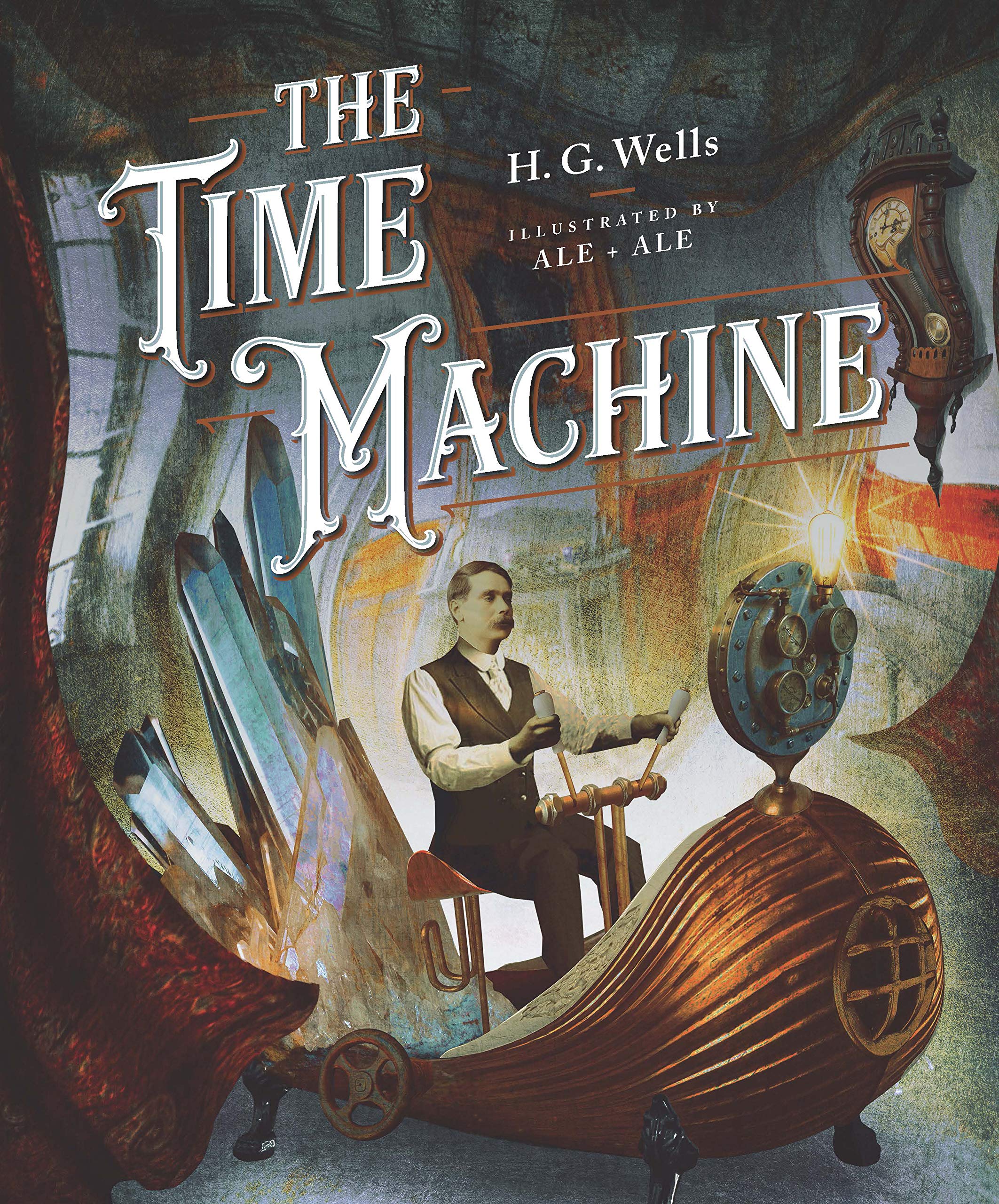
We are to shape our state in a world of uncertain seasons, sudden catastrophes, antagonistic diseases, inimical beasts and vermin, out of men and women of the like passions, the like uncertainties of mood and desire to our own.”. Examine the Time Machine as a static utopian fiction contrasting critical perspectives of kinetic utopia highlighted in the commentary.

H.G. Wells' time traveler surmounts to venture upon his adventuresome journey in aftermath of the narrator’s dialect to ‘consider I have been speculating upon the destinies of our race”, the epilogue of the novel where the narrator suggests, “He [ …] thought but less cheeringly of the Advancement of Mankind, and saw in the growing pile of the civilization, only a  foolish heaping that must inevitably fall back upon and destroy its makers in the end.” The time traveller’s futuristic analyses of the society of Victorian England are extrapolations of close surface similarities of male and female Eloi community between adults and children alike, where forth the author concludes, “the strength of the man, the softness of the woman, the institution of the family, the differentiation of the occupations are merely militant necessities of an age of physical force.

The science fantasies are offered as so many cautionary fables, so many dreadful warnings to humanity to look to itself, to take stockings from its current sick condition and remedy it before it is too late. Population control, childbearing and childrearing decline of motherhood, falling stoicism of menial chores or physical labour in males, will show less differentiation and consequent immaturity into adulthood, such leisure brings, leads the Time Traveller to observe that, “children seemed to my eyes to be but the miniatures of their parents.”

Morlockian cannibalism satirizes the burgeoning working class proletarian revolution in the tumultuous turmoil wrecked by the upsurge of militant trade unionism particularly left wing labour party political organization. Earlier the Eloi had rose to ascendancy but subsequently dethroned by Morlockians, since the latter possessed initiative in the face of adversity. Industry and working-class accommodation were removed from the surface of the earth and buried underground, since all the surface of the earth was bequeathed to be conferred upon the ruling class of aristocracy. In this sense, all the surface of the earth came to be dominated and owned by the enterprises proprietors of Victorian bourgeoisie, “artificial undergrounds that such work as was necessary to the comfort of the daylight, race was done”. The Time Traveller maintains that for his audience, envisioning a society that does not require a great leap of imagination, “even now there [/////] is a tendency to utilize underground as the space for less ornamental purposes, there is the Metropolitan Railway in London, for instance, there are new electric railways and subways, there are underground stations and restaurants, and they increase and multiply.”

It is worth analyzing how the Elois degenerated and eventually were eliminated by the surge of extinction, since they were diminished of their intelligence and their strength in contrast to their subterranean habitats dwelling neighbours subalterns Morlocks; Morlocks possessed the intuitive spirits of resiliency by engagement in productive labor and physical prowess in order to savage damnable starvation and malicious suffocation. Post Darwinian evolutionary adaptations, thus, overthrew the Eloi to their downfall and the Morlocks to their triumphalism in the extremes of individualistic collectivism. The Time Traveller discovers that the Elois privileged aristocracy as the automatic rulers of the earth unearthed the fatal flaw: “that perfect state had lacked one thing even for mechanical perfection-----absolute permanency.”

The Time Traveller believes that middle-class inbreeding was fundamental and crucial to the slit in the humanity produced by the Eloi and the Morlocks, with the widening gulf between classes, being the result of the promotion by intermarriage, which at present, retards the splitting of our species along the lines of social stratification, becoming lesser and lesser frequent.” An animal in harmony with its environment is a perfect mechanism. Nature never appeals to intelligence unless habit and instinct are useless. There is no intelligence when there is no change or no need for change….” Eloi over the centuries have adapted so well to their environment that life had become instinctual once again.

However, when considering the Morlocks the opposite must be the case: “It is a law of nature to overlook, that intellectual versatility is the compensation for change, danger and trouble….Only those animals partake intelligence that have to meet a huge variety of needs and dangers.”  Food crises reinforced these minion ant like creatures to prey and preserve their cattled like creatures upperworlder masters Eloi. Event the writer prolifically exclaims in astonishment, “I was surprised to find it had been carefully oiled and cleaned. I had suspected that the Morlocks, had even partially taken it to pieces while trying in their dim way to grasp its purpose.”

Robert M Philmus points out that, “by 802/701 no species has the intelligence anymore to set limits on the struggles for existence, in where the defenseless Eloi fall victim to the carnivorous Morlocks. Furthermore, the Morlocks are unable to walk upon the surface of the earth due to their blindness in daylight and their new role as exploiters of the upperworld Eloi simply reverses the old equation rather than changes its nature. Thus the story ends with the general biological devolution and the destruction of the planet as witnessed by the Time Traveller in his “Future Vision”.

In valedictory argument, Mc Connell’s critical interpretation is a justifiable approach to vindicate the Time Machine as a static utopian fiction, “The environment will inevitably change upon the course of geological, cosmological time. And the species that has been too close at home with one phase of climate and ecology will probably lose the resiliency to change and meet the demands of another phase.”

Further Reading and References

John S Partington’s The Time Machine and A Modern Utopia: The Static and Kinetic Utopias of the Early H.G. Well’s, Utopian Studies, 2002, Vol. 13, No. 1, pages: 57-68.
HG Wells’ The Time Machine Reviewed –archive, 1895 The Guardian