
Beauty Is Where You Find It

We went to the art museum

But the art museum was closed.

My stomach hurts, and outside the clouds

Sit somewhere while I look at my phone.

That’s not art.
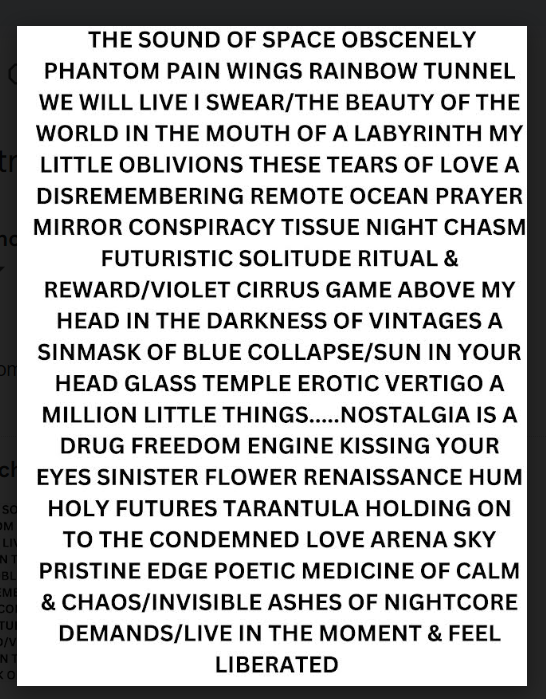
Poetry from Rus Khomutoff
Essay from Shoxijahon Urunov
About choosing a friend
A friend is a balm for the soul. A true friend is always present when things are going wrong. When choosing a friend, a person should, first of all, be educated and worthy of the chosen friend. If you want to be friends with a good person because of your bad behavior, you will naturally be rejected by your chosen one. Start your first friendship with yourself. That is, you are your own friend. First of all, sharpen the mind, purify the psyche, follow the rules of etiquette and discipline. Then it’s time to choose your friend. You choose a friend based on your personality. That is, your friend’s soul should be pure, and he should also follow the rules of etiquette and discipline.
Poetry from Pat Doyne
                TRUMP TRADING CARDS  #2

		When Trump checks his mirror, what does he see?
		A surface image or Herculean depths?
		This second batch of NFTs* gives clues.
		The old porker’s bootlegged frame is lean.
		The face is Trump’s, and easy to recognize--
		except for unlikely expressions:
		kindly smile, serene bearing, dignity.
		Never pouting and fuming,
		scowling with narrowed eyes,
		or name-calling and drawling spiteful slurs.

		Behold: a Trump-faced 14-carat chess piece
		topped with a Medieval golden crown.
		For scepter, he displays the stars and stripes.
		He holds the whole world in his other hand.
		Message: man of wealth and winning moves.
		MAGA groupies dote on golden idols.

		He wears an emperor’s crown as King of Hearts,
		the tarot’s symbol for complete control.
		He finger-frames his heart to show he has one.
		Donald’s lawyers clog the courts with card tricks,
		and yet he’s been indicted in New York.

		He’s Elvis, too, the king of rock and roll.
		Sequined cowboy shirt and pompadour,
		guitar at hip, Trump rocks the microphone--
		curls his lip and brays “YMCA”
		better than anyone else has ever brayed it.
		His song-and-dance brings men to tears. Or giggles.

		Then there’s Donald wild and free, a biker
		garbed in a leather jacket,  with black guitar.
		As he rides, he wails sad country tunes--
		women troubles, jail woes, and his favorite:
		I won, but voters stole the whole election.

		Five times this guy’s avoided being drafted,
		but it’s all good!  See “Army Trump” in camo--
		dirty face, a mud-stained combat helmet,
		and plans to call a halt to war in Ukraine
		by letting Russia take all Putin wants.

		Grill-king Donald stands next to his Weber,
		sporting a flag-striped apron, red and white.
		Hot dogs? Burgers?  Fresh from Mar-a-Lago.
		He waves a spatula in lieu of scepter.
		His next-in-command’s a Labrador Retriever.
		Easier to boss around than turncoat Pence.

		Trump, the symbol-loving super-Patriot,
		holds up the Liberty Bell, his sacred shield.
		The bell deflects attention from his crimes:
		inciting insurrection on Jan. 6.

		Trump in tricorn hat as Washington
		stands straight and tall in the bow of a painted boat,
		spyglass trained on Stormy Daniels. Wowza!
		His left hand grasps a long sword by the blade—
		but Trumpster never faces consequences.

		The final icon shows Trump in a suit
		next to a flaming force, a gold-crowned lion
		as orange as Donald’s hair,
		who pounces on the planet, sharp claws bared.
		I am lion tamer; also, lion.
		When I rage—watch out!  Ketchup will fly!

		Does Trump picture himself as a fiery lion?
		Founding father? Golden chessman? King?
		If so, who with the sense that God gave geese
		would choose this deluded dude to rule our nation?
		Or spend big bucks to download Donald’s daydreams?

		Copyright 4/23                Patricia Doyne


                	*Non-fungible tokens
Story from Sevara Eshonqulova
The land watered with blood

My mother tells the stories of the Sphinx and the stories of the pharaohs. - Thus, Pharaoh, who claims to be a god to his people, ordered the Muslim maid to be thrown alive into a huge boiling cauldron. My mother has a bad habit. If I don't wash the dishes on time during the day, if I don't pretend to make the house as clean as sheet she stops at the most interesting part of the story telling time and punish us without continuing.

Maybe because of the war period, in the countryside where we live, there were no people who considered themselves rich. The thatched walls, which were leaning on the ground, were ready to give their bosom to the soil, using the lying wind as an excuse. The last crops of the villagers, who were waiting for the harvest, were robbed, and the whole nation was left without wheat.

I still cannot forget those years. My mother's shoelaces were worn out. She didn't wear it regularly, she only used it to walk along the thorny, thick sand road to visit my grandmother's grave. Kindhearted mother baked bread from a light bag of wheat that she kept in the barn, and took it out sometimes to aunt Salima's house, and sometimes to old woman Khosiyat's house.

One day, a young man, who is either familiar or unfamiliar to my mother, and a complete stranger to me, begged my mother to give him slippers for his mother, whose foot was swollen with pus. On the one hand, my mother's right hand, who was feeling pity, was handing out shoes, and on the other hand, her left hand was trying to return the gift, saying, "If you walk barefoot on that thorny path, your feet will be no different from hers"...

The land that was watered with the blood that leaked from my mother's blessed steps, and where the cypress sprouted, today has been turned into a royal garden with marble stones. There is a race of people who can't be indifferent to the golden counter. It says: "This road is dedicated to the memory of a generous woman named Noila.
Essay from Quademay Usanova
MORPHOLOGICAL FORMATION OF NOUNS IN UZBEKI, RUSSIAN AND KORAKALPAK LANGUAGES


              Abstract.  This article examined the morphological way horses in Uzbek, Russian and Karakalpak languages are made, their comparison, similarities and differences.
            Keywords: Noun, object, affix, thing, weapon, measure, object, work-action, verb, ravish, pronoun, number, imitation words.

In Uzbek, Russian and Karakalpak languages, the noun means an object. In all 3 languages, the meaning of the noun is different, it refers to living objects (dog-собака-iyt, cat-кошка-pishiq) (child-ребёнок-bala, bird-птица-qus), things, objects and events. (milk-молоко-sut), (rain-дожд-jawin), (notebook-тетрадь-da'pter, kitab-книга-kitap), (majlis-собрание-jiynalıs).
In the current Uzbek language, the noun group makes up the number of words in the tugat. Because the noun word group is a group that gets rich quickly due to new words compared to other word groups. In the Uzbek language, nouns are formed by morphological, syntactic and abbreviation methods.  Below we will look at the morphological formation of nouns in the Uzbek, Russian and Karakalpak languages, as well as their similarities and differences.

In the Uzbek language, according to the morphological method, a new noun is formed by adding special noun-forming affixes to the base of the word. Noun-forming affixes are made from independent word groups such as noun, adjective, number, pronoun, verb, adverb, as well as modal and imitative word bases. Morphologically, noun-forming affixes semantically form nouns of the following group:
1. Affixes forming personal and professional nouns.
2. Affixes forming nouns of things, weapons, units of measurement.
3. Affixes forming place-time nouns.
4. Affixes forming abstract nouns.

Affixes forming personal and professional nouns are mainly added to the root of the noun to form personal nouns related to the object understood from the root and professional nouns engaged in a certain field and profession.  These affixes include: -chi: o’qituvchi, -dosh: kursdosh, -gar,-kor: zargar, -bon,-boz: bogʻbon, -paz: oshpaz, -kash: suratkash, -dor: chorvador, -shunos: tilshunos, -soz: soatsoz, -xon: kitobxon, -doʻz: etikdoʻz, -xoʻr: choyxoʻr. Among the personal and professional affixes, the affix -chi is one of the most frequently used affixes.

Affixes forming the nouns of a thing, a weapon, a unit of measurement, are mainly added to the base of the verb, which is the result of the action and situation understood from the base, or the thing that is used to perform the action, forms the noun of the weapon . These affixes include: -k, -ak, -q, -oq: kurak, teshik, soʻroq, -gich: suzgich, -gi: supurgi, -m: toʻplam, -ma: qiyma, -don: qalamdon, -indi: yuvindi,  -qin: toshqin,  -in: yigʻin,  -a: jizza,  -os: chuvvos,  -moq: quymoq, -cha: olacha,  -chiq: yopinchiq, -ildoq: shaqildoq,  -noma: taklifnoma

  The affixes that make place nouns are mainly added to the noun root and form the nouns of place where there is an object understood from the root. These affixes include: -zor: olmazor, -loq: qumloq, -iston; Oʻzbekiston, -goh: oromgoh, -xona: choyxona.
Abstract noun-forming affixes noun, adjective, number, pronoun, verb, adverb are sometimes added to modal word bases to form a noun with an abstract meaning related to the concept represented by the base. These include affixes such as -liq(-lik): goʻzallik, -ch(-inch): sevinch, -chilik: paxtachilik, -gilik: koʻrgilik.

In Russian, it is more possible to create new words by morphological method, because in Russian, in addition to suffixes, new words are created with prefixes or with the simultaneous use of prefixes and suffixes. For example: -ник: колхозник, -ак: рыбак, при-ход, за-пись, вы-крой-ка, под-готов-ка, etc.
The Russian language is very rich in suffixes. Even the same meaning is expressed by different suffixes. For example: -тель: писатель,  -щик: стекольщик, -чик: лётчик, -ник: колхозник,  -ист: тракторист,  -ец: борец, -ак(-як): рыбак suffixes form the noun of a person engaged in a profession.

In the Russian language, it is possible to express unrelated meanings with the help of one suffix . For example: with the suffix - -ниц, nouns are formed as follows: a) a noun denoting a woman with a profession: колхоз-ниц-а, b) names of dishes: -сахар-ниц-а c) names of special buildings used by the public: бол-ниц-а, гости-ниц-а, d) sick names: such as -груд-ниц-а.
In the Russian language, when new words are formed with some suffixes, some phonetic changes occur in the word structure that are characteristic of Russian grammar. For example: друг-дружба, партия-партиец. In the Uzbek and Karakalpak languages, such phenomena are very rare: son-sana - san-sana, ulugʻ-ulgʻay, isi-issiq, - isi-issiqlash, etc.

In Russian, the formation of new words with suffixes depends on the grammatical stem category. Therefore, when expressing the same meaning, suffixes are added depending on the grammatical stem of the word. For example: мужской род: колхоз-ник, учи-тель; женский род: колхоз-ниц-а, учи-тель-ниц-а etc.
There is no rod category in Uzbek and Karakalpak languages. If it is necessary to emphasize that the owner of the profession is a woman, the syntactic method is used, that is, one of the words girl, wife, woman is added to the personal word and it is written like this. For example: traktorchi qiz – трактористка – traktorshı qiz, kolxozchi xotin – колхозница – kolxozshı hayal.

In Russian, the relationship of a person to his place of birth and residence is expressed by suffixes such as -ец, -анец, -янец,  -як, -ин, -ич, -анин, -янин, -чанин. For example: Испания- испанец, Грузия- грузин, север- северянин, etc. In the Uzbek language, instead of these affixes, the suffix -lik is used, and in the Karakalpak language, the affix -liq is used. For example: Amerika- Amerikalik – Amerikaliq, Ispaniya – Ispaniyalik – Ispaniyaliq.
  In the Karakalpak language, as in other Turkic languages, one of the main methods of creating new words is the morphological method. In the Karakalpak language, noun-forming affixes are semantically divided into 3 different types:

1. Affixes forming personal and professional nouns.
2. Affixes forming nouns of things, weapons, units of measurement.
3. Affixes forming place-time nouns.
The affixes forming personal and professional nouns are -shı, -shi, which are added to the base of the noun and denote an object or a person engaged in some work: balıqshı, suwshı, etikshi, etc.
Added to a noun, it refers to a subject, a job or a person who works in social organizations: Leninshi, kolxozshı, bozshı, etc.
Added to the noun base, it means a person with a certain character: sedentary, stubborn, etc.

It is add oʻtirikshi, urlıqshı ad to the words that express the meaning of action or are related to the action by content, and is applied to the person who performs the action or performs this task: oqıtıwshı, boyawshı, terimshi, etc.
The affixes -ker, -ger, -kesh are very close in meaning to the meanings of the affixes -shı, -shi. Nouns formed with these affixes are also used to refer to a person performing a specific profession: zerger, pidaker, xizmetker, etc.

The suffix -man, -ban means a person who keeps or takes care of the object represented by the noun root: bagʻman, daʻrwazaman, etc.
The suffix -paz means a person who deals a lot with the object represented by the noun root or creates this object: aspaz, oyınpaz, etc.
The meanings of the affixes -das, -des, -las, -les are the same. That is, in all of these, it means partnership: joldas, kewilles, etc.
-purysh affix indicates a person engaged in the sale of an object understood through the root of a noun: shaypurısh, otınpurısh, etc.
The affixes -lik, -lik, -laq are also added to a number of nouns, indicating that the subject is abundant in this place: tawlik, togaylik, etc.

  In short, the most productive of the methods of forming nouns in Uzbek, Russian and Karakalpak languages is the morphological method. Morphological formation of nouns is different in all 3 languages. Morphologically, in Uzbek, noun-forming affixes are semantically divided into 4 different types, in Karakalpak language into 3 different types. When forming a noun, suffixes and prefixes also form a noun in Russian. It is even possible to combine suffixes and prefixes to form words in Russian.

The Russian language is very rich in suffixes. Even the same suffix can have different meanings. There is no rod category in Uzbek and Karakalpak languages. In the Russian language, the formation of new words with suffixes depends on the root category. In Uzbek, -lik and -liq affixes in Karakalpak indicate a person's relationship to the place of birth and residence, while in Russian there are several - -ец, -анец, -янец,  -як, -ин, -ич, -анин, -янин, -чанин suffixes are reported. The meanings of noun-forming affixes in the Karakalpak and Russian languages are shown in full. In the Uzbek language, it is understood only with the help of examples. This, of course, can cause some inconveniences, and in turn, it can cause certain difficulties not only for representatives of other nationalities, but also for ourselves in the comparative study of the language.


REFERENCES:
1. Azizov O. and others Comparative grammar of Uzbek and Russian languages Tashkent: "Teacher" publishing house, 1965.
2. Hamroyev M and others. Mother tongue . ‒ Tashkent: "Economy-Finance" publishing house. 2007.
3. Nasirov D. and others. Modern Karakalpak language Nokis: "Qarakalpakstan" publishing house. 1981.


Nukus State Pedagogical Institute

First level student of Uzbek language
foreign language groups
Faculty of Turkish Languages
USANOVA QADEMAY MURATBAY QIZI
Phone: +99891 305 69 79
Email: qademayusanova@gmail.com
Essay from Fotima Sayfullayeva
Humanity is created in such a way that self-awareness is the first priority for it. A person is an individual at birth. Later, he gradually overcomes the trials of life and reaches the level of a mature and mature person. As we mentioned above, a person must first understand his identity and learn about himself. We know that every human being has an "I". I want to talk about my "I" today. Before that, "What kind of person am I?" everyone should ask themselves that question. I judge my humanity by my behavior. Like everyone else, I have flaws and shortcomings. No one is perfect in this world. Perfection belongs only to the Creator. I don't want to praise myself. Because there are opinions among the people that you should not talk about yourself, let others talk about you.

I am very gullible. I believe in people as much as I believe in myself, and for this I have been criticized many times. I am capricious, capricious, very demanding of myself and others. My capriciousness and capriciousness must be related to my temperament. Our teacher says: "The temperament and character of people cannot be changed." Maybe that's why people around me are not able to change this character trait of mine?!

I think that people around me are sincere, as I imagine them to be. But they are not what I thought. They came one day and took off the mask from their faces and left an indelible wound in my heart with the hypocrisy of those I loved. Life is like that... People treat you well only for their own benefit. When the time comes, even your close relatives will not see your achievements.