
The Man Who Talked to the Sea
By Christopher Bernard

            He stands, hour after hour, at the edge of the surf, staring at the sea.
            In an old battered suit and scuffed shoes, he looks as if he just walked out of an office on Main Street. He sometimes wears a hat, a businesslike fedora, though usually his head is bare, the tufts of thinning whiteness stir like grass in the sea breeze.

            His eyes are watery blue, his skin pale despite hours in the sun. Every so often he takes a deep breath of air briny and ion-charged from the churning waves, then slowly exhales with a look almost of happiness.
            At times he focuses on small craft: a sailboat, motorboat, jet-skiers, wind surfers. Or surfers near the beach’s heaviest waves, a quarter mile off: he watches them with detached interest as the young men – and increasingly young women – lurch up on their boards and shoot the swells as they rise and collapse one after another, hour after hour.

           Or he gazes at the sky: a biplane with a banner advertising hair dye or a new movie, a police helicopter like a spider swinging down from the sky’s rafters, a commercial air carrier lifting off from a local airport like an aluminum cigarillo, a high-flying air force jet leaking a contrail over half the sky – that disappears in an instant or spreads across the azure, becoming an ice cloud as it expands until it looks like the wing of an enormous dragonfly.

           What he most loves are the freighters and cruise liners coming and going from the mouth of the nearby harbor, piled with oblong containers like boot boxes, or tall and white, striped with balconies or spotted like a colander with portholes, keeping their grace despite all attempts to ruin it for the sake of profit. They even retained a little of the old-fashioned romance of sea voyages, as they appeared on the horizon, small points or dirty smudges, and slowly grew, their bows sharp and high, their bridges straight and cool as a captain’s gaze, their smoke stacks saluting as they passed down the shoreline like the bodies of great whales – or leaving the coast at whose edge he stands and, heading out to sea, their sterns turning toward him as they faded to dots, the smoke turning into rust and ash on the horizon as the ships disappeared over the horizon.

            And of course, there are the birds: terns; sea gulls; crows flapping up now and again like black flags of anarchy; sandpipers nibbling nervously; ragged lines of pelicans, with their awkward bills and heads cocked like triggers and wings angled for either a long, leisurely drifting or a sudden plunge to surprise a fish for dinner.
            He never tires of watching the sea’s commerce: infinitely various, never the same yet always the same: sea and sky like an old married couple with the same quarrels and the same needs, even the stars and moon over the night sea reflections of shells and sand, foam and flotsam that lay at his feet. Just as they seemed reflections, as in a small mirror, of moon and stars and sun.

            Sometimes, after taking a furtive glance around him, he talks to the ocean. He speaks quietly, almost caressingly, for a long time, sometimes nodding or shaking his head or shrugging, as he might when speaking with a friend, and sometimes he pauses and appears to be listening for a response.
            After a time he turns away with a vague smile and quiet look of satisfaction, as though he has gotten whatever it was he was looking for and, his face bent to the sand, slowly walks away.

            The local children sometimes watch him while playing fort or catch, digging wells in the beach or dribbling sandcastles. They stop and stare, wondering briefly to themselves or passing rude jokes before going back to their games.
          More than once a few crept up behind him and tried to hear what he was saying to the sea. They crouched down and listened, hitting the one who threatened to giggle. But they couldn’t catch his words, soft as they were against the noise of the surf, and they got bored and crept away. One time they beat a retreat in full cry, and the man turned to them, a look of surprise on his face that turned instantly into a rueful smile. He shrugged and glanced back at the sea as at a wise and sympathetic friend, as if sharing a quiet joke and relishing it, even if the joke was at his own expense.
*
          One day a young couple was walking barefoot down the beach. They were silent, avoiding each other’s eyes, their faces grim, a wide distance between them. The beach was otherwise empty: the sand showed only their footprints, parallel lines of spoor disappearing in the distance. The waves fell with unusual quietness, and the tide was out leaving a wide swathe of bright wet sand.
            A breeze stirred the hair of the young woman, slender and soft, though angry and hurt. She let the wind pull the hair across her eyes as though wanting to hide behind it, from the light and the young man beside her.

            He looked exasperated and glum, his mouth twisted, and walked with exaggerated emphasis, his footprints emphatic, like gashes, the woman’s softer, as if she hardly wanted to touch the ground.
            She seemed to want to disappear. He seemed to want to hit something with all his might.
            They walked in silence beneath the morning sun and an almost cloudless sky.
            Neither of them noticed the man gazing out to sea till they almost walked into him – or rather, the young man did, who was walking near the water.

            They stopped, a little disconcerted. The man didn’t seem to notice them. He was staring intently at the waves, his face full in the brilliant sunlight, his eyes seemingly blind in the glare. He seemed far away, in his own world. And he was speaking, softly, and – given the quietness of the waves – just audibly. They listened.

            “Thalassa, thalassa,” the old man said, “sea, o sea, you who murmur across the world’s seasons, who bear life in the cup of your seabed, who bore life from the beginning, who crash and swirl along every coast, who are both thing and symbol of the thing, of being and destruction, life and death and love and birth, of joy and suffering, ecstasy and despair, ephemeral, perpetual, in change and permanence, water and crystal and gold and ash and mud and wine and earth and sea, o sea, thalassa, thalassa, you are the comforter and destroyer, the ever-kind and ever-ruining, lover and demolisher, betrayer of promise, builder of promise, creator of hope, betrayer of hope, image of the eternal, image of God, thalassa, thalassa, o sea, o sea, speak to me with your tongue of many voices, chant to me your music, and grant me ears to hear and know, with love and awe and patience and faith, as you give me being and take it away, thalassa, thalassa, o sea . . .”

            And the old man murmured on in the same fashion, and the young couple stood there listening and wondering, the man is crazy, he’s talking to the sea, astonished and a little repelled but frozen to the ground. He paid them no heed. He spoke to the sea as if he were, as usual, alone, as to an intimate friend.
            The couple, almost despite themselves, turned to look to the sea as well, and listened to the waves
And it was almost as though they could hear words in the ocean sounds, as though the old man and the ocean were speaking together, even though the old man never stopped to listen; they seemed to have an understanding, seemed tender together, one might almost think they loved one another, and the young couple was curiously moved.

After a time longer than they knew, as the sun rose higher and the wash turned back at the turning of the tide, a wave rushed up and crashed against their legs. The woman stumbled, cried out, fell . . .
The young man leapt over and tried pulling her away, but the wave yanked her from his hands and dragged her, choking in the foam, down and out toward the ocean. He dove after her, slipping, falling in the wash as a second, even bigger wave, crashed over him. He bobbed up, spitting and choking, and saw her arm flailing a dozen yards away in the swirling foam as more rollers swept toward them.

He lurched again toward her, grabbing her hand just as it disappeared under another wave, and reached out just in time to catch the elbow of her other arm and, managing to get a grip on the sand, pulled, almost lost his hold, then pulled and dragged again with all his might in a brief lull between the backwash and the next wave. The young woman appeared out of the water, sputtering and frightened, like a naiad, half drowned as she was born from the waves.

The two struggled and stumbled up the slick tract of sand just as another big wave raced in pursuit of them.
Once back on dry sand, the couple, drenched to the skin and shivering, turned to each other, their frightened eyes darting, opening, deeply, each into the other, and a moment later they fell into each other’s arms.
“I almost thought . . .”
“I know . . . “

They slowly caught their breath, then wiped the water out of each other’s eyes, and, still wrapped in each other’s arms, walked slowly away, keeping just out of reach of the tide as it washed up the beach like a violating hand or an invading army.
“Where did the old man go?” the young woman asked, stopping and, smoothing back her wet hair and peering across the now empty shore.

	The young man shrugged. “Who knows? Maybe he was just a hallucination!” He laughed, nervously. But the woman kept peering, worriedly, out to sea. . . .
	Perhaps he had been caught in the same waves they had. The riptide here, at times of the tide’s turning, was known to wash the unsuspecting off the beach, sweeping them a mile out to sea, drowning them and sweeping their bodies miles away down the coast.

Or maybe he had walked away just in time. Maybe he had grown tired of staring at the sea and talking to the waves. All good things come to an end, they say.
Or maybe he had accomplished his task and he could go home with a good conscience. It was the right time for him to move on.
For whatever reason, he was never seen again after that day.
But according to some, if you listen closely to the surf, you can hear the words, “Thalassa, Thalassa, sea, o sea . . . .”

____

Christopher Bernard is a poet, novelist and co-editor of the webzine Caveat Lector (www.caveat-lector.org). His books include In the American Night and Other Stories (where this story first appeared in a slightly different version), A Spy in the Ruins, Meditations on Love and Catastrophe at The Liars’ Café and the award-winning poetry collection, The Socialist’s Garden of Verses.
Art from Thomas Riesner
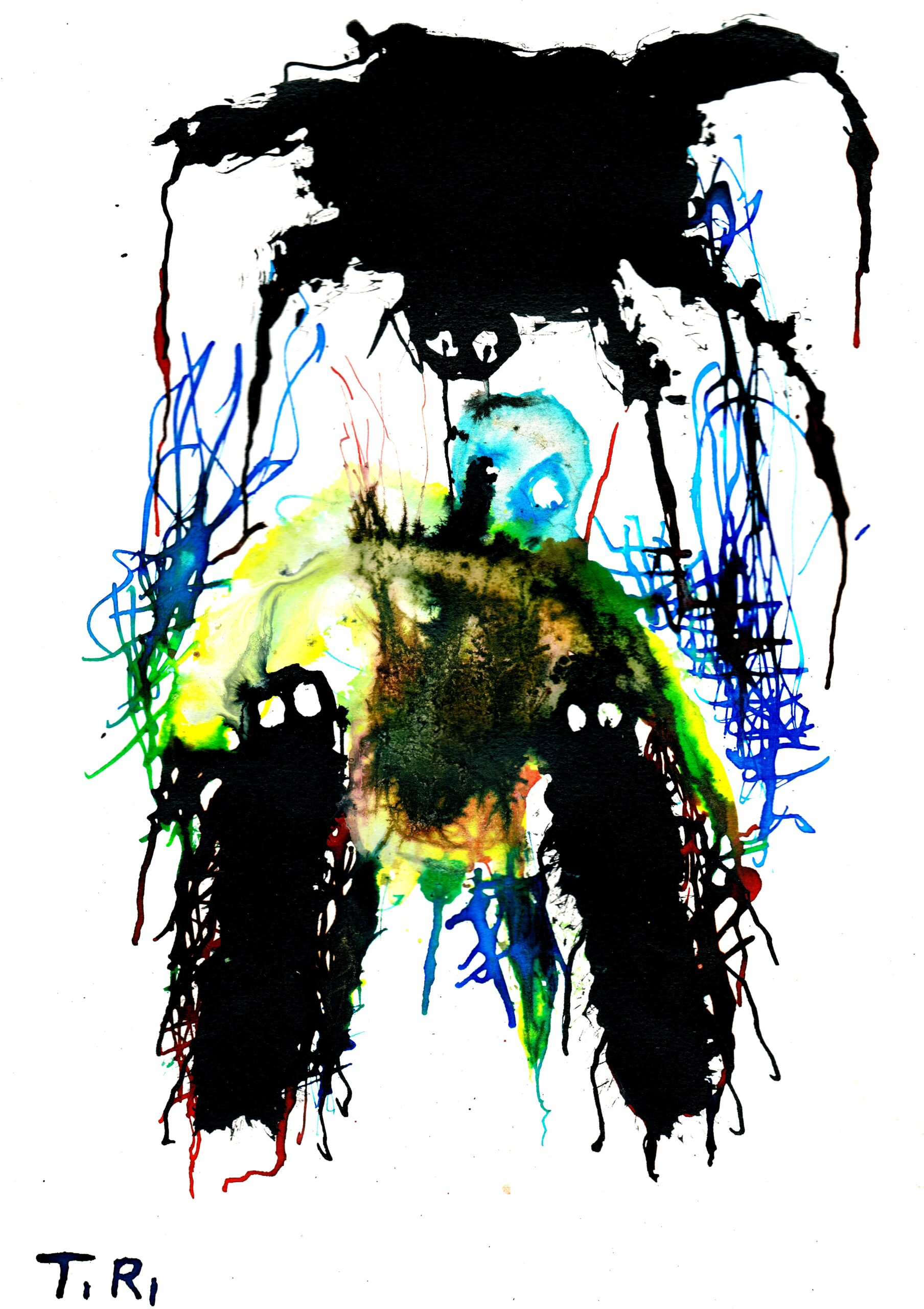
Danger from Heaven
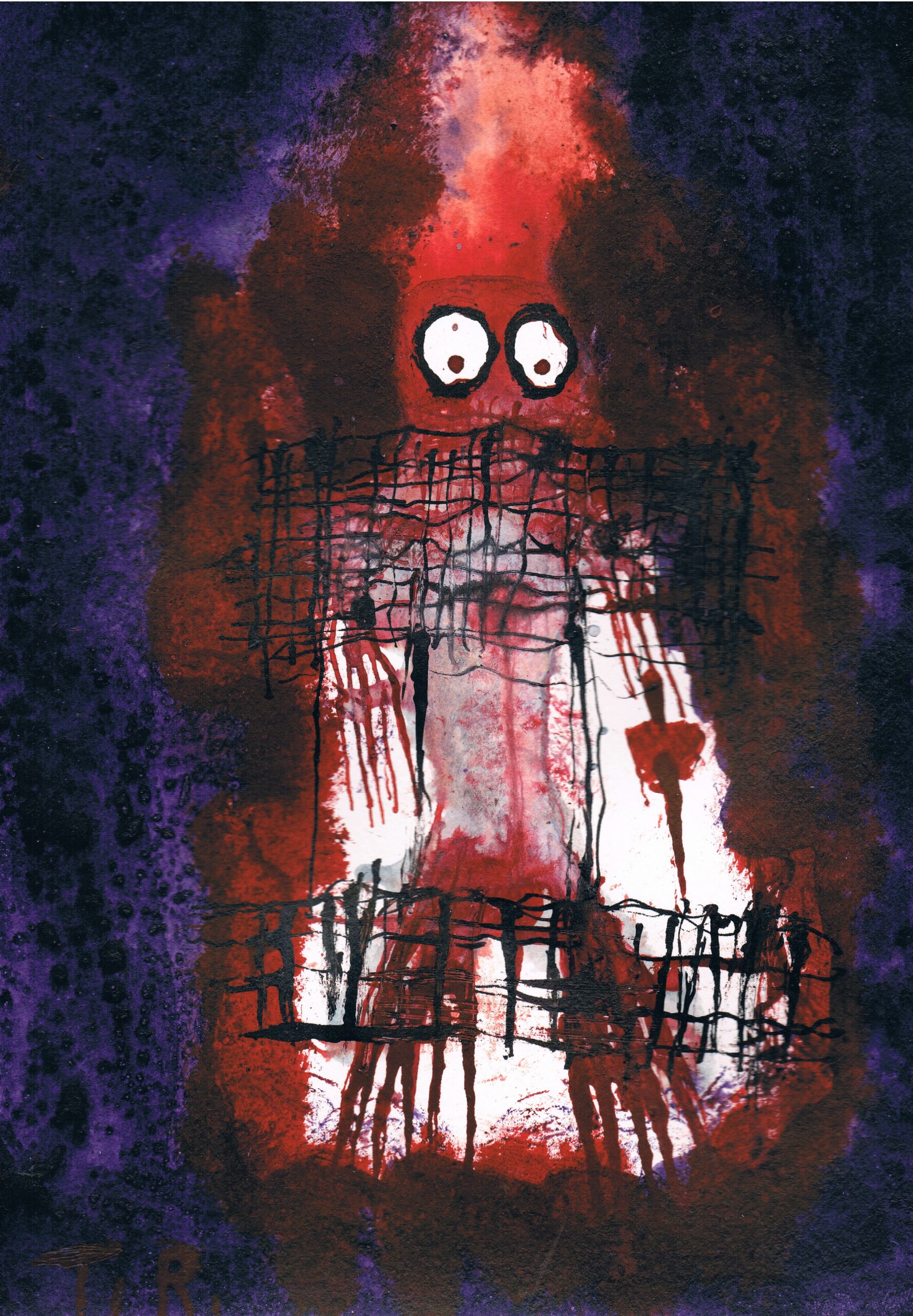
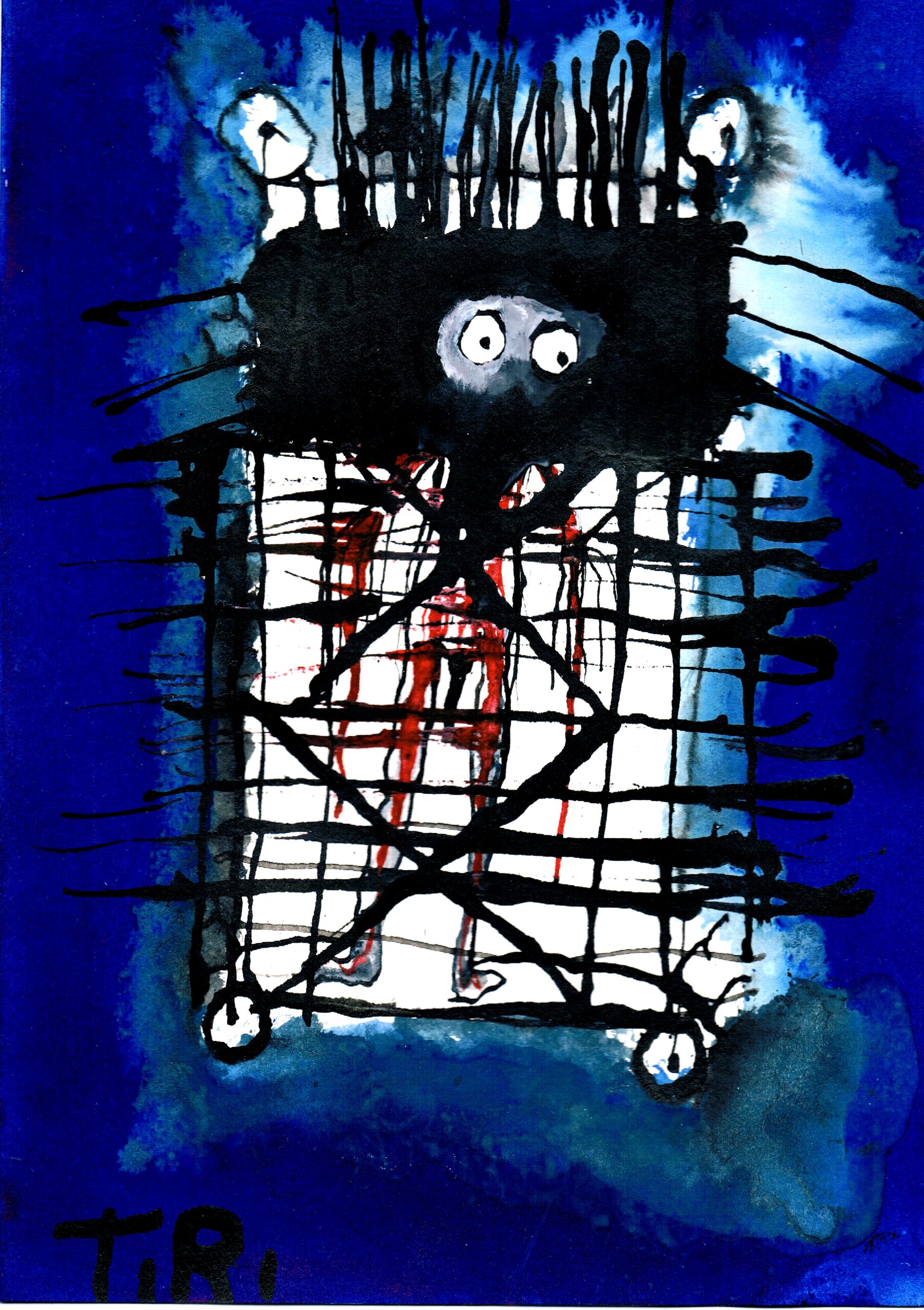
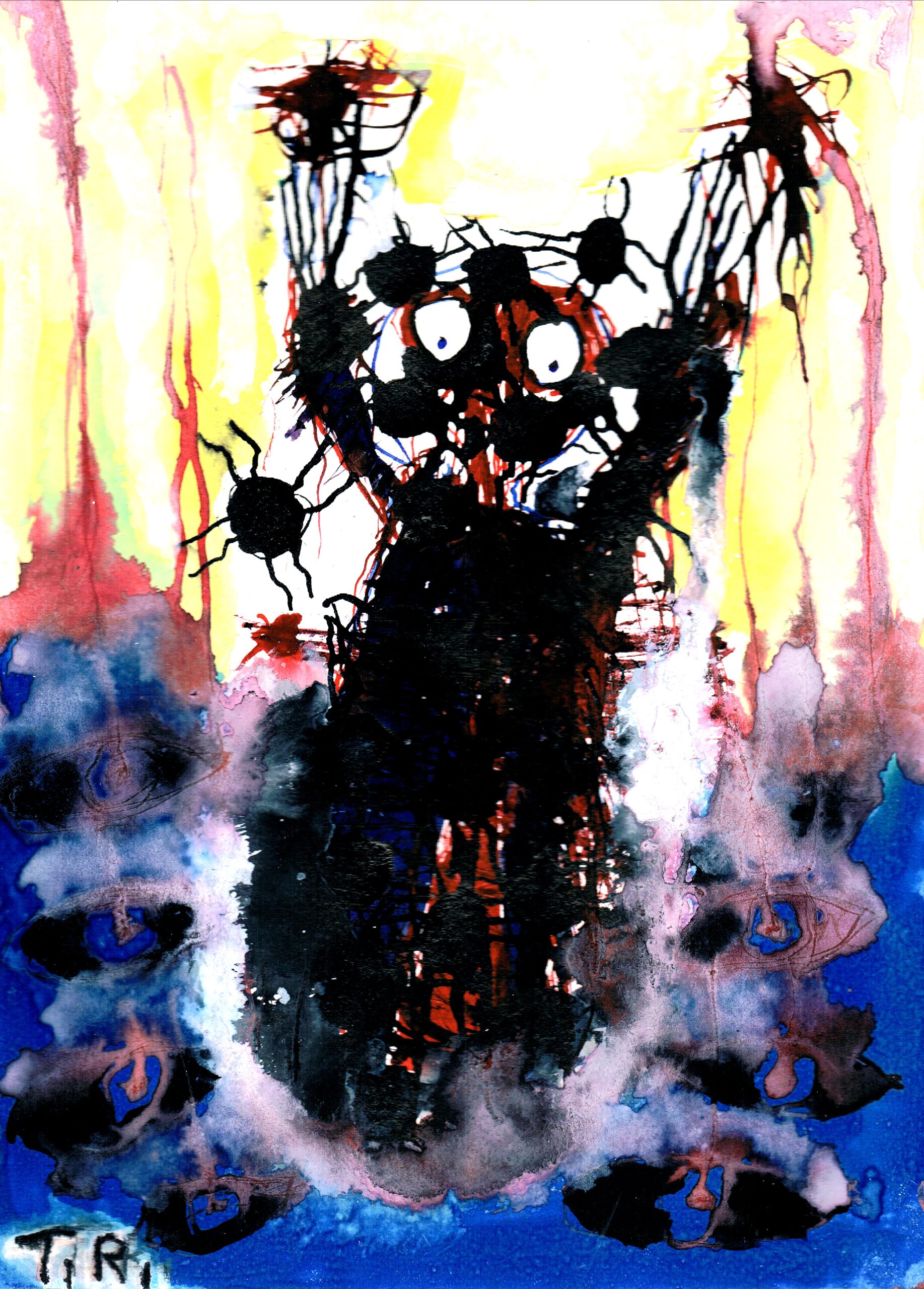
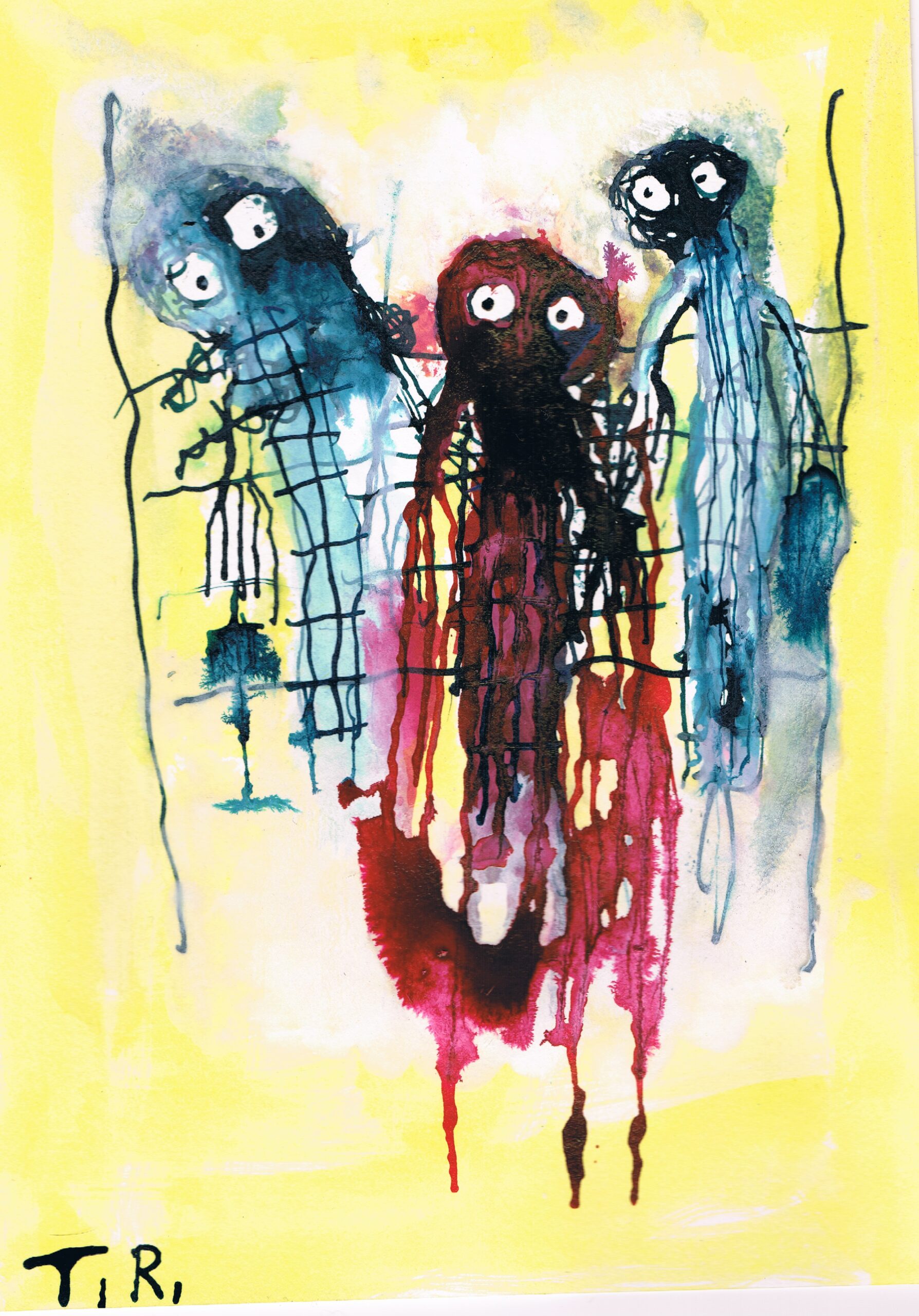
I was born in Leipzig in 1971 and I still live here today. Already in elementary school I often painted "abstract "instead of the given concrete drawing. I later retained this style or changed it to "abstract figuration." painted a lot at home, always without professional guidance, I didn't have any specific role models. When I start a picture, I only have a certain idea, but often something completely different emerges. I would describe myself as an outsiderart artist.

Width:30 cm
Length:41cm

All painted on Paper with ink

https://www.facebook.com/thomas.riesner.de
http://www.thomasriesner1.wordpress.com
Poetry from Aisha MLabo
HUNGRY FIRE

Here is a debutante
Burning on a hungry fire
That is sparkling and searing
Chewing the nerves in her chest
Gulping the blood in her spleen
Though not satiated
The fire is hissing like the sound a snake might make
Symbol of hungriness written on the wall of her hub
Designed by blue flames
She feels the hungry fire burning and burning
The fire to flow like water that flows in the ocean
The fire to glow like a candle that glows in the dark
The fire to sparkle like freshly fallen snow that sparkles in winter
This fire is felt not seen
I feel hungry fire burning in me too.

Aisha MLabo writes from Katsina,Nigeria,and is a Law student of Umaru Musa Yar'adua University Katsina Nigeria.
Poetry from J.D. Nelson
a football party
at a house across the street—
yellow moon grows full


chickpeas & brown rice . . .
a spider climbs down a thread
to investigate


leaves are blown from trees—
the driver with a flashlight
asks for directions


in the chicken coop
a few mice scurry away . . .
the cold autumn wind


bare tree silhouettes
against the cloudy night sky—
the dog sniffs dead leaves


crescent moon at dusk—
the squirrels’ nests are revealed
in the bare branches


-------------


bio/graf

J. D. Nelson (b. 1971) experiments with words in his subterranean laboratory. His poems have appeared in many small press publications, worldwide, since 2002. He is the author of ten chapbooks and e-books of poetry, including Cinderella City (The Red Ceilings Press, 2012). Nelson’s poem, “to mask a little bird” was nominated for Best of the Net. Visit http://MadVerse.com for more information and links to his published work. His haiku blog is at http://JDNelson.net. Nelson lives in Colorado, USA.
Poetry from Canadian poet Lisa Reynolds

Poetry from Gerard Sarnat
Theater Of Your Absurd

Arguably during life’s central act,
drama included both of us finishing
education and training, raising our family
plus finding fulfilling work; I was the adult
more in need of nurturance, well as support.

But during one of these last smaller phases,
maybe approaching a decade now, it occurs
that I, more often than not, am likely partner to
give in excess of receive. Fair’s fair, reciprocation
fine ‘n dandy unless Gerard’s basics aren’t being met?

Thanks, Stanford Medical School


While passing on their short-lived plan you get joint Ph.D. in social psychology then oy veh become an academic shrink
(Didn’t happen); when I chose The Farm because of virtue of five not-standard-four-year curriculum, which unlike maybe say Havad, seemed extremely convenient for kid who never took any college pre-med--also since pass-fail rather than grades-although first semester was flunked by Nobel Laureates teaching biochemistry’s ust-review course for most classmates

---But all new to Sarnat….Schmoozing one noon with Dean’s Office secretary he reveals Faculty Senate now’s looking
at my exam book as example of students on LSD: specifics being absurdly wrong I complained to Chairperson they should at
very least, give Gerry a chance to defend self against charges. He expressed guilt t denying due process, and after Gerard
ranked tops on year-end final exam, R.M. look it upon himself to make things right. Although I used extra downtime to major
in San Francisco’s 1967 Summer of Love, sex, drugs, rock ‘n roll; I luckily ended up sponsored by sequential Internal Medicine Department honchos for plum internship then junior residency at Beth Israel Hospital!

subtle absurdity

some folks (perhaps all, & I am just not observing other bodies)
have commodity runs, maybe changing glasses frames every year
whereas Gerry only gets new ones if my style is no longer available
would guess occurs in neighborhood of once per decade

though yesterday
for a very 1st time you began to understand or realize, after 2-term-President
or even cicada lifecycle periods of wearing that single quite old pair of slippers
over last most recent era, it appears Sarnat’s become sooo promiscuously volatile
Gerard Sarnat has been nominated for the pending 2022 Science Fiction Poetry Association Dwarf Star Award, won San Francisco Poetry’s 2020 Contest, the Poetry in the Arts First Place Award plus the Dorfman Prize, and has been nominated for handfuls of 2021 and previous Pushcarts plus Best of the Net Awards. Gerry is widely published including in 2022-2023 San Diego Poetry Annual, 2022 Awakenings Review, 2022 Arts & Cultural Council of Bucks County Celebration, 2022 Rio Grande Valley International Poetry Festival Anthology, The Font, BigCityLit, HitchLit Review, Lowestoft, Washington Square Review, The Deronda Review, Jewish Writing Project, Hong Kong Review, Tokyo Poetry Journal, Buddhist Poetry Review, Gargoyle, Main Street Rag, New Delta Review, Arkansas Review, Hamilton-Stone Review, Northampton Review, New Haven Poetry Institute, Texas Review, Vonnegut Journal, Brooklyn Review, San Francisco Magazine, Monterey Poetry Review, The Los Angeles Review, and The New York Times as well as by NYU, Slippery Rock, Northwestern, Pomona, Harvard, Stanford, Dartmouth, Penn, Columbia, North Dakota, McMaster, Maine, University of British Columbia and University of Chicago and University of Virginia presses.
He is a Harvard College and Medical School-trained physician who’s built and staffed clinics for the marginalized as well as a Stanford professor and healthcare CEO.Currently he is devoting energy/ resources to deal with climate justice, and serves on Climate Action Now’s board. Gerry’s been married since 1969 with progeny consisting of four collections (Homeless Chronicles: From Abraham To Burning Man, Disputes, 17s, Melting the Ice King) plus three kids/ six grandsons — and is looking forward to potential future granddaughters.
Poetry from Gaurav Ojha
FREE, IF your past can’t recognize you for what you are now

Free, IF you know that the face you carry is a mask that has been unmasked many times

Free, IF you realize that you are a pretender that you always wanted to become

Free, IF you can think even when they want to think for themselves but they can’t

Free, IF you let your life speak rather than measure your being on the shadows of other lives

FREE,  you want to try again, even IF you have been tested out many times

Free, IF you remain interested in something just to feel its resonances in your bones

Free, IF you can travel on a bumpy road that doesn’t have any destination

Free, IF you can let go of everythings you have for who you are

FREE, IF you realize that your a selfish gene and you are only here for a brief survival

Free, IF you recognize the difference between having and being

Free, even IF someone  closes the door on you, we are all under the same sky

Free, IF you can imagine a possibility even when without any probability

Free, IF you can walk in and out of the market without buying anything

Free, IF you can suspect what you have been told with what has been discovered

Free, even IF you have chosen the most traveled way, you know there is no other way out

FREE, IF you are not framed within an idea or identity, which says you are us/not like them

Free, IF you can meet someone for that moment, without diluting her present with past

Free, IF you know that you have to carry a rock to the hilltop and roll the burden down

Free, IF you realize that it's just a circus in rounds and the audiences admire their clowns

FREE, IF you can find ALL in NOTHING and Nothing in All