The metropolis is divided by viaducts – a disparate world where aerosol art is eroded by automobile exhaust and industrial rain puddles littered with man-made debris. Much happens beneath these viaducts – from the holy to the ungodly…
Apparitions haunt passersby whose footsteps echo tales of life, death, and all else. Rumbling trains accelerate black eroded raindrops, sending soot-coated pigeons into a frenzy – protecting their dark nests tucked deep in the crevices of this elevated underworld, their crimson eyes cry forbidden songs.
Al frequently passes through the viaduct – his preferred route from the 4th-floor room he inhabits at the Y to the Blue line train that takes him to his seemingly endless stream of appointments. Today he’s going to see his therapist who seems to derive pleasure from changing his meds after nearly every visit. Al’s short on change again, so he checks for cops then hops the turnstile, feeling a rush of triumph over the pricey fare required for the two-mile ride to Six Corners.
The only thing wobblier than the swerving train car is his trembling hand – a janky side effect of the Klonopin. It thins his hair too, so he sports a grey golf cap he got for a quarter at the Brown Elephant. However, copping donated gear is not Al’s main reason for frequenting The Elephant – it’s the cashier…
Xochil has dark, shoulder-length hair that she sometimes stuffs into an engraved clip that reads “Hecho En Męxico”. She doesn’t talk much, but her fluctuating tone fills the verbal gaps. When she speaks of the weather her voice lilts up as the sun showers or down if the rain falls. She always drives her points home with pronounced hand gestures that suggest she enjoys a good dance from time to time. Xochil says that the Brown Elephant makes her feel like she’s serving the Lord in a practical way.
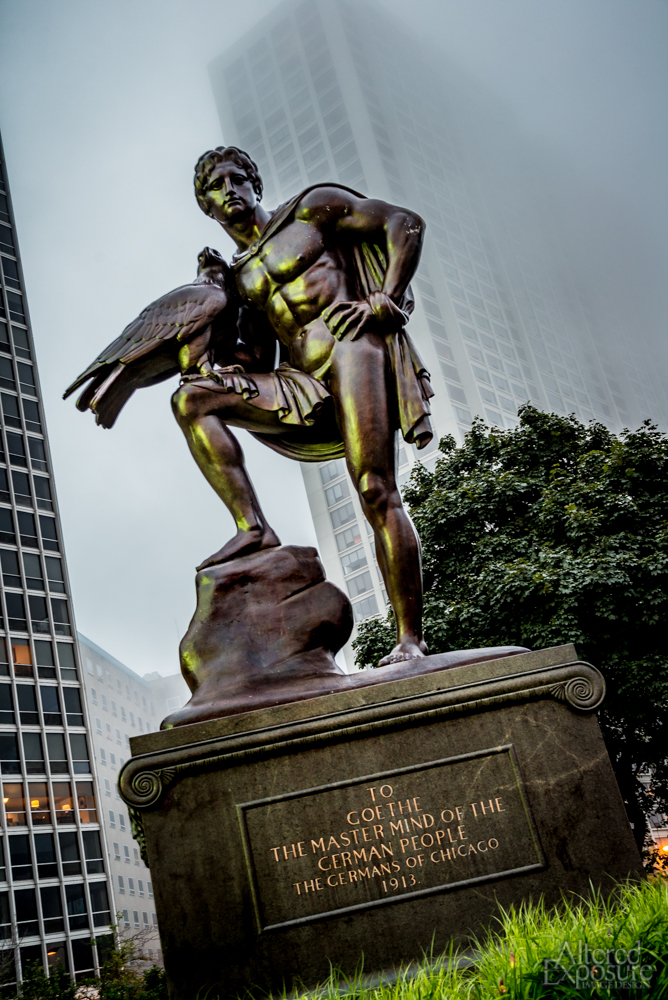
After his appointment, Al takes the Blue line back east then transfers to the Brown line. He’s heading to East Lakeview for his weekly social rehabilitation group at Catholic Charities. He hopes they paint today because he loves taking his easel to the park and practice painting the big Goethe statue on Diversey. There’s something calming about the smooth, earthly texture of the metal and the giant hawk perched on the knee of the protagonist. The base of the sculpture reads, “To Goethe: The Master Mind of the German People”.
Directly across the street is the Elk’s lodge – it’s always been a mystery to Al. Much more ornate than the Goethe site, its Romanesque architecture and well-polished sculptures add to its mystique.
What an amazing piece of nature
Yet, reflecting the other side of its torture
A place of  inspiration
Yet, the site for depression
The commonality or all  visible interactions
Yet, the disparity of all information
The presence of life abounds
Yet, the absence of death abounds
A creation of the living and non living essence
Yet, a design of  vacuum residence
Beside a rivulet running along the woods just beyond the border of a suburban home, an assembly of frogs had gathered. You couldn’t mistake the croaking however far from the site you stood. It was urgent.
“I’ve had enough” one of the more remonstrative males said. “I’ve just laid my second batch of tadpoles. It’s humiliating. Everyone is making fun of me.”
Others joined in. They all knew they were the laughingstock of the species and the laughingstock of humans, too.
“Soon we’ll be wearing dresses and putting on lipstick. It’s disgusting.”
“Here here” came the general agreement echoed in the woods as more and more frogs came to join the assembled.
“They want their little manicured lawns and sculpted hedges and they won’t tolerate wildflowers and any living thing they call a weed. And God forbid any insects should invade their little gardens. So they spray their lawns with pesticides that get into our water and we end up mutants- male frogs that get pregnant and give birth.”
“What’s to be done” one of the more thoughtful croaked.
“Let’s go to their Village Square in vast numbers and demonstrate” said a huge female sitting in the mud. “Perhaps, we can stage a die-in. That would generate some interest in our cause.”
“Hear hear” came a great croaking from the woods and by the rivulet and along the banks of the nearby river that ran along the town.
“Break up into cells and report to the central committee we will establish today “said a small male frog. “We need to prepare and organize and have everyone attend. Thousands of frogs pretending to be dead in the center of their Village Square will wake them up to our existence.”
So that day the Union of Concerned Frogs was born in the suburbs in the town of Bayville. They quickly spread word to all frogs that lived in the neighboring townships so as to increase their numbers at the die-in.
By the end of the night, the frogs in all the adjoining townships had organized and begun hopping under cover of night towards Bayville. There were easily tens of thousands as historians would later relate.
As light broke on the highway, thousands of frogs could be seen moving along the edge of the road by drivers on their way to work. Some of the people were amused, some were panic stricken. There was no accounting for such an event. It was unparalleled.
Close to the opening of businesses, the Village Square was filled with frogs. They lay prostrate on the ground looking as if they were dead.
As workers arrived, they were alarmed. They discussed the problem among themselves. Some suggested calling the Volunteer Fire Department. Some suggested they contact the Bayville Animal Control Center. Some of the elders who were just entering the local diner thought of the Plague on Egypt. The appearance of so many dead frogs sprawled about had a Biblical appearance to it. Children were ushered away by their parents.
Pretty soon the fire engine of the Fire Department appeared on the scene. The hose was connected and a powerful jet of water was directed at the frogs. It lifted some of them off the ground, but when the Firefighters saw the frogs begin to stir to life, hop away and swim away, they realized there had been something else going on than at first sight appeared. Plus there were so many frogs that the hose was not going to be enough to wash them out of the Square.
The Sanitation Department came in with the men using the great stiff brooms to sweep away the frogs. Well with thousands of frogs assembled, it was nearly impossible to make much headway in the task.
Finally, the Animal Control Center was called in to assist. With all the Village services combined, they managed to sweep most of the frogs into huge plastic containers to be moved to the woods outside of the Village.
Of course, the frogs were the subject of all the conversations held that day. The daily news station covered the removal effort. The story even reached some of the larger metropolitan news outlets.
In the end, though the frogs had garnered the much needed attention they desired, no one, not one person connected their appearance to the pesticides that were genetically transforming the male frogs into egg bearing females.
A schoolgirl, having seen the frogs that day, began to read about them. She came upon an article in a science journal that explained how humans were destroying habitats by dumping hazardous chemicals into the environment. This schoolgirl might turn out to be the one the frogs were looking for.
 302-
 Fernando Passoa Modern Dance Studio.
 Do you pony. Like hony maroni. Night
 of a thousand dancers. Rumba. Tango.
 vodka and orange premix cocktails.
 Worst drunk ever. The Beauty of the
 Husband: A Fictional Essay in 29 Tangos.
 Dance script with electric ballerinas.
 Not PK Dick. Fulton. Not the NY gov.
 Alice. Not the one who descends into
 rabbit holes. Of disinformation.

 303-
 The Madwoman in the Attic. Jane Eyre
 or Wide Sargasso Sea. Jean Rhys or
 Charlotte Bronte. The one who actually got
 laid. Dominica or Haworth. Don’t drink
 the water. Hochmeister. Corpse water.
 The Blue Hour. After Leaving Mr. McKenzie.
 Good Morning Midnight. Voyage in the Dark.
 Smile Please. Difficult women. The end of
 the novel of love. Tigers were better looking.

 304-
 Talking to frogs in boiling
 water. Lobsters on a leash.
 Sunday in the Park with.
 George. William or Mary.
 Who’s your Dada.


 305-
 Now out of the blue, out of the black,
 a number caller-id’d from Hades.”
 Stephen Bett. Not the exchange. Rate.
 That’s bothersome. The caller id.
 What’s your area. Code. Zip. Code. Bar.
 Code. Navajo code talker anonymous.
 The answer (s), my friend, are blowing
 in the wind.


 306-
 “Modern historical reality has greatly
 enlarged the imagination of disaster.”
 Said Susan Sontag. All too accurately.
 The beginning of the end. Them! The Hulk.
 Spiderman. Radioactive spiders from Mars.
 The Atomic Cafe. The sheep look up.
 Not Biblical. Though it could be. Was.
 Is. Not science fiction. Fallout. Illness
 as metaphor.
Art(Tarot, Major Arcana XIV.)The declining age first tastes like honey, yet its instant fermenting sweat, the constant human struggle, the cramped and inflexible exercise of power squeezes stinking secretion through the pore billions of Earth’s skins.The degenerate species are dying out. The Savior is climbing on the lustfully gaping chimney of the caves towards our Earth mother’s womb. The universe: an umbrella.Successive events: sewing machine. The creative intention: dissection table.What it’ll find is Cybele’s frog-headed, rotten fetuses,their tales are arrowhead claws(We lifted the processes of the dead world to the vegetative level,and indeed, fat homunculus jumped out of the alchemist's cauldron, but at a lower quality, as its creator.)The offspring are our caricatures! The offspring are our caricatures!The eternal mystery is research, experiment, when Aethyr collapses into a magical orgasm,and explodes. The remains are a cooled off, lifeless cosmic spider web, what for a moment, the charlatan enchanted to live.
(Translated by Gabor Gyukics)
Laszlo Aranyi (Frater Azmon)
A Művészet(Tarot, Nagy Arkánum XIV.) Hanyatló kor először mézízű, ám azonnal erjedő verítéke… Az állandósult emberi erőlködés, a görcsös és rugalmatlan hatalomgyakorlás bűzös váladékot présel ki a Föld-bőr pórus-milliárdjain. Kiveszőfélben a korcs faj. A Megmentő barlangok kéjre táguló kürtőjén mászik Földanyánk méhe felé.Az univerzum: esernyő. Az események egymásutánja: varrógép. A teremtő szándék: boncasztal. Amit talál: Kübelé békafejű, rothadó magzatai, farkuk nyílhegy-karom. (A holt világ folyamatait emeltük vegetatív síkra, s tényleg, kövér homunculus ugrott ki az alkimista-üstből, de alacsonyabb rendű minőség, mint teremtője.)Az utódok: karikatúráink!Az utódok: karikatúráink! Csakis a kutatás, a kísérlet az örök misztérium, amikor az Aethyr mágikus orgazmusba ájul, és szétrobban.A maradvány kihűlt, élet nélküli kozmikus pókháló, amit a szemfényvesztő egy pillanatra élővé bűvölt. Aranyi László
Laszlo Aranyi (Frater Azmon)
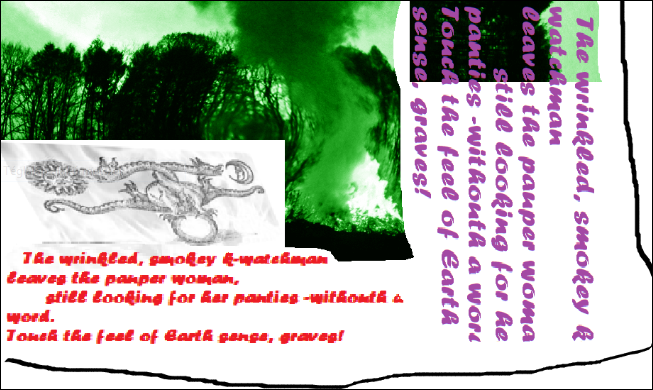
The One Who Arrives Late Leaves the EarliestGhost figure. Stretching and dilating erratically.It’s a cotton candy textured. wobbling flame of a candle. Its puke tasting flesh is sticky. Its silvery spark disappears in the depressing whiteness.“Whaddaya want, dickhead?”The Philosophers' Stone! The universal knowledge that transcends the worlds!Gopher chewed, holed, spray-stained hat on the scarecrow… Worthless… Our depraved World soon will be nothing else but a shrunken head pendant on the keyring of the Guardian of the Keys.Why do you always have to stir up the sediment? Miserable, despicable restrictors and restricted ones!A distrustful, fat cat is sitting on the threshold. (It is a Threshold…)The woman is again endlessly screaming without taking a breath. She’s drunk.She peed herself so ‘cause she wasn’t able to take her panties off in the toilet…She turned out from the forge, eerie amount of waste stir and move insidiously.A bunch of passersby are slim sandglasses demanding usurers.
(Translated by Gabor Gyukics)
A késve érkező korábban távozik Szellemalak. Szeszélyesen nyúlik-tágul. Imbolygó gyertyaláng. Vattacukor állagú. Émelyítő ízű húsa ragadós. Ezüstös csillogása a elvész a nyomasztó fehérségben. „Mit akarsz, fatökű?”A Bölcsek Kövét! Az univezális, világokon átívelő tudást! „Pocok-rágásoktól lyuggatott, permetlé-foltos kalap a madárijesztőn… Nem jó az semmire… Az elfajult Föld előbb-utóbb úgyis zsugorított fejű figyegő marad a Kulcsok Őrzőjének kulcstartóján.Miért kavarjátok fel mindig az ülepedőt? Nyomorult, hitvány korlátozók és korlátozottak!”A küszöbön gyanakvó, kövér macska ül. (Ő a Küszöb…) Az asszony már megint egyfolytában, levegővétel nélkül rikácsol. Részeg. Még a bugyijától sem szabadult meg a WC-n, így összpisálta magát… Héphaisztosz műhelyéből került ki, alattomosan mocorog-mozdul a hátborzongató mennyiségű selejt.Uzsorást sürgető karcsú homokórák az összeverődött járókelők. Aranyi László
The population of North American indigenous people was decimated by a 90 percent reduction and the land they controlled was reduced from 100 percent to 2 percent, as a result of the Anglo-European invasion and US conquest. The entire USA has and continues to benefit from the inhumane treatment of the people of the Native Nations.
It is shocking and dispiriting to see first hand the land the US government “gave” the tribes of the Sioux Nation for their reservations in the Badlands, after Sitting Bull and Crazy Horse surrendered to end the Black Hills War. The Sioux didn’t even get all of the land, because the government cut out a major chunk of the Badlands to create Badlands National Memorial in 1929. Ten years later the memorial was upgraded to become a national park.
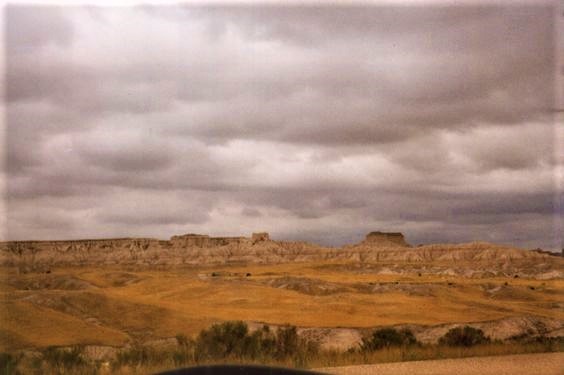
Driving across the bleak, prairie land of the Badlands, you pass forbidding white spires, angry grey cliffs, and squatty buttes. The Sioux people must have felt as desolate as the landscape, when they realized that, of all the lands they had roamed, the most uninhabitable area was where they were to be confined. The oppressive August heat in 2013 emphasized the grim harshness of the sun-baked landscape of the Badlands as I motored along State Road 40.
Evidence of neglect of reservation lands, and the needs of resident Indians, was even revealed in the road conditions to and through the Pine Ridge Reservation. South Dakota’s State Road 40, the road I drove heading southeast from the City of Keystone to the Pine Ridge Reservation, was a well-maintained, paved road. But when it became a Bureau of Indian Affairs (BIA) road within the reservation, the pavement ended. My vehicle had to endure forty miles of gravel whacking its undercarriage to reach Wounded Knee. Pavement reappeared when I left the reservation.
I stopped at Badlands National Park before driving through Pine Ridge to Wounded Knee. After reviewing the historical and geographical information at the Park Visitors Center, I asked the sole ranger on duty what I would find at the actual site of Wounded Knee. The ranger was tall, lanky, and had the weather-beaten good-looks of Gary Cooper. His laconic reply to my question was, “There’s not much there.” His answer was correct on the surface, but at a deeper, personal level, he was wrong.
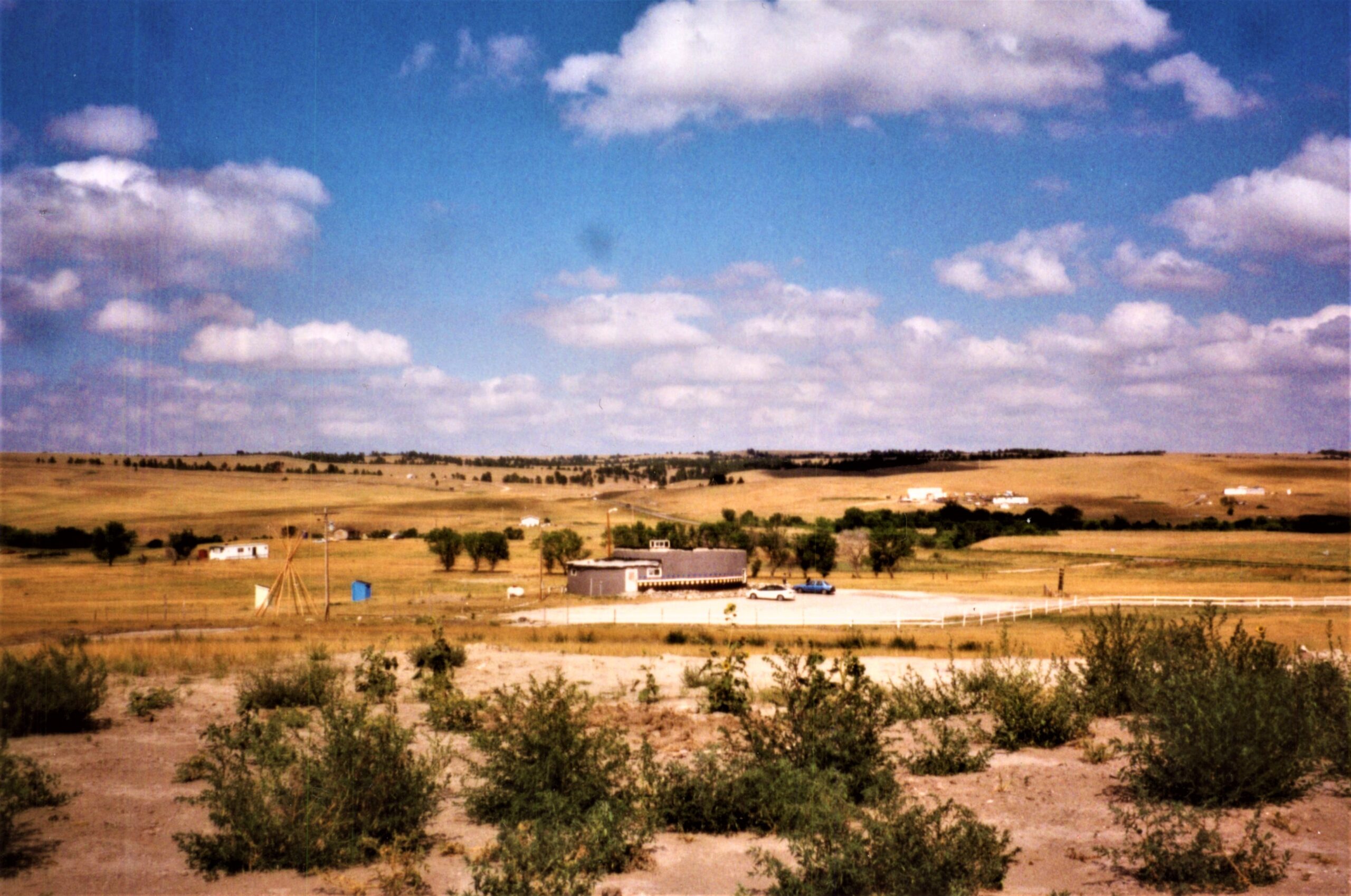
On the east side of the dirt road at the site of the massacre were a couple of forlorn-looking booths with beaded belts, necklaces, and other handcrafts for sale. An elderly Indian in a stained white t-shirt with a Fruehauf Truck cap shading his eyes was asleep on a metal folding-chair behind one booth. A couple kids played in the dirt under the other table. On the west side of the road was a curved structure of wood and concrete with a sign indicating it was the American Indian Movement Center.
Inside, the walls were covered with posters and propaganda for AIM. The sparsely furnished interior had a long counter with an aged metal cash register. Piles of t-shirts, books, and handmade trinkets were for sale on top of rickety tables. The “library” consisted of several boxes of cut-out newspaper and magazine articles, a few dusty hardback books, and a scrapbook about the history of AIM.
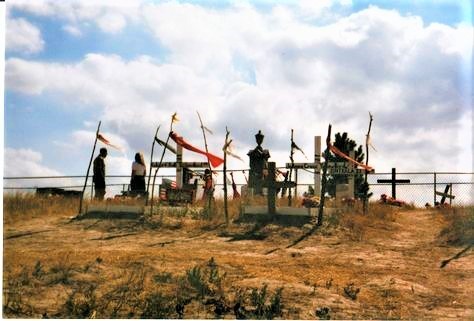
Behind the building were two small hillocks with graveyards on top of each mound. An elderly Indian wearing a faded cowboy hat, dirty jeans, and stained t-shirt was leaning against the side of the building smoking a hand-rolled cigarette. I asked him if there was a monument to those who were killed at Wounded Knee by the US Cavalry. He looked me up and down without registering any expression. He slowly raised his arm and pointed toward a fenced area beyond a number of grave markers on the closest mound. I thanked him. He made no reply.
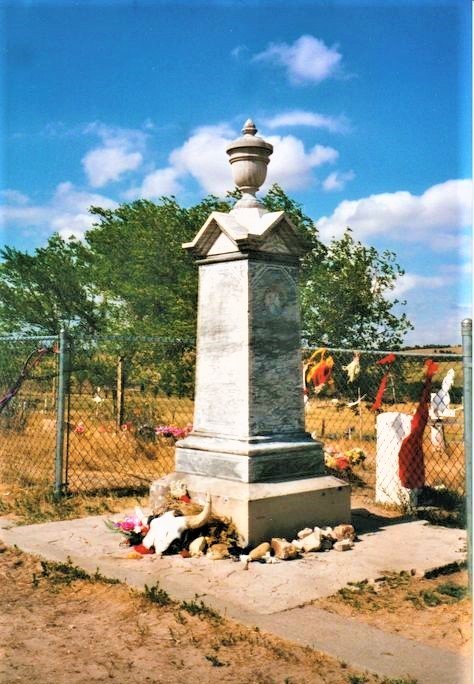
The fenced area for the memorial was about ten feet by six feet. A six-foot high granite monument stood inside the fenced area. Names of victims and a few words about the massacre were incised on the monument.
While we know that at least 200 – and it was probably closer to 300 of the 350 Minneconjou Sioux in Spotted Elk’s band – were killed at Wounded Knee, I counted fewer than 40 names on the monument. I don’t know whether the other names are lost in the mists of history. The skull of a horned steer was placed at the base of the monument. Shards of broken pottery, a few faded flowers, ribbons, and a couple fake gold coins were scattered around the base of the monument.
I placed two stones on top of the weather-beaten skull. I had purchased the rocks for one dollar each from two Oglala Sioux kids at the intersection of two gravel roads within the Pine Ridge Reservation. Their father told me he wanted to “encourage entrepreneurship” in his kids. Beaming with pride, Dad explained how his two boys search for nicely-shaped rocks, polish the best ones they find, and then sell the shiny stones on the roadside to people driving through the reservation.
How brave and pathetic! My heart ached for those kids and their dad.
It seemed like an appropriate symbolic gesture to pay for those two little pieces of the land and then give the polished stones back by leaving them at the memorial to Spotted Elk and the Minneconjou who were killed by the bullets fired by my ancestor, First Lieutenant James DeFrees Mann, and the soldiers of the 7th US Cavalry.
No one else entered the small cemetery during the half hour I spent on the hillock meditatively eyeing other grave markers. I shielded my eyes from the sun and gazed back across the road beyond the AIM Center. It was just over there, on the other side of the road, where Spotted Elk and his band of 350 Minneconjou Sioux had camped under the watchful eyes of Lt. Mann and the cavalrymen of K Troop. Beneath the soil of the earthen mound where I stood are the bones of the men, women, and children, whose bodies were tossed into the mass grave dug in the days following the massacre. The remains of more recently deceased residents of Pine Ridge Reservation share that little plot of raised earth with Spotted Elk and his Minneconjou.
Back inside the AIM Center, I tried to make conversation with a stoic-looking middle-aged woman, who was sitting behind the counter with a few kids. She didn’t give her name, and I didn’t ask. No other visitors entered the building while I was there.
I overcame my hesitation and told her about my ancestor’s participation in the Wounded Knee massacre. She evinced no hostility; just gazed evenly at me through tired brown eyes. She wore a blue work shirt buttoned up the front, jeans, and had long, straight black hair, which almost reached her waist.
She said she didn’t know anything about the cavalrymen involved in the massacre, and didn’t recognize Lt. Mann’s name. My look of surprise registered with her. She looked away, then pursed her lips and said that maybe she remembered reading an old newspaper that mentioned Lieutenant Mann.
A boy, who looked to be about ten years-old, studied me with watchful, curious eyes, when I was perusing the library materials. Later, while I was conversing with the Center’s attendant, the lad listened intently to our conversation. When the conversation wound down, the woman nodded at the boy and told me he was her son. That seemed to be the cue he’d been waiting for, because he launched into an obviously prepared speech requesting a contribution to a fund for his baseball team. He held out a rumpled leaflet for me to read. His limpid, brown eyes shone with excited anticipation. I gave him a ten-dollar bill, tapped the brim of his baseball cap, and wished him and his team good luck. His mother’s lips turned up very slightly at the corners. It was almost a smile; the first and only indication of friendliness I received from his mother. Her son thanked me and shook my hand formally.
Before I left the AIM Center, I bought a t-shirt for twenty dollars with the American Indian Movement logo on the front and back. The logo was the figure of an Indian warrior with two feathers in his hair shaped to look like the two-fingered gesture of victory.
I fantasized time-traveling back to high school and wearing the AIM shirt to a basketball game. Our varsity teams were the Goshen Redskins. The mascot was a little White kid, whose cheeks were streaked with red “war paint”. During my K through 12 years in the Goshen Community Schools, “Little Chief” wore an elaborate buckskin outfit with a feathered-headdress. He led the basketball team onto the court for warm-up drills before the start of each home game. During warm-ups, Little Chief stood at mid-court with his arms crossed like a dignified Indian chief. The little White boys chosen to be Little Chief were always about the same age as this boy, who looked at me with wide-eyed curiosity when I entered the AIM Center and shook my hand before I left.
My junior year in in high school, a young woman fresh out of college was hired as our journalism teacher. Ms. Thomas allowed students to change the name of the school paper from The Tomahawk to The Goshen Peace Times. Instead of bland, rah-rah school-spirit articles, The Peace Times published anti-Vietnam War articles and reviews of rock music. It printed an editorial suggesting that the team name should be changed out of respect for Native Americans. The editorial was met with almost universal hostility. It was condemned by townspeople, faculty members, school administrators, and many students. No Indians had complained about our mascot being offensive, nor had any tribes demanded that the school change the name. It was outrageous blasphemy against our customs and traditions even to suggest such a thing!
Ms. Thomas was rebuked for allowing her student-journalists too much freedom of expression. The high school administration shut down The Peace Times after that outrageous editorial. The young, idealistic journalism teacher left town at the end of the school year. But a couple decades later, in 2016, the Goshen Community Schools Board decreed that the team name would be changed from Redskins to Redhawks.
The Goshen News
I left the AIM Center and drove into the “town” of Wounded Knee, which was just around a bend on the unpaved BIA Road 28. A rusted metal chair stood in the middle of the dirt road running down the center of town. Resting on the rusty chair was a hand-painted sign on poster board. It read, Drive Slow Stop Killing Our Children.
Wounded Knee had the depressed ramshackle look of other settlements I’d driven through on reservations in South Dakota. But it was the worst. It was and is a squalid, poverty-stricken settlement with dilapidated houses and rusting mobile homes. When I was there, trash littered the street. An old woman walked across the dusty road in front of my car. She looked at me through the car’s window without registering any emotion. Her eyes were dull and her movements listless.
The Census Bureau’s information on the town of Wounded Knee for 2018 reports a population of 456 with a median household income of $7,292, which has fallen, instead of rising, since I was there in 2013. Between 2017 and 2018, the population of Wounded Knee declined from 521 to 456. According to the Census Bureau, the poverty rate is 95.2%, and only eleven residents are employed. The median household income for the State of South Dakota in 2019 was $58,275, about 8.5 times higher than the median family income in Wounded Knee.
The median age reported for Wounded Knee is 21.6. In South Dakota it is over 40. Several Trip Advisor descriptions of tourist experiences at Wounded Knee and the Pine Ridge Reservation include complaints of being accosted by young men demanding money or trying to scam tourists. Not that I approve of scamming tourists, but what exactly are young people supposed to do in a community with a poverty rate of 95.2 percent?
If America is going to continue to claim it is a moral leader, the “city on a hill” and beacon to the rest of the world, we have to finally and fully face up to our genocidal history and national sin.
Excerpted from America’s Existential Crisis: Our Inherited Obligation to Native Nations by Jeff Rasley, Midsummer Books 2021, exclusively available on Amazon.