Once upon a time, in an ancient land, there lived two neighbors named Olimboy and Davronboy. They lived peacefully side by side.
One day, Olimboy was going to the market to sell his sheep. Davronboy saw him and said:
— Please sell my sheep too. I suddenly have some work to do.
Olimboy was a kind and generous man, so he could not refuse.
He took both sheep and went to the market. There, he handed them to a seller named Lochin. After some time, Davronboy’s sheep was sold. Olimboy waited, hoping that his own sheep would also be sold.
Then Lochin said to him:
— Your sheep has not been sold yet. It is time for me to leave. Give me my share, and take your sheep back.
Lochin took the money from the sold sheep and left. Olimboy started walking home with his own sheep.
The day before, spring rain had fallen heavily. On the way home, Olimboy slipped in the mud and fell down. His clothes became wet and dirty. By the time he reached home, the wind had dried his clothes, but the mud stains remained. Soon he caught a cold.
Davronboy saw him in that condition and became suspicious.
— His clothes are muddy, and he looks upset. He only has his own sheep with him. Something must have happened to my sheep, — he thought.
The next morning, Davronboy angrily went to Olimboy’s house and dragged him to the judge.
When they arrived, Davronboy said:
— Greetings, honorable judge. I came to ask for justice. I asked this foolish Olimboy to sell my sheep at the market. Yesterday evening he returned home with muddy clothes and looking miserable. He only had his own sheep with him. I think he did something to my sheep. Please solve this matter.
The judge looked at Olimboy and asked:
— Well, Olimboy, what do you say about this?
Olimboy smiled slightly and explained everything that had happened the previous day. He also said that he was feeling sick and could not visit Davronboy’s house.
Then he took the money for the sold sheep out of his pocket, handed it to Davronboy, and said:
— Evil for kindness…
After saying this, he quietly left.
Moral of the Story
Dear reader, learn a lesson from this story. In life, people should not judge others before knowing the full truth. Think carefully before making conclusions, because kindness should never be answered with suspicion or evil.
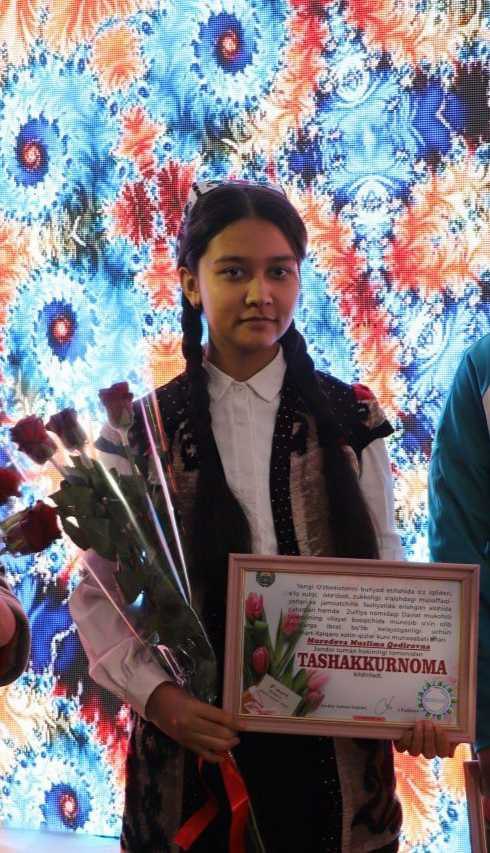
Muslima Murodova is a laureate of the Zulfiya State Prize. She is the author of one poetry book and four anthologies. She is also the recipient of the “Jadidlar Izdoshi” and “In the Middle East Scientific Uzbek Creators” badges of honor.
She is the winner of numerous competitions, and nearly 25 of her creative works have been published in well-known international magazines abroad. Muslima Murodova is a poetess and a young creative talent who has earned more than 50 international certificates
As I walked the streets Winter underneath my feet With lingering thoughts Like past lives incomplete With beauty hidden underneath my tongue With dreams as green as my mother’s thumb I kneel at God’s feet My breath incomplete Like a secret defeat Futility dancing to tomorrow’s beat Vivid notions to deceit Dragging in the heart of the midday hour Stressing the sun’s smirk Watching winter’s Swoon… Then comes summer As crescent as candid as the moon Like the morning soon Creeps out of its cocoon…
Jacques Fleury
Jacques Fleury is a Boston Globe featured Haitian American Poet, Educator, Author of four books and literary arts student at Harvard University online. His latest publication “You Are Enough: The Journey to Accepting Your Authentic Self” & other titles are available at all Boston Public Libraries, the University of Massachusetts Healey Library, University of Wyoming, Askews and Holts Library Services in the United Kingdom, The Harvard Book Store, The Grolier Poetry Bookshop, Amazon etc… He has been published in prestigious publications such as Spirit of Change Magazine, Wilderness House Literary Review, Muddy River Poetry Review, Litterateur Redefining World anthologies out of India, Poets Reading the News, the Cornell University Press anthology Class Lives: Stories from Our Economic Divide, Boston Area Small Press and Poetry Scene among others…Visit him at: http://www.authorsden.com/jacquesfleury.–
Jacques Fleury’s book You Are Enough: The Journey Towards Understanding Your Authentic Self
CONTEMPORARY RUSSIAN PROSE: IN SEARCH OF A NEW HERO
Jizzakh State Pedagogical University
Faculty of Philology
Major: Russian Language and Literature, Student of Group 723-24
Kobulova Madina
Abstract: This paper examines the problem of finding a new hero in contemporary Russian prose of the late 20th and early 21st centuries. The characteristic features of the central characters in works by leading authors of the period — Lyudmila Ulitskaya, Zakhar Prilepin, Viktor Pelevin, and Mikhail Shishkin — are analysed. Special attention is paid to the transformation of the hero’s image in the post-Soviet context, the loss of traditional value orientations, and the search for a new identity. The paper concludes that contemporary Russian prose reflects the spiritual and moral aspirations of society, offering a diversity of heroes, each of whom answers the question of the meaning of life in their own way.
Keywords: contemporary Russian prose, new hero, post-Soviet literature, character image, moral quest, identity, value orientations.
Main Body
Contemporary Russian prose occupies a special place in the global literary process. Shaped by the conditions of fundamental historical change — the collapse of the Soviet Union, the reassessment of national identity, and the rapid entry into an era of globalisation — it set itself fundamentally new artistic tasks. One of the most central among these was the question of the hero: who is he, the person of the new era? What values guide him? Is he capable of a genuine moral choice?
The study of this question is particularly relevant, since literature has always responded keenly to the demands of the age, offering readers models for reflection and spiritual orientation. Unlike Soviet literature, which imposed strict requirements upon the ‘positive hero’, prose of the turn of the 20th and 21st centuries rejects a single canon, granting the reader the right to judge the moral standing of characters for themselves.
Among the authors who have most vividly reflected the search for a new hero are Lyudmila Ulitskaya, Zakhar Prilepin, Viktor Pelevin, and Mikhail Shishkin. Each offers their own vision of the modern person, their place in society and their inner world. The heroes of Lyudmila Ulitskaya are people immersed in the world of private life, family relationships, and moral dilemmas. In the novels The Kukotsky Enigma (2001) and Daniel Stein, Interpreter (2006), the writer creates images of people seeking spiritual support amidst historical catastrophes. Her heroes are imperfect and contradictory, but it is precisely this that makes them vivid and recognisable. Ulitskaya affirms the value of ordinary human life as such, without grand declarations or ideological programmes.
Zakhar Prilepin, in his novel Sankya (2006), turns to the image of a young man seized by a thirst for action and a search for meaning in radical political protest. His hero is a product of an era of social disillusionment — stripped of former reference points and attempting to create new ones. Prilepin raises pointed questions about the relationship between the personal and the historical, and about the limits of what is permissible in the struggle for one’s convictions.
Viktor Pelevin chooses the path of postmodernist irony and mythologisation. His heroes — from Generation ‘P’ (1999) and Buddha’s Little Finger (1996) — exist in a space of simulacra, where reality is replaced by media images and advertising constructs. The search for a genuine ‘self’ becomes for them a quest through a labyrinth of illusions. Pelevin shows how consumer civilisation destroys the individual, reducing a person to a set of clichés.
Mikhail Shishkin, in his novels The Taking of Izmail (2000) and Maidenhair (2010), explores the possibilities of language as the last refuge from chaos. His heroes find themselves through the word — through the attempt to describe and thereby hold onto a reality that is slipping away. Time and memory become the key categories in his artistic world.
Thus, contemporary Russian prose does not offer a single model of the ‘new hero’, but it is precisely this diversity that constitutes its value. The heroes of Ulitskaya, Prilepin, Pelevin, and Shishkin are different answers to the same questions: who to be, how to live, what to believe in. Literature fulfils its eternal function — it helps a person to make sense of themselves and their time.
Conclusion
In the course of the study conducted, it was established that contemporary Russian prose of the late 20th and early 21st centuries actively participates in the process of forming new cultural and moral orientations. Analysis of works by L. Ulitskaya, Z. Prilepin, V. Pelevin, and M. Shishkin showed that the image of the hero in post-Soviet literature undergoes a profound transformation: the place of the monolithic ‘positive hero’ is taken by a contradictory, searching person who has frequently lost former values but has not ceased their spiritual quest.
The particular significance of contemporary prose lies in its capacity to reflect honestly, without embellishment, the reality of a transitional time. Themes of the loss of identity, existential loneliness, and the search for meaning in a world without ready-made answers prove to be close to a broad readership — primarily young people facing the same questions.
At the same time, the study showed that, for all the diversity of artistic strategies, contemporary authors remain faithful to the humanist tradition of Russian classical literature: at the centre of their attention is the person, their inner world, their capacity for compassion and moral choice. This allows us to assert that contemporary Russian prose does not break with the great literary tradition but continues it under new historical conditions.
References
Ulitskaya, L.E. The Kukotsky Enigma. — Moscow: Eksmo, 2001. — 448 p.
Prilepin, Z. Sankya. — Moscow: Ad Marginem, 2006. — 352 p.
Department at Technical School No. 3 Dangara District —
Rakhimova Dilafro’z Axrorjon qizi
Annotatsiya
Mazkur ilmiy maqolada oziq-ovqat sanoatining jamiyat taraqqiyotidagi o‘rni, iqtisodiy va ijtimoiy ahamiyati hamda aholi turmush darajasini oshirishdagi ta’siri keng yoritilgan. Tadqiqot davomida oziq-ovqat sanoatining ishlab chiqarish, qayta ishlash, eksport salohiyati va oziq-ovqat xavfsizligini ta’minlashdagi vazifalari ilmiy jihatdan tahlil qilindi. Shuningdek, mazkur tarmoqning iqtisodiy rivojlanish, yangi ish o‘rinlarini yaratish va innovatsion texnologiyalarni joriy etishdagi roli ham o‘rganildi. Tadqiqot natijalari oziq-ovqat sanoati mamlakat iqtisodiyotining ustuvor yo‘nalishlaridan biri ekanligini va jamiyat barqaror rivojida muhim ahamiyat kasb etishini ko‘rsatdi.
Kalit so‘zlar: oziq-ovqat sanoati, iqtisodiyot, oziq-ovqat xavfsizligi, jamiyat, ishlab chiqarish, eksport, innovatsiya.
Abstract
This scientific article discusses the role of the food industry in social development, its economic and social significance, and its impact on improving living standards. The study analyzes the functions of the food industry in production, processing, export potential, and food security. In addition, the role of this sector in economic development, employment creation, and the introduction of innovative technologies was examined. The research findings indicate that the food industry is one of the priority sectors of the national economy and plays a vital role in ensuring sustainable social development.
Throughout the development of humanity, the production of food products and their delivery to the population has been one of the most important tasks. Human life, health, and labor activity directly depend on quality food products. Therefore, the food industry is not only an economic sector but also an important field that ensures social stability.
In today’s era of globalization and market economy, the importance of the food industry is increasing significantly. Population growth, urbanization processes, and the rising demand for food products require the continuous development of this sector. World experience shows that in economically developed countries, the food industry is organized on the basis of high technologies and forms an important part of the country’s export potential.
In the Republic of Uzbekistan, the development of the food industry is also considered one of the priority directions of state policy. Large-scale reforms are being implemented in our country to deeply process agricultural products, expand local production, increase export volumes, and provide the population with quality products. In particular, ensuring food security is recognized as one of the most urgent issues of the present day.
The food industry is closely connected with other sectors of the economy. This field operates in direct relation with agriculture, transport, logistics, trade, and service systems. Therefore, the development of this sector positively influences the growth of other economic branches as well.
In addition, the development of the food industry plays a significant role in ensuring employment. Especially in rural areas, the establishment of processing enterprises contributes to the creation of new jobs, the increase of population income, and the reduction of poverty levels.
Currently, environmental problems, rational use of natural resources, and the production of environmentally friendly products remain among the main tasks facing the food industry. Through the introduction of modern technologies, it becomes possible to improve product quality and safety, reduce production costs, and produce goods that meet international standards.
The main purpose of this article is to scientifically analyze the role and economic importance of the food industry in social life, as well as to study the prospects and existing problems of the development of this sector.
Literature Review
In economic literature, the food industry is interpreted as one of the important factors of economic development. Classical economists such as Adam Smith and David Ricardo emphasized the importance of production processes in the national economy. In their scientific views, industrial development is considered one of the main means of ensuring public welfare.
Modern economic studies approach the food industry from a broader perspective. In particular, issues such as food security, export potential, environmental problems, and the introduction of innovative technologies are considered important research directions.
The food industry has also been widely studied by Uzbek economists. Scholars such as Sh. Shodmonov, M. Sharifkhojayev, and Q. Abdurakhmonov researched the economic efficiency of the food industry, its impact on employment, and its role in the national economy.
Reports published by the FAO and the World Bank state that the development of the food industry is an important factor in reducing poverty, improving living standards, and ensuring food security.
Research Methodology
During the preparation of this scientific research, several modern scientific methods were used. The methodological basis of the study consisted of economic analysis, statistical observation, comparison, generalization, and systematic approaches.
At the first stage, scientific literature, monographs, economic reports, and statistical data related to the topic were studied. In particular, information regarding the share of the food industry in the economy, production volume, export-import indicators, and employment levels was analyzed.
During the research, the statistical analysis method was used to study the development trends of the food industry in recent years. Production volumes, product types, export indicators, and domestic market demand were compared. Through this method, the impact of the food industry on economic growth was determined.
The comparison method was used to study the experience of developed and developing countries in the food industry. Special attention was paid to foreign experiences in applying modern technologies, improving product quality, and expanding export volumes.
Through the systematic approach method, the interconnection between the food industry and other economic sectors was examined. In particular, its integration with agriculture, transportation, logistics, and trade systems was analyzed.
In addition, the observation method was also applied in the study. The activities of local manufacturing enterprises, production processes, and product quality issues were generally studied. Based on the obtained results, promising directions for the development of the food industry were identified.
The scientific novelty of the research lies in the fact that not only the economic but also the social significance of the food industry was widely highlighted. In particular, its impact on public health, employment level, and food security was comprehensively analyzed.
The results of the study can serve as an important source for developing scientific and practical recommendations for the advancement of the food industry.
Analysis and Results
The analysis showed that the food industry is one of the most important sectors of the national economy. This sector serves social stability by continuously supplying the population with food products.
First of all, the development of the food industry positively affects economic growth. The increase in production volumes helps provide the domestic market with quality products. At the same time, the expansion of export volumes increases the country’s foreign currency earnings.
Another important aspect of this sector is its role in ensuring employment. Thousands of employees work in food industry enterprises. Especially in rural areas, the establishment of processing enterprises contributes to increasing the income of the population.
The analysis also revealed that the introduction of modern technologies in the food industry increases product quality and competitiveness. Innovative technologies make it possible to preserve products for a longer time, maintain their nutritional value, and produce goods that meet international standards.
In addition, the food industry plays an important role in ensuring food security. The development of local production reduces dependence on imported products and strengthens domestic market stability.
Discussion
Today, the food industry faces several urgent problems. Environmental issues, the need for efficient use of natural resources, rising energy costs, and strong competition all affect the development of this sector.
At the same time, there are broad opportunities for the development of the food industry. By introducing innovative technologies, expanding export geography, and producing environmentally friendly products, it is possible to improve the efficiency of this field.
According to experts, government benefits and investments positively influence the development of the food industry. In particular, supporting small businesses and private entrepreneurship contributes to the growth of domestic production volumes.
In the future, in order to further develop the food industry, it is necessary to strengthen the integration of science and production, ensure environmental safety, and focus on producing goods that meet international standards.
Conclusion
In conclusion, the food industry is one of the strategic sectors that occupies an important place in social life. This sector plays a significant role in supplying the population with quality food products, strengthening economic stability, and creating new jobs.
The research results showed that the development of the food industry is one of the important factors in increasing economic growth and public welfare. The wide introduction of modern technologies, improvement of product quality, and expansion of export potential are of great importance for the future development of this sector.
The Harmony of Humanistic Feelings in the Works of Abay and Navoi Nazarova Hamida Teacher of Native Language and Literature Scientific Supervisor: Eshnazar Jabborov
Although Abay and Navoi lived in different eras, it is not difficult to notice similarities in their lives, creative activities, and moral as well as didactic views. According to historical sources, Alisher Navoi received a very large salary during the reign of Husayn Bayqaro, yet he did not spend this wealth on himself. Instead, he used these funds every day to provide financial assistance to widows, the poor, and needy people.
During his time as a statesman, Navoi issued fair decrees in order to improve the living conditions of the population and financed the construction of bridges, bathhouses, hospitals, and other public service buildings at his own expense. Navoi carried out many charitable deeds for the welfare of the people. In particular, through various instructive stories in his works, he beautifully and clearly explained to rulers and princes that thinking about the interests of the people and governing with justice are the highest duties of a ruler.
Abay Qunanbayuli was also a person ready to do anything for his fellow villagers. When we examine his life path, we can clearly see that, like Navoi, he never withheld either moral or material support from people in need. In Mukhtar Auezov’s novel “The Path of Abay”, we can witness how noble and generous Abay was. At the same time, history records that these two great poets were sometimes viewed with hostility. Even during his lifetime, some of Abay’s close associates treated him unfairly. In “The Path of Abay”, when ordinary people suffered under the burden of heavy taxes, Abay defended innocent poor people and was severely oppressed by local officials for doing so.
Even in such situations, he did not abandon his principles and continued helping those in need. He sincerely struggled for the enlightenment of his people. Through his poems, he called upon the nation to become educated and live in harmony with the spirit of the times.
In the Resolution No. PQ-3598 of the President of the Republic of Uzbekistan dated March 13, 2018, it was emphasized that the immortal heritage of great scholars such as Abay Qunanbayuli carries increasingly important significance for our peoples. Considering the great contribution of his literary works, exemplary life, and social activities to the development of culture, proposals were approved to widely study and promote the creative heritage of the great Kazakh poet and thinker Abay Qunanbayuli.
Abay and Navoi considered serving the people to be the greatest happiness in life. Both poets valued honest service to the people, human virtues, justice, and pure love above any rank or position.
Navoi wrote: “Turn away from rank toward ranklessness, Ranklessness is better than any position.”
Abay said: “A great position is like a high cliff. Even a snake may climb it if it crawls tirelessly.”
The fact that one gave up ministership and the other abandoned local authority demonstrates how similar their life principles were. The following excerpt from Mukhtar Auezov’s novel reveals Abay’s courage and nobility:
“They say that a brave man is tested in hardship. Your words lifted my spirits. If danger comes, my companions are ready to sacrifice themselves for me. Why should I fear death? There is no punishment or anger that can truly harm me.”
These lines reveal the hidden aspects of Abay’s personality.
The following words spoken by Suhayl in Navoi’s “Sab’ai Sayyor” also glorify bravery and nobility:
“If you displayed dog-like behavior, I shall show you true manliness.”
Navoi glorified labor and encouraged people to work. In his “Farhod and Shirin”, he wrote:
“What use is preserving my skill, If in the end I carry it into the soil?”
Abay similarly wrote: “If you work tirelessly, Your stomach will be full without begging.”
Navoi glorified the power of words: “The jewel of speech possesses such honor That no shell can compare to it.”
In Abay’s works too, great importance is given to speech and eloquence: “If you speak carefully, everyone will respect you.
Wise elders speak with proverbs.” The feelings of friendship and love are harmoniously reflected in the works of Navoi and Abay.
The lines “Do not be merely your father’s child, be a child of humanity” have become a slogan understood by both Uzbek and Kazakh peoples. These words show that the idea of the perfect human being was an eternal theme for both great thinkers.
All this demonstrates that Abay constantly benefited from the works of great scholars such as Firdawsi, Nizami, Navoi, and Babur, considering them his teachers and showing them great respect.
Although Navoi and Abay belonged to Turkic-speaking nations, the humanism and tolerance reflected in their works prove that such feelings transcend nationality.
References
Mallaev N. History of Uzbek Literature. Tashkent: Teacher Publishing House, 1976.
Auezov M. The Path of Abay. Tashkent, 1957.
Auezov M. Excerpts from Abay, Book 2. Tashkent, 1953.
Alisher Navoi. G’aroyib us-sig’ar. Tashkent, 1988.