Sonia and I pulled up to the shabby duplex around 9:00 pm. The location was on a narrow road with no sidewalks in the working class suburb of Castle Shannon, also known as Andy Warhol’s old neighborhood. We parked in the driveway, making sure to lock up her Ford Escape.
I immediately took notice of the “Black Lives Matter” sign posted conveniently in front of the window. Already I was shaking my head in dismay. Here’s another example of words instead of action.
We held hands as we climbed up the stairs. Sonia had on a black dress, no panties. I however looked like a gang member, with my black shorts, wife beater, blue bandana and formidable tattoos all over my upper body.
I had Sonia do the knocking. Some so-called poet answered the door who looked awfully familiar. This sexually oppressed bastard was drooling at first sight. The perfection of my girlfriend’s body is in fact, a work of art. He was quick to let us in, then came the interrogation.
“Hey, I’m Ken. So who are you guys, who invited you?”
Poetry is a universal form of language hobnobbing with other souls and minds. It is means to understand our feelings and to find our place in the universe. Poetry is a divine antidote to our inner upheaval and is a medium of peace in itself. The goal of anthology is to display the greatest contemporary poems wrapped up in one book. The title is self-explanatory and will showcase the greatest single poem of the poet being featured i.e. your poem that has been best appreciated or adjudged by the readers, reviewers, critics, social media or journals etc. It is also self-revealing that one cannot submit more than one poem and each poet will be evenly and equally represented. It is also evident that such poem would mostly be previously published. If you think that your unpublished or freshly composed poem can be your magnum opus you can submit it as well. It is in those aforementioned senses we use the term ‘Universal Oneness’ in the subtitle.
“If you don’t have anything nice to say, just keep quiet.”
Many of us grew up with that kind of advice from our parents.
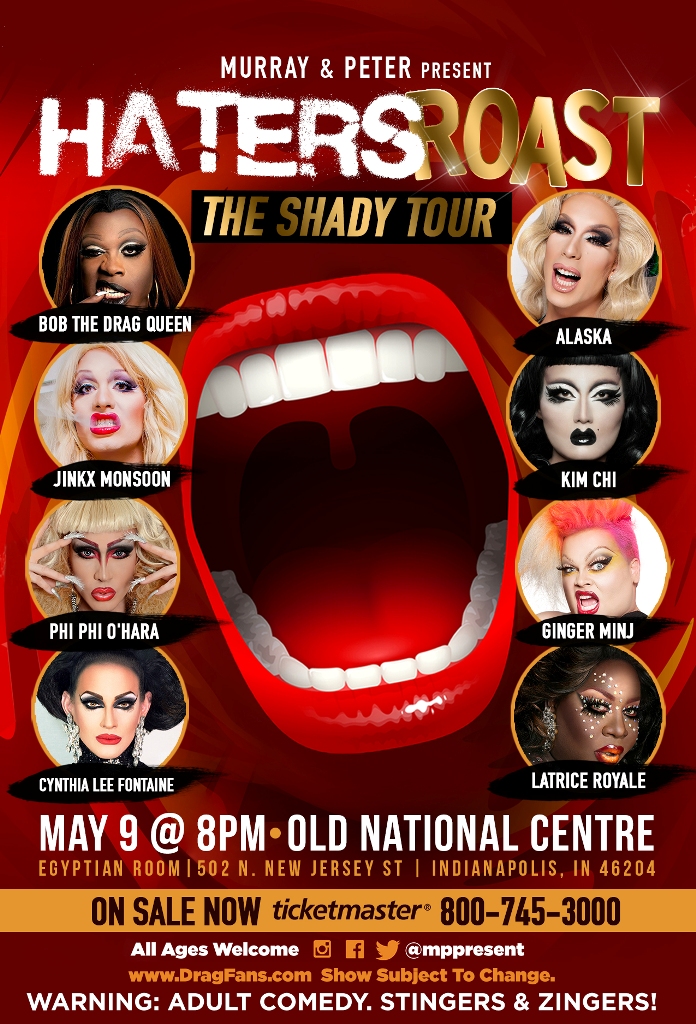
But, if as an adult, you fantasize about breaking that rule, you might enjoy Haters Roast: The Shady Tour.
Put on by the stars of RuPaul’s Drag Race, the show, which will take place Tuesday May 9th at 8pm at the Old National Centre in Indianapolis, allows you to watch the power and humor of insults and social criticism in action.
Queens Latrice Royale. Kim Chi, Cynthia Lee Fontaine, Jinkx Monsoon, Ginger Minj, Phi Phi O’Hara, Alaska, and Bob the Drag Queen dish it out on stage, throwing shade on politics, modern romance and social media.
It’s also frequently said that if you’re going to toss out zingers, you should at least be able to take what you give out. So, not to worry – the queens here will poke fun at themselves and each other just as much as they do at the rest of our crazy world.
Come enjoy the show! Tickets start at $20 and are available here: http://www.ticketmaster.com/Haters-Roast-The-Shady-Tour-tickets/artist/2331866
Next week we’ll publish Michelle Rhiannon Cox’s review of the show.
Synchronized Chaos’ May theme is Close Encounters. While we won’t find any alien life in our issue, we do see many pieces that look into the different ways that we respond when we interact with others. Or into the clash or blend of cultures, ideas, art forms, landscapes or words.
Joan Beebe gives us a pleasant ode to music, showing us the joy of encountering and playing the piano after a long absence from the instrument. And she reflects on inner peace she found despite a scary medical experience.
Sometimes we encounter other beings and the initial response is mutual confusion, fear, or offense. In Elizabeth Hughes’ Book Periscope column, both Ana in Fifty Shades of Grey and Melanie in Small Persons with Wings meet and interact with people very much unlike themselves to their mutual annoyance. It takes years and many later interactions for them to understand each other.
When it comes to encounters with authority figures, that kind of understanding can come through trust in the legitimate guidance of those one respects.
Mahbub demonstrates submission to authority: to his father while he was a boy, then later on to his boss, using language and concepts many rarely hear outside of perhaps a religious context.
Yet, his respect and obedience is selective, not slavish. In another piece he decries the powerlessness of ordinary people, with a speaker who compares himself and others to soccer balls kicked around by the uncaring who see life as a sport with the goal of enriching themselves.
Dave Douglas’ poem also reflects the choice to submit to authority, divine authority in this case. His speaker allows himself to have his entire identity re-made so that he can have a life of relationship with and service to God rather than the selfishness and pride that has alienated him.
Other pieces explore the ramifications of encounters among social groups, and of people trying to live within society.
J.K. Durick presents poems of complication. Elderly bodies which cannot do everything that people would like, airport security regulations that get in the way of people having a good time for free, penalties for nonviolent wrongdoing that everyone considers good and only fair until they experience them themselves.
Donal Mahoney’s piece relates his experience as a social services caseworker, when he failed to acknowledge the social realities his unemployed African-American client faced. Here he was the authority, well-meaning but limited in his understanding, and humored by those he served because he was part of the system that delivered needed services.
Randle Pink further elaborates on the very real effects of social barriers and informal prejudices. He discusses the struggles of transgender people to be accepted and treated with respect, and the phenomenon of imposter syndrome, where members of minority groups internalize the prejudice against them and feel like ‘imposters’ undeserving of the accomplishments they earn. He also points to the problematic nature of respectability politics, where minorities enforce classism and other prejudices of the mainstream society in their own communities in an effort to get some of their members accepted.
Sometimes the ‘others’ we encounter are other versions of ourselves.
Mark Murphy gives us poetics of isolation and alienation. Why and how do we keep loving when our feelings aren’t returned, when we have to wait endlessly for someone, when we’re lost in the miniscule traffic jams below the cathedrals of life? Maybe we do just because of who we are, because we are creatures who love and relate to others and try to connect with the larger whole because that is what keeps us going, from feeling completely insignificant.
Michael Robinson’s speaker finds himself haunted by his past, overcome by memories of a past rape as he tries to get close to his lover. His later pieces illustrate loss of privacy in a mental institution and ultimately ends on a note of gentle affection.
His transformation reflects the learning and growth that we hope creative writing of all sorts can inspire. With that in mind, we invite you to read and thoughtfully consider this issue.