Elisabetta Bonaparte is an Italian poet, writer, lawyer and teacher. Her passion for poetry has materialized in a significant literary production, characterized by a profound sensitivity to existential and natural themes and by a refined, intimate and meditative language, rich in symbolism and metaphors. Elisabetta Bonaparte has participated in national and international literary competitions, obtaining First Prizes, Medals, Plaques, Special Prizes, as well as numerous other literary awards. Her compositions, translated into several languages have been selected and included in literary anthologies and published in national and international specialized journals, both in print and online, in many countries.
GRACIELA NOEMI VILLAVERDE is a writer and poet from Concepción del Uruguay (Entre Rios) Argentina, based in Buenos Aires She graduated in letters and is the author of seven books of poetry, awarded several times worldwide. She works as the World Manager of Educational and Social Projects of the Hispanic World Union of Writers and is the UHE World Honorary President of the same institution Activa de la Sade, Argentine Society of Writers. She is the Commissioner of Honor in the executive cabinet IN THE EDUCATIONAL AND SOCIAL RELATIONS DIVISION, of the UNACCC SOUTH AMERICA ARGENTINA CHAPTER.
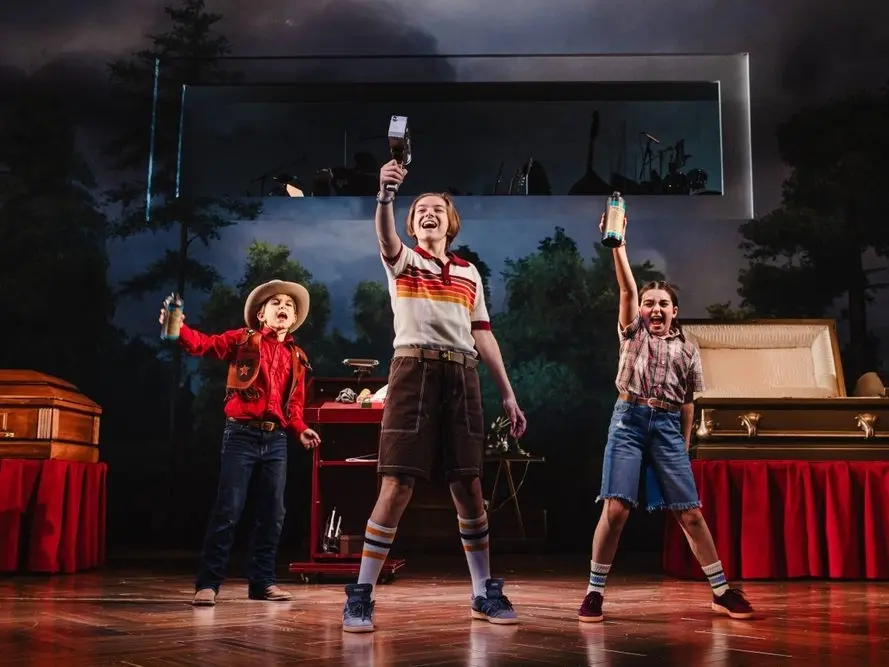
Caleb Levin, Odin Vega, Lyla Randall in Fun Home; directed by Logan Ellis; photo by Marc J Franklin
Serious Playtime at Huntington Theater’s “Fun Home” November 14 – December 14, 2025
A serious yet playful reimagining of parental memory through surreal childhood dreams conflating with the imposition of adult reality
The winner of five Tony Awards including Best Musical, Fun Home is a beloved, groundbreaking, and soulful story of conceiving your parents by way of adult point of views. Constructed from Alison Bechdel’s best-selling graphic memoir, the musical unearths Alison through childhood, college, and adulthood as she decrypts her coming-out story, and her compounded relationship with an astute, labile, and closeted father. How have the mysteries of her father’s life shaped her own discernment of love and integration of her lesbian identity? With a lofty score by Jeanine Tesori and a terse, emotionally charged book by Lisa Kron, Fun Home is a mesmerizing, must-see theatrical experience, directed by Logan Ellis.
Among the multifarious thematic spirits of the unfeigned theatrical biographical missive ‘Fun Home’ (inspired by the popular comic strip Dykes to Watch Out For), which is a play on words meaning ‘Funeral Home’, is a rip roaring song and dance journey into a childhood past to come out soaring into the greater understanding of present day adulthood. It explores how we perceive our parents from our childhood perspectives and how we come to understand them better through adult introspection. Through the plays’ use of the musical genre, it was able to achieve magical dreamlike moments that may have otherwise proved to be a challenge. The main characters’ understanding of her mysterious complex and brilliant father left me feeling a need to understand his obscure sense of aloofness myself. His perhaps deliberately vague characterization left me with a queer desire to learn more about his enigma, much like the way some of us feel about our own fathers.
Amidst all the adult complexities of parental woes and domestic tensions, growing up, navigating college life while discovering her budding sexuality, the main characters constant presence on stage to explain in a literal sense the multitudinal stages of her life effectively kept the audience in on her private thoughts and youthful perspectives that kept spectators engaged and invested. I, for one, was really rooting for her and symbolically rooting for my own childhood self remembering the mysteries of my own parents and homelife. “Fun Home” alleviated the tense moments of the production with a hot handyman in tight seventies short shorts, awkward first dates and sexual encounters that conceivably made some uncomfortable, albeit in a “fun” sexy way.
This play speaks to the phenomena of children wanting to understand their parents better through childhood dreamlike imaginations, wishful thinking and adult realistic reflections conflating to give us a serious study of childhood understanding of adult relationships but in a “fun” way; thus consequently that’s a five out of five stars for me!
pencilling notes on a lung black cigarette packet-
our Winston, wronged for a woman and sin
rewrote history on scrolls thought down tubes
that came to him
in the Ministry of Truth Of Fools
where conscience learns to lie within.
not like today
the smug-sly haves say and look away
so sure
there’s nothing wrong with wanting more,
or drown their sorrows
downing bootleg gin
knowing tomorrows
truth is paper thin
.
at home
in sensory
perception
with tapped and tracked phone
the Thought Police arrest me
in the corridors of affection-
where dictators wear, red then blue, reversible coats
in collapsing houses, all self-made
and self-paid
smarmy scrotes-
now the Round Table
of real red politics
is only fable
on the pyre of ghostly heretics.
they are rubbing out
all the contusions
and solitary doubt,
with confusions
and illusions
through wired media
defined in their secret encyclopaedia-
where summit and boardroom and conclave
engineer us from birth to grave.
like the birds,
i will have to eat
the firethorn
berries that ripen but sleep
to keep
the words
of revolution
alive and warm
this winter, with resolution
gathering us, to its lantern in the bleak,
to be reborn and speak.
THE PORTAL IN THE WOODS
Seeing somnambulist sunrise
Through open window
Touch your face
After love rides
On moon tides
In ebb and flow
At tantric pace-
Love resides
Tasted
No asides
Wasted
Spices of the flesh
Soaking rooms in Marrakesh
How I ate your truffle in Zanzibar
While you smoked my long cigar.
Back home-
Tribes of bloods
And druids roam
Seeking out the overgrown
Portal in the woods
Where we hondfast
In this present of the past
Dance chanting
In stone bone circles
Like ooparts
Practicing
Magical arts
Settling
What chaos hurtles-
Reconnecting rhythms
In living and dead
To those algorithms
In nature’s head.
We are rustic-
Romantic
In land and sky
The air fire water
To warriors who slaughter
If Us or Them must die.
We wake
For clambake
Pleasure
In a cauldron lake
Of limbs together
Then cut sods of peat
From the bog under our feet
Exposing the pasts
That never last.
CUBIST GHETTOS
I think
To shrink
The distance
Of resistance
Inside self
To all else-
Knowing
Showing
Vulnerability
In the mystery
Leaves what is closed
Openly exposed-
To explanation
Under examination
When there isn’t one
That hasn’t gone
Until roof floor and sky door
Are no more-
Only roulette rubbles
Of drone troubles
Imprisoning
Reasoning
In cubist ghettos
Wearing jazz stilettos-
Flashing flamingo legs
To pink paradise Harlem heads
While new trees grow up mute
And ripen with strange fruit
Some whites too this time
A drowned boy, me and mine.
THE HEAD IN HIS FEDORA HAT
a lonely man,
cigarette,
rain
and music
is a poem
moving,
not knowing-
a caravan,
whose journey does not expect
to go back
and explain
how everyone’s ruts
have the same
blood and vein.
the head in his fedora hat
bows to no one’s grip,
brim tilted into the borderless
plain
so his outlaw wit
can confess
and remain
a storyteller,
that hobo fella
listening like a barfly
for a while
and slow-winged butterfly
whose smile
they can’t close the shutters on
or stop talking about
when he walks out
and is gone.
whisky and tequila
and a woman, who loves to feel ya
inside
and outside
her
when ya move
and live as one,
brings you closer
in simplistic
unmaterialistic
grooved
muse Babylon.
this is so,
when he stands with hopes head,
arms and legs
all aflow
in her Galadriel glow
with mithril breath kisses
condensing sensed wishes
of reality and dream
felt and seen
under that
fedora hat
inhaling smoke
as he sang and spoke
stranger fella
storyteller.
Strider Marcus Jones – is a poet, law graduate and former civil servant from Salford, England with proud Celtic roots in Ireland and Wales. He is the editor and publisher of Lothlorien Poetry Journal https://lothlorienpoetryjournal.blogspot.com/. A member of The Poetry Society, nominated for the Pushcart Prize x4 and Best of the Net x3, his five published books of poetry https://stridermarcusjonespoetry.wordpress.com/ reveal a maverick, moving between cities, playing his saxophone in smoky rooms.