Description of the image of the stepmother in the novel “Stepmother” by Ahmed Lutfiy Kazanchi
Ahmad Lutfi Kazanchi was born in 1936 in Churum district of Turkey. He is a very famous writer. His works include “Stories of the Age of Happiness”, “Abu Bakr Siddiq r.a.”, “Hazrat Umar ibn Hattab r.a”, “Stepmother”, “Mother-in-law”. Writer relies on historical sources while showing the beauty of Islam, how well-mannered and conscientious Muslims. From the artistic point of view. When the writer writes about the bandalas on the right path, he narrates the stories that can be an example for us.
Speaking about the work “Stepmother”, it should be noted that it is not about Fatima. Badia is about what the mothers of the whole community are like. Like many works of Ahmed Lutfiy Kazanchi, the work “Stepmother” made a special impression on the readers, and the exemplary behavior of people whose only religious goal is God’s pleasure is beautifully illuminated. “Stepmother” by Ahmed Lutfiy Kazanchi can melt everyone’s heart, it can be said that it is a piece of his soul.
This work gives readers a lot of knowledge. He calls them to be believers, to do good. This book is scientifically interesting, but also full of virtues. The sequence of events is also very well written. The experiences of the heroes of the work absorb the reader to such an extent that one becomes a partner in their joys, pains, and trials. As soon as we read the title of the work, we imagine a mother who oppresses and humiliates her stepchildren. But Fatima is not one of those mothers. She studied both religion and the world from a young age. She lives only with love for God and his prophet. In his heart was not to win the love of servants, but to fall in the eyes of God.
So, can we call Fatima, who brought up Odilbek’s children more than her own children, who washed and combed her hair white and white, “stepmother”? Mother, who had the intention of becoming a true Muslim in her heart, accepted the hardships and various trials as a blessing. Because,
In verse 127 of Surah An-Nisa, God blesses you with “…treating weak children and orphans fairly. Whatever good you do, God is All-Knowing.”
There are many qualities that we should learn from Fatima. Surrender to God, patience and love… She became the educator not only of his children, but of the entire society. It is said that if you educate a boy, you educate a person, and if you educate a girl, you educate the whole society. Therefore, it is necessary for us girls to learn every second, to be like Fatimas. This work “Stepmother” is a work that can prove that a person can achieve bright and shining days by being patient and doing good deeds. In short, this book is proof that every good deed does not go unrequited. Every work of Ahmad Lutfiy Kazanchi has a place in the hearts of people. Each of his books are wonderful books that call to faith. In the end, we realize that Allah will reward us according to all our deeds and that we can receive two worldly rewards for our good deeds. Can I do the same as you read the feats of Fatima? you ask. We ask Allah to give us all knowledge and courage like Fatima.
DEFEATED

At the break of dawn, when the night melts
And light finds its way,
The slumbering soul thinks of you.
At the middle of the night, when the world tries to be silent,
This insane soul thinks of how to feed the hunger of your absence.
When the pink evening lights diffuses, and it gets darker,
The fire inside this unruly being burns down every single memory,
The tears freeze in a silent snowy dusk.
Still the buried dreams returns again and again,
In this mind.
Still the soul thinks that there is a return from the final destination of life.
And one day,
This story ends,
With the burial of this unruly soul.
YOUNG PEOPLE AND THE INTERNET

   The internet was first created to store research information for scientists to access them at any time or from any place. The internet has made an immense contribution to globalization.

    Nowadays it is much easier than ever to access the internet. Wherever you are you can listen to  your favorite music, reading the books and things like that. There is no doubt that many young people spend their hours online during their day. It has some cons but also numerous drawbacks.

    One advantage of the internet is that young people can do a lot of useful websites for students. This often helps teenagers to widen their grades. Another positive aspect of the internet is that people can practice the foreign languages by chatting with their friends from other countries. This is a good way of keeping in touch with their friends and family around the world. Even when someone lives hundreds of kilometers from you, you can call each other. In my opinion the internet is an amazing tool. The benefits outweighs the downsides. However we should be careful not to use the internet excessively!


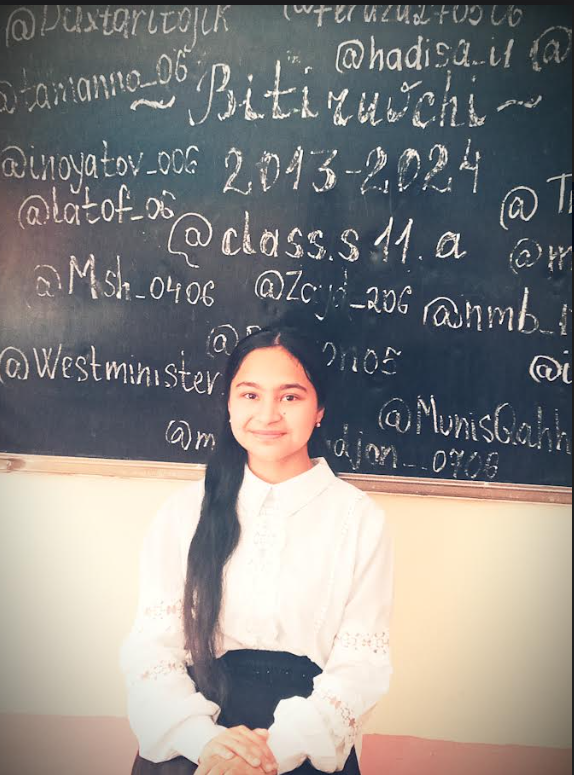
   NARZULLOYEVA MUNISA BAKHROMOVNA was born on August 13th,2006 in Surxandarya region Sariasia district of the Republic of Uzbekistan. She graduated school. She accomplished to a lot of achievements. For instance: her articles published on the Germany's "Raven Cage", Kenya's "Mt.Kenya Times" international magazines. Also she is also the member of "All India council of Technical skill development" and the member of "Global Education Ambassador".
PUMPING GAS

All Rick has to do to keep his job
is pump…and keep pumping.
Fear of life without a paycheck
turns to praise in his boss’s eyes.

It’s work that’s all brawn, no brain,
except for the torture of making the correct change
and it comes with a fancy uniform,
and a hat that he’s too embarrassed to wear.

In other states, drivers do this for themselves.
But not here. Not in Jersey.
He can’t imagine himself living in Massachusetts.
He would fade away. He would die.

He even does more than is called for,
rubs a wet cloth across the windshield
like he once saw in a black and white movie.
Occasionally, someone’s generous with a tip.

He realizes there’s no future in what he’s doing.
The boss isn’t going to die and leave the place to him.
There’s only the present and, though it moves him forward,
it never gets ahead of itself.

But someone has to do what he does.
And he’s stuck inside the one that’s doing it.
“Fill ‘er up,” says the guy who just pulled into pump A.
Rick is the guy within hearing range.


THINGS TO DO IN PROVIDENCE

Marvel at your transformation
when you haven’t really changed.

Grow weary of the same routine
and then stick to it.

Ignore the jackhammering in your skull.
It’s permanent.

Play chess in the park while your worst enemy
is getting laid off at a costume jewelry factory.

Dress differently
so people will mistake you for a college student.

When you have a hell of a lot of explaining to do,
say nothing.

Take aim at all your preconceived ideas.
With a bow if possible. Make the arrow  stick.

Forget that search for happiness.
Hype up sadness instead.

Join in conversations.
Even when you’re alone.

Stand by your beliefs. Then move slowly, quietly,
away so those beliefs don’t notice you’re gone.


THE FACE AS IT PRESENTS ITSELF

It’s an odd face.
Some people like it.
In one or two,
it invokes pity.

It’s drawn to a mirror.
Which are the standout features?
What is in decline?

Old around the mouth
yet the eyes are young.
Cheeks unblemished
but one earlobe bears a scar.

What does it say
about the mind and heart?
That’s where the trick comes in.
It can pose open-minded and wide-hearted.
Or it can slump into the opposite of these.

It retreats from the mirror
and rejoins society.
Most smile because
it’s back among them.
It turns from the ones
who shake their heads.


ON THE DAY HIS MOTHER DIED HER HAIR PURPLE

He left the house thinking,
“This time I’m leaving for good.”

He had no belongings with him.
He was just headed for the store.

But, to him, she looked ridiculous.
He could no longer invite friends back to the house.

No way would he be seen with her in public.
“Free at last!” he screamed in his head.

It was a warm clear day
and the entire world was open to him.

On his walk, he saw other mothers.
Their hairstyles were age-appropriate.

None of them were an embarrassment to their children.
Some may have even had husbands.

At least, they looked as if they did have one
then they could keep him.

He returned home with the few items
he picked up for her at the store.

He tried not to look at her when he handed them over.
But his eyes could not avoid her hair.

It looked like a serving of grape cotton candy.
He kept the change. It was his price for staying.


IN WAR AND PEACE

Soutine perished on the run
from the Nazis,
Freundlich died in the camp,
imagine being...
no I can't even imagine it.

I cuss the weather
when it's too hot to write poetry.
But trying to create something
in the middle of crazy, outrageous, bloody war?
I'd be in a foxhole
tapping out my next breath.

For every tortured surrealist
or Dadaist in a charnel house,
there’s me:

the same old crippled relationships,
damnable family life.

There are no guerrillas in the trees
outside my window.
No bombs drop on my rooftop.

I am safe from the enemy.
I’m most as risk
from the people I know.


John Grey is an Australian poet, US resident, recently published in New World Writing, North Dakota Quarterly and Lost Pilots. Latest books, ”Between Two Fires”, “Covert” and  “Memory Outside The Head” are available through Amazon. Work upcoming in California Quarterly, Birmingham Arts Journal, La Presa and Shot Glass Journal.
*

Five Hay(na)ku

lap
sag low
yap die cup

*

twinkle
dual neck
conical soil chisel

*

spiny
lop keeper
splotchy bigot hose

*

closet
treaty gasp
lock dredge flowerless

*

arc
cue rib
sag moo dim


Brian Le Lay is a multidisciplinary writer and sound artist whose work has appeared in places like Peach Mag, BOMBFIRE, Sledgehammer Lit, and dadakuku.
My Love Will Not


I can forget my memories but not you
I can lose everything but not my love
I can sell my world but not my heart
I can change the face of time but not dream
I can stop everyone but not you
See the flame of dream where love lives
See the wings of love where you fly
Ask your eyes about the seed of love
Planted in your heart before time
Touch the sky and hear my heartbeat
Every beat tells the story of your existence
I am not me for a moment without you
 You are everything in my life.
The seasons may change easily
The rivers may dry
Time can fly from here to there
The  hills may change their possession
The night may be endless
The sun can not rise
The moon may sleep
But my love will not.
The Stages of the Emergence of Economic Terms in the Uzbek Language and the Peculiarities of their Derivation
Khakimova Zamira Xurram qizi Teacher at The Department of integrated course of English language №3Uzbekistan State World languages University
ABSTRACT This article describes the origin and derivational characteristics of economic terms in the Uzbek language. Some terms are analyzed and compared with English economic terms.
The process of forming finance and economic terminology in the Uzbek language, which has a nine-century history of development, also goes back to a long history. This history includes three periods. Most of the terms whose origin and development are studied below belong to the third period, that is, to the period after independence. The reason for this is the relative relevance of the research of the terms that are current, in practice, and in circulation for specialists of this profession.
English terminology borrowed many words from Latin and French, Arabic and Persian languages lead the rich stage of Uzbek terminology. Cultural and political relations between these nations in ancient times have an important place in this. We can see the first examples of economic terms in the Uzbek language in “Devoni Lug’ati-turk” by Mahmud Kashgari, “Boburnoma” by Zahiriddin Muhammad Babur, in the works of Alisher Navai, Ogahi, Yusuf Khos Hajib. For example the terms below are taken from the work “Devoni Lug’ati-turk”:
“Og’ur” 1 (government) “O’ro’nch”2 (a bribe) “Sart”3 (merchant) “Bergo’”4 (debt)
1 Mahmud Koshgariy “Devoni Lugati-turk” the first volume p-87 2 Mahmud Koshgariy “Devoni Lugati-turk” the third volume p-451 3 Mahmud Koshgariy “Devoni Lugati-turk” the first volume p-328 4 Mahmud Koshgariy “Devoni Lugati-turk” the first volume p-403 Keywords: Economy, terminology, Latin, Russian, derivation, borrowing, affixation.
Received: November 29, 2022 Accepted: December 30, 2022 Published: January 31, 2023 Article Information
For example: “naqdina” (cash) 5 , “mablag” (funds), “miqdor”6 (amount), “dastmoya” (working capital). Then the second period of development of Uzbek terminology began. During this period, under the influence of the occupation by Tsarist Russia, many terms came from the Russian language.
For instance: Blanka (form), veksel (promissory note), bank (bank), kassir (cashier), Tovar (commodity), taftishchi (inspector). Economic terms in the Uzbek language have developed mainly on the basis of two sources. If the first is within the inner language capabilities, such as affixation, meaning transfer, meaning expansion, semantic derivation are examples (jamg’arma-accumulation, ijarachi-tenant), the second method is borrowing from foreign languages, in which mainly Arabic and Persian-Tajik languages until the 20th century, then Russian, and English after independence caused the enrichment of Uzbek treasury terminology.
When it comes to the characteristics of the terms formed through internal possibilities, it is seen that the concept represented by that term has existed in our language and way of life since ancient times. Example: trade – Arabic language The concepts expressed by terms formed through foreign assimilation are concepts that are new for the entire language as a result of development.
For instance:Auksion 7 (auction)-english word. Below we will consider a diachronic study of several terms: “Audit” 8 (audit)- borrowed word. It means “I hear” from the Latin language. Currently, it is used to check whether the financial statements of an enterprise or organization meet the specified standards.
The same audit is conducted by someone who is well versed in finance and accounting. It is called “Auditor”. These terms were not directly transferred to the Uzbek language. It was transferred to English from Latin, and the form “Auditor” was formed as a result of the addition of the personal suffix “-or” to the base “Audit”.
It should be mentioned that most of the terms related to finance and economy in the Uzbek language were not formed by derivational or other word formation methods and were transferred from other languages as such terms. The word “balance” is one of them. If the English word “balance” is translated as balance, in the treasury it means the balance between debit and credit, i.e. the inflow and outflow of money. As such, this word has been accepted into our language as an international word.
“Antimonopol”9 (antimonopoly)- the term “monopoly” was borrowed from the Russian language as an international word into the Uzbek language. The root of this word is Latin, in the form “monopolyum”, in Greek as “monopōlion”, in English as “monopoly” (from the 16th century), in Russian as “monopoly”. It means sole domination in a certain type of trade. The prefix “anti-” in the Uzbek language imposes a negative meaning on nouns.
“Avans”10 (advance)- this word, which means advance payment, goes back to the Latin language. The word “abante”, which means “to move” or “promote” in Latin, was transferred to the French language in the form of “avanc” or “avancer”, which means to move forward. At the end of the eighteenth century, it was borrowed from French to Russian. From it to Uzbek. The meaning of giving part of the money in advance for the goods began to be noted in the 60s of the last century.
5 Alisher Navai “Hayrat ul-abror” p-80 6 Alisher Navai “Nasoyim ul-muhabbat” p-87 7 O’zbek tilining izohli lug’ati”- A p-94 8 O’zbek tilining izohli lug’ati”- A 93-bet 9 Idum.uz “Iqtisodiyotga oid atamalar” 10 O’zbek tilining izohli lug’ati”- A 6-bet Web of Synergy:International Interdisciplinary Research Journal ISSN: 2835-3013
“Buxgalteriya”11 (accounting)-. This word, which entered the Uzbek language through the Russian language, represents the practice of accounting. But it is not a Russian word itself.
Translated from German to Russian. The German words “das Buch” – book and “halter” – lifter were combined to form the word “book lifter”.
“Dotatsiya”12(subsidy)-in latin “dotatio” means gift. He switched from Latin to English, from English to Russian and then to Uzbek. It means non-refundable financial aid.
“Hisobot”13(report)- the word “hisob” is a word from the Arabic language. it represents the representation and designation of numbers. The noun-forming suffix “-ot” was added to the root of the word “hisob” and the term “hisobot” appeared. The word “hisobot” is not only an economic term, but is also widely used in general terms. If it represents a summary of the work done in general, it is a statement of the operations performed during the previous period or quarter in the financial sector.
“Kassa”14(checkout)- department where money operations are carried out. It comes from the Italian word “cassa” which means box. Although new terms have been borrowed from foreign languages along with new concepts in the Uzbek language, it has been seen that new terms have been created based on the borrowed terms with extensive use of the affixation method. The fact that the Uzbek language is an agglutinative language is a factor in this.
Derivation serves as a method of terminological conceptualization of a field of language. Creation of terms is carried out according to the following classification parameters: lexicosemantic, borrowing, syntactic, morphological syntax.