
1

bidding goodnight

and lights off

children giggling

a bedtime story

of two siblings


— Christina Chin/Uchechukwu Onyedikam


2

baby strapped

to mama's back

the endless path

pot of water

on her head


— Christina Chin/Uchechukwu Onyedikam


3

the fragrance

of night blooming

jasmine

a red-lipped

queen of the district


— Christina Chin/Uchechukwu Onyedikam


4

an old lady

a mite uneasy

of ageing

a sigh of relief

after the will


— Uchechukwu Onyedikam/Christina Chin
Category Archives: CHAOS
Poetry from Muntasir Mamun Kiron
Trees

Beneath the azure sky so wide,
With tender care and hopeful pride,
We plant a seed, a promise there,
A gift to Earth, a breath of air.

In soil rich, the sapling grows,
A silent vow the future knows,
Green leaves will dance in morning light,
A shelter born from dark to bright.

Each tree a guardian, standing tall,
A haven for the great and small,
Roots dig deep, their strength to share,
Whispers of life in the forest’s care.

So plant with love, with heart and hand,
A verdant dream across the land,
For every tree a story sown,
A legacy in green, our own.


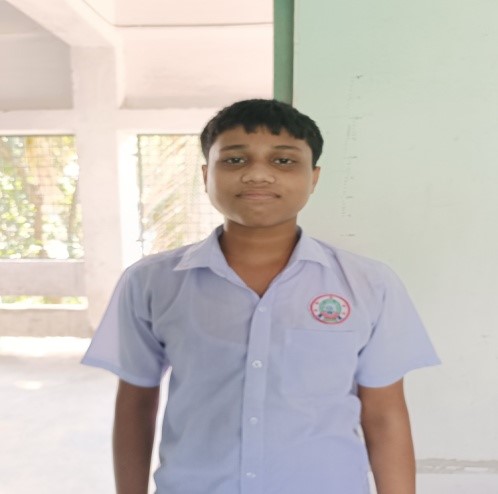
Muntasir Mamun Kiron is a student of grade ten in Harimohan Government High School, Chapainawabganj, Bangladesh.
Essay from Shokhzod Dilmurod

THE USE OF INFORMATION TECHNOLOGIES AND ONLINE PLATFORMS IN PHYSICS LESSONS
Jizzakh State Pedagogical University
Begmuradov Shokhzod
Abstact: The problem of using gaming technologies for teaching schoolchildren to solve physical problems is discussed. The possibilities of a virtual environment for organizing gaming learning activities are considered. The analysis of the domestic and foreign gaming resources in physics presented in the open access is given. The necessity of replenishing the modern resource base of this type, including the section of computer games for training sessions on solving physical problems, is substantiated. The didactic game “Golf” developed by the authors of the article is presented. The game model of the resource is implemented in the 3D simulation mode in the Unity environment. The content of training tasks, dynamic game video sequence, the interactive nature of the interaction of participants with game objects and the competitive effect of the game are aimed at consolidating and developing the knowledge, skills and abilities previously acquired by the student in solving physical problems on the topic “Kinematics”.
Keywords: teaching physics, solving physical problems, game learning technologies, virtual game environment, development of digital game, learning resources in physics.
Problem solving is one of the important ways for students to acquire scientific knowledge and develop their cognitive skills. This type of activity contributes to the development of thinking and creative abilities of students, influences the formation of their interest in the study of physics.
To date, a very extensive system of scientific and methodological knowledge and effective pedagogical practices for teaching students to solve problems in physics have been accumulated. This serves as a sufficient basis for comprehending and transferring the accumulated pedagogical experience to a new information and educational environment, saturated with virtual educational objects and computer learning technologies.
The implementation of productive technologies for teaching students to solve physical problems by means of a virtual information environment is an urgent problem of modern methodological science and pedagogical practice. Works devoted to finding ways to solve this problem have already been presented in the pedagogical press (D.V. Bayandin, M.D. Dammer, V.A. Izvozchikov, A.S. Kondratiev, V.V. Laptev, A.A. Ospennikov, E.V. Ospennikova, V.G. Petrosyan, L.V. Petrosyan, I.R. Perepecha, S.E. Popov, L.A. Proyanenkova, A.V. Smirnov, M.I. Starovikov, D.E. Temnov, A.O. Chefranova and others). The process of accumulating digital resources intended to support the educational process in solving physical problems is gaining momentum. These are resources on CD and resources of the global network.
Digital manuals on CD for high school, distributed in the domestic market, contain a large number of educational tasks. The practice of developing such resources has more than two decades. In recent years, the quality of these resources has changed for the better. The species composition of tasks has been updated, in particular, the number of tasks of different levels of complexity (tasks-exercises, typical, non-standard) has increased, more attention is paid to contextual physical tasks and tasks-projects for educational research. The variety of media formats for representing problem situations is growing. A wide range of virtual objects (video drawings, animations, models, simulators, etc.) are involved, which can be used not only to present students with problem situations, but also to support the process of solving a problem, as well as to check the result. Computer technologies for the formation of students’ skills and abilities in solving problems are being improved: the variety of interactive exercises for practicing individual operations necessary for solving problems of various types has increased; original simulators have been developed for mastering the basic actions that make up the solution of a physical problem; the help system has been updated and expanded, which provides examples of solutions to problems of varying complexity; Interactive training tests appeared, designed for self-control by students of the level of formation of their skills and abilities in solving problems.
In addition to resources on CD, an Internet database of digital materials for solving problems has been created and is being developed. There is a whole network of educational portals and sites (federal, regional, regional and personal), which present: collections of problems of various types, digital solution books and reference books, tool programs for solving problems, simulators and tests, video tutorials for solving problems on various educational topics, distance schools (courses) to prepare students for the Unified State Examination, workshops for applicants, materials for physics olympiads, materials for physics teachers on the methodology of teaching students to solve problems, etc. Enough the developed digital resource base creates all the necessary conditions for a significant update of the practice of organizing the educational process to solve physical problems in order to increase its effectiveness. The purpose and role of the task in learning is determined by its essence as a pedagogical tool. In accordance with the concept of A.N. The Leontief task is considered as a component of the subject’s activity (a relatively independent formation in the structure of this activity): “… the goal of the action, set in certain conditions” [7]. In a more complete interpretation, the essence of this concept is defined as follows: “The task is the result of reflecting in the consciousness of the subject the situation of life activity, which requires mental and practical actions from him, aimed at its transformation, taking into account the goals relevant to the subject and objectively specified (internal, external) conditions for this transformation” [8, p. 481]. Note that task situations can be fixed not only in the individual, but also in the public consciousness. Objectified by a person and presented on an auxiliary medium, the task becomes the property of society and can be both relevant and irrelevant for society.
An educational physical task is a task for the solution of which knowledge of the basics of physical science is used and methods of cognition corresponding to this science are applied. The educational nature of the task is determined by the orientation of its content and methods of solution to the mastering by students of the system of subject and meta-subject knowledge, skills and abilities (KAS), as well as the development of a system of psychological properties (in particular, methods of mental actions – SUD) and personality traits of the student [8].
The following are the educational functions of the learning task:
– educational:
• assimilation of knowledge (about facts, concepts, laws, theories, methods of activity);
• improving the quality of knowledge (depth, strength, consistency, etc.);
• comprehension of interdisciplinary connections of various fields of science and practice;
• mastering the methods of natural science knowledge;
• formation of cognitive and practical skills;
– developing:
• improvement of the entire system of cognitive processes (attention, perception, representation, imagination, thinking, memory, speech);
• formation of readiness for creative activity;
– educational:
• formation of scientific outlook and natural-science style of thinking;
• formation of socially valuable motives for learning (in particular, cognitive interest);
• formation of individual independence in learning;
• education of volitional and moral qualities of a person;
• Assistance in the formation of the general culture of the student and his readiness to apply knowledge in solving various problems of life.
One of the important conditions for the implementation of broad educational opportunities inherent in the activity of solving problems is their necessary and sufficient diversity. Classifications of learning tasks are given in [8, 10]. The construction of these classifications is based on ideas about the variety of types of educational activities, including the activities of students in a virtual educational environment. The authors identify more than 15 classification grounds. According to the content of the activity, they distinguish: scientific tasks (to be solved together with a teacher, a scientific consultant: the concept of V.V. Mayer); learning tasks and game learning tasks.
Within the framework of this article, questions of the development and application of game situations in solving physical problems are considered.
Game tasks are quite an effective means of learning. Game development (proposing an idea, preparing a script, producing game objects) based on educational tasks is a fairly obvious and very effective methodological activity, since almost any game situation is associated with a person solving certain problems.
The game is the resolution of any situation of human life in a conditionally modified environment. A person agrees on the content of the changes to be made with the participants in the game or with himself. Changes are both ideal and material. Material changes are associated with the use of special game objects. The laws of interaction of an individual with game objects, regardless of the environment (nature, “second” nature, book, audio and video, virtual environment), to which they belong, are of a general nature.
Game activity necessarily has as its result a pronounced complex educational effect: training, development and education. The acquisition of new experience in the game (learning) is its important goal, but, in addition, the game is a significant means of satisfying the needs of the emotional-sensory sphere of a person, his needs for self-affirmation, self-realization, and communication. Game activity contributes to the development of the volitional beginning of a person’s personality, his intellectual and physical abilities, etc. The presence of the second (personal) component of play activity makes learning in play involuntary, emotionally comfortable, and highly productive (although the effect is usually achieved in a fairly narrow area of social practice).
References:
1. Zentsova I.M., Ospennikova E.V. Application of ICT tools in the organization of a home physical experiment // Bulletin of the State Pedagogical University. Series: ICT in education. – Perm: PSGPU. – 2016.
– Issue 12. – P. 45 – 81.
2. Games and applications for learning physics, chemistry and mathematics. [Electronic resource]. (date of access: 02/15/2018).
3. Lanina I. Ya. Methods of forming the cognitive interest of schoolchildren in the process of teaching physics: Dis. … Dr. ped. Sciences. L., – 1984. – 409 p.
4. Lanina I.Ya. Formation of cognitive interests of students in physics lessons: A book for teachers. – M.: Enlightenment. – 1985. – 128.
5. Lanina I.Ya., Dovga G.V. Physics lesson: how to make it modern and interesting: Book. for the teacher. – St. Petersburg: Publishing house of the Russian State Pedagogical University im. A.I. Herzen, 2000. – 260 p.
6. Lanina I.Ya., Tryapitsina A.P. Pushing the boundaries of the familiar: a journey through the lessons of physics – L .: Lenizdat, 1990. – 110 p.
7. Leontiev A.N. Activity. Consciousness. Personality. – M.: Politizdat, 1975. – 304 p.
The son of Begmuradov Shokhzod Dilmurod was born on January 4, 1997 in Bakhmal district of Jizzakh region. He is currently a 3rd -year student of Physics and Astronomy at Jizzakh State Pedagogical University located in Jizzakh and the winner and prize-winner of several Olympiads and events.
Poetry from J.K. Durick
Back Roads

What do we do when the day stalls out

on a back road, one you don’t at first

recognize, as if this hasn’t happened

before, but it has, and you know what

comes next. You open the hood on your

life and begin to tinker with what you

find, as if there is a simple fix to all this.

Perhaps your battery needs charging or

maybe it’s a matter of choosing the right

things to jiggle and swear at. Perhaps it’s

a matter of attitude or personal mindset,

the way you’ve been handling the day to

day. Back roads become destinations if

we let things get beyond us. Perhaps all

this stalling out is nothing more than what

happens when we slow down too much

and assume that there’s something wrong

with everything around us. It’s easy to have

things turn out not the way we wanted them.

Like now our days dress the same, and say

much the same things when questioned.

An afternoon can spend itself dealing with

the sameness of sameness, trying to buy

its way out with promises that the next time

the time will be consumed in trying to find

things that fit – and fit in with the things we

hope cover the monotony, the repetitiveness

the dull consistency that leaves us out here

stalled out on this crumbling back road.


 Reading to Myself

Halfway through

I lost my way

In his poem

Became lost

In the words

A dark forest

To stumble through

A tilt of the page

And there I was

By myself

Whispering to myself

About how often

This happened

A bit of bad eyesight

If I were lucky

Or something more

Something dangerous

An unavoidable lapse

Perhaps

Or something permanent

Forever lost

In a maze of my own

Stuck in this labyrinth

Of my own making

Forever lost

In someone else’s poem

Halfway through

I may be here

From now on.


               Terrorism TV

We’re learning about terrorism from

The best of ’em, the worst of ‘em

Isis, Hezbollah, and Hamas, the better

Known groups, and those smaller ones

And individuals who often claim

Responsibility for some attack, explosion

Or the assassination of some political figure

Anything to get to be part of the news on

Our various news networks, claim it and

Get the fame, the recognition they need in

The terrorist game. We watch it go on

24 hours a day, yesterday, last night, this morning.

It’s like an out of control weed, a pandemic,

A bit of climate change that is drying us out

Leaving us the shell of our former selves.

Now we have become students of death, in its

Various forms, destruction for its own sake.

We’ve become helpless talking heads that

Are watching the world come apart, and we

Are terrorizing ourselves with it.
Poetry from Gabriel Flores Benard
Tinted Mirrors

Imagine a room
brightly lit with autumn aura
of dried yellow and sweet potato.

No doors,
no windows
except to the soul.
Mirrors line the walls
in fractures and rainbows,
simplistic to extravagant
eyes of separate shades
peering into yours.
Oh, the ideas, memories,
reflections bleeding out,
pouring back into
your essence.
I envy your shards
of opportunity.

Now, imagine the page
in front of you,
notebook sheltered in hand.
The light is no longer warm;
dark blue whispers
emanate through the room.
Pen ink lingers on the page,
colors, letters,
remnants of sensory sorcery.
The tinted reflector
has a color of your own:
blood, tears, touch, eyes
lining fractions of your story
A new beholder
shall soon perceive
this work of art.
Short story from Leslie Lisbona
My Doppelganger
In early March of 2020, my sister, Debi, and I took a yellow cab on our lunch break to the Volta Art Fair, near the West Side Highway. She had just purchased a small painting from an artist who had a booth there. I loved the painting and was looking forward to seeing more of the artist’s work. On the day we went, we heard she would be present.
“Let’s talk about shaking hands,” I said.
“Why, are you afraid of Corona?” Debi said.
“I don’t know. It’s just not a good idea.”
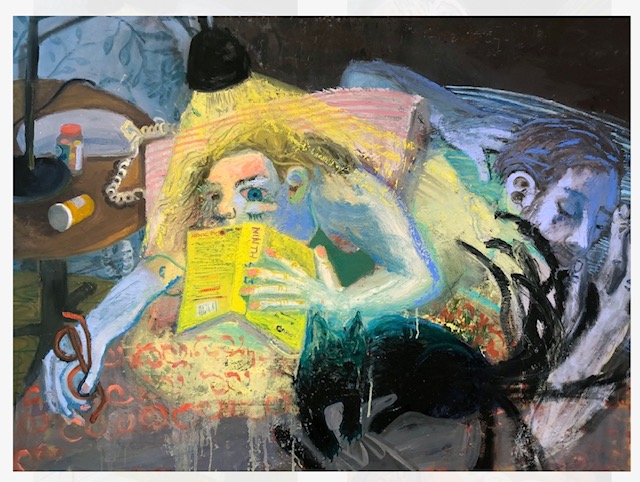
We went upstairs, chitchatting with every step, and then I saw it. It was large, horizontal, and colorful. I couldn’t turn away. There was a couple in bed. The husband was sleeping in a purple haze on the right side; you had to look hard to realize he was even there. At his feet was a black cat with a swishing tale that at first I mistook for a giant spider. The woman was harshly lit by a reading lamp directly over her blonde head. She had a yellow book in one hand and reading glasses in the other, and she looked frazzled and anxious. A bottle of prescription pills lay on its side on her bedside table. She had one blue eye that overshadowed the other in sheer size. It shimmered, staring at the viewer. She was like an ogre but relatable.
“Les, that is so you,” Debi said. I understood what she meant.
The artist appeared. Debi shook her hand. I didn’t. I asked her what book the woman in the painting was reading.
“The Ninth Street Women,” she said.
“Oh!” I said. “Our great aunt was an artist in that circle,” and suddenly we had a lot to chat about.
At night, all I wanted was to read peacefully before closing my eyes and falling asleep. But it was a struggle: My husband, Val, kept asking me to turn off the light. I tried the Itty Bitty Book Light, but that was unpleasant. Instead, we bickered. “In a minute,” I’d say, or, “Let me finish this page” or “paragraph” or “sentence.” He would come back with, “It’s midnight,” or, “I have to get up early,” or the most offensive, “Why don’t you go read in the living room?”
I talked some more to the artist, and before I knew it, I was handing the gallerist my credit card. I had never made a purchase like that before. It was more than I was used to spending but within my means. The painting would be delivered to my home in New Rochelle. I couldn’t believe how happy I was.
A few days later, New Rochelle was in the news. A one-mile containment zone was going to be established because there was a Covid outbreak in my neighborhood. People in white hazmat suits were going to homes on my block where people were infected. The National Guard was there, although I wasn’t sure why.
The day before, I had taken the train to work. The platform was crowded. A man coughed, and I felt his hot breath on my neck. As I inched away from him, he said, “I’m not Chinese, you know.” I carried this unpleasant encounter into the city and then stayed only half a day. I said a tentative goodbye to my co-workers. I didn’t know if I would be allowed to leave the containment zone to come to work the next day. I considered fleetingly the shoes in a basket under my desk and whether I should bring my stuff home. But the thought of packing up overwhelmed me, and I left the shoes behind.
My older son, Aaron, was at Albany finishing his senior year of college. Oliver was commuting to Manhattanville not far from our home. Val, who traveled for his job, was suddenly grounded. That night we went to bed, but I couldn’t sleep. I turned on the TV once Val was safely snoring and purchased the movie Contagion. I watched it to the end, and at 2:30am I emailed my employer’s HR department. I asked if I should come to the office in the morning, considering where I lived, ground zero. I got an answer at 5:30am saying, “Not until further notice.”
The painting arrived on the first day of lockdown, like a new member of the family. I hung it over the fireplace; at four feet across and three feet high, it was significant. Val came out of his office and looked at me as if I had gone insane. “You bought a painting?” he asked, his voice shrill. I ignored him. Oliver emerged from his room, looked at it and said, “Wow!” Aaron arrived later and said, “Cool painting.” Since our first floor was an open plan, you could see it from the kitchen, dining area, and TV room.
I locked our front door and settled myself on the couch in view of my new best friend.
I had been a banker all my life and had held this last job for nearly 14 years. The bank I worked for had been acquired, and I was going to be let go with a severance package at the end of May. I was a bit unmoored by this loss and would never have left my employment willingly, but the termination date secretly excited me. I hated the grey walls of my office, the constant smiling, the feigning of interest in a field I didn’t really care about. For a few weeks after lockdown, I did not work at all. When I started up again, my workload was light.
I liked being home. My sons took their classes virtually, each of them in their rooms. I loved their proximity and that we were all together. I cooked, played with my puppy, went on long walks with her. I sometimes napped in the middle of the day. Words that seemed archaic, like quarantine, became common. I learned new words like Zoom. I took my yoga classes on it. I wore sweats daily. Makeup was optional.
I carved out a space in the living room that was just for me. I found an old desk that a neighbor was giving away on Facebook and had the boys put it to the right of my painting. I placed trinkets on it, a framed library index card, and some books. I sat there at my desk and daydreamed, and when I sat there, I was invisible and no one bothered me.
I started purchasing things on Amazon. I ordered the yellow book from the painting, which I didn’t realize was over 1,000 pages, and read it in full view of that blue eye, another woman in this house full of men. I read about Lee Krasner and how her fame was overshadowed by her husband’s.
I returned to my office one last time on my end date to sign my termination documents and collect the shoes from under my desk. There were only three people there; they stuck their heads out of their offices like moles. I was struck by their pallor. As I walked out of the building, a box with my things in my arms, the smile on my face was irrepressible, even if it was hidden by my home-made mask.
For the first time in my life, my crucial waking hours were mine to do with what I wanted. I read some more. The next chapter was about Elaine de Kooning. If only she had been born a man. I searched for my great aunt’s name and found her mentioned several times, but not because she was an artist or a friend. She was a neighbor. Her paintings hang on my walls. They used to hang at the Leo Castelli gallery. I wondered how she became a footnote.
I pulled out a needlepoint canvas that I had started years before and finished it seated near my painting.
The boys bought a firepit for the backyard. The TV room turned into a gym with weights and a bench. Val bought a Peloton, which was slightly less expensive than my painting.
We watched a lot of TV. George Floyd died on my screen again and again as I tried to look away. Marches in the streets followed. A few months later, the capital was nearly overrun, and the word “sedition” left my mouth for the first time. I had to explain to Aaron and Oliver what it meant. We introduced them to The Sopranos, and Val and I reminisced about watching it together as newlyweds when I worked for a French bank. All the while, the woman from the painting and I glanced at each other from across the room.
Sometimes before bed, Val and I would discuss what we would do if one of us woke up sick. And then, before we turned off the light, I’d say, “Good luck to you,” and he’d say, “And to you.”
One day the gallerist emailed me asking if a museum could borrow my painting when the pandemic was over. When I told Val, he was suddenly proud of our acquisition over the fireplace.
“Will it gain in value?” he asked.
“Probably,” I shrugged.
“Will it say ‘On Loan from Leslie and Val,’” he asked.
“No,” I said. “It will only have my name on it.”
This made both of us laugh. He snapped some pictures with his phone as if he were in a museum. “What a great painting!” he said, admiring my purchase.
“Step aside,” I said. “You are too close.”
Leslie Lisbona has been published in various literary journals such as Synchronized Chaos and most recently in Wrong Turn Lit, The Bluebird Word, and Dorothy Parker’s Ashes. She has recently been featured in the New York Times Style Section. All her published essays can be found on Substack.
Poetry from Don Bormon
Whispers of Rain

Raindrops tap gently on my windowpane,
A soft serenade from the gray-skied domain.
They dance and they play, a liquid ballet,
As if the heavens weep in a quiet display.

Each drop a memory, a tear from the sky,
Falling to earth, bidding sorrows goodbye.
They kiss the leaves, caress the ground,
A symphony of solace, a healing sound.

The rooftops shimmer, streets come alive,
Petrichor rises, memories revive.
Umbrellas bloom like colorful flowers,
Shielding dreams from the tempest's powers.

In the city's rhythm, rain finds its beat,
Puddles mirror reflections of souls incomplete.
And lovers seek shelter, hand in hand,
Their laughter blending with the rain-soaked land.

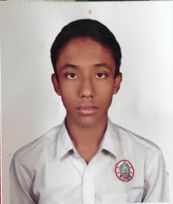
Don  Bormon is a student of grade nine in Harimohan Government High School, Chapainawabganj, Bangladesh.