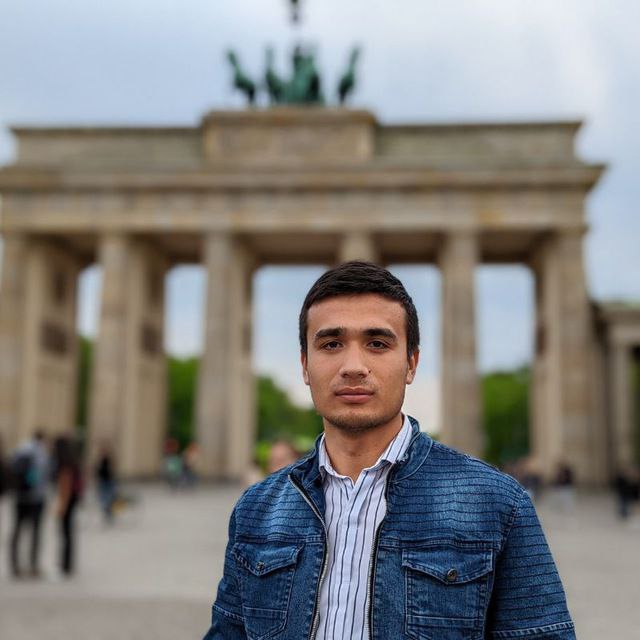
GET AWAY FROM ME…

I agree in the deposit world, from me,
Well, let's not leave the gold and the castle,
I will fill him with good deeds,
But don't let my life pass in vain.

Do not remember me as bad,
Let them say my name as Mehr.
May sweet memories remain from me,
I don't want to see other people's hatred.

If I am a handful of soil,
But let me have a lot of books.
Well, if not wealth and career,
But let the name of the poetess remain.
Domestic Air Travel


He’s at

The airport now,

He hasn’t flown

In about

Four years,

A combination

Of Covid

And his London,

As he enters

The airport,

The first thing

He hears

Is one of his

Fellow Americans

Asking what

A terminal is.


Taylor Dibbert is a writer, journalist, and poet in Washington, DC. He’s author of the Peace Corps memoir “Fiesta of Sunset,” and his debut poetry collection is due out later this year.
Lizard

I sit on the parched front porch;
around me the house is falling down,
soon my rocking chair may fall through the verandah.
The lizard under the shadow of the rock looks at me
as though I am its new tenant.
My skin is dried and crinkled like my landlady lizard.
I may shed it soon.
Perhaps human skin is the latest lizard fashion —
Lazy Lizard, poke your tongue back in.

Old Elijah in the pawnshop looked at me between rows of watches,
'Latest crocodile skin bags, Sir.'
I wondered if his wife had died.
E.Levy's Emporium; goods bought, sold and exchanged.
Amongst broken guitars, pictures of flowers and chipped vases
ruled 'Lijah,
amongst his rocks, in their dusty shadow.
'Lijah Lizard, put your Woolworth glasses back on.

The sun beats down on my little verandah.
Here I am sitting like a guard watching my own Sahara.
Join the French Foreign Legion.
See the sands.
Allons enfants de la patrie.
French generals, German captains
dwelling in the shadow of Moroccan rocks,
Legion Lizards, put your képis back on.

It is near the end for me now.
Perhaps it is best to rest
instead of cramming in all those little things
I would like to have done.
I wanted to see the big city.
Still, there is an even bigger one
waiting for me now,
waiting for me in the shadow of the rock of ages.
Leaving Lizard, put your halo on.

9/1959


A note on 'Lizard'

'Lizard' was the first poem I ever wrote. I was seventeen, suffering teenaged angst & concerned about my mortality which, for some reason, seemed particularly fragile at the time. I don't know why but I decided to write about it, perhaps write it out of me or clarify my feelings. It ended up being a poem; & in the course of writing it my attitude towards death turned around. I was quite happy by the time I'd finished. I cannot remember if there was much revision. I have a feeling that there was little if any. & even then I wrote at a typewriter. Something about the separation between writer & instrument – you have to hold a pen; there is a distance between your fingers & a keyboard. It's like the start of a relationship. Those tentative touches to test the waters.

I knew no writers, though my mother wrote verse for the women's magazines of the time, knew poetry only through college & that part of my first year at University when I attended lectures. I think we did Eliot & Yeats at Uni, but everybody else I studied had been dead for at least a century. I was unenthusiastic about it. I was a musician, a classically-trained contrabassist. The cello would have been my preferred instrument – it still is the one whose sound I love the most if I put aside the personal sound of Miles Davis - but I was a lover of jazz, & the bass was an instrument for jazz.

But here I was writing. & sufficiently impressed by what I'd done to write some more. Three poems altogether, in the space of a couple of weeks. I showed them to my mother who suggested I send them off to the N.Z. Listener, a colonial imitation of the English Listener, the back with the radio programs, the front with articles & reviews & one or two poems in each issue. It was one of the few serious outlets for poetry at that time available in N.Z. I didn't know what literary journals were, or little magazines. Unsurprising, because I think there was only one of each in the country then.

They were accepted. 'Lizard' was the second poem published, just after my eighteenth birthday.

I still played & wrote jazz. But when I returned to university the next year I had the cachet of being a Published Poet. Yes, definitely capital letters. I didn't consider myself a writer but others did. I was asked to edit the University Literary Society's annual publication. I became involved with other writers. I discovered Poetry, got influenced by people who wrote it, felt I had to write, wrote crap for the next three years. There was nobody I knew who wrote like I did when I started out so I started to write like other people who I really had nothing in common with.

Somewhere during this time I gave up playing music. If I'd played flute or piano I might have continued, but playing bass in those days was a dangerous undertaking. Wellington isn't known as windy Wellington for nothing, & there weren't many yank-tanks around, & none owned by anyone I knew. The taxis were still relatively small, English-made but not English taxicabs. Most of them I couldn't fit my bass into. I had to carry it, my shoulder fitting into its waist, whenever I had to play anywhere. Ultimately the visions of me getting caught in an uplift & blown down a hillside or off the bridge between home & the university became too much.

What saved me from becoming a pallid poet in the English tradition was Don Allen's 1960 anthology The New American Poetry which probably made it to N.Z. the year after its publication. I found in it poets whom I felt at home with, who wrote in a similar manner to how I had done when I first started writing, whose influences I didn't mind. Who I quite shamelessly stole from. Gary Snyder's 'Riprap' — "Lay down these words / Before your mind like rocks;" MY's 'The Quarrel' — "Put down those words / rocks picked hastily from the beach of mind." Charles Olson's 'The Lordly & Isolate Satyrs' — MY's 'Oriental Bay' — "The motorcyclists of Cocteau / were Death's / angels." Frank O’Hara's 'In Memory of my Feelings' — "My quietness has a man in it;" MY's 'The Tigers' — "Within the tiger / reels a turmoil of desires." Poems to Denise Levertov, to LeRoi Jones. They went through my blender, came out sometimes smooth, sometimes chunky. But within a couple of years I was writing as myself, still referring to those who'd influenced me but from a different stand- & viewpoint. Openly acknowledging my influences is something I have always done. From 'Mirror/Images:' "There is / an A-Z of those whose images I have pursued / perused & used."

& it all started with 'Lizard.' It makes use of stereotypes but I knew no better then. It has the last vestiges of my belief in Christianity although I think that had gone out the window a year or so before, but not that long ago to make me hesitate to use facets of it. 'Lizard' is, in all senses, a pure poem. Colloquial, uninhibited by influences, its form shaped by the poem rather than the reverse. Because I always lumped my earliest poems in a basket labeled "crap, not to be opened" it took me forty years & the prompting of others to recognise it for what it was, a poem that still works, & something to be proud of.

"When one is seventeen, one isn't serious" wrote Rimbaud. But he was fifteen when he wrote those words, & I think he probably changed his mind in those intervening couple of years.

6/29/2004
Daddy's Daughter

Dad, you wanted my name to be Julia
Maybe because I was born in the 7th month
Or what you liked that name,
I am too late in this life to ask you about your wish.
My mother wanted me to be called Maya,
But there is a seal of 5 letters of that name carved in me.
Dad I send you a hug wherever you are,
I'm sure you're in a better place than I am now.
I love you, your Julia!


AWAKENING

The awakening of the soul from the material shackles,
The body of flesh and blood through the mind
And false ego holds us back,
But it is a trick for naive people.
Let us rise above material conception
And be in harmony as one living organism.
Let us unite in unconditional love,
we poets who convey the message through the magic word,
Which is AWAKENING.
Let us stand up as warriors of light
And show others the path that leads to spiritual transformation
And self-realization of the soul.


Maja Milojković was born in 1975 in Zaječar, Serbia.
She is a person to whomfrom an early age, Leonardo da Vinci's statement "Painting is poetry that can be seen, and poetry is painting that can be heard" is circulating through the blood.
That's why she started to use feathers and a brush and began to reveal the world and herself to them.
As a poet, she is represented in numerous domestic and foreign literary newspapers, anthologies and electronic media, and some of her poems can be found on YouTube.
Many of her poems have been translated into English, Hungarian, Bengali and Bulgarian due to the need of foreign readers.
She is the recipient of many international awards.
"Trees of Desire" is her second collection of poems in preparation, which is preceded by the book of poems "Moon Circle".
She is a member of the International Society of Writers and Artists "Mountain Views" in Montenegro,and shealso is a member of the Poetry club "Area Felix" in Serbia.
Responsibilities of a Teacher

Teachers are the personalities who deal with education to students. It is the responsibility of teachers to give proper education of and treat them well. Teachers guide the students to the right path. They give good advice to students for their better future. In every case teachers are very punctual and regular in taking classes and do their duties sincerely. Their pronunciation is good. Almost teachers work with their students both in classroom and outside the classroom. They try to make their lesson interesting and keep their students active in the class. Teachers know well how to increase the curiosity of the students in their respective performance. Every language teacher should speak in English with the proper accent.

Teachers should give love to students. Teacher should maintain their responsibilities properly. And student should respect the teachers. Teachers guide their students to maintain the right path of the students. Every teacher should look after their students. Teachers are also responsible for updating their knowledge in rules such as health & safety at work and child protection guidelines. Students need to have a teacher that has values and understand the importance of values. Teachers are instructors, guides, philosophers, friends, tutors, and evaluators. So only the teachers are the persons whom we think to be the torch bearers for the students.


Md. Tasirul Islam is a student of grade 9 in Harimohan Government High School, Chapainawabganj, Bangladesh.
Uzbek Historiography: Tracing the Development of Central Asian History
Umrbek Ibragimov
Freie Universitaet Berlin
Nadira Kuzieva
Urgench state university
Annotation: “Uzbek Historiography: Tracing the Development of Central Asian History” This article provides a comprehensive overview of the development of Uzbek historiography, from its earliest accounts in Persian language to contemporary challenges faced by the field. The article traces the various themes and periods of Uzbek history, including the influence of Soviet-era historiography and the current efforts to promote a more inclusive understanding of Uzbekistan’s past. The article highlights the importance of Uzbek historiography in providing insights into the cultural heritage and complex history of Central Asia. It also sheds light on the challenges faced by scholars in the field, such as the lack of resources for research and the need to promote greater academic freedom and diversity of perspectives. Overall, this article is a valuable resource for anyone interested in the history and culture of Central Asia, and provides a useful introduction to the field of Uzbek historiography.
Uzbekistan is a country located in the heart of Central Asia, with a rich history that dates back to the ancient Silk Road. Uzbekistan’s historical significance has been recognized by the various empires and powers that have ruled the region throughout history, such as Alexander the Great, Genghis Khan, and Tamerlane.
The study of Uzbekistan’s history, as well as Central Asian history in general, is referred to as Uzbek historiography. Uzbek historiography has been a subject of scholarly research for many years, as it provides valuable insights into the region’s past and cultural heritage. In this article, we will explore the development of Uzbek historiography, its major themes, and the challenges it faces today.
Early Uzbek Historiography: The earliest Uzbek historical accounts were written by the Persian-speaking scholars who served the Timurid dynasty, which ruled over Central Asia and Iran from the 14th to the 16th century. These accounts focused on the reigns of Timur (also known as Tamerlane) and his successors, and were written in the form of chronicles or biographies.
During the 17th century, Uzbekistan came under the rule of the Kazakh Khanate, which was followed by the Bukharan Emirate in the 18th and 19th centuries. These periods saw the development of the first written works in the Uzbek language, which mainly focused on religious and ethical themes. One notable work from this period is the “Hikmat al-Israr,” a collection of Sufi teachings and stories written by the Uzbek poet Alisher Navoi.
Soviet Era Historiography: The early 20th century saw the emergence of Soviet rule in Uzbekistan, which brought about significant changes in the field of historiography. Soviet historians emphasized the economic and social transformations that occurred during the Soviet era, such as the collectivization of agriculture, industrialization, and urbanization.
Soviet historiography also placed a strong emphasis on the role of the Communist Party in shaping the course of Uzbekistan’s history. This approach led to the creation of a new canon of Uzbek historical figures, such as the Bolshevik leaders Abdulla Oripov and Sharaf Rashidov.
Post-Soviet Historiography: Following the collapse of the Soviet Union in 1991, Uzbekistan gained independence and embarked on a new phase of historiography. The post-Soviet period saw a renewed interest in Uzbekistan’s pre-Soviet history, with scholars exploring themes such as the region’s cultural heritage, architecture, and literature.
However, the post-Soviet period has also been marked by political tensions and controversies surrounding Uzbek historiography. The Uzbek government has been criticized for promoting a nationalist narrative of Uzbek history that downplays the contributions of other ethnic groups and marginalizes critical voices. Some scholars have also expressed concern about the lack of academic freedom and the government’s control over the publication of historical works.
Challenges and Future Directions: Uzbek historiography faces several challenges in the present day, such as the lack of resources for research and the difficulty of accessing archival materials. In addition, there is a need to promote a more inclusive and nuanced understanding of Uzbekistan’s history that acknowledges the contributions of all ethnic groups and accounts for diverse perspectives.
To address these challenges, scholars and policymakers have called for greater investment in historical research and the establishment of independent research institutes. There is also a need to promote greater dialogue and exchange between Uzbek and international scholars, as well as to encourage the publication of works that reflect diverse perspectives and interpretations.
Conclusion: Uzbek historiography provides valuable insights into the rich cultural heritage and complex history of Central Asia.
REFERENCES:
1. Б.Ж.Эшов, А.А.Одилов Ўзбекистон тарихи 1-жилд – Тошкент 2014, 246-бет
Few people flourish at one point of time because of their past concrete Deeds, but, at the same time, people criticize such people mercilessly for any gain without useful strategy.
EARNING FOR SUFFERANCE
People earn money for self and family happiness, but there will be no sight of happiness seen anywhere in their life, rather such people land in more & more problems with complicated tax evasion cases and ultimately such people suffer for want of peace of mind.
STRUGGLE FOR PEACE OF MIND
I don’t think so, there is Peace of Mind for any person. If anybody say’s so he has, it is sure such person is bluffing with an eye on some favor. But, it is sure that Peace of Mind cannot be purchased, but one will get the Peace of Mind by virtue of his/her good character deeds and discipline in life.
IMAGE TARNISH
The brand image of a person cannot be tarnished by anybody other than himself/herself, if his/her deeds, character and antecedents are not good.
STRATEGY FAILURE
I can’t blame anybody for my own failures, but, during the success period, had I maintained good financial management discipline and good public relations, the failure should have not dared to reach me, if my strategy in management and execution of projects was good.
NO FREE MEAL
One can’t work for free as there is no free-meal, but, free-meal can’t be given for free as at the end of the free-meal, management may ask for little donation like fund for use of developmental activities.
QUALITY OF FOOD
In olden days, the quality of food items was so good that peoples’ longevity was 100 years; whereas, these days lack of quality of food items makes the longevity to 50 years, it’s all because of adulterations and bad habits, as is evident these days.
PATIENCE IN LONG QUEUES
People can’t wait in long queues at ATMs, Banks and at Cinema Theatres, but, people wait in long queues for long hours at Temples to have a one minute God’s darshan, as this is linked to sentiment.
SATISFACTION MEMORIES
The broken stones represent the broken failures, but, molded stones are the success and concrete diamond stones.