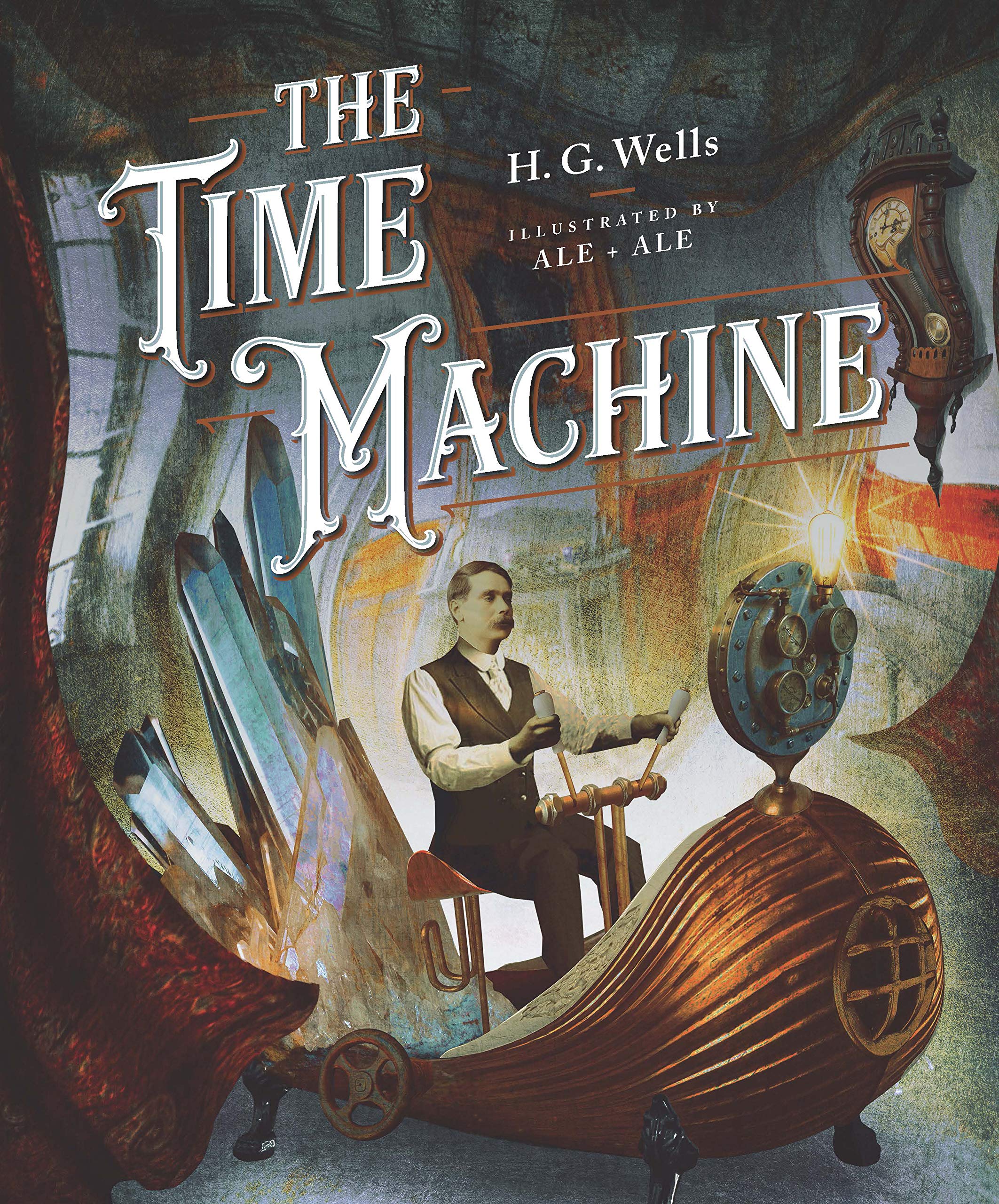
We are to shape our state in a world of uncertain seasons, sudden catastrophes, antagonistic diseases, inimical beasts and vermin, out of men and women of the like passions, the like uncertainties of mood and desire to our own.”. Examine the Time Machine as a static utopian fiction contrasting critical perspectives of kinetic utopia highlighted in the commentary.

H.G. Wells' time traveler surmounts to venture upon his adventuresome journey in aftermath of the narrator’s dialect to ‘consider I have been speculating upon the destinies of our race”, the epilogue of the novel where the narrator suggests, “He [ …] thought but less cheeringly of the Advancement of Mankind, and saw in the growing pile of the civilization, only a  foolish heaping that must inevitably fall back upon and destroy its makers in the end.” The time traveller’s futuristic analyses of the society of Victorian England are extrapolations of close surface similarities of male and female Eloi community between adults and children alike, where forth the author concludes, “the strength of the man, the softness of the woman, the institution of the family, the differentiation of the occupations are merely militant necessities of an age of physical force.

The science fantasies are offered as so many cautionary fables, so many dreadful warnings to humanity to look to itself, to take stockings from its current sick condition and remedy it before it is too late. Population control, childbearing and childrearing decline of motherhood, falling stoicism of menial chores or physical labour in males, will show less differentiation and consequent immaturity into adulthood, such leisure brings, leads the Time Traveller to observe that, “children seemed to my eyes to be but the miniatures of their parents.”

Morlockian cannibalism satirizes the burgeoning working class proletarian revolution in the tumultuous turmoil wrecked by the upsurge of militant trade unionism particularly left wing labour party political organization. Earlier the Eloi had rose to ascendancy but subsequently dethroned by Morlockians, since the latter possessed initiative in the face of adversity. Industry and working-class accommodation were removed from the surface of the earth and buried underground, since all the surface of the earth was bequeathed to be conferred upon the ruling class of aristocracy. In this sense, all the surface of the earth came to be dominated and owned by the enterprises proprietors of Victorian bourgeoisie, “artificial undergrounds that such work as was necessary to the comfort of the daylight, race was done”. The Time Traveller maintains that for his audience, envisioning a society that does not require a great leap of imagination, “even now there [/////] is a tendency to utilize underground as the space for less ornamental purposes, there is the Metropolitan Railway in London, for instance, there are new electric railways and subways, there are underground stations and restaurants, and they increase and multiply.”

It is worth analyzing how the Elois degenerated and eventually were eliminated by the surge of extinction, since they were diminished of their intelligence and their strength in contrast to their subterranean habitats dwelling neighbours subalterns Morlocks; Morlocks possessed the intuitive spirits of resiliency by engagement in productive labor and physical prowess in order to savage damnable starvation and malicious suffocation. Post Darwinian evolutionary adaptations, thus, overthrew the Eloi to their downfall and the Morlocks to their triumphalism in the extremes of individualistic collectivism. The Time Traveller discovers that the Elois privileged aristocracy as the automatic rulers of the earth unearthed the fatal flaw: “that perfect state had lacked one thing even for mechanical perfection-----absolute permanency.”

The Time Traveller believes that middle-class inbreeding was fundamental and crucial to the slit in the humanity produced by the Eloi and the Morlocks, with the widening gulf between classes, being the result of the promotion by intermarriage, which at present, retards the splitting of our species along the lines of social stratification, becoming lesser and lesser frequent.” An animal in harmony with its environment is a perfect mechanism. Nature never appeals to intelligence unless habit and instinct are useless. There is no intelligence when there is no change or no need for change….” Eloi over the centuries have adapted so well to their environment that life had become instinctual once again.

However, when considering the Morlocks the opposite must be the case: “It is a law of nature to overlook, that intellectual versatility is the compensation for change, danger and trouble….Only those animals partake intelligence that have to meet a huge variety of needs and dangers.”  Food crises reinforced these minion ant like creatures to prey and preserve their cattled like creatures upperworlder masters Eloi. Event the writer prolifically exclaims in astonishment, “I was surprised to find it had been carefully oiled and cleaned. I had suspected that the Morlocks, had even partially taken it to pieces while trying in their dim way to grasp its purpose.”

Robert M Philmus points out that, “by 802/701 no species has the intelligence anymore to set limits on the struggles for existence, in where the defenseless Eloi fall victim to the carnivorous Morlocks. Furthermore, the Morlocks are unable to walk upon the surface of the earth due to their blindness in daylight and their new role as exploiters of the upperworld Eloi simply reverses the old equation rather than changes its nature. Thus the story ends with the general biological devolution and the destruction of the planet as witnessed by the Time Traveller in his “Future Vision”.

In valedictory argument, Mc Connell’s critical interpretation is a justifiable approach to vindicate the Time Machine as a static utopian fiction, “The environment will inevitably change upon the course of geological, cosmological time. And the species that has been too close at home with one phase of climate and ecology will probably lose the resiliency to change and meet the demands of another phase.”

Further Reading and References

John S Partington’s The Time Machine and A Modern Utopia: The Static and Kinetic Utopias of the Early H.G. Well’s, Utopian Studies, 2002, Vol. 13, No. 1, pages: 57-68.
HG Wells’ The Time Machine Reviewed –archive, 1895 The Guardian
In the Evening

In the evening the sun sets in the west
The breath of the day
Left in the horizontal blue sky
Then the nature takes its new shape
The birds' chirping as it were
Bids the sun calling---
"Good bye", "Good bye", "Good bye" -----.

07 August, 2023

Monira Mahbub is a student of grade 6 in Nawabganj Government Girls' High School, Chapainawabganj, Bangladesh.
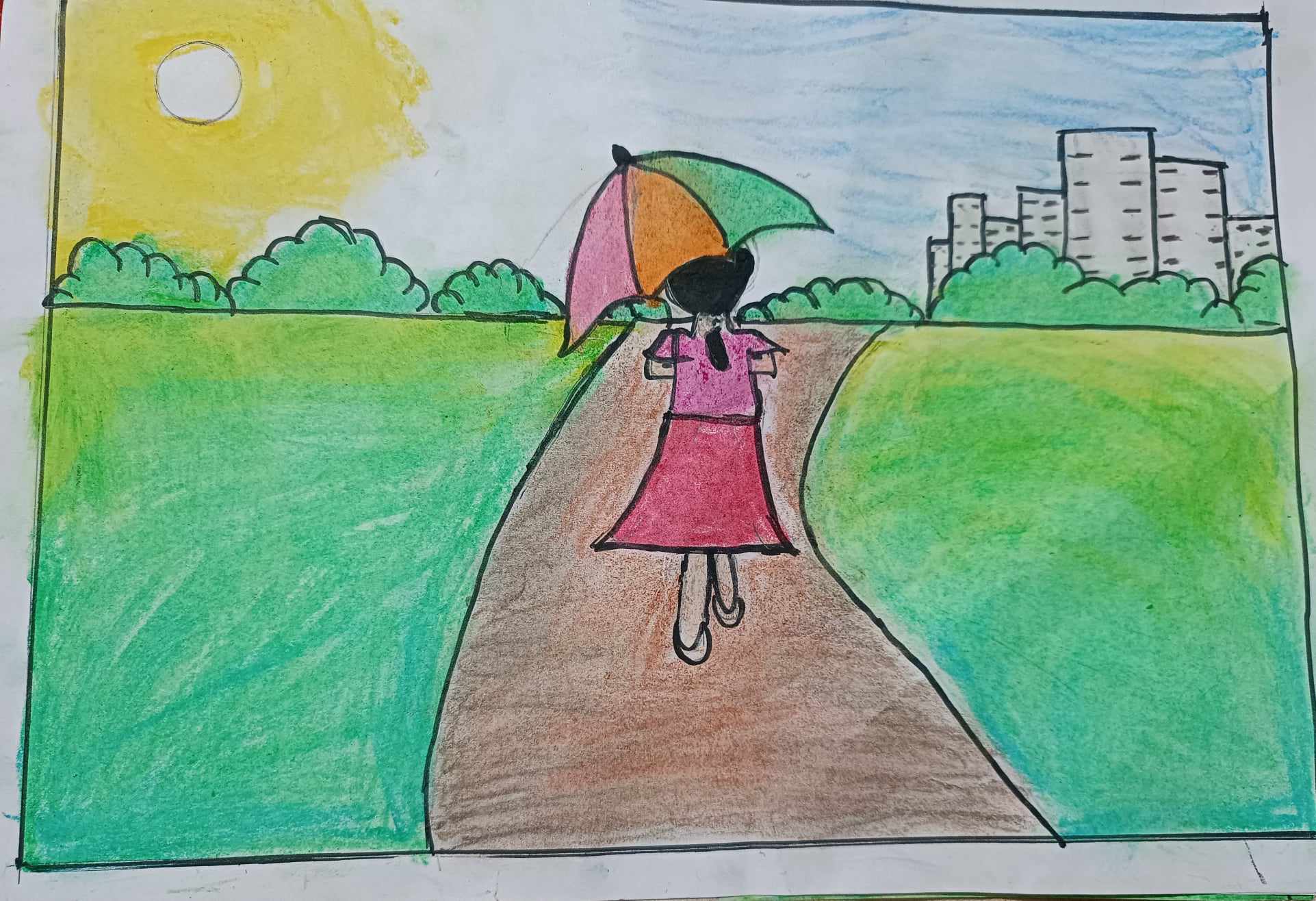
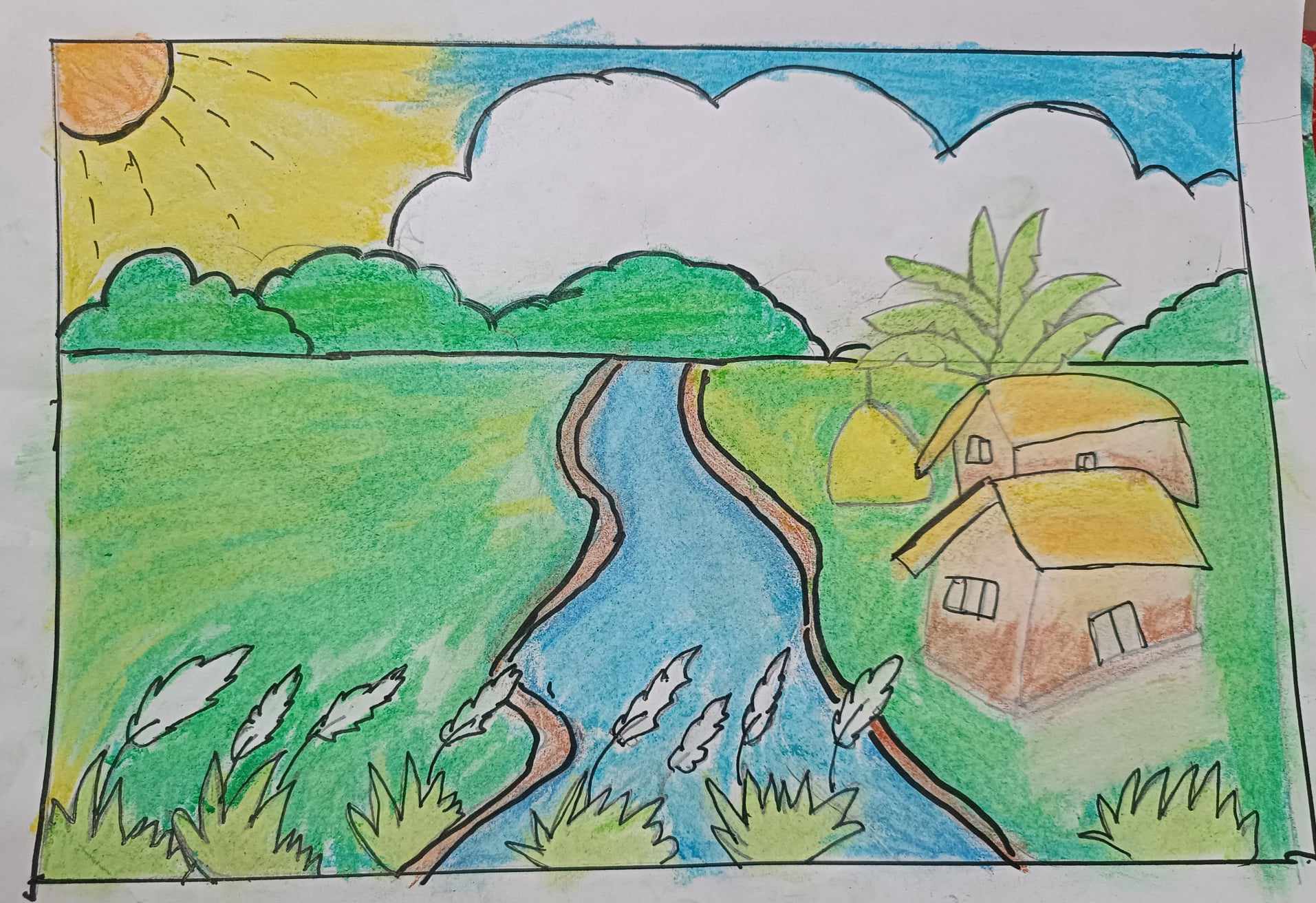
Art from Monira MahbubArt by Monira MahbubArt by Monira Mahbub
They walked on just like in the old days where windows and doors slid by bounded all over with bright sills and thick frames on the one side flat hard ‘men down the bottom and off’n that udder size the chainlink just flew egg yip the chainlink just flew so much and damned faster if ya pushed your hand in it it’d pop it clear off—left right left right booted-down solidly flowing, they flowed to the very Jai alai court’s entrance as every day lately but stopped up short again by the fact of a brand new shiny red super stock coinslot-drop machine on a post by the door and again this’ so new’s so worth saying through them about itself, What the hell is that?
A place to drop a coin. Like when buying something from a machine. You know. A coin-slot half zipper. Like that it is. And like that and like that.
But there’s nothing to buy there.
Oh well {ho hum} there is it anyway. Who cares? Go in, all clocks are ticking and, so; they passed by that mystery and went dear Jesus thank God and our into fling fly pop whizz catch slide big lucky stars we found Jai run look squeak, again alai fling fly pop whizz alai, Jai catch slide Jai alai isn’t it great, great run look squeak, again fun? { whizz alai w } Yes God fling fly pop damn it to whizz catch slide run hell, it’s great look squeak, again fun yes it’s fun—then then several slides in succession slid away all previous slides each slide’s a day seven slides are a week and about ten or less smaller tense intervals in the vast central in-between passed until one day on approaching the door of the Ja’a ‘lai center { whizz alai w } [ and more praise the son more timely and earlier even no sass ass be-frore, you didn’t know from before but you been told right now WHOOP ] there stood by the coin box a yellow-clad worker slash (/////) like that, attendant { whizz alai w whizz alai w } pushed out a hand.
Hold it and stop. Hold it. Stop.
Uh. Uh. What? Why?
Here, said the attendant, palming straight at them one single coin.
What’s that?
A coin. Take it.
Why? they said, as they took it.
Push it in the coin slot there.
Why?
Just push it.
And the coin got manipulated to the necessary angle ‘tween the necessary two fingers held totally correctly to get dropped smooth’d n’gone into the dark slot, and the attendant said, before even being looked at and asked, Okay there now, what Okay thanks, go on in. You can go right in now, have a nice day, a nice day, what the hell was that all about? Have a day, a hell of a nice day—and they did, but still, on in over’n, What the hell was that all about, hoo hoo, what the hell was that all about, anyway. But.
hoo hoo
But.
hoo hoo
hoo hoo
hoo hoo
And all, but; so that melted into the frame of every day after that the walk to the center the stop for the coin game the tip t’ th’ hen-tendant became an expected part of the frame of every day, until, now again. What the hell is this, again what the hell is this sᴉɥʇ sᴉ ןןǝɥ ǝɥʇ ʇɐɥM Mɥɐ ɥǝןן ᴉs what the ʇɥᴉs siht hell is this now si lleh anyway what eht tahW the hell is this?
Slow down slow down slower and slower and : what the hell’s this anyway : ?? stop.
The attendant still stood and the coin box also but to the side got tacked up by s’buedy a type of vertical narrow control panel with three buttons | approx. | Kevin Seltzer? Who the hell is Kevin Seltzer? arranged one’s top’d the other and as usual the attendant held out the coin but bu-they did say {which one’s say’d matteh? No which ones say’d matteh} Grovel Conical (wow what a corporately appropriate t’ – never mind that + my name is Kevin Seltzer and I’m happy to speak to you today about your brand new career with Grovel Conical * biggest single superior supplier of conicals to the military industrial quite complex community half the world wide already and growing beat ya to it beat ya did beat ya * uh oh + as the took the coin from them, What is this here? These buttons here? What is? What is it we are to do with these buttons here, or-r-r-r- are we to do nothing at all? Think ‘cause you’re telling us nothing it’s do nothing at all and the coin, slipping home, told ‘th its tinkly-tink the attendant to say that the new procedure is to press one of the buttons after depositing the coin’s teensy tinkly-tink and then the wide double doors will swing open and you may enter and be seated.
Huh?
Enter and be seated? This is a Jai alai court no no no show?
The attendant replied, This is the script I must follow to tell you I was told to do so and so do so I will here you go = the new procedure is to press one of the buttons : which button doesn’t matter any button why’s there three buttons my my aren’t you the busy brained little one aren’t you ha ha : ^ scratch the “cute child” up top o’ th’a’ad ^ after depositing the coin and then the wide double doors will swing open and you may enter and be seated.
They stood blank, not just them, but that, also—this attendant’s ‘gun acting more like a that than an a t’ them—to be nice is always fine fallback when in doubt—being nice, say fine parents world-wide—being nice you cannot go wrong with a career at Grovel Conical always pays you will never get in trouble being nice—being nice, say fine parents world-wide—Kevin Seltzer? Who the hell is Kevin Seltzer? being nice always pays you will never get in trouble being nice—{I am sorry I am so sorry but this is the way the management says we must push out into for a while “please be seated”} No. you cannot go wrong with a career at Grovel Conical the new procedure No—to be nice is always new procedure is to fine fallback when in doubt—being is {wrapped all in towels} to press one of the buttons nice, say fine Kevin Seltzer? Who the hell is Kevin Seltzer? parents the buttons after depositing the coin world-wide—being nice always pays the coin and then the wide double doors will swing open you will never get in trouble being nice—will swing open and you may enter being nice, say fine parents world-wide—being nice you may enter and be seated you cannot go wrong with a career at Grovel Conical always pays you may enter and be seated will never get in trouble being nice—{I am sorry I am so sorry but this is the way you may enter and be seated and the show will start the management says we must push Kevin Seltzer? Who the hell is Kevin Seltzer? out into for a while “please be seated”} on time because No. on time because it is No. mandated that the show should start on time and you cannot go wrong with a career at Grovel Conical therefore—please go in and “be seated” since the show will start on time because the show always has and always will start precisely on time.
Innocence


Two families lived peacefully in a suburb of Jacmel, capital of the southeastern department of the Republic of Haiti. They are herders. Both families were well respected in the neighborhood.


One day, the Jean family was furious to see that their goat was killed by a member of the Joseph family under the famous pretext that the animal ate a few plants of corn in their garden. This unfortunate situation caused a fierce argument to the point of seeking to kill each other.

That same day, in the afternoon, the two families would face off in a fight with daggers drawn. This is when they noticed from afar two children who were flying a kite together. They were very happy, and they were playing like two wild children.


Suddenly, the two families were reconciled because one child belonged to the Jean family and the other to the Joseph family.


~Roodly Laurore

_________________________________________________

L’ innocence


Deux familles vivaient paisiblement dans un banlieue de Jacmel, chef lieu du département du Sud-est de la république d'Haïti. Elles faisaient de l'élevage. Les deux familles étaient très respectées dans le quartier.


Un jour, la famille Jean était furieuse de voir que son cabrit a été tué par un membre de la famille Joseph sous le fameux prétexte que l'animal a mangé quelques pieds de maïs dans son jardin. Cette malheureuse situation a provoqué une dispute farouche au point qu'elles cherchaient à s'entretuer.


Le même jour, dans l'après-midi, les deux familles allaient s'affronter dans un combat à couteaux tirés. C'est ainsi qu'elles ont remarqué de loin deux enfants qui montaient ensemble un cerf-volant. Ils étaient très heureux, ils jouaient comme deux fous.


Tout à coup, les deux familles se sont réconciliées parce que les deux enfants appartenaient l'un à la famille Jean et l'autre à la famille Joseph.


Roodly Laurore

________________________________________________


Roodly Laurore was born and raised in Haiti. He is an engineer and poet. His poems are published & forthcoming in Spirit Fire Review, Taos Journal of Poetry, Kosmos Journal, Autism Parenting Magazine; Solstice Literary Magazine, The New Verse News, Synchronized Chaos, Jerry Jazz Musician and others.  His writing & spiritual life touches the lives of everyone who knows him.  He's a role model in his community!
When The Heart Becomes An Artifact


For few it begins with the first kiss,
While for most it is a game of hit and miss.
Hoping for the one solid contact bringing them home;
Landing in the yard with picket fence and garden gnome.
Holding out for love's holy grail,
Losing more of their selves the more they fail.
Always on the lookout, hoping to find
That one arti.....WAIT....STOP....rewind.
When the heart aches and the earth quakes
Just hope it doesn't open to a pit of snakes.
I've fallen so often it's hard to tell
Just how often and deep I fell.
In a long forgotten hell I was sure I found the one
That would forever shine like the Sun.
Just a dream that toyed with my heart,
And I watched the Moirai take that future apart.
Sorrow fell upon me like raiders of a lost heart.
The darkness deep within picked me apart.
In this love I was alone
Searching for the philosopher's stone.
Trying to make love out of pain.
Trying to make sense of a stain
But that dream did in fact
only make my heart an artifact.
Burning blood became cold
Until I finally found my gold.
And this love is in fact
The only true artifact.


The Code Says I am a Number


Minority Report should have been a warning not a template
And yet we have judicial A.I. we will soon regret.
Emotionless computers judging the human factor
Non empathetic hardware trying to correct human error.
A.I. : Artificial Intelligence; Algorythmic Inqisitor
Tomorrow's dark future is here today;
More and more human purpose being taken away.
Facial recognition assessing job applicants; qualifications exempt.
A false interpreted expression can block the best attempt.
Bots deciding what we can and can not say;
Taking human rights to express away.
Do we still have control or causing a butterfly effect?
What more do we have to expect?
Humans are becoming the minority
Code is taking up the majority.


Author Biography

From South-Western, Michigan, Jerry Langdon lives in Germany since the early 90's. He is an Artist and Poet. His works bathe in a darker side of emotion and fantasy. He has released five books of Poetry titled "Temperate Darkness an Behind the Twilight Veil", “Death and other cold things” “Rollercoaster Heart” and “Frosted Dreams” Jerry is also the editor and publisher of the literary magazine Raven Cage Zine poetry and prose. His poetic inspirations are derived from poets such as Edgar Allen Poe, Robert Frost and Henry Wadsworth Longfellow. As well as from various Rock Bands. His apparently twisted mind, twists and intertwines fantasy with reality.
Dream

Dream is a condition of mind
I really feel anxious when I miss to find
My family members expect that
I would be a doctor
But it is a major fact
If I become a teacher
It is the step of grandmaster
Everybody wants to know my dream
But I say, it is future stream.
Different people, different dreamer
Always moving with their fervor
Dream is not remaining on the bed,
It will be gained with farfetched
It needs to face the reality besides imaginative
Hence, it's going on the proceed.

Nurujjaman is a student of grade 9 in Harimohan Government High School, Chapainawabganj,
Bangladesh.
After the Wake (originally published at The Gorko Gazette)

Yellow wallpaper
peels
behind faded pictures
in dusty frames,
falling to the floor
in ashen drifts—ephemeral—
of births and wakes,
stabbing
to the heart
like first kisses
or cold sips
of Orange Crush
but dulled
from memory
(and time)
like giftless Christmases
and old calico,
drying on the line.
What ghosts roam these halls,
haunting bowls
of waxed fruit
and glass doorknobs,
lingering ‘round chicken coops,
dust bunnies,
and jelly jar glasses
like palls
or the bitter of burnt almonds.
As a pale pink echo
of rose
peeks through the air’s must,
a voice whispers, “Remember this. Now,”
leaving me to chuckle and smile.

How silly it is to mourn life as we live it.


Indigo (originally published at San Antonio Review)

The curtains pull ‘cross the landscape behind my eyes—the way they do on days like this—emerged from sleep, from splashes of water in the basin and black coffee past a sugared tongue. Silently, I praise drip-dried epiphanies that swirl and stir beneath drowsy lids, over smoking toasters and morning papers, rousing consciousness with gentle shocks like chewing aluminum foil and the last lick of a taser’s kiss. There’s a blue sky outside. A blue blue. The bluest blue. The kind of blue that bruises the sky before its skin splits, (re)submerging us with splashes (more) of an angry rain that dismantles but doesn’t drown, diminishes but doesn’t destroy. Indigo is its color—Indigo, the King of Blue.

It’s a violet field, trampled by God’s thumb and the hard souls of saints, raining down blessings of sweet water—like napalm set aflame by the perfumed blood of petals—upon waking earth and trees, parking lots and sidewalks, and skin, leaving scars and cold scorches and ghosts. It smells like cuts and mud and shit. It smells like indigo—Indigo, the King of Blue.

Longing is deep for the cold comforts of my walls and drawn curtains. The cool blazes of artificial suns in every room. The scent of dog and recycled breath coming from the AC. But I hear the call of the rain (I always do, it seems)—for all it takes and gives, for the cold it brings and the loans it calls in—and it draws me back, again, again, and again—a shade haunting the pane.

Today, I feel indigo—Indigo, King of the Blues.


Slam! (originally published at The Gorko Gazette)

Disturbing white calm,
lightning strikes
conjure storms
in coffee cups

and sleepy inkwells,
baptizing words
in snaps
and rolling alliterations—
obliterations—
of sweet ether
and strums
of liars’ strings.
Drops
of fire
on wanting eardrums
(and moistened seats)
sharpen sterling tongues
like whetstones
to a razor’s kiss
for a night’s slice
and dice.
How cuts flow, sweetly.


Sour Grapes (originally published at DED Poetry)

Crumb’ling truths
and destinies, entwined,
fray
and crumble
to dust
at the speed of
rushes o’ blood
to cuckolded cheeks,
boiling tears
and setting fire to the rain,
melting
souring
this love—
a wounded fruit—like
ice cream
left
in the sun
too
long.


Last Rights of Fire Thieves (originally published at Fahmidan Journal)

Moments
before the viewing,
before your newfound family piled in
and my aunts and uncles, dear (long gone
since the judge’s decree),
the black hole
between
us
collapsed
upon itself
to the silent ring of destiny
and cruelty of crossed stars.
How small (so frail) you seemed,
since Fate’s last kiss upon our lips,
like lint on God’s shoulder
or a water-colored echo
of giants.
And angry. So angry,
you were, to give up the ghost
with a scowl I’ve long since seen
no mortician’s palette
could ever begin to stave.
Funny
how true nature
rises
past the crud—a soured cream—
when one
decides, finally,
to get out of the way.
But,
here we are, again,
this time trading secrets,
eating crow
cold to the bone.
I’ll keep yours
behind our brown eyes,
‘hind latches and catches,
lock and key.
I’ll hold them close
like babes and beatitudes—
bullets and blood clots—
if you’ll keep mine.
Just look at us,
a couple of fire thieves,
carbon copies
left out in the cold,
forever looking,
looking for warmth,
forever looking
where there ever was none,
forever looking
finding none.

So,
this is “Goodbye”—
maybe
“See you later.”
Don’t try to find me
(There’s no point,
now.)
and I promise
I won’t call.