
God's Confession

I was sitting alone
In a god-forsaken bar
the Cosmos Bar in Soi Cowboy
 Bangkok, Thailand

On the lunatic fringes of society
Twenty drinks too sober
In the ass end
of a Friday night booze binge

On the bad part of town
Over by railroad tracks
Heading to hell
As fast as I could drank it down

Enjoying my lonely drink
Drinking by my lonesome self
With my partners

Jimmy Bean, Jack Daniels,
The Walker brother
Evan Williams And his old Granddad

Just drinking one bourbon,
 one scotch, and one beer
and hanging
with Jack Daniel's
gentlemen’s club

A crazed bum
With a thousand-year stare
Walks up to me

He begins
Muttering to himself
Nutty nonsense

Crazy words
In a lunatic's voice

He had the look
Of one possessed
By his demons

Only he can see
Or hear

Possessed
by a secret knowledge
Only he knew

Despite myself
I was fascinated
By this lunatic's tale

So I stopped him
And said

“Say, crazy little Dude!
So what's your game, Anyway?”

The short little dude
Stopped his insane prattle

Starting at me
With that
 thousand-year-old stare

Just another
washed-up lunatic
Too many drugs

His mind blown away
Down too many rabbit holes
Too many bad nights
On the wrong side of life

An ACID causality
From the 60s
Been down so long
It looks like
up to him

He looked at me
And proclaimed his story

He reared up
And filled up the room
And lifted the bar

On his finger
And stared down at me
From the sky

And said

“Since you asked
I am Allah
The Alpha and Omega
Ganesh
Kali
Jupiter
Jehovah
Shiva
Zeus
And a billion other names
The real deal
The original dude of dudes
The Sultan of Swing
God of hosts
And the father of that Jesus dude

But no one knows me
Any more
No one cares
They think I am irrelevant
They think I am dead
They think I am a fairy tale
From some olden, ancient time
That my work is done

I looked at him
Carefully now

And what did I see
An old man
With that lunatic look

But there was something else
He was crazy

Sure. Yeah
Out there
Bat sh… looney tunes


But perhaps
he was the real deal
I mean why not

In this materialistic age
Why would God not be
a wandering lunatic
wandering around loose

Talking to low lives like me
In a bar
On the highway to hell

So I looked at him
And invited him to share
His tale of cosmic woe

God tells me

“Well, it's like this
Many a year ago
People believed in me
But one day
They quit believing in me
they moved on

And they went on without me
As they left me
My powers got weaker and weaker

And so eventually I became
What you see today

A broken-down drunk
Hanging out
Looking for a handout
Looking for some company
Or at least a free dinner”

And he laughed
and laughed

And I looked at him
And saw
the beginnings of the end
And the ends
of the beginnings

I saw a million planets
Flash by
Trillions of people
Thinking all at once

Thoughts filled my head
Lights flashed
And I knew

He was telling the truth
But it did not matter

In this day and age
Of materialism

God has no role
God is truly dead
And so I bought him a drink

And walked out of the bar
still twenty drinks too sober
Profoundly saddened
From what I had seen

God was dead
And we had all conspired
To kill him

Long live God
Category Archives: CHAOS
Christopher Bernard reviews Cal Performances’ Blank Out, an opera by Michel van der Aa
The Trauma of Memory
Blank Out
Cal Performances
Berkeley
How many of us have ever been caught in a lie? Or caught others in a lie? Or caught ourselves in a lie – to ourselves?
It’s likely few can say, to any of these questions, “Not me. No. Not ever.”
Though when it comes to a trauma – an accident, a crime, a moment of misjudgment with catastrophic consequences – there may be many who adamantly assert, “No! Not me! Not ever!”
Blank Out, a compelling chamber opera by the Dutch composer Michel van der Aa, who conceived, directed and developed its libretto, probed these and related matters in a violently imaginative way – enigmatic at first, sometimes mystifying, but in the end deeply moving – at a performance I saw at UC Berkeley’s Zellerbach Hall on a recent April evening.
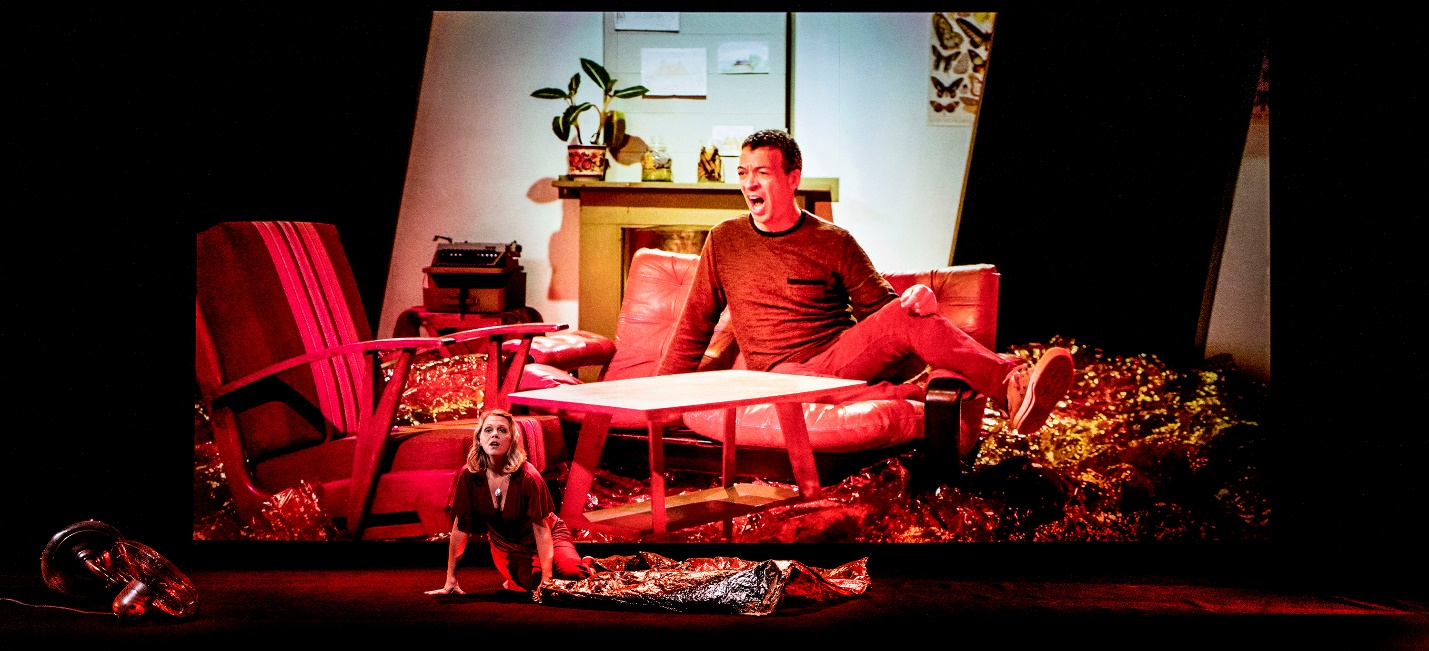
A work that addresses the psyche’s dialectics of reality and denial in the aftermath of loss, it bracingly incorporates film, music and live action to examine the darker corners of authenticity. In the opening act of what amounts to a three-act drama played without pause, a beautiful young woman (played by Sweden’s celebrated Mozart soprano Miah Persson) takes the stage to sing, in fragments of sometimes surreal verse, of an event long ago at her seaside home – an event she must relive over and again, without end or resolution, in which her young son disobeyed her orders not to go out further in the water than “up to his belly button,” and drowned.
A screen projects at first one, then two images of her as she sings in duet, then in trio with herself. She unwinds a bit of narrow cloth from a spool. She walks to a table at the edge of the stage and manipulates a dollhouse-sized cottage and a fragment of its neighborhood in front of a camera. The image abruptly appears onscreen and she walks and sings before it, creating a curiously uncanny sensation, seeing her blur and blend in with the toy home; memory, fantasy, childhood dream and present-day illusion, enwrapped in a single embodiment.
But there is something off; this is not just an elegy for a lost child, though at one point the woman stops singing and speaks directly to the audience. The lovingly infatuated young mother describes the special joys and oddities of her boy – his games, his little dramas and comedies, his pretending his beach blanket was a flying carpet held to earth by little piles of stones at its corners – with a transparent pleasure that seems to preclude mourning or lament. The lack of tears is both moving and strange. She describes their last evening together, when the television set caught fire and while it was being repaired, they drove in their VW beetle to a nearby eatery for a pizza (his very first).
The screen begins fluctuating between images of the dollhouse cottage and of the real home it is based on, isolated at the far edge of a field and toward which the camera moves as on an angel’s-eye drone. The woman becomes increasingly abstract as images of the boy are seen distantly, just visible turning a corner of the house, when the camera cuts to a close up and the “boy” suddenly dominates the screen – no boy now but a middle-aged man.
The screen projection changes with equal drama: the 3D goggles I was given in the lobby now prove their worth as the film goes three-dimensional, and a dialectical drama between stage and screen – the screen seeming to become an extension of the stage, the stage an extension of the screen – incorporates the drama we are seeing: two fantasies become two realities, two realities two wishful dreams.
The boy’s dream is of what might have been against the overwhelming guilt of reality on that day decades ago: it was not the boy who drowned, but his mother who drowned saving him.
The second act is commanded by the exceptional singing of Roderick Williams as he enacts a dream of loss and remembrance while his young mother fades in and out, sometimes one, sometimes multiple, always alone, on the stage infinitely far away from him: the screen is a wall between them, built of reality and fantasy, of light and stones. He becomes the young boy, playing his carefree games, teasing his mother, tossing melodies back and forth with her, then in anguish remembering his one misstep that led to a loss that cannot be repealed.
The third act is a transcendent blending of the 3D film, the stage, the dollhouse cottage, the actual home and its memories, the music (now combining a chorus with the continuing sampler and electronic accompaniments to the singing), and even the VW beetle, symbol, or perhaps a better word is incarnation of the insouciant joys and silliness of childhood, the happy discovery of pizza, the nightly child’s baths, the boy’s favorite game of jumping from chair to chair in the living room (because touching the “lava-covered” floor would mean instant death), the funny episode with the hot pebbles he once swallowed because he wanted to “taste their heat,” the endless non-tragedies, the exuberant follies, and the one endless tragedy that ended childhood in a rage of flying stones and wrecked car and a storm of autumn leaves and blinding light beneath the silence of the sea.
The choral additions were sung by the Nederlands Kamerkoor. The libretto includes fragments from the writings of the South African poet Ingrid Jonker, who died young of suicide.
_____
Christopher Bernard is a co-editor and founder of Caveat Lector. He is also a novelist, poet and critic as well as essayist. His books include the novels A Spy in the Ruins, Voyage to a Phantom City, and Meditations on Love and Catastrophe at The Liars’ Café, and the poetry collections Chien Lunatique, The Rose Shipwreck, and the award-winning The Socialist’s Garden of Verses, as well as collections of short fiction In the American Night and Dangerous Stories for Boys. His children’s stories If You Ride a Crooked Trolley . . . and The Judgment of Biestia, the opening stories of the Otherwise series, will be published later in 2023.
Essay from Mamatkasimova Sitora
From one street of my life paths...

I remember...My childhood began in a beautiful place called Mirzaabad and still continues in the warm embrace of this place. When I was young, I remember waiting for my mother's hot loaves in the oven to be ready...

I have loved books since I was young. And this light led me to the "Knowledge Competition" held earlier at school. Because I fell in love with the book, I became the absolute winner of the republican stage of this competition. It is not surprising that the feeling of interest in creativity awakened in my heart even then.
  I still remember the first poem I wrote in my school days:

Hello, my daughter-in-law is Spring
I miss you so much
I was waiting for you to come
You are a beautiful garden.
Here, you entered my beautiful nature
Spreading the scent of flowers to the green world,
Now don't go to other countries
Your daughter Sitora will miss you.
It's true, maybe this poem, which came out of my young heart at that time, has no rhyme, no meaning, but it was the first melody of a young heart...

Years have passed since then. The golden pages of the book invited me to Gulistan State University. I remember my high school years...
When I was preparing for Oliykhoh, I read books under an umbrella despite the snowflakes and raindrops falling. Perhaps, because of these hardships, I have achieved the happiness of being a student...
I would like to thank life and fate for these great rewards. I bow down a thousand times to my parents who stood by me and supported me in my bold steps. I still have high hopes for life. Praise be to my God who created me... I am thankful that my life is beautiful and bright...
Currently, I am teaching and educating young people at school 34, Boyovut district. When I see hope for life and confidence in the future in young souls, my interest in life increases. The high status of "MASTER" coming from their tongues makes me hope to live yet. Maybe my life is beautiful with such memorable moments...
Essay by Yodgorova Billurabonu Shuhrat

The essence and development of translation between the 19th and the 20th centuries.

    Communication is the basis for human societies. Contact between communities is the basis for translation. Whether by conflict or cooperation, translation has been involved in the evolution of societies and it has evolved with them. Translation has an effect on the relationships between peoples, between people and power and between power and people. Translation has been instrumental in the formation of writing and literary culture in every European language (‘European’ here refers to more than the geographical area of Europe, as defined today). Indeed, the history of international contact and cultural development, within and beyond Europe, can be traced by noting the routes of translation.

Translation is still of the utmost importance in the affairs of a world that has gone through the rapid technological development called modernization, which furthermore has enhanced international relations to the point where people feel they can legitimately talk of ‘globalization’. While this development is far from having reached all parts of the world in equal measure, it is true that science, media, entertainment, commerce, and the many forms of international relations embrace the globe so extensively now, that translation becomes an almost overwhelming issue, indeed a ‘problem’ (the notion of the ‘problem of translation’ has a long and colourful history). Many see a possible solution in the adoption of a single global language, and it seems that English is well on its way to taking on this international role, as Latin did in the very different circumstances of the Late Middle Ages and Renaissance.

The history of translation theory can in fact be imagined as a set of changing relationships between the relative autonomy of the translated text, or the translator’s actions, and two other concepts: equivalence and function. Equivalence has been understood as “accuracy,” “adequacy,” “correctness,” “correspondence,” “fidelity,” or “identity”; it is a variable notion how the translation is connected to the foreign text. Function has been understood as the potentiality of the translated text to release diverse effects, beginning with the communication of information and the production of a response comparable to the one produced by the foreign text in its own culture. Yet the effects of translation are also social, and they have been harnessed to cultural, economic, and political agendas: evangelical programs, commercial ventures, and colonial projects, as well as the development of languages, national literatures, and avant-garde literary movements. Function is a variable notion of how the translated text is connected to the receiving language and culture. In some periods, such as the 1960s and 1970s, the autonomy of translation is limited by the dominance of thinking about equivalence, and functionalism becomes a solution to a theoretical impasse; in other periods, such as the 1980s and 1990s, autonomy is limited by the dominance of functionalisms, and equivalence is rethought to embrace what were previously treated as shifts or deviations from the foreign text.

      The increasingly interdisciplinary nature of translation studies has multiplied theories of translation. A shared interest in a topic, however, is no guarantee that what is acceptable as a theory in one field or approach will satisfy the conceptual requirements of a theory in others. In the West, from antiquity to the late nineteenth century, theoretical statements about translation fell into traditionally defined areas of thinking about language and culture: literary theory and criticism, rhetoric, grammar, philosophy. And the most frequently cited theorists comprised a fairly limited group. One such catalogue might include: Cicero, Horace, Quintilian, Augustine, Jerome, Dryden, Goethe, Schleiermacher, Arnold, Nietzsche. Twentieth-century translation theory reveals a much expanded range of fields and approaches reflecting the differentiation of modern culture: not only varieties of linguistics, literary criticism, philosophical speculation, and cultural theory, but experimental studies and anthropological fieldwork, as well as translator training and translation practice.

Any account of theoretical concepts and trends must acknowledge the disciplinary sites in which they emerged in order to understand and evaluate them. At the same time, it is possible to locate recurrent themes and celebrated topoi, if not broad areas of agreement. The Latin poet Horace asserted in his Ars Poetica (c. 10 BC) that the poet who resorts to translation should avoid a certain operation—namely, word-for-word rendering—in order to write distinctive poetry. Here the function of translating is to construct poetic authorship. In a lecture entitled “On the Different Methods of Translating” (1813). Moreover, Louis Kelly has argued that a “complete” theory of translation “has three components: specification of function and goal; description and analysis of operations; and critical comment on relationships between goal and operations” (Kelly 1979:1). Kelly is careful to observe that throughout history theorists have tended to emphasize one of these components at the expense of others. The component that receives the greatest emphasis, I would add, often devolves into a recommendation or prescription for good translating.

    It would be interesting to note that translation theory during this period are rooted in German literary and philosophical traditions, in Romanticism, hermeneutics, and existential phenomenology. They assume that language is not so much communicative as constitutive in its representation of thought and reality, and so translation is seen as an interpretation which necessarily reconstitutes and transforms the foreign text. Nineteenth-century theorists and practitioners like Friedrich Schleiermacher and Wilhelm von Humboldt treated translation as a creative force in which specific translation strategies might serve a variety of cultural and social functions, building languages, literatures, and nations. At the start of the twentieth century, these ideas are rethought from the vantage point of modernist movements which prize experiments with literary form as a way of revitalizing culture. Translation is a focus of theoretical speculation and formal innovation.

In conclusion of this scientific research, the main essence of translation process helped to develop that sphere faster and more efficiently during XIX and XXʼs centuries, which nowadays with the contribution of that works, the field of translation is much more improved.

Author: Yodgorova Billurabonu Shuhrat qizi
Student of BukhSU Foreign languages Faculty.
Poem from Lindsey White
Anyone Hungry?

Mom pushes herself away from the table with a loud
squeak from the chair legs. My body
slumps, full from a satisfying meal. I don’t feel like speaking
tonight. My mind is already clouded, but I listen to mom, always loud and dramatic.

Dad’s breathy laugh drifts through the kitchen as my sister finishes her story, and the hum of the heater turns to warm us all.

“Dessert?”, Mom offers, walking back with her homemade
peanut butter pie. I can hear Dad smile without looking at his face. Peanut butter pie is his favorite. My mother sits in front of me, closer to the heater, a woman who is always cold no matter the season.

She makes a comment about my sister. The word “selfish”
slices the air, a knife sharper than what she used to cut
our roast beef. Tension rises with the heat in the kitchen.
Their voices clash against the ceiling.

Dad, complacent to conflict, puts his hands up in a T as if he is a referee.
“Time-out, time-out”, he says.
I stare at the bottom of the heater.

No one hears him. My sister's voice
starts to shake.

Focus
on the hum of the heater.
Focus
on the floor.
Sparks sneak out the edge of
the black box. My heart quickens
its beating. No one notices
a thing, but I see a spark
touch the wood floor, see it grow
into a flame,
stretch its vengeful
fingers towards
my mom's chair.

She screams.
I don’t think.
The cord is right
next to me,
so I reach.

The hum of the heater
stops its singing,
and I am left to stare at the black hole
tattooed on our kitchen floor.
Essay from Sherova Orzigul Alisher
Our new Uzbekistan

Yes, I am that even by the residents of other rich, developed countries I was born in Uzbekistan, a unique country described as a “Paradise land”. First of all, thank God for this. This country is truly a paradise. Its nature, scenery, air, delicacies, friendly and hospitable people, everything is special. Day by day, the example of a new bride in our country is becoming more beautiful and polished. Whether there is a living soul living in this land, whether it is a human, an animal or a plant, everyone is happy to be born in this land, in this wonderful place.

There are countries where you won’t find a single flower that is a symbol of beauty that will bring you a smile and a good mood. There are countries where you cannot find a child who can be a support to his parents who raised him and loved him in his old age. But God’s eyes fell on our country and everything was given in abundance. Alhamdulillah. The leader of our country, our father, our first president, Islam Karimov, did not stop until our country reached this level. They said that they are my people, whether they walk or stand. They saw people as their family members. They paid special attention to us young people. They said to themselves, “Our children must be stronger, more educated, stronger and certainly happier than us!” they put the slogan.

In a word, every Uzbek, along with our compatriots, was able to take an indelible place in the hearts of the people of other countries. Today, their follower, our new president, Shavkat Mirziyaev, is continuing the work of our first president, Islam Karimov, for the peace, prosperity, and further development of our country. They are working day and night for the prosperity of our country, for the peaceful and happy life of our people, for us young people to get a good education and never be inferior to anyone else. After all, isn’t this the land under God’s eyes. The people under God’s eyes? Isn’t this the nation on which the bird of happiness landed?

Yes, this happiness is not for everyone. It is the duty of each of us to preserve this happiness. It is our great goal of every young generation to protect our country, which is growing and developing day by day. Our country is changing day by day, even a person who lives here and goes to study or work in another country for a short period of time comes back and is surprised by the changes. Our country is surprising the world. The leader of our country, our grandfather, is never tired of striving for the prosperity and development of our country, just as the bees never get tired of gathering honey and keeping it.

There is a big difference between Uzbekistan five years ago and today’s Uzbekistan. In a short period of time, the people of our country have achieved great achievements that have made our country take a worthy place in the world community. He introduced a number of reforms and innovations to our country. Our country has entered a qualitatively new stage of its independent development, New Uzbekistan. And this New Uzbekistan is developed on the basis of the principles of friendly cooperation with the world community, strictly following the recognized norms and principles of democracy, human rights and freedoms, and the ultimate goal is to create a free, prosperous and prosperous life for the people. It was proudly mentioned by a number of editors.

The phrase “New Uzbekistan” means, first of all, a new life, new reforms, a new way of life, a new worldview. In this regard, we cannot count the achievements made during the past 5 years. During these 5 years, our country has developed more and has more unique landscapes. It proved that it will not be left behind by other developed beautiful countries. Developed in every way. Of course, these achievements are based on strong knowledge. The owners of this knowledge are our peers, young people, people of our country. After all, our first president Islam Karimov said, “The future of Uzbekistan is in the hands of the youth!” they hardly boasted. This is the future! And Uzbekistan is in the hands of our youth. We must make it more prosperous, raise it further, justify the trust given to us. In a word, we should join hands, tie our waists tightly, and live for the country and the  people with enthusiasm!

For Homeland

My grandfather said, "My child this world is yours.
Gird up your loins, you are a flower in the mountains.
Live for this country, let it be self-sacrificing soul,
Be great like your ancestors, white blood in your veins.

Don't give away your cradle, open to the people your door,
Try with all your heart, may luck be always with you.
This beautiful country is for you, for a black eye is yours
Let's hold hands, let's live for the Motherland too.

Since the new Uzbekistan is being built for us, we should live for our homeland. our country, our people, and work together wholeheartedly. We must justify the trust given to the youth. We need to improve our new Uzbekistan and make it flourish. We are proud to live in such a heavenly country, and it is our main duty to protect every inch of its soil like our own home. It is a dream for some to see the beauty of our new Uzbekistan, and some dream of living in other countries. And we are in this country. We should be thankful that we are among the people whom God loves.
Poetry from Charos Makhamova

Thinking of me, are awake at every step,
When i see you, i feel myself over the moon.
Donʼt refuse, let me lay my head on you lap,
You are always my remedy to my pain.

You sang a lullaby to me over the night,
You calm me down by saying "my daughter".
Let me kiss your beady eyes only a once
Let me lay my on your lap, dear mother.

Such a pity, i donʼt always have time help you
But you always keep me in your heart and mind.
Many years passed since i missed you so much,
Let me lay my on your lap, dear mother.

Your sunshine with an immense kindness
Even the ice melts from your love.
Stroke my head, again kiss my forehead
Let me lay my on your lap, dear mother.

Such a cruel and evil fate cannot test me,
Your prays are a shield and protector.
I forget the whole world, when you tell a story
Let me lay my on your lap, dear mother.
Makhkamova Charos Davron’s daughter. Was born on December 23, 2005 in Orta Chirchik district, Tashkent region. Currently, she is an 11th grade student at the 44th General Secondary School. Articles anda poems were published in newspapers of India, Thailand, the USA, Great Britain, Canada, Australia, and in anthologies sold in 26 countries. The winner of the district stage of the 2022 “Smart Reader” competition.