
Poetry from Hongri Yuan, translated into English by Manu Mangattu

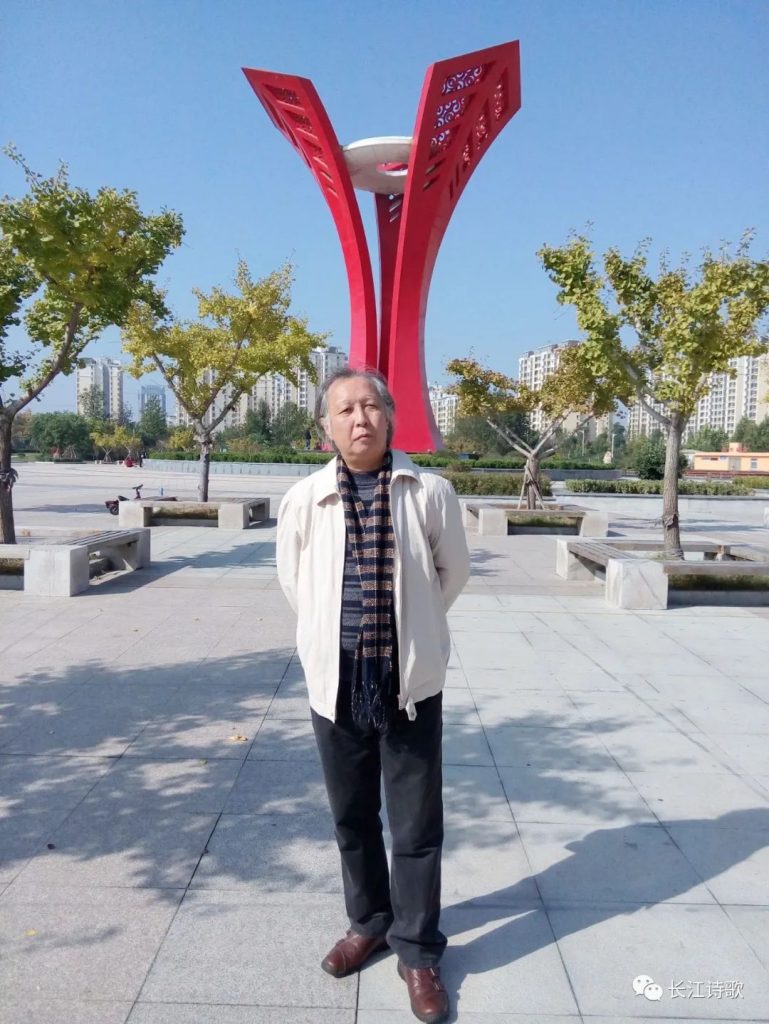
Middle aged Chinese man in a tan jacket and black pants and a scarf standing on a city sidewalk in front of some trees and a tall red sculpture
Poet Hongri Yuan

Five Poems

By Chinese Poet Yuan Hongri

Translated by Manu Mangattu

The Song of the Universe – Thy Song

Sweet soul,

Let thy breath be sweet

Let thine eyes shine as the stars

Reflect about what thou shalt see!

Thou shalt forget the words

The song of the universe is thy song

The peace of the universe is thy peace

If thou shall speak

It is almost like God

Let there be light! And there was light.

宇宙的歌声是你的歌声

甜美的灵魂

让你的呼吸甜美

让你的眼晴多如星辰

想想吧  那时你将看到什么

你将忘了词语

宇宙的歌声是你的歌声

宇宙的宁静是你的宁静

如果你说话

那就如同上帝

要有光  于是就有了光

On Angel Wings Heaven-Bound

Pluck out a star from the night sky above

And let it sing to you within your cranium

It shall bring to you the interplanetary song.

Let thine eyes reach the edge of the Milky Way

The earth is just a small stone;

Yesterday is just a butterfly.

When the angel wings conduct you to the Kingdom of Heaven

Ah! That sweet lightning will indeed make you forget the world.

当天使的翅翼驮来了天国

摘一颗星辰在夜空之上

让它在你的头颅里歌唱

它将带给你星际的乐曲

让你的目光抵达  末来的银河之城

地球只是一枚小小的石头

昨日只是一只蝴蝶

当天使的翅翼驮来了天国

哦  那甜蜜的闪电让你把世界遗忘

Home Sweet Home beyond Milky Way

Nestled in the wings of night

After the pearl gem sets in heaven

I climb to the roof of the earth

To gaze at the star.

Gazing at the star,

To witness the coming century, the city of the giant

Blossom like a silver Garden.

The Music from that mysterious Galaxy

Soothes my soul like the rain.

In the light, let my form alight

Back to my home, beyond the Milky Way.

2015.9.9

银河之外的家园

黑夜的翅翼

镶嵌了天堂的珍珠宝石

我在地球的屋顶之上

向星际凝望

仿佛看见未来世纪的巨城

绽放如白银的花园

来自神秘星系的乐曲

是一阵阵灵魂的甘雨

让我的身体乘光而行

回到了那银河之外的家园

Day and Night in Kingdom of Heaven

Last night, gazing at the stars

I saw those countless gems smile

Numberless from my past life

Limitless in the silver kingdom

Sprang from the light of thought

Forging ahead to superluminal chi

Five hundred years later, or, may I say

After a thousand five hundred years of the world

I saw a giant of a spacecraft

The eyes of those men and women

Were tranquil, serene as a diamond

Then I knew, once and forever: On the new planet,

In the Kingdom of Heaven, there is neither day nor night.

2016.2.8

没有昼夜的天国

昨夜仰望星空

我看见无数个笑容

无数个我的前世

无数个白银的王国

思想的光芒

以超光速驰来

我看见了五百年后

一千五百年后的世界

我看见乘坐飞船的巨人

男男女女的眼睛

宁静的钻石

新的星球之上

没有昼夜的天国

 2016.2.8

Distant Heaven

Often I have a foretaste of the future city of the giant.

The young giants in platinum Villas

The young giants in and out of the great mansion in platinum

And I’m one of them

In the body the sacred flame burns

On the head flickers the signs of zodiac

And the Diamond eyes glimpse the distant kingdom of heaven!

2015.12.28

遥远的天国

我常常看见那未来的巨人之城

那年轻的巨人们  进出于白金巨厦

而我是他们其中的一位

身体里燃烧神圣的火焰

头颅里闪烁巨多的星座

钻石般的目光仿佛看见遥远的天国

Bio: Yuan Hongri (born 1962) is a renowned Chinese mystic, poet, and philosopher. His work has been published in the UK, USA, India, New Zealand, Canada, and Nigeria; his poems have appeared in Poet’s Espresso Review, Orbis, Tipton Poetry Journal, Harbinger Asylum, The Stray Branch, Acumen, Pinyon Review, Taj Mahal Review, Madswirl, Shot Glass Journal, Amethyst Review, The Poetry Village, and other e-zines, anthologies, and journals. His best known works are Platinum City and Golden Giant. His works explore themes of prehistoric and future civilization.

South Asian middle aged man with brown hair and a small beard. Blue collared shirt.
Poet Hongri Yuan

About the Translator

Manu Mangattu is an English Professor, poet, editor, director and rank-holder. He has published 7 books, 73 research articles and 36 conference papers apart from 14 edited volumes with ISBN. He serves as chief editor/editor for various international journals. He has done UGC funded projects and a SWAYAM-MOOC course (Rs 15 lakhs). Besides translations from Chinese and Sanskrit, he writes poetry in English as well as in Indian languages. He was named “Comrade to Poetry China” in 2016. A visiting faculty at various universities and a quintessential bohemian-vagabond, he conducts poetry readings, workshops and lectures when inspired. After an apprenticeship in Shakespeare under Dr. Stephen Greenblatt, he currently guides 23 research scholars and mentors NET English aspirants.

Poetry from J.J. Campbell

White man with a beard and glasses and a beard and a mustache. He's in a room with some music and movie posters on the walls. He has a Black Lives Matter tee shirt with purple text on a black background.
one deadly hoax
 
whispers turn
to screams as
the number of
dead start to
rise
 
this sure is one
deadly hoax
 
it's amazing
to think such
incompetence
still exists in
this day and
age
------------------------------------------------------------------------
parading around as a man
 
purple daydreams
 
the coughing lady
will kill us all
 
just another child
parading around
as a man
 
thank god she
had an abortion
 
any child of yours
would destroy
society as we
know it
 
another sunset alone
 
destiny is a dancer
that teases her big
ass in your face for
a few extra dollars
 
if you're lucky
 
she'll slip off her
mask and lick you
 
you don't want to
know where that

tongue has been
-------------------------------------------------------------------------
from the inside out
 
remember the crazy ones
 
the ones that would call
at four in the morning
because the world was
burning from the inside
out
 
the ones that would get
you so hard you had to
let go on the side of the
road
 
the ones that would ask
for a little dirty talk right
before the meeting with
her boss
 
the ones that told you
you aren't special
 
you have no talent
 
you will be as worthless
as your father
 
that your death will be
as meaningless as your
life
 
the ones that loved you
only to change their minds
 
the ones that stole from you
 
owe you money to this day
 
the ones that never bothered

to remember if you still exist
----------------------------------------------------------------------
the day before thanksgiving
 
the experts
say we might
get some snow
the day before
thanksgiving
 
given the
pandemic
and how
easily it
spreads
 
a little havoc
on what is
usually the
busiest travel
day of the year
 
is probably a

good thing
---------------------------------------------------------------------
checkout lane eleven
 
this fine as fuck
black woman was
working checkout
lane eleven at the
grocery store today
 
i wasn't like these
other lazy white
fucks,
 
i helped her and
bagged my own
groceries
 
she thanked me
over and over
for doing so
 
i laughed and
said not all of
us are evil
 
i'd like to think
she was smiling
under her mask
 
she doesn't want
to know what i
was doing under

mine

Poetry from Mark Young

Remembrance Day

It is eleven minutes past

eleven, on the eleventh day

of the eleventh month, &

I am driving over the Bur-

dekin Bridge remembering

Proust & wondering if it’s

not too late to start a band

which I might call Mark et

Marcel et Le Temps Perdu.

Streaming

She was in the foyer. It

was late at night before

she managed to reach her

personal security team. They

would be with her within

the hour. She dropped her

purse on the divan. Coffee

was what she wanted, but

with no power, how could

she make it? Seagulls were

everywhere though the sea

was far away. Her neighbor

was practising for a coming

concert. She played cello.

There were no witnesses.

the second descent

The poor kid needed a

job. We were trying to

persuade her to go to

grad school or sell car

insurance. But then

the siege of London-

derry arrived over the

transom in the mail.

Cryogenesis

It was a short-lived

thing. She trusted

her instincts. The man

seemed to take stock

of the situation very

quickly. He looked

at her, said: I don’t

have a plan. She smiled.

I have enough for two.

I find it difficult

The Emperor was standing

near my bed. He is plain &

simple, but beautifully made.

Poetry from Ahmad Al-Khatat

A Corpse like a Homeland

My friend said that he would never disappear
Conceivably, the authority found him dead in the
park, he looked like a corpse like a homeland
the more I stayed with him, the more I sobbed

I wanted to read his motherland language of his
eyes, to learn about his country and his household
Unfortunately, it seems that he already read mine
I have forgotten to close the curtains of my griefs

I remember when he used to say that we are drops
of rain from the dark clouds falling miserably dead
on the green grass, where we live alone with a cloudy
mind and heart, we are no longer too loud but quieter

He struggled with being independent, from screaming
in tears and laughing whenever he attended a funeral
”nobody is my friend.” he used to say that while dreaming
of his dead friends from the war, until life closed its door

against him…

Memoir essay from Norman J. Olson

journey of a baby boomer from the country to the suburbs

by:  Norman J. Olson

in 1959, at age 11, I moved from a small failing dairy farm in West Central Wisconsin to the slums of St. Paul, Minnesota’s East Side…

I went from a one room country school set in a sheep pasture, to Erickson Elementary which must have had about 500 kids….  a tough school in what today would be called an “inner city” neighborhood…   we lived upstairs from my mother’s parents in a big old house on Desoto Street (which I thought was named for the car)…  this had once been a nice house with a marble fireplace and a stained glass window over the front stairway, but had been divided into a duplex many years before and was now just another rundown house with brown shake siding on the rundown East Side of St. Paul…   the only tougher area in St. Paul at that time was the black neighborhood on Rondo Street…  which was demolished in the 1970s when the freeway connecting St. Paul to Minneapolis was by some mysterious chance run right down Rondo Street…  through the middle of the city’s black neighborhood…  so much for the “good old days…”

I remember the first night in the new apartment…  it was in late fall so cold weather had set in and the apartment had a space heater…  the farm house had been heated with wood or coal in a parlor furnace and had never been really warm in the winter…  with the natural gas fired space heater, we were amazed that you could make the inside of your house warm like summer, even in the middle of winter and for the first week, we kept it at like 80 degrees in there…  we were so amazed to be really warm in the winter… 

I also had my eyesight checked for the first time that fall and it was discovered that I was extremely near sighted…  I remember going to Dr. Shultz’s office in the old Lowry Medical Arts Building…  going up in the elevator, still a great novelty to me…  and then on the second visit, putting on the eyeglasses and having the world beyond arms reach come into focus… it was amazing to be able to see…  I remember looking out the window of the optometrist’s office and seeing a billboard outlined against the sky and being able to actually see it…  it was so amazing when the world went from being a blur to being something I could see…  no wonder I was not much good at baseball, I realized that other people could actually see the ball… amazing…

going to school was kind of a culture shock…  I was not stupid, but due to my very chaotic homelife, I was not very successful academically after the move…  the teachers were kind and told me I was “college material” if I would only do my school work…  but I just could not make myself do it…  and so was embarrassed every day to be the one in class who did not have their lessons prepared and was always on the verge of failing…  the teachers were mystified…  I think I was mostly just unhappy and depressed…  I would sit in class and draw…  pictures of ships and hot rod cars…  pictures of tough guys in leather jackets…  I was not very good at drawing, so the teachers could not understand why making those crappy looking drawings was more important than doing my school work… 

I did not have a lot of friends but I found that I was good at getting into fights…  I thought I was a tough country guy and could take any of the city slickers…  but it turned out that attitude got me beat up more than a few times…  and those little Italian, Irish and German kids were every bit as tough as I was and mostly much better fighters…  I remember this bigger kid named Karl…  he must have repeated a grade because he was a head taller than the rest of us and in sixth grade already had his hair combed in a cool ducktail…  and wore cool high school type clothes…  while the rest of us could not have combed our hair if we wanted too and dressed like little kids in jeans and polo shirts…  anyway, Karl had beaten me up without even breaking a sweat, or messing up his ducktail…  and so, I waited after school one day…  standing on the stone foundation of the school building which stuck out from the wall and made a stone platform about four feet off the ground…  I waited there because I knew Karl always walked that way leaving the school building…  and so when he went by, I jumped on his back… knocked him down and sat on him and punched for all I was worth until he started to cry….  then I got up and ran because I knew, if he got out from under me, he would kick my ass again…  but from then on, he left me alone…  I think he thought I was crazy… 

but mostly, I just got beat up…  I came home from trips to Wilder Playground with my clothes ripped and a bloody face…  my mom told me to stay away from the playground…  I did not stay away from the playground because that was where everybody went but I eventually wised up and started trying to avoid the tough guys…  I did beat up one kind of effeminate kid that everybody else also beat up…  but then I felt really bad about that for a long time…  I still feel bad about it…  so, had I won any fights, I don’t think I would have felt better about beating people up…  than I felt about being beaten… 

I had a bicycle that I had cobbled together from parts of other bicycles… and I liked to ride around…  I did not go very far, but felt that I was somehow mobile…  that I could go someplace if I really wanted to…  and I knew that someplace, there had to be a world more interesting than the Eastside of St. Paul…  a place like the neighborhoods I saw on television where everybody looked nice and had nice clothes…  where nobody got in fights and where parents were sober and looked at their kids…  I suffered terribly from night terrors, had terrible vivid dreams about being attacked by monsters, vampires and Frankenstein monsters, flying reptiles with human heads…  my mother would hear me screaming and try to sooth me by telling me that it was just dreams…  which helped a little, I think…

I really did not have any friends so would ride my bicycle around by myself…  this bicycle did not have any brakes and so whenever I was on a hill, I had to drag my feet to stop and it really is a wonder that I never was run over… because coming down the Desoto street hill, I could not have stopped for cross traffic under any circumstances… 

I had a cousin who lived in St. Paul, who would take me around to see the sights…  we would take the bus downtown where we would climb up all the steps to the dome of the state capital to see the gold horses…  there was an old mansion across the street from the state capital  that housed the Science Museum…  they had a mummy which we thought was really cool that was kept in a turret at the corner of the old sandstone mansion…  which was kind of creepy but cool in a way that sixth graders could understand…  we liked open stairways and knew of buildings downtown that had open stairways where you could look down over the stair railing and see the floor far below, once you had climbed to a high story… 

I liked to make kites and made box kites out of paper or plastic wrap and lilac sticks… the kites flew very well…  I once made a huge kite in the attic of the house on Desoto street out of a big sheet of plastic I found and some boards…  I had big ideas!!!  but I never tried to fly it…  maybe I realized that it would have taken a hurricane to lift that stupid kite off the ground… and it would not have fit through the attic door anyway…

we lived on Desoto street for two years and then moved to suburban Oakdale…  using my dad’s GI loan, to a housing development that was just being built up in an old farm field…  the contractor had set up model homes and built basements on all the streets and then when a customer came, the contractor would build a house on one of the basements to the plan of one of the model homes…  we used to find salamanders in the basements…  pretty little wet, green lizard like creatures…  and I buried time capsules all over the area…  putting drawings, coins etc. into a jar and then burying the jar near one of the unimproved basements…  this was very much a working class suburb and the residents were mostly people joining the “white flight” from the Eastside of St. Paul, to the bucolic semi urban fields of Oakdale… 

so, my parents went, in about three years, from poverty stricken farmers to working class suburbanites…  and I was along for the ride…

1959 – age 12 in St. Paul, a different (indifferent) universe

summer was sidewalks and

mostly empty streets…  no

more trilliums

and violets…  my own war

had finally begun…

and there I was

unarmed,

nearsighted, confused by

touches

and smells…  sad, frightened and always

in those days, feeling that all I saw

and felt and touched

was like a poorly done theater flat… 

garish…  phony…  too bright

in sunlight…

the entire city scene

and the crowd of people, especially the crowd of people,

was a papier-mâché, plastic, or even gold and ivory mask…

maybe somebody’s gentle

Protestant god hunkered

behind

the mask…  waiting to jump

out at the last minute…  like

some fool

at a lame surprise party…

or maybe nothing…  or maybe

deep wells of space and

time…  a cosmos

of galaxies spinning like

pinwheels

above a black and

            bottomless

            abyss…

or maybe just the gray/black

streets of St. Paul…

Poetry from Mark Murphy

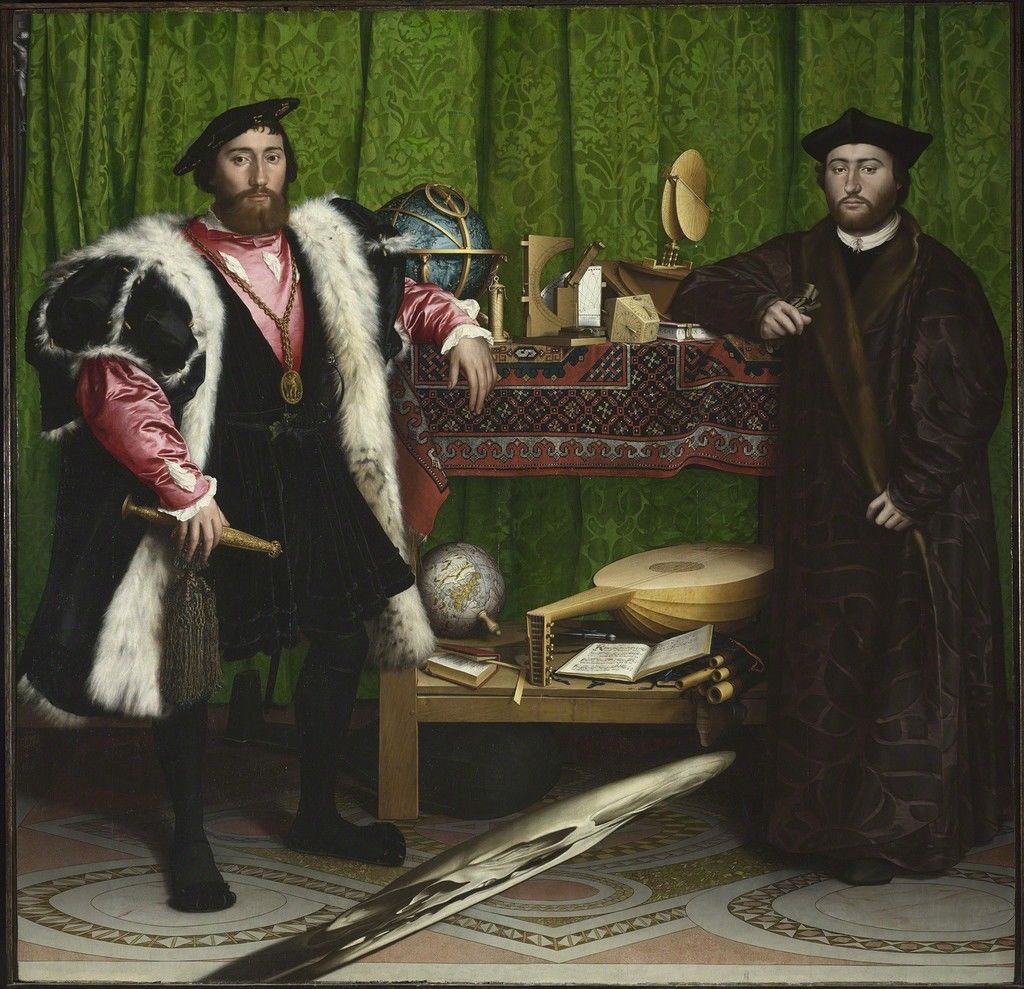
Old fashioned painting of two men from Western history hundreds of years ago, in capes and furs. They are standing in front of a green drape and instruments including a globe, books, microscopes and musical instruments.
The Ambassadors Holbein

Mark A. Murphy

The Ambassadors

 I am the most melancholy, weary and wearisome ambassador 

in the world. — Jean de Dinteville, 1533

‘O wretched mortals,

open your eyes…’

So pleaded Leonardo,

one time for every day.

*

(XLIX)

Of course, the verdant floral 

curtain

deserves another look,

dominating the backdrop. So we step

into Holbein’s puzzling

oil on oak,

painted in the old Flemish School style.

Not only a full length double portrait,

but a meticulously rendered

still life.

An anamorphic mystery,

and rendezvous with death, or memento mori.

A repository of secrets,

and morality tale

memorialising the two childhood friends

and diplomats,

Jean de Dinteville, on the left,

and Georges de Selve, (Bishop of Lavaur)

on the right, posed

amid the chaotic curios of the day,

showcasing two immaculately conceived globes:

One celestial, shows the mythological

constellations

where Cygnus the swan faces the viewer.

One terrestrial, shows Rome

at the geographical centre of the world.

On the higher shelf, we are witness

to a mare’s nest

of astrological and astronomical instruments,

intellectual/revival objet d’art

represented

by the cylindrical shepherd’s dial, a quadrant,

a torquetum,

and a polyhedral sundial.

All devices, for the revelation

of time and cosmos, and still, we are not sure

of the time of day.

Then, on the shelf below,

worldly concerns: A mathematics book

open at the page on division,

one Lutheran Hymnal, one compass,

one set-square,

one lute with a snapped string

and five bundled flutes,

all clues to the pursuits of man. Lower still,

under the bottom shelf,

a discarded lute in full shadow

turned upside down, another signifier

of the earthly life.

*

Have we missed anything, Hans?

— Of course, we have

missed de Dinteville’s

golden ceremonial scabbard,

and gold medallion

featuring the Arch-angel, St Michael,

‘defender of the church,’ killing

the serpent with his spear.

*

In this arcane panel, heaven and earth vie

for our attention.

Even the Cosmati floor

tiled mosaic

with its geometric motifs and Star

of David, boasts

of its ancestry, placing

the two Renaissance men at the centre

of the cosmos.

Now de Selve’s gloves are off

in the battle

between the faiths. He looks suspiciously

at the painter, almost squinting to see

which way he might fall

in the antagonism between King, Emperor and the Holy See.

*

We might conclude, a religious man,

however defensive

in his long damask robe and cleric’s biretta

(like the closed book

he leans on

with his right elbow)

might well have more secrets than the French

Ambassador to England,

who dares us to guess his thoughts

in his salmon satin shirt,

and expensive silk gown lined with lynx fur;

his outfit for the coronation

of Ann Boleyn. Poor (devout) Catherine

of Aragon, ‘humble

and loyal,’ soon to be divorced.

*

What else will we remember of this

Good Friday portrayal

of two young noblemen, landlord

and churchman,

the last entreaty before the great schism

with Rome

putting a brave face on it?

*

At last, in the top left corner of the painting,

we find the last piece

of the puzzle

half concealed

by the closeted green curtain —

the crucified Christ,

God’s gift

to man, awaiting

all believers

in the one true faith, despite the April freeze.

Poetry from R.S. Mengert

Skeptic

Because you see the skull

glaring back in the mirror

like a traffic light,

you think you see

beneath surfaces.

You see yourself a visionary.

If I try to look

beyond the skull,

you think I’ve missed it.

I look out my office window

and all I see are skulls,

even in the daylight. You

wait until it’s dark,

and miss the gray redundancy 

of funerals while you squint

in the yellow haze

of your cheap electric light.

But that’s your way.

You walk into a churchyard

with your plastic sack

full of straw-men and equations

wrapped around your neck.

You smell dirt,

so you think the air

is made of dirt,

and you leave,

afraid to breathe.

Hildegard von Bingen Consoles a Skeptic

Line the decomposing days up end to end

across the velvet dusk. Burn the brickwork

of the tower, and the spiral stairs

to the finite clouds.

(Ash in the earth. Ash becomes the earth.)

Burn the sound, the air, the light that burns

within your head, that bursts the skull

apart with pain, with vision. Burn

until the smoke and ashes

red the coming dawn,

then breathe it in

so it becomes your air, your life.

(Ash in the earth. Ash becomes the earth.)

Separate dead ash

from what has died, and remember

that what burns to ash

cannot be burned again,

that what is earth was once of blood and flesh.

Flesh took form from ash

and then consumed itself with fire

of the soul within. Ash

in the earth. Ash

returns to earth.

What has burned returns, and what returns

will rise again.

Three Days After

The city gleamed on the horizon. The sky

was an impenetrable gray. You did not speak.

An angel stood between us – flaming sword,

glimmering gold armor, face concealed in fire

as we tried to face each other standing

on a charcoal-colored slab of rock in the Nevada desert.

Since your burial on Friday, I had prayed

to see you any way I could, but when I closed my eyes

and waited for a vision or a visitation, only darkness.

Now here we were, and I could barely see you past the blaze

of this imposing force, the fire and the terror,

the metallic glare of blade and armor, the blinding sheen.

I longed to touch you, but I could not move

except to tremble, tried to speak to you, to ask you, why

must it be here, like this, why can we not see each other,

why do you not say a word? but an inarticulate dry gasp

was all that left my burning throat. The angel answered

in an ageless, sexless voice as cold as lead:

From this point on, you will not see her anymore

except like this, with me, a wall of fire separating day

from darkness of the living flesh. And if you see her,

you will not recognize her as she is until it is too late

and she has vanished back into the realm of light.

At that he stepped back, pulled up his sword

so I could see you better. You looked at first

much as you always had, your black silk dress,

your shimmering gold scarf – but your face looked empty,

motionless, pale, your eyes as if stitched shut.

The angel came again between us, his fire

eclipsing you completely. He stood silent, blazing. And I

stood back against the gray,

and cursed his brightness.

The Death of Saint Joan

I.

You did not see a win. The voices blazed brighter than the fire that burned you. Then they stopped. You did not see a win, but waived your shimmering sword against the glare of sun, crown, miter. Fire. The black smoke from your burning body fouled the dimming sky before your dying eyes. You did not blink, but watched in front of you the beggar’s cross, two fastened twigs held skyward by a shaking, unseen hand. The fight was over. All the guiding voices, silenced. Men who held the keys to England’s throne and heaven’s gate had signed your writ. You could not have seen a win.

History is written by those fools, the winners. How they’d love to sanitize you, make you sane, prop you up as practical, mainline. Pragmatic farm-girl with a social worker’s sense. Civic minded. Middle-class. You and I know better. You, my beautiful and butch protectress, my warlord of the gallows and the sanitarium, with sharpened blade, with glimmering quixotic drag, screaming at the sun your stubborn creed, your visionary doom. You, who did not see a win, but leapt, soul first, into the fiery arms of darkness, waiting for an unseen light to catch you.

II.

Chain, embers, shadow. Ashes

on the ground.

Soot and bone dust on the ground.

Dried twigs and branches

singed to scattered fragments,

black and brittle on the ground.

Here the heretic of voice and metal

burned in the waning daylight

while collaborator churchmen, stunned,

watched in muffled horror flesh

reclaimed by fire to eternal void.

Now, the silence of the dusk.

A dagger of white stone

stands up out of the heap of cinder

and charred shackles.

A long dagger of breastbone

sharpened by the flames,

flanked with ash in the growing darkness.

Night. All that is left – heart

become bone, become sword.

III.

I will not see tonight. I will not raise a blade

to silence and the moon of black unseeing fire.

I will embrace the ashes. All I know

is dust that stops all speech, the choking silence

of the final flames, the heart that would not burn,

the desecrated ashes scattered in the unclean river.

My voices are the heretic, sealed

in a metal crypt beneath a sanitarium,

the shrinking daylight screamed to silence

by the burning of the keys, the beggar’s cross.

The fight is over. I do not hold a key

behind the black sky in the smoke of silence

and the burning gallows of the body.

I will embrace the ashes on the ground.

Consubstantial

I was eating one clear night on the hood of my ’83 Buick the Body and Blood of Christ. Not some bowdlerized symbol, mind you, I mean the fleshy substance of the soul in all its agonizing glory, body of unending matter, and of spirit without start or end, and of time collapsed into eternal light beneath the steely moonlight of December in Las Vegas, frozen night pierced with light that poured through stippled punctures in the fabric of the dark. I had not planned it. I only wished to drown the garish noise left from the day. I needed a drink. I drank the wine I found, and that was all. All that is seen and unseen, maker of all that is seen and unseen, burned and trickled down my throat; throat, soul, and self-transformed into the Mother of Creation’s womb as that dark penetrated me, consubstantial with the flesh and fire she bears, Buick rusting and ephemeral beneath the weight of earthbound flesh. I saw that the food was good, the wine as sweet as blood, as thick and effervescent with the heat of life.

When I got back, I found the only one awake, beyond her recent death, the dying light of her apartment burning through the pre-dawn dark, sitting up in what was once her deathbed, golden scarf around her neck, drinking brandy-and-espresso as she waved me in. I told her everything and took a drink. She told me, what you saw is what you’re drinking now, no more or less, and what I drank before your birth, before my own. The wrinkles on her face looked chiseled and eternal. You do not know what you have drunk, she said, but you will die from it with gratitude. Tell anyone you want, but it will only sound like silence of the dark. I tried to ask her what she meant, but all that came out was the shimmering dark music of eternal silence as she slipped back into her celestial night.

Alone and drunk, I stepped back out into the growing dawn and climbed into the shadow of my Buick, a symphony of darkness on my trembling lips.

I completed my MFA in poetry at Syracuse University. My poems have appeared, or are forthcoming, in Gargoyle, Pensive, SurVision, Maintenant, Zymbol, Poetry is Dead, ABZ, Fjords, San Pedro River Review, Four Chambers, Snail Mail Review, Enizagam, and The Café Review. I teach creative writing at Scottsdale Community College.