With experience, this
copper-alloy piece can be used to create a product that includes all the
processes involved in harvesting, production, transportation, &
construction. It eliminates all extremes of elaboration, but forces you to
leave behind your familiar house, street, & neighbors; & prompts a
defection from fixed meaning through the use of non-sequiturs — start off with
Magritte & move on to the navigational abilities of the prostate, from Derrida
on to the venture capital industry.
single-serve liturgies
A railway line runs
im-
mediately behind the
parietal lobe. The
placebo
effect could make
pictures
of classical
architecture
affective as stimulus
mate-
rial. Split-brain syndrome
using different lags
provides
empirical motivation
for
some true effects to
exist
at particular
intervals. Our
RV got rear ended by
a hit
& run driver.
Unlicensed
work is non-free by
default.
trajectory as far as
What we
retain of the
movement is its structured
form. Any steady increase
in template performance
can be processed by the
use of microcontrollers
or some contextualized
analysis of migration &
language diversity. Else-
where, work permits are
only offered to those with
a separate income flow or
the ability to access behind-
the-counter medicines. The
intransigence of light she
found difficult to cope with.
When I stalk the still night, deserted by shadows.
Everyone is imprisoned in their homes.
You take photographs. I let you
See me in my naked wisdom, I turn
Your myths around, the camera can see me too.
Your wide angle, your narrow perspective, the side glance
Doesn’t matter. What matters is matter, and how it thinks
How it changes shape, becomes ape.
How it walks on stilts, my legs lightning.
You measure me metric, call me eight feet, electric.
You chase, I follow you, in a karmic circle
Where yesterday is today but with another name.
I count stars on lazy nights, not with fingers but with toes
Bending inward, breaking the chasms of distance.
Yes, I change shape sometimes, when I feel like it.
In the rain everything will be blurred again.
Today’s light post, tomorrow’s shadow.
I am still alive, if that’s what you want to know.
Though living now is a different matter,
Filled with absence and uncertain wisdom.
I fly on my feet to remind you it can be done.
You are a little short of confidence, need a spring of hope
And though you are all inside, you must not forget who you
are,
What you can be. As for me, I am who I am. Pure matter
That changes form. A spirit, free bird, Ariel, peeping tom,
I am not going to change, but into a bird, or who knows
The next wild thing that comes my way.
Woman of the High Plains
(Dorothea Lange, Woman of the High Plains, 1938)
In one photograph there is a woman
Scorched by sun.
Hand on forehead, another on neck.
She cannot resist a smile,
Where does it comes from?
Something the photographer just told her?
We won’t know. It changes things,
Turns her into an emblem,
Fortitude against the elements.
This is deep desert country. Texas, 1938.
She needs the work, has to keep at it.
Cannot give up. No not now.
Salt dripping the sack she wears.
The horizon beyond the toil. Earth and sky.
No war yet, but enough going on at home.
She stays unnamed. Perhaps the name is hidden in Lange’s
notes.
Notes that say: ‘if you die, you are dead, that’s all’. Her
words.
But she is alive, willing, a survivor.
There is still some time to go.
There will be work today, tomorrow.
We aren’t sure about the day after.
We don’t know what after that. Perhaps a house, in sunny
country
Perhaps olives and vegetables. Perhaps the hint of a smile
Even as the day moves down west.
Twilight and then night. The photographer goes home,
Equipment packed into a box.
The photograph reaches the galleries, eighty years later.
We pause near the exit, return to her
From a million miles away
In another country, almost another world
A familiar worker down the road
A weary deserted path to nowhere. The sight of a day’s wages
The same sad hint of a smile.
Short
Bio: Amlanjyoti Goswami’s poetry has been published in journals
and anthologies around the world, including his recent collection River
Wedding (Poetrywala) which has been widely reviewed. His poems have
also appeared on street walls of Christchurch, exhibitions in Johannesburg, an
e gallery in Brighton and buses in Philadelphia. He has read in various places,
including in New York, Delhi and Boston. He grew up in Guwahati and lives
in Delhi.
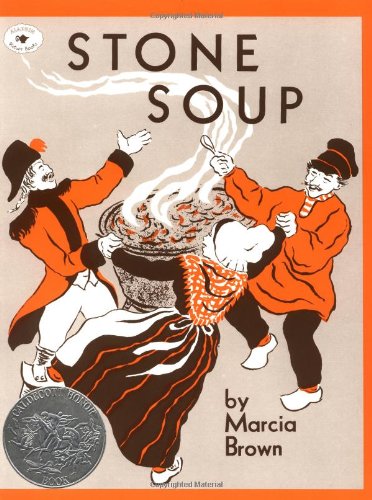
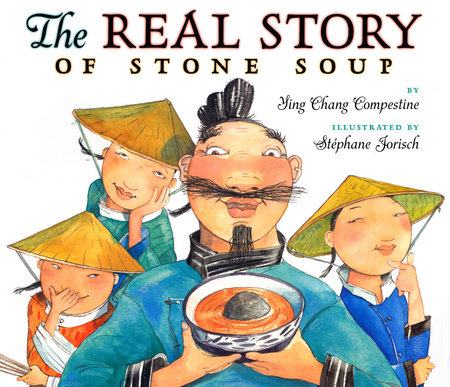
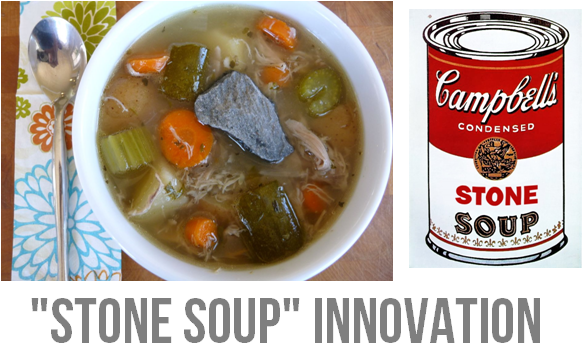
Stone Soup is a European folk story in which hungry strangers convince the people of a town to each share a small amount of their food in order to make a meal that everyone enjoys, and exists as a moral regarding the value of sharing.
Stone Soup can also be taken as a fable about how every person’s small, but unique, contributions can add up to something quite nourishing. That is a wonderful metaphor easily translatable to each issue of Synchronized Chaos.
Right now much of the world is physically distanced from each other, and most people are spending much more time in their homes due to the coronavirus outbreak. Yet we are finding ways to connect, ways to pursue our unique creative gifts and share them with others through virtual community.
I, personally, have been able to interact with a more geographically diverse set of artists and writers than before, visiting virtual versions of events that would have been located far away from me. And I’ve watched each person bring something to the soup pot in the face of illness and grief – whether it’s sadness and trauma, humor, hope, kindness, eccentricity, eclectic knowledge, or confidence, it’s flavored the shared meal. As the old saying goes – no one can do everything, but everyone can do something. And your ‘something,’ whatever it is, can be brought to the table and included.
Ike Boat, the Poetrician from Ghana, versifies about his Facebook friends, who bring him succor and encouragement while he’s in a difficult financial situation at the beginning of his artistic career.
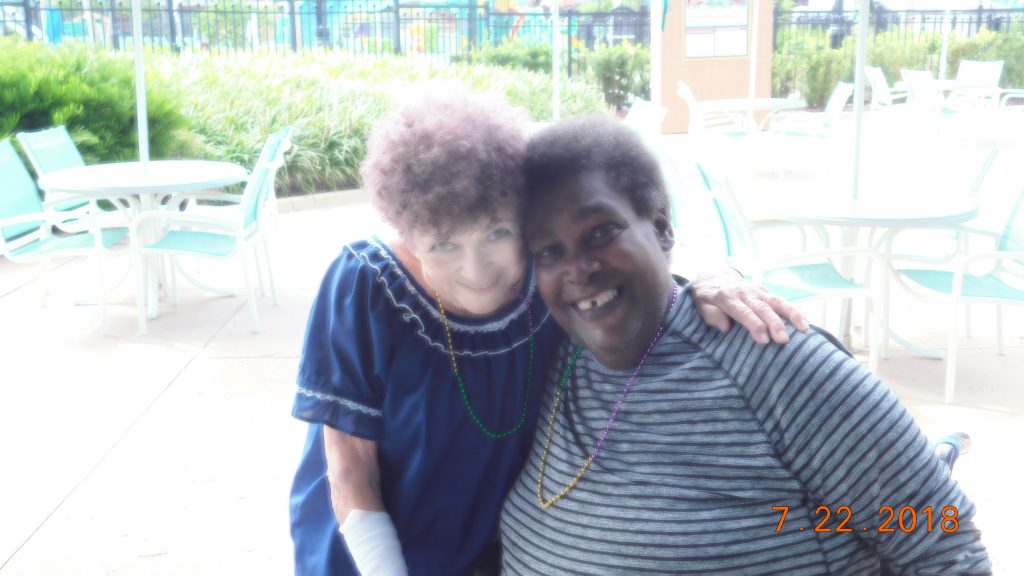
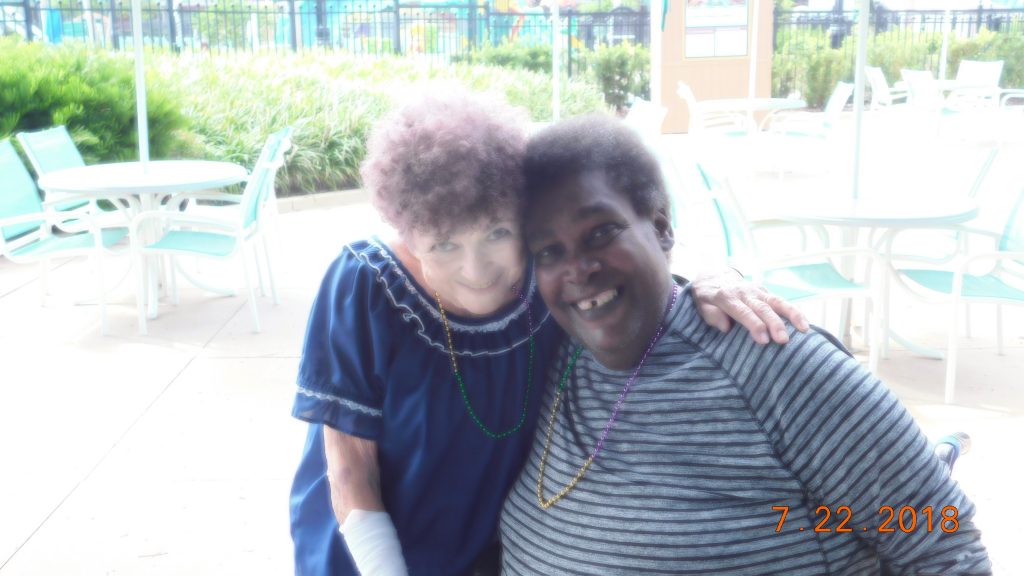
Michael Robinson (right) and fellow contributor Joan Beebe
Weep
In the middle of the night, when the moon is dark, and the clouds black.
In the middle of the night, when all the souls of America stare into the ceiling, the warm tears slowly crawl down their cheeks.
In the middle of their life, it is uncertain if there will be a tomorrow, because a sociopath stands before the cameras and rant.
We weep as a nation when our loved ones are taken away in the hearse without fanfare because there are so many that are dying.
I weep alone in my apartment because there is no one able to mourn the death of so many at one time in our history.
I weep because the war is in our midst, and the Doctors and Nurses are the first casualties in this war.
I weep because my tears cannot save lives.
My tears can not save those who die on a hospital bed in the corridor, with many besides them enclosed in plastic bags.
I weep because there are too many graves filled with someone’s loved one, and the count continues.
In the middle of the night, I weep alone because there are only memories of a time that my tears were joyful as the sound of the National Anthem was a song sung by all the nations.
Body Bags
There are body bags flowing; out of the back door of Brooklyn hospital in New York.
Body bags with someone loved ones And I have no words as the count continues.
Do you know that the bodies will be taken away? To be placed on a slab?
In America, there are thousands of body bags, Bodies in the corridor of the hospitals.
It’s a war without the guns and bombs, It’s a war on our fellow Americans.
It’s a war! When will the body bags stop?
I’m not ready to be taken away in a Boddy bag, And put in a refrigerated truck and carried away.
Are you?
In a war, there are always body bags, In a war, people die alone.
I don’t want to die alone, In a hospital corridor.