This article explores how young people in Uzbekistan are accessing international opportunities through information and communication technologies (ICT). It analyzes key platforms, real-life experiences, and the pathways youth follow to showcase their knowledge and skills globally through global programs, grants, online courses, and international cooperation projects. The article also highlights the importance of digital literacy, language skills, and networking in the digital era.
Keywords:
Information technologies, international opportunities, Uzbek youth, online education, grants, digital literacy, networking, global collaboration.
In today’s digital age, the ability to use information technologies effectively is not only a tool for self-development but also a key to competing in the global arena. Young people now have access to the world’s best courses, scholarships, volunteer programs, and startup competitions via the internet. However, making the most of these opportunities requires not only technical knowledge, but also determination, goal-setting, and a strategic approach.
The number of young Uzbeks accessing international platforms through ICT is steadily increasing. For instance, there are youth who study on platforms such as Coursera, edX, and Khan Academy, completing courses offered by institutions like Google, Meta, and NASA. Uzbek youth are also gaining international recognition by participating in programs of organizations like One Young World , Junior Academy , and UNESCO . These achievements are the result of using technology wisely, learning English, and continuously working on self-improvement.
Social platforms such as Telegram , LinkedIn , and Facebook play a vital role in discovering grant and competition announcements, maintaining a strong personal profile, and building a professional network. Many young Uzbeks are now taking their startups to the international stage with the help of platforms like Devpost , Hackathon , and Google Developers .
Furthermore, international cooperation is expanding in areas such as gender equality, inclusive education, and sustainable development — all supported by ICT tools. Interest in technology among young girls is growing, and they too are earning international recognition.
However, several challenges still exist on this journey — such as slow internet speed, language barriers, misinformation, and financial limitations. These problems can be overcome by using free online courses, joining local mentorship programs, actively monitoring grant platforms, and establishing connections with governmental and non-governmental organizations.
Conclusion
Information technologies are tools — how they are used depends on the youth themselves. In Uzbekistan, an increasing number of young people are using these tools for creativity, innovation, and global integration. This progress is accelerating development across the country. Every young person can define their own destiny and compete globally by leveraging technology.
This article has outlined how Uzbek youth are accessing global opportunities through ICT. Real experiences, platforms, and strategies have shown how they demonstrate their potential. In this process, digital literacy, language skills, and continuous learning play a crucial role. Therefore, every young person should use information technologies as a means to achieve their goals.
References
UNESCO. (2023). Digital Skills for Youth Empowerment .
Coursera.org is an online learning platform.
edX.org – Free Online Courses from Harvard, MIT, and more.
Abstract: This article examines the attention being paid to the education system, reforms currently underway in Uzbekistan’s preschool education, achievements reached through preschool services, and reforms in higher education aimed at accelerating intellectual development.
Keywords: Preschool education, social life, reform, foundation, education and upbringing, globalization, concept, professional competence, material‑technical base.
Today’s young generation, which will determine the future and prospects of our homeland, must be raised with dignity—this is tied to the continuous modernization of education and upbringing. Expanding access to preschool education, improving the quality of preschool services, ensuring favorable conditions for full participation in life, and integrating children into social life are among our most urgent tasks. In New Uzbekistan, comprehensive reforms are underway across all sectors. It is impossible not to emphasize the transformative changes in education—the foundation of society—driven first and foremost by preschool reforms, which play a critical role in preparing children for global realities and in shaping their entry into societal life.
Today, modern kindergartens that meet current standards are being built not only in major cities but also in remote rural areas. Over just five years, the number of preschools in our country has quadrupled. Until recently, preschool teachers—and in some districts even students—were sent to harvest cotton for four months. Thanks to recent reforms, those practices have been eliminated.
In the last five years, educators at preschools have received one‑and‑a‑half times salary increases; the number of educators honored with state awards and participants in national competitions has grown; paperwork has been significantly reduced; and bureaucratic red tape has declined—these changes have paved the way for remarkable improvements in preschool education.
Efforts have also been made to enhance the capacity of personnel in preschool institutions. Regular scientific‑practical seminars and training sessions have been held, introducing innovative ideas and technologies into educational processes and promoting the comprehensive professional development of educators.
Higher education reforms are also a major part of the current transformation in the education sector. In particular, the Concept for the Development of Higher Education in Uzbekistan until 2030 serves as a prelude to these reforms. The Concept aims to expand the enrollment capacity of universities, improve the quality of education, implement digital technologies and education platforms, and involve youth in scientific activities—all of which raise the education process to a new level of quality.
That said, even more important priorities remain before us, requiring our attention. These include further improving the preschool education system, expanding the network of preschool institutions, strengthening their material and technical base, ensuring qualified teaching personnel, and implementing modern educational programs and technologies to foster children’s intellectual, moral–aesthetic, and physical development. Our primary goal is to significantly elevate children’s readiness for school, because our future and destiny rest on the young children growing up in these institutions.
Our esteemed Leader’s words—“The future and prosperity of our country are tied to what kind of people our children grow up to be. Our main duty is to create the necessary conditions for youth to realize their potential”—carry great trust and responsibility for preschool educators. They call us all to patriotic service. Let us be mindful of the fate of our children, our nation’s future.
Conclusion: Reforms in preschool education today are as relevant and impactful as reforms in any other sector. Expanding these reforms broadly is a necessity of the times. Every teacher should approach his or her work with responsibility, informed by the conclusions drawn from these national initiatives.
References:
Resolution No. 802 of the Cabinet of Ministers of the Republic of Uzbekistan on approval of the State Standard for Preschool Education and Upbringing, December 22, 2020
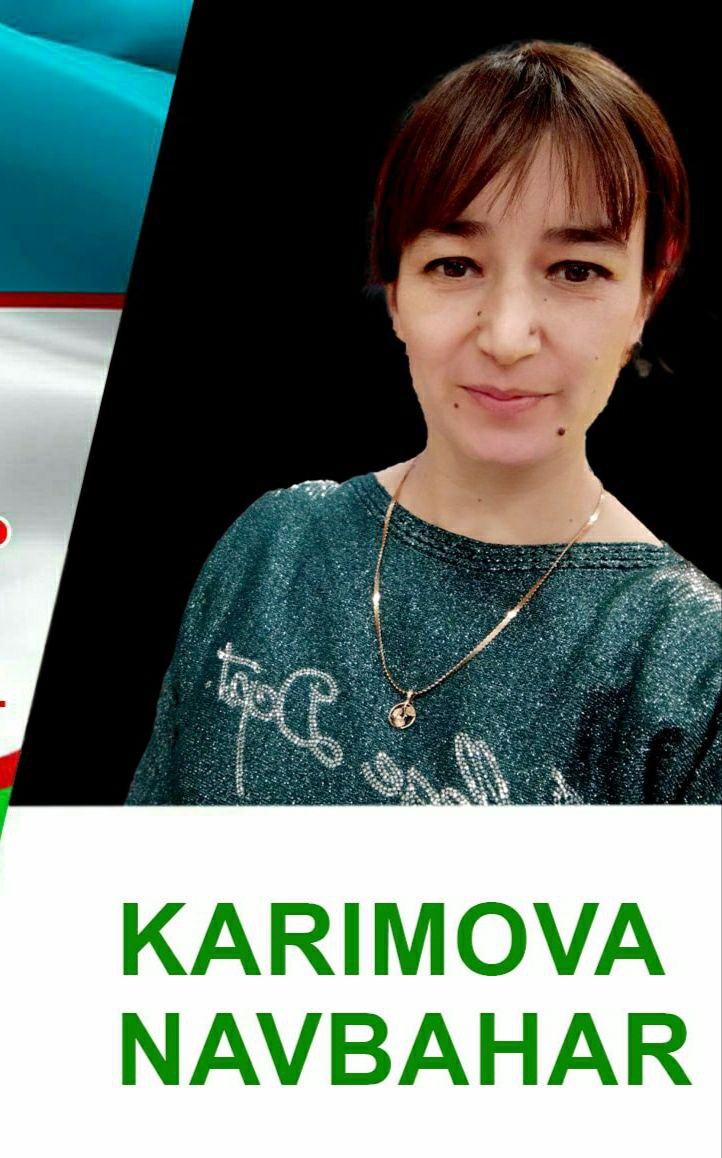
Karimova Navbaxar Mahmudjanovna Born on March 25, 1984, in Gurlan district of Khorezm region, into a family of intellectuals.
From 1990 to 1998, she studied at School No. 1 in Gurlan district. From 1998 to 2001, she continued her education at Gymnasium No. 6 in Gurlan, graduating with excellent marks.
Between 2001 and 2003, she studied in the Nursing field at the Electro-Medical Technical School in the capital city, Tashkent, and successfully graduated with honors.
From 2020 to 2025, she completed her bachelor’s degree in the field of Preschool Education at Urgench State University.
Currently, she is working as an educator at Preschool Educational Institution No. 9, a multi-disciplinary specialized preschool institution under the National Agency for Social Protection under the President of the Republic of Uzbekistan, located in Gurlan district, Khorezm region.
She is fluent in both Russian and Turkish.
In 2023, she was awarded the badge of honor “Devoted Specialist of Her Profession”.
In 2024, she was awarded the badge of honor “Top Scientific Researcher of the Year”.
In 2025, she received the honorary badge “Excellence in Preschool and School Education”.
She is the author of the methodological guidebook “Inclusive Education in Preschool Institutions”. Her published books include: “Towards My Goals”, “For You, Dear Child”, and “Discoverer Children”.
She has published numerous articles in international newspapers and journals.
Her article “STEAM Technologies in Preschool Institutions” was published in Turkey in the book titled “Leading Women and Girls of Uzbekistan”.
The majority of the world’s population suffers from dental caries. This disease is highly prevalent and occurs in about 95% of the population. In dental caries, complex pathological processes are observed, involving both rapid and slow necrotic changes in the tooth tissues. As a result of these necrotic processes, cavities are formed.
Introduction:
Dental caries is the most widespread oral disease in the world, caused by the erosion of tooth enamel due to harmful bacterial infections. It occurs when acids produced by the consumption of sugary and acidic foods accumulate on the teeth, leading to pathomorphological changes.
In modern dentistry, effective methods have been developed to prevent caries and treat it at early stages. Studying caries, its prevention, and modern treatment methods play a crucial role in maintaining health.
The purpose of this article is to provide detailed information about the causes, development mechanisms, symptoms, treatment, and prevention methods of caries. Understanding caries and exploring ways to prevent it can contribute to improved dental health and well-being.
Causes
a) The onset of dental caries usually begins with the formation of bacterial plaque that accumulates in the mouth. This plaque mainly consists of bacteria, proteins found in saliva, and food debris.
b) Bacteria (such as Streptococcus mutans and Lactobacillus, which are cariogenic) thrive in the fluctuating pH environment of the mouth. These bacteria metabolize sugars on the tooth surface and produce organic acids.
Effect of acids:
Acids introduced into the oral cavity (such as lactic acid) affect the mineral components of the tooth enamel, primarily calcium and phosphate, leading to demineralization. During the demineralization process, there is a reduction in the mineral content of the enamel and dentin layers of the tooth.
Mechanism of Caries Development
Changes in the enamel layer:
Initial stage: Caries initially begins with the loss of the enamel’s mineralization process, initiating demineralization. The structure and strength of the enamel deteriorate, leading to yellowing. Although demineralization occurs in the enamel, the tooth surface remains intact at this stage. The early stage of caries appears as “white spots.”
Changes in the dentin layer:
Middle stage: Demineralization progresses into the dentin layer, causing mineral loss and damage to the dentinal tubules. At this stage, the surface layer is destroyed, but the pulp (the inner part of the tooth) is not yet affected. Changes in the dentin appear as yellow or brown discoloration. Demineralization in the dentin weakens the tooth structure, making it more susceptible to damage.
Changes in the pulp layer:
Advanced stage: This is considered the final stage of caries, where inflammation and swelling occur in the pulp. When the pulp nerves are affected, the tooth becomes painful and sensitive. Infections in the pulp lead to inflammation (e.g., pulpitis), usually causing pain and swelling and requiring dental intervention for treatment.
Morphological changes of caries:
Morphological forms: Caries can appear in various forms—dot-shaped, linear, or polygonal. As caries progresses, both the structure and shape of the tooth change accordingly.
In the diagnosis of caries:
Radiographic images and microscopic examinations play an important role in identifying the morphology of the tooth. With the help of radiography, it is possible to determine the depth and extent of the carious lesions.
Histological Changes
Bacterial infection:
Bacteria play a major role in the development of caries. They metabolize glucose present in the oral cavity and produce acids, which lead to the demineralization of the tooth. Under microscopic examination, the structure of the damaged enamel is clearly visible, showing a high concentration of bacteria and evident demineralization processes.
Damage to tooth layers:
In the histological view of caries, processes of demineralization, mineral loss, and tissue changes in the dentin and pulp are clearly observed. Changes in the dentin layer are characterized by particle breakdown and surface weakening.
Demineralization and Remineralization Processes
Demineralization:
The demineralization process plays a crucial role in the progression of caries. Acids produced by bacteria dissolve the minerals in the enamel and dentin layers of the tooth. Initially, demineralization occurs only in the enamel, but over time, it can also affect the dentin and pulp.
pH level and tooth demineralization:
As the pH level in the mouth decreases (e.g., after consuming sugary foods), acids are produced that accelerate demineralization. If the pH drops below 5.5, enamel begins to demineralize, leading to yellowing or discoloration of the tooth.
Remineralization:
As the opposite of demineralization, the remineralization process allows for the repair of tooth structure. Minerals such as calcium, phosphate, and fluoride present in the oral cavity support remineralization. However, this process is only effective if the demineralization is in its early stages.
Treatment of Caries
The treatment of caries includes a series of medical procedures aimed at stopping its progression and restoring the tooth. Treatment methods vary depending on the stage of caries development. The main goal of treatment is to ensure complete restoration of the tooth and prevent further disease. Below are the main methods and approaches used to treat caries at different stages.
1. Treatment of Early-Stage Caries
Preventive treatment:
At the early stage of caries (when tooth discoloration or white spots are present), it is essential to stop demineralization and support the remineralization process. The main treatment methods at this stage include:
Use of fluoride:
Fluoride helps stimulate the remineralization process. It assists in forming new mineral layers on the surface of the tooth, which strengthens the tooth and prevents the progression of caries.
Remineralization agents:
Treatment with preparations containing calcium, phosphate, and other minerals can also be effective. These agents help restore the outer layers of the teeth.
Improved oral hygiene:
Regular brushing, flossing, and the use of mouth rinses reduce bacterial plaque accumulation and help prevent caries.
2. Treatment of Moderate-Stage Caries
Tooth filling:
If caries has progressed to the moderate stage, affecting the dentin layer, the filling method is used. The damaged part of the tooth is removed, and the cavity is filled with a dental filling. Fillings can be made from various materials, including amalgam (silver), composite, or ceramic.
Composite materials:
These materials match the color of natural teeth, offering an aesthetically pleasing and durable solution. Composite fillings help restore the damaged part of the tooth and return it to its original shape.
Ceramic fillings:
In some cases, when a large portion of the tooth needs treatment, full restoration is done using ceramic materials. These materials provide a natural tooth-like appearance and high durability.
3. Treatment of Advanced-Stage Caries
Endodontic treatment (root canal therapy):
If caries has reached the pulp (the inner part of the tooth) and an infection has developed, root canal therapy is required. The goal of this procedure is to eliminate the inflammation in the pulp and remove the infection.
Cleaning the canal and removing damaged tissue:
The pulp must be cleaned, and the infected tissues removed. Once the canal is cleaned, it is filled with special materials.
Tooth restoration:
After root canal treatment, the tooth is usually restored using crowns or other restorative materials to ensure full functionality and structure.
Application of a crown or onlay:
If the tooth is severely damaged, a crown may be placed to strengthen it. A crown protects the tooth externally and restores its normal shape and function.
4. New Treatment Methods
Laser therapy:
Laser technology can also be used in dental treatment. With the help of a laser, the damaged part of the tooth can be removed accurately and effectively. This process is less painful and promotes faster healing.
Ozone therapy:
Ozone gas can be used in the treatment of caries. Ozone neutralizes bacteria and helps restore the mineral content of the tooth.
Conclusion
The development mechanism of caries begins with the demineralization process caused by bacteria converting sugar into acids, which alters the structure of the tooth. In the prevention and treatment of caries, oral hygiene, proper nutrition, the use of fluoride, and regular dental check-ups play an important role. Proper maintenance and early detection of dental issues are effective in eliminating pathological changes.
This article highlights important aspects of caries morphology in detail. The morphology of caries—its impact on and changes within the tooth structure—is essential for fully understanding the progression of the disease. Morphological changes in caries occur in several layers of the tooth: enamel, dentin, and pulp.
Studying the morphology of caries helps in understanding the changes within these layers. Over time, these changes significantly affect the structure, function, and appearance of the tooth. Understanding caries morphology is vital for developing effective strategies for its prevention and treatment.
2. Азимов М., Ризаев Ж.А., Азимов А.М. К вопросу Классификации одонтогенных воспалительных заболеваний. ВIСНИК Проблем биологии и медицини. Випуск 4. Том 1(153) С. 278-282.
3. Азимов М.И., Азимов А.М. Ультразвуковая остеометрия при острых одонтогенных воспалительных заболеваниях.// “Stomatologiya” Научно-практический журнал № 3 (80) 2020 С. 38.
4. Азимов А.М., Турсуналиев З.З., Шодмонов А.А. Современные методы комплексного лечения воспалительных заболеваний периапикальных тканях.// “Stomatologiya” Научно-практический журнал № 1 (81) 2021 С. 56-59с.
5. Рабинович, И.М. Клиническое применение ультразвука при эндодонтическом лечении / И.М. Рабинович, И.В. Корнетова // Клиническая стоматология. – 2012. – №4. – С. 10-14.
6. Ризаев, Д., Азимов, А., Тожиев, Ф., & Турсуналиев, З. (2021). Ultrasound Osteometry in the Diagnosis of Inflammatory Processes of Periapical Tissues. in Library, 21(3), 36-39.
7. Абдуллаев, Д., Собиржонова, A., & Турсуналиев, З. (2021). Лечение хронического генерализованного пародонтита хирургическими методами у пациентов с сердечно-сосудистой недостаточностью. Актуальные проблемы стоматологии и челюстно-лицевой хирургии 4, 1(01), 140-141.
8. Khabibjonova, Y. (2024). OCCURENCE OF DENTAL CARIES. Евразийский журнал медицинских и естественных наук, 4(1), 90–95.
9. Ёкутхон Хабибжонова. (2024). ВИДЫ, ПРИЗНАКИ И ПРОФИЛАКТИКА КАРИЕСА ЗУБОВ. Научный импульс, 2 (16), 1082-1087.
Ahmadova Sarvinoz was born in Altinkol district, Andijan region. She is a student of the Faculty of Dentistry at the Andijan Branch of Kokand University in Andijan region.
For the sun of love to gather its golden shawl and depart
My melody still sings for life.
***
I still love the chatter of birds
And the childhood of the brook and the smile of the moon
Despite the pain, I still carry in my soul
Remnants of light
I will dance despite the oppression and dream of justice
I will carry in the darkness my sad guitar
And play from the depths of my heart
A warm, delicate tune
And sing for hope.
Between My Heart and Me
You ask me, my heart:
What is love?
What is the secret of a feeling that rages between my ribs
Igniting the veins of my soul with happiness?
I say:
Love is the spirit’s elevation over the body
Love is a ray of hope that shines in the darkness of life
Love is nightingales singing
Melodies pulsating with ecstasy
Morning breezes
The lily is freed from its mouth
Love is life and prayer
Love is existence and eternity
Love is a guarantee and a safety
Do you know, my heart, the meaning of love now?
Hanaan Abdelkader Ashour
Egyptian poet and novelist, editorial consultant at the Poets’ Pub website. She writes short stories, articles, and children’s literature. She is a visual artist who has participated in international exhibitions. She has published six poetry books, a short story book, and a novel. For children, she has published a poetry book, a collection of short stories, and a poetry play. She has a YouTube channel dedicated to children.
“People are trapped in history and history is trapped in them.”
James Baldwin
In this issue, we explore how people are influenced by their times and cultures, and how they learn from and engage with the thoughts of their forebears. Also, we acknowledge the wealth of wisdom and life lessons carried within each person due to the events through which they have lived.
Amit Shankar Saha writes of then and now, memory and future, remembrance and forgetting, universal human questions. Duane Vorhees’ poetry evokes change, thought, aging, and the creative process.
Stephen Jarrell Williams speaks to memory and the human experience. Eva Lianou Petropoulou speaks to artists and authors’ learning from and being inspired by each other throughout the ages. Writer Rizal Tanjung offers up an existential analysis of Eva Petropoulou Lianou’s poetry.
Giorgos Pratzigos interviews Konstantinos Fais on his artwork and advocacy for rediscovering Hercules and ancient Greek virtues. Muxlisa Khaytbayeva records her grandfather Jumaboy Allaberganov’s memories of knowing famed Uzbek author Omonboy Matjonov as a young adult and discusses Matjonov’s contributions to culture. Shukurilloyeva Lazzatoy Shamsodovna relates her scholarly and personal journey to understanding and illuminating Russian writer Alexandr Faynberg’s poetic legacy and its influence on Uzbek culture.
Kuziyeva Shakhrizoda highlights the Uzbek government’s investment in the nation’s youth and the incredible potential of their young adults. Otaboyeva Khushniya outlines how the psychology of early childhood can inform education. Su Yun collects and translates the work of Chinese elementary school students.O’tkirava Sevinch outlines strategies for learning Mandarin Chinese as a second language and for teaching the language in Uzbek schools. Olimboyeva Dilaferuz outlines verb conjugation rules in the Uzbek language.
Mashhura Farhodovna Joraqulova’s short story encourages students from low-income families to persevere with their education. Sevara Kuchkarova outlines strategies to motivate students to complete work at school. Rashidova Shaxrizoda Zarshidovna honors the life and work of a woman who mentored many of the girls at her school. Dilbar Aminova advocates for a balanced approach to screentime in young children’s lives. Shahnoza Ochildiyeva reflects on the value of her journalism education at an Uzbek university. Xo’jamiyorova Gulmira Abdusalomovna highlights the role of emerging and young poets in Uzbekistan’s national destiny.
Duane Vorhees compares the poetry of Phillis Wheatley and Nikki Giovanni as part of a broader comment on changing Black consciousness in the United States.
Cherise Barasch writes with respect for the hardworking people she observes digging into the earth in the heat. Yongbo Ma brings a poetic and scientific perspective to fog. Sayani Mukherjee contemplates peaceful natural scenes in a reverie. Priyanka Neogi compares accepting life’s changes to living through different seasons and times of day. David Sapp reflects on the transcendent experience of seeing a peacock. Dilnoza Islamova looks to nature’s beauty as an invitation to spiritual faith and practice. Maki Starfield sends up elegant reflections on weather and fruits in Thailand as Maja Milojkovic meditates on sunflowers, existence, and perseverance.
Brian Barbeito lets his mind wander to cosmological and existential places while walking near birds by a lake. Orinbayeva Dilfuza rejoices in the beauty of nature at springtime as Dilobar Maxmarejabova shares the emotional significance of tulips in her life. Don Bormon revels in the fun of rain at school. Mark Young renders up more of his fanciful “geographical” maps of Australian regions. Mathematics is a language we use to describe nature, and Timothee Bordenave discusses how his geometric studies inform his artwork. Mesfakus Salahin speaks to drought in Bangladesh in a meditation on accepting life and nature’s cycles.
Bruce Mundhenke urges humanity to turn away from hate towards love and acceptance. Vo Thi Nhu Mai illuminates the beauty and communicative power of the craft of poetry.
Leslie Lisbona sends up a childhood memory of having fun dancing to and figuring out rap lyrics. Marjona Baxtiyorovna Jorayeva celebrates sports and their fandoms and their power to bring enjoyment and bring people together.
Kholmurodova outlines strategies to bring digital access and economic opportunities to the world’s rural women. Rakhimov Rakhmatullo outlines challenges and solutions for logistics technologies. Sa’dia Alisher outlines some benefits, problems, and challenges from modern digital technologies. Gulnora Rakhimjonovna Khomidova explores the educational potential of artificial intelligence.
Dr. Jernail S. Anand relates how, regardless of the tools we use to craft our work, restraint and discipline can serve as a creative force. Dr. Debabrata Maji highlights the power of perseverance and devotion. Azemina Krehic compares the care she has for her poetic works to the process of washing her clothes on a line. Hassan Mistura speaks to the journey of developing a healthy self concept. Surayyo Nosirova reminds us to let go of the illusion of more control than we have and to stay open to change.
Grant Guy offers up stage directions for absurdist theater, an artistic reaction to periods of rapid social change. Ahmed Miqdad speaks to the absurd persistence of normal life amid wartime. Mykyta Ryzhykh, in a similar vein, evokes the quest for queer love and sensuality among bombs and bullets.
Pat Doyne laments violent immigration enforcement overreach in Los Angeles. Otabayeva Khusniya reveals the deeply humane vision of Erkin Vahidov’s work Rebellion of Souls, a tribute to the memory of Nasrul Islam and other artists who died as a result of unjust persecution. Chimezie Ihekuna shares some of life’s paradoxes and urges nations and groups of people to move away from war as a solution to issues. Mahbub Alam also puts out a call for peace, remembering the many people lost to war. Boboqulova Durdona laments the many civilian deaths in Gaza as Stephen House highlights war’s effects on ordinary people, especially children.
Muslima Olimova reflects on surviving an unhappy marriage and urges families to welcome young brides and for women to carefully consider before marrying. J.J. Campbell speaks to the lingering effects of trauma on people and the tension between hope and disillusionment. Dr. Bindu Madhavi speaks to the inner battles many of us fight as Mirta Liliana Ramirez evokes the pain of loneliness.
Doug Hawley’s short story presents several characters representing a mix of lawful and roguish motives and actions. Taylor Dibbert’s poem lampoons the worldliness of a priest and the devotion it still inspires. Sarvinoz Sobirjonova Abdusharifova depicts the dual nature of humanity: kindness and cruelty.
Kelly Moyer uses vegetable humor to convey and navigate the experience of chronic illness. Alan Catlin frames evocative images with words, plumbing the imagined photos for meaning.
Mark Blickley, a combat veteran who finished education later in life, reflects on what he gained as a person and an artist from popular literature and reminds the “literary” crowd not to so easily dismiss popular writers.
For the happiness of children They work hard from morning to night Without giving less than anyone They bring them to maturity They give their lives for their children They forget themselves Without working hard They make us happy My father
Mother
Your beautiful love Is unique in the world A mother like you Will never be found in the world Sometimes by giving reprimand You start on the right path For the happiness of children You never stop praying For children
Hamroyeva Shahinabonu Shavkatovna was born in Romitan district, Bukhara region. She’s currently studying at school 43 in Bukhara City, Bukhara region, Uzbekistan. She is interested in writing poetry. Many of her poems are published in Turkish.