Brief Biography: Shikdar Mohammed Kibriah from Bangladesh, is a globally published, awarded and translated world-renowned poet, versatile writer, translator, editor, peace ambassador and philosopher. He is the president of the Poetry and Literature World Vision. His published books so far 21 on poetry, prose and story. He is the editor of encyclopedic anthology volumes World Contemporary Poets. He is published in world reputed anthologies, magazines, newspapers, journals, channels, TV and radio, and translated in 55 languages of the world. He is featured and awarded as a Global Poet, Elite Diamond Writer, Golden Eagle, White Eagle, Golden Heart, World best personality etc.
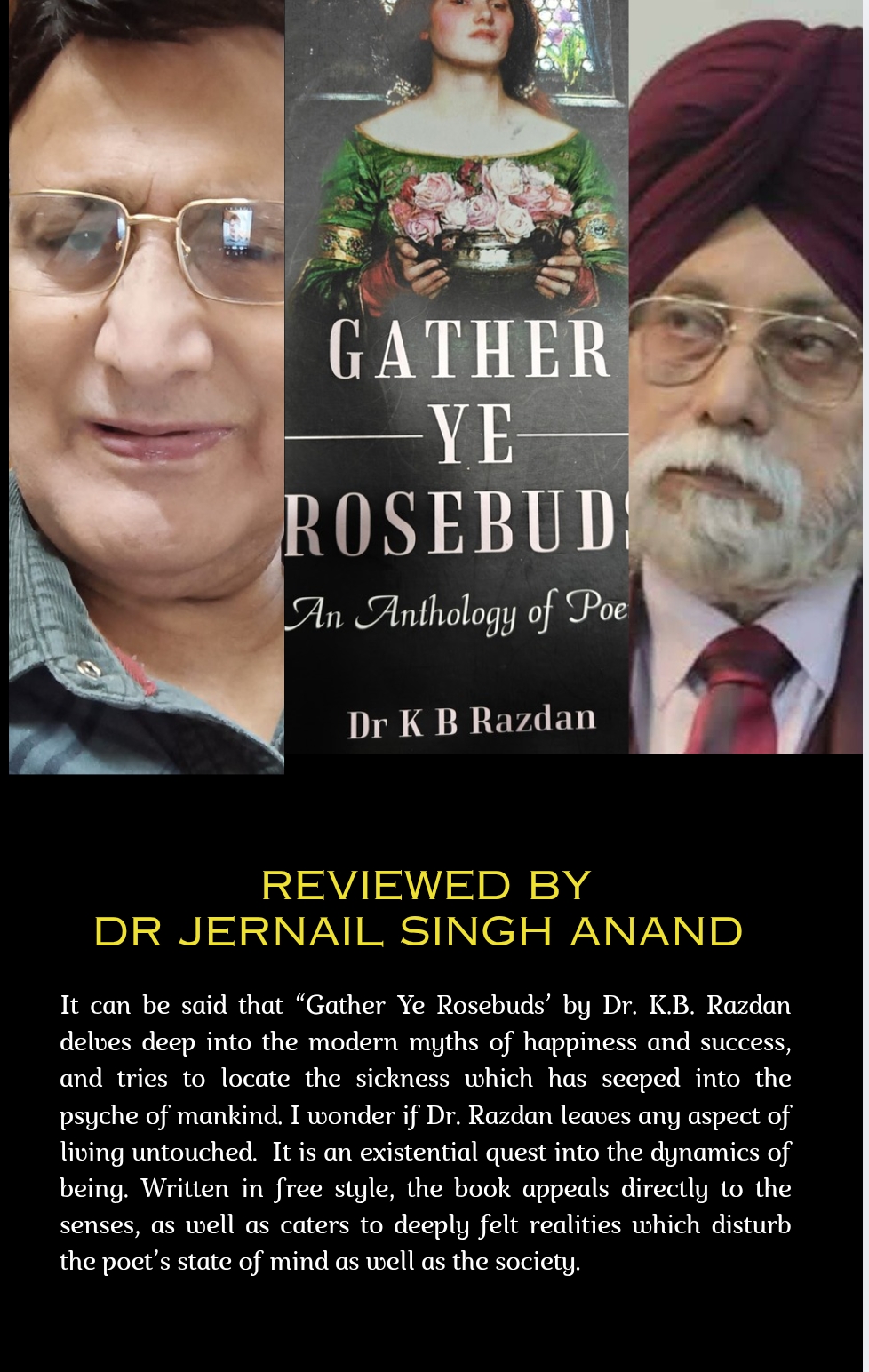
DR. KB RAZDAN: GATHER YE ROSE BUDS: AN EXISTENTIAL QUEST INTO THE DYNAMICS OF BEING
Writing poetry is a very personal affair and different poets write for different reasons. The most intriguing thing about poetry is that the poet who once starts writing, even if he is writing on a specific topic, does not know when and where he will conclude his poem. This is the power and independence of poetry. No poet can claim suzerainty over it.
Dr KB Razdan is a wizard of words who has guided students of literature at the University of Jammu for three decades, as Professor and Head and then as Dean Faculty and Convener of Board of Studies. He has taught modern and postmodern American fiction, poetry drama, comparative literature, critical theory, translation and translation theory. Having weathered so many disciplines, he possesses the finer sense of aesthetics essential to craft a masterpiece out of the rock material of ordinary life. A poet handles ordinary material, but he extends to it his philosophic shine and it starts radiating subliminal messages.
Dr. Razdan, has a keen sense of the dignified status of poetry. Leaving aside formalistic aspects of poetry, he is more concerned with what he has to say. What shape it takes, let the poetic moment decide. A higher passion draws words from his inside, and they flow into poems, as at a village well, driven by oxen, the ‘tinds’ [the chain of iron pots ] draw water from inside, and let it flow, fertilizing the earth. His verses are like mustard leaves grown on a fertile land, dangling their tiny heads in sheer frolic, carrying messages far beyond their transitory being. The poet rightly calls his work a ‘Cosmodrome of Poetic imagination and Poetic euphoria.
‘The Sieve of Time’ and the talk of filtration hangs heavy on the poet’s creative psyche, the image of the sieve recurs, focusing our attention on the fact how time throws off everything retaining in the sieve only the last remains of man. The somber mood of the poem lends it a touch of deep philosophy, and draws it closer to the fatalistic moorings of Hardy.
What is Poetry? For the poet, poetry is a realization, a revelation:
……a realization
That becomes a revelation,
A Soliloquy erupts akin to a Volcanic eruption.
Here the poet appears to drift away from Eliot’s view of a poem as an escape from emotion, when he calls a poem ‘a soliloquy’. He also deviates from William Wordsworth for whom a poem is a spontaneous overflow of powerful feeling, recollected in tranquility. Dr. Razdan’s poetics appears to be rooted in urgency which lends its excitement, passion and a rare flow to his poems.
‘O Lord What Fools these Mortals Be’ derides human wisdom which breeds manipulators schemers and crooks. The poet rejects “pretended prudence” and thinks that the wisdom of apes and dogs far transcends the wisdom of human beings. ‘Every Man is Two Men’ talks of the split personality of man, which is home to both the base as well as the sublime. Judas and Christ may be two different personalities, but both are equally loved by the mother who begets them. ‘A Rendezvous with the Contemporary Sphinx’ appears to focus on the narcissistic tendencies in man, and the poet warns one should know oneself if he wants to know the world. He criticizes too much dependence on mind, which can become nemetic [cause for nemesis ] for mankind:
O Ye frivolous man, should ye know yourself, you shall know all men all women” .
‘What’s in a Name’ engages with a quote from Shakespeare, but Carlyle’s reference in the poem is starkly beautiful: No name. No shame.
‘Images and Voices’ opens into the vistas of spiritual and cosmic dimensions. Here, the poet invokes Walt Whitman and his image of a Composite Man when he says
“What I assume, you shall assume
For every atom belonging to me, belongs to you as well.”
‘A Noble Sad Heart’ compares human mind and heart in an unconventional manner.
Our mind is a sponge, our heart is a stream, ….
Most of us choose sucking rather than running..
‘The Lustonian Blundrbuss’ takes a dig on marital ethics, while ‘When Life Walks in the Procession of Freedom’ supports the cause of women who walk out of unhappy marriages. ‘Song of Adam’ makes a plea for innocence in a world full of guile. The poet considers Ethics as the panacea which can heal the world of its maladies, and friendship is the elixir which can guarantee blossoms of Peace, Prosperity and Plenty on this earth:
“Let friendship be a Great Deluge,
A Deluge that engulfs our planet,
With the Blossoms of Peace, Prosperity and Plenty
And let the phenomenon of Ethics
Become an Ideal Panacea to Heal.
-Friendship, An Oasis of Rejuvenation,
Dr. Razdan considers marriage an unequal partnership in which the woman is ‘a sacrificial victim’. [‘The Throne of Tribulations’] From family to the social ethos, Dr. Razdan finds the world under the siege of Mammon, the Undisputed Controller, as a result of which it has been reduced to a ‘Maelstrom of Malevolence’, marked by greed and lust.
While on Nature, ‘The Tree and the Man’, presents a searing indictment of humanity, where the tree calls man a monster, and a desperado, whose mind and conscience are in consonance with darkness. ‘The Day Dreamers of Mankind’ again blasts the myth of Adam, where men think, God in his kindness, will offer them another Eden, and endow them with a modicum of Good Sense, giving them a new opportunity to “create a tripartite Realm of Purity, Innocence and Heroism.” Nothing bad in entertaining such dreams, thinks the poet.
The poet talks of a buffer zone between Right and Wrong and Truth and Untruth – a No man’s territory which constitutes the battle ground for corrosive conflicts. ‘Ethics of Pure Love’ looks upon parents as bows from which children are shot like arrows, as Kahlil Gibran has said. The poet turns ecstatic in ‘O My Loriana Lore Lee’ giving a final lesson in love:
Can it be
That you merge in me and me in thee?
‘Malady of Gossip’ perhaps embodies a great truth of life, told so beautifully:
A dilemma I find hard to negotiate
My house says to me:
“Do not leave me for here dwells your past,
And the road says to me:
“Come, and follow me,
For I am your future”
This to me appears to be the height of poetic craftsmanship. The language and thought both achieve classical heights., I feel the poetic thrill in these lines.
‘The Trojan Horse’ is a metaphor for people who approach you with Mephistophelean joy. The description of a poet in ‘Anatomy of a Poet’ conjures a scene which resembles the ruins on which the statue of Ozymandias stood:
A poet is a king dethroned,
Sitting amidst the ruins of his palace
What truth can be more piercing and elevating at the same time, as we come across in this exiomatic expression:
It is very simple to be happy, but it is very difficult to be simple.
‘The Unassuming Society Man ‘is a bitter critique of modern society, where he compares human mind to a “war room where thoughts play Chess/Making moves and using weapons weird.” ‘Ethics of colours’ points out that men have complete mastery in changing colours beating even chameleons at the game. ‘Unethical Monomanics’ derides human beings who fall a prey to inordinate passions, corruptions, jealousy, greed etc. It is hard to find a more strident criticism of our times:
It is a world of atrophied values
Of frozen emotions, fossilized love
In conclusion, it can be said that “Gather Ye Rosebuds’ by Dr. K.B. Razdan delves deep into the modern myths of happiness and success, and tries to locate the sickness which has seeped into the psyche of mankind. I wonder if Dr. Razdan leaves any aspect of living untouched. It is an existential quest into the dynamics of being. Written in free style, the book appeals directly to the senses, as well as caters to deeply felt realities which disturb the poet’s state of mind as well as the society.
Dr. Jernail Singh Anand, with an opus of 190 plus books, is Laureate of the Seneca, Charter of Morava, Franz Kafka and Maxim Gorky awards. His name adorns the Poets’ Rock in Serbia. His work embodies a rare fusion of creativity, intellect, and moral vision. Email: anandjs55@yahoo.com
This article analyzes the theoretical and practical aspects of conducting production accounting using digital technologies such as ERP systems, electronic invoices, cloud services, blockchain, and artificial intelligence. The thesis explores the double-entry principle, financial and management accounting, and the impact of digital transformation on enterprise efficiency. Furthermore, the advantages and emerging requirements of implementing digital accounting in Uzbekistan are examined through the examples of “1C”, electronic invoicing, the State Tax Committee’s digital systems, and UzAuto Motors.
Keywords: digital technologies, accounting, production process, double-entry, blockchain, artificial intelligence.
Introduction
Accounting based on digital technologies refers to the process of collecting, processing, and analyzing information about a company’s financial condition, expenses, revenues, and cash flows using automated information systems. With digital accounting systems, financial statements such as the balance sheet, income statement, cash flow statement, and statement of changes in equity are generated automatically in real time. This enables rapid analysis of assets, liabilities, and financial stability.
Implementing digital technologies ensures transparency and accuracy based on International Financial Reporting Standards (IFRS). As a result, analyzing production costs, determining product cost, and making managerial decisions become more efficient. Modern accounting systems (such as 1C, SAP, Oracle, and ERP) integrate financial and managerial accounting, allowing manufacturing enterprises not only to record costs but also to perform planning, budgeting, and control functions effectively.
Production (cost) accounting involves collecting information on expenses incurred during enterprise operations, allocating selected costs to products, services, and other cost objects, and evaluating the efficiency of cost utilization. In addition to cost calculation methods, the following cost accounting techniques are applied by management to control expenses and make key business decisions. These techniques are not independent methods of cost calculation but can be effectively combined with any of the traditional methods.
Table 1. Cost Accounting Methods and Techniques
Marginal (variable) costing:
This method allocates only variable costs (e.g., materials, labor, direct costs) incurred in the production process, excluding fixed costs such as rent and depreciation, as they may distort results. It is useful in industries with fluctuating production volumes.
Direct costing:
This method assigns all directly related costs to a product or process, while indirect costs are covered through profits. Unlike marginal costing, some fixed costs may also be treated as direct costs under specific conditions.
Full (absorption) costing:
This approach includes all variable and fixed costs in the production process. In other words, the total product or service cost covers all expenses—wages, raw materials, rent, and others.
Uniform costing:
This method applies standardized cost calculation rules across several enterprises or organizations. Standardization includes criteria such as cost types, depreciation, taxation, and cost allocation. It facilitates comparison between enterprises, pricing policy formulation, and fair evaluation.
Main Part
In the digital economy, accounting is recognized not only as a component of financial management but also as an important factor in economic development. Modern digital accounting systems strengthen financial stability and provide reliable information necessary for strategic decision-making.
Digital technologies play a crucial role in improving accounting processes and enhancing production efficiency. Practice shows that digitalization helps regulate economic processes, strengthen control, and ensure the accuracy of financial information.
In Uzbekistan, the introduction of electronic invoicing for small and medium-sized enterprises has significantly simplified production accounting. For example, small shops and service providers can now prepare reports quickly, accurately, and without errors using automated programs such as 1C. These systems reduce human errors and save time and resources.
Large manufacturing corporations, including UzAuto Motors, have digitized their accounting systems based on IFRS standards, aligning production costs and financial results with global requirements. As a result, the company established reliable partnerships with foreign investors and strengthened its position in international financial markets.
At the state level, the implementation of digital accounting systems contributes to better economic governance. In particular, the State Tax Committee’s digital information systems allow real-time monitoring of enterprises’ financial activities, control of budget revenues, and reduction of illegal operations.
Modern ERP systems (SAP, 1C, Oracle) are widely used as leading tools for automating production accounting. These systems integrate enterprise income, expenses, and budget status on a single platform, simplifying financial analysis and control. The widespread use of 1C software in Uzbekistan has made accounting processes more transparent and efficient in manufacturing enterprises.
Moreover, blockchain technology plays a significant role in enhancing security in accounting. International production transactions and payments processed via blockchain are faster and less vulnerable to fraud. Artificial intelligence (AI) serves as a powerful tool for analyzing financial reports, optimizing costs, and improving production efficiency.
In general, the application of digital technologies to production accounting ensures speed, accuracy, and security, taking financial management to a new level.
Conclusion
The introduction of digital technologies in production accounting improves quality, reliability, and timeliness of management information, thus increasing enterprise efficiency. Simultaneously, digitalization introduces new professional requirements, such as IT competence and continuous skill development.
Digital technologies have established the necessary infrastructure and principles for conducting accounting in the production process. The integration of the double-entry principle, ERP systems, blockchain, and artificial intelligence helps enterprises maintain financial stability, transparency, and global competitiveness.
Accounting has now evolved from a reporting function to a strategic management tool. Overall, digital technologies make production accounting more convenient, accurate, transparent, and efficient. This field, however, demands continuous innovation and technological advancement.
Consequently, it promotes international recognition of enterprises, builds investor confidence, and fosters cooperation with foreign partners. Accounting conducted in compliance with IFRS accurately reflects a company’s financial condition and strengthens its competitiveness in the global market.
Practical Recommendations:
1. Implement digital accounting systems in manufacturing enterprises step by step — starting with the integration of core processes (supply, production, sales).
2. Introduce continuous training programs to enhance accountants’ digital competencies.
3. Develop and support local software (e.g., 1C modules) adapted to national standards and IFRS requirements.
4. Gradually test and apply blockchain and AI technologies in pilot projects to enhance security and analytical capabilities.
5. Encourage the creation and implementation of affordable, customized digital accounting systems for small and medium-sized enterprises through public-private partnerships.
References:
Smith, J. (2020). Digital Accounting in the Digital Economy. Journal of Accounting Research.
Coman, Elena Liliana. Digitalization of Accounting within the Concept of Cost Management. Valahia University of Targoviste.
Nazarov, Sh. (2021). The Impact of Innovative Technologies on Financial Management. Tashkent: University of Economics Press.
Karimov, M. (2020). Principles of Modern Accounting. Tashkent: Economics Publishing.
Abdukarimov, A. (2022). Development of Financial Control and Accounting Systems. Tashkent: Science and Technology.
Norton, D. (2021). Digital Accounting Systems and Transparency. New York: Oxford University Press.
• A1~B2 grammar topics • Reading practice • Listening practice • New words and using them in sentences • Discipline and plan • Writing practice • Reading practice
1. Consistently learn grammar and use this knowledge to form sentences and practice them. 2. Read articles and books. 3. Listen to podcasts, TED talks. 4. Write texts and essays to express your thoughts. 5. Write formal articles such as emails and applications.
6. Watch Turkish movies (with subtitles, especially at the beginning). 7. Write down unfamiliar words from movies in a notebook and repeat them along with the actors. 8. Choose a specific actor from a movie and imitate them, also learning their speech and emotions.
9. Whenever possible, watch newly released films; it is not recommended to watch old, historical movies. 10. I recommend the following 3 movies: • Aşk Taktikleri 2 (Love Tactics 2) – Romantic Comedy • Sen Büyümeye Bak (You Look at Your Growth) – Drama • Bursa Bülbülü (Bursa Nightingale) – Musical Comedy
Learning Turkish in three months is a huge goal, but it can be achieved with determination! Live with the language every day: watch films, listen to music, and podcasts. Dedicate at least two or three hours daily; consistency is very important. Focus on basic grammar and everyday words. Don’t be afraid to speak; learn from your mistakes. Find language exchange partners. With perseverance and practice, you will certainly succeed! You can do it!
I am Muhammadjonova O’g’iloy Bunyodbekov qizi. I was born on September 11, 2010, in Qo’rg’ontepa district, Andijan region. I am a 9th-grade student at the 5th Specialized School.
This article provides a comprehensive guide to modal auxiliary verbs, exploring their unique role in expressing ability, possibility, permission, and obligation in English. It explains the distinctive ways modal verbs like “can,” “could,” “may,” and “might” function to convey permission and ability, while verbs such as “must,” “have to,” “should,” and “ought to” express necessity and obligation. Common challenges, including past tense forms and question structures, are addressed with clear examples. Practical exercises help readers, from English learners to native speakers, master proper modal verb usage in both spoken and written communication.
Keywords: Modal verbs, English grammar, Auxiliary verbs.
Literature review
Modal verbs in English have been the focus of extensive research due to their intricate semantic, pragmatic, and structural characteristics. Hinkel (1995) observes that non-native speakers often use modal verbs in ways influenced by their first-language pragmatics, which leads to differences in usage compared to native speakers. In my opinion, this highlights how cultural and linguistic backgrounds shape language learning, emphasizing the need for tailored educational approaches that address such variations.
Similarly, Boyd and Thorne (2008) argue that the meaning of modal verbs is influenced by both semantics and the illocutionary force of speech acts, underscoring that effective communication requires more than mere grammatical accuracy. I find this perspective insightful, as it suggests that modals contribute subtly yet significantly to conversational intent, an essential concept for language learners to understand.
Further, Depraetere (2017) explores how contextual factors impact modal interpretation within the semantics-pragmatics interface. This complexity, in my view, underlines the importance of teaching students to consider context when using modals, rather than focusing solely on rigid grammatical rules.
Historically, the usage of modal verbs has evolved. Millar (2009), analyzing the TIME Magazine Corpus, observed a decline in traditional modal usage from the 1960s to the 1990s, with an increase in semi-modals influenced by shifts in stylistic preferences. This trend, in my opinion, mirrors broader social changes that favor informality in communication. Biber (2004) further supports this view by noting genre-specific shifts and a rise in semi-modals in modern corpora, which demonstrates the adaptability of language in response to changing communication norms.
Diver (2015) also examines historical patterns, revealing a shift in distinctions between past and non-past modal forms over time. In my opinion, these findings emphasize the fluidity of language, reminding us that grammatical constructs are not static but evolve alongside cultural shifts.
From a pedagogical perspective, Iranmanesh and Motallebikia (2015) compared task-based language teaching (TBLT) with traditional methods, discovering that TBLT enhanced learners’ understanding of specific modals, particularly can. This approach, in my opinion, aligns with modern learners’ needs, as context-based teaching tends to be more effective than rote memorization. Similarly, Kennedy (2002) utilizes the British National Corpus to advocate for contextualized strategies in teaching modals, which I believe help students grasp practical usage in real-life contexts
Cross-linguistic studies also enrich our understanding of modality. Wurmbrand (2000) challenges traditional syntactic interpretations by arguing that both epistemic and root modals could be considered raising verbs. Personally, I find Wurmbrand’s view refreshing, as it encourages a re-evaluation of conventional classifications. Kehayov and Torn-Leesik (2009), through their study of Balto-Finnic modals, illustrate the diversity of modality across languages, highlighting how other linguistic systems can provide valuable insights into English modal studies.
Additionally, Guéron (1970), in her work explores how modals interact with tense to convey complex temporal relationships. This perspective, in my opinion, is essential for understanding how modals reflect not only certainty or obligation but also specific time frames within a conversation. Guéron’s approach underscores the temporal depth of modal verbs, revealing them as versatile tools for indicating when events may or should occur.
In conclusion, the literature demonstrates that modal verbs in English serve complex semantic and pragmatic functions, have evolved significantly over time, and are best taught through contextualized approaches. The insights from cross-linguistic research further underscore the global relevance of modality. Future studies could continue exploring how specific contexts influence modal usage, particularly in specialized and evolving language environments. For educators and learners, these findings emphasize the importance of understanding modals as both grammatically and culturally dynamic elements, enhancing the richness of language learning and communication.
Methodology
This corpus analysis is complemented by an in-depth literature review, synthesizing key research on modality’s role in cross-linguistic contexts, semantic interpretation, and evolving communicative norms. Observations were made on how modality varies between formal and informal settings and across regional dialects, with specific focus on common challenges faced by language learners, such as distinctions in formality and the use of modal verbs to express obligation, permission, and possibility. This combined methodology aims to provide a holistic understanding of the evolving function of modals in English and to highlight effective teaching approaches that contextualize modal usage for learners.
Discussion
The complex nature of modal auxiliary verbs brings us to a point where theory and practice meet. Our analysis shows that modal verbs do more than serve as grammar tools. They build vital bridges between what we intend to say and how we express it in English.
Modal verbs show remarkable flexibility in different situations. These language elements adapt to many communication needs but keep their basic grammar roles intact. This adaptability stands out in professional settings where choosing between formal and informal modal expressions can make a big difference in how well we communicate.
Modern English shows some interesting patterns in how modal verbs have changed. Here are the main developments we see today:
People ask for permission more casually
Traditional modal differences are mixing together
More people accept different ways of expression
Digital communication uses simpler patterns
Different regions have different priorities
Learning about modal verbs needs more than just memorizing rules and patterns. Context plays a big role in picking the right modal expressions. This matters even more in cross-cultural communication where modal verb choices can change how people understand messages.
Traditional boundaries between some modal categories have become more flexible. Take ‘can’ and ‘may’ for example – their formal differences are changing when people ask for permission. Language keeps changing this way, but knowing the traditional rules still matters for formal communication.
Modal verbs and their alternatives tell an interesting story. Modal auxiliaries remain basic to English expression, but other ways of saying things work better now in some situations. This change doesn’t make modal verbs less important. Instead, it gives speakers and writers more options.
People who use modal verbs strategically in professional settings communicate better. Knowing how to switch between different levels of formality through modal verbs has become a key skill in today’s workplace communication.
Modal verbs keep changing but still play their essential role in English grammar. They adapt to new communication needs, which shows how language stays dynamic, even in basic grammar.
Conclusion
Modal verbs are key building blocks of English grammar that help us express ability, possibility, permission, and obligation. These unique elements have special grammatical patterns and play a vital role in our daily communication. These versatile auxiliaries work well in both formal and informal settings and help us direct different social and professional situations.
When we use modal verbs correctly, our communication becomes more precise and clear. Our analysis of common mistakes and real-world uses shows how becoming skilled at these auxiliaries helps us express ourselves better in written and spoken English. Native speakers and language learners find these tools invaluable because they work in many different situations.
Modern language keeps changing, but modal verbs keep their basic grammatical roles. These verbs remain crucial in professional environments, academic writing, and everyday talks. Their lasting importance proves their value in English communication. Knowing how to use modal verbs properly gives us the confidence to express ourselves accurately in any situation.
Reference:
Biber D. Modal use across registers and time //Topics in English Linguistics. – 2004. – Т. 45. – С. 189-216.
Boyd J., Thorne J. P. The semantics of modal verbs //Journal of linguistics. – 1969. – Т. 5. – №. 1. – С. 57-74.
Depraetere I. On the pragmatics of modal verbs //Selected papers on theoretical and applied linguistics. – 2017. – Т. 22. – С. 14-26.
Diver W. The modal system of the English verb //Word. – 1964. – Т. 20. – №. 3. – С. 322-352.
Guéron J. On the temporal function of modal verbs //Time and modality. – 2008. – С. 143-172.
Hinkel E. The use of modal verbs as a reflection of cultural values //TESOL quarterly. – 1995. – Т. 29. – №. 2. – С. 325-343.
Iranmanesh H., Motallebikia S. M. Teaching Modal Verbs: Task-based vs. Traditional approaches //International Journal of Foreign Language Teaching and Research. – 2015. – Т. 3. – №. 11. – С. 39-46.
Kehayov P., Torn-Leesik R. 11. Modal verbs in Balto-Finnic //Modals in the languages of Europe: A reference work. – 2009. – Т. 44. – С. 363.
Kennedy G. Variation in the distribution of modal verbs in the British National Corpus //Using corpora to explore linguistic variation. – 2002. – Т. 9. – С. 73.
Millar N. Modal verbs in TIME: Frequency changes 1923–2006 //International journal of corpus linguistics. – 2009. – Т. 14. – №. 2. – С. 191-220.
Wurmbrand S. Modal verbs must be raising verbs //Proceedings of WCCFL. – 1999. – Т. 18. – №. 1.