Hypothetical Existences

In the swamp of the senses
hear the rustle of the shadows,
and the thrill becomes strong
when the breeze sighs on clothes modeled by poets.

Linen or silk shirts
in the abundant imagination
covers nudity with metaphors
conceptual in the elegiac sanctuary,
with the visible elegance of the speakers.

Listening makes your breath tremble
when by emphatic statement emanates art to seduce
the audience to seconded applauding
the pleiades of the numerous virgins.

Oh, how many hypothetical existences
and no future in this oven
of abstract and conceptual works,
when the spotlights go out
instead of the delirium in the script.

The silence falls on hypothetical existences!

BIOGRAPHY

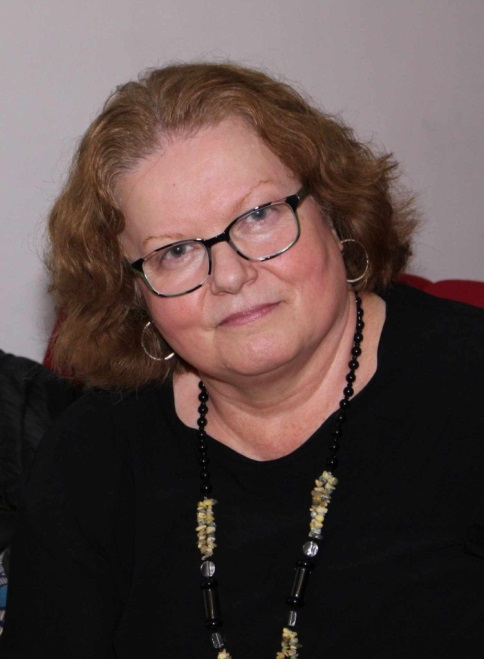
Lidia Popa was born in Romania in the locality of Piatra Șoimului, in the county of Neamț, on 16th April, 1964. She finished her studies in Piatra Neamț, Romania with a high school diploma and other administrative courses, where she worked until she decided to emigrate to Italy.

She has been living for 23 years and worked in Rome as part of the wave of intellectual emigrants since the fall of the Berlin Wall.
She wrote your first poem at her age of 7. She is a poet, essayist, storyteller, recognized in Italy and in other countries for her literary activities. She collaborates with cultural associations, literary cenacles, literary magazines and paper and online publications of Romanian, Italian and international literature. She writes in Romanian, Italian and also in other languages as an exercise in knowledge.

BOOKS

She has published her poems in six books:
in Italy:
1. " Point different ( to be ) " - ed. Italian and
2." In the den of my thoughts ( Dacia ) " - ed. bilingual Romanian/ Italian AlettiEditore 2016,
3.“ Sky amphora " - ed. bilingual Romanian/ Italian EdizioniDivinafollia 2017,
in Romania:
4. " The soul of words" ed. bilingual Romanian/ Albanian Amanda Edit Verlag 2021,
5." Syntagms with longing for clover " ed. Romanian, EdituraMinela 2021.
6." The Voice interior " LidiaPopa and BakiYmeri ed. bilingual Romanian/Italian, Amanda Edit Verlag 2022.

Her poems featured in more than 50 literary anthologies and literary magazines on line from 2014 to 2023 in Italy, Romania, Spain, Canada, Serbia, Bangladesh, United Kingdom, Liban,USA,etc.
Her poems are translated into Italian, French, English, Spanish, Arabic, German, Bangladesh, Portuguese, Serbian, Urdu, Dari, Tamil, etc.
Her writings are published regularly with some magazines in Romania, Italy and abroad.
She is a promoter of Romanian, Italian and international literature, and is part of the juries of the competitions.
She translates from classical or contemporary authors who strike for the refinement and quality of their verses in the languages: Italian, Romanian, English, Spanish, French, German, stating that "it is just a writing exercise to learn and evolve as a person with love for humanity, for art, poetry and literature ".

SHE IS
*Member of the Italian Federation of Writers (FUIS)
*Honorary member of the International Literary Society Casa PoeticaMagia y Plumas Republic of Colombia,
*Member of Hispanomundial Union of Writers (Union Hispanomundial de Escritores) (UHE) and Thousands Minds For Mexico (MMMEX)
*President UHE and MMMEX Romania, August 21, 2021
*She had come power of attorney Vice-president UHE Romania, Mars18, 2021- August 21, 2021
*President UHE and MMMEX Romania, August 21, 2021
*Counselor from Italy for Suryodaya Literary Foundation Odisha India,
*Director from Italy for Alìanza Cultural Universal (ACU) Argentina
*Member Motivational Strips Oman,a member of numerous other literary groups at the level internationally,
*Director of Poetry and Literature World Vision Board of Directors (PLWV) Bangladesh
*Membership of ANGEENA INTERNATIONAL NON PROFIT ORGANISATION of Canada
International Peace Ambassador of The Daily Global Nation International Independent Newspaper from Dhaka Bangladesh - 2023
*Founder literary group Lido dell'anima with LIDO DELL'ANIMA AWARDS
*Founder LIDO DELL'ANIMA Italian magazine
*Founder SILVAE VERBORUM INTERNATIONAL multilingual magazine
*Founder literary currently #homelesspoetry
etc.
Abdulla Avlaniy’s contribution to the development of pedagogy
Irodakhon Ziyoyeva Umidjon’s daughter is a student of the Denov Institute of Entrepreneurship and Pedagogy. Her scientific articles have been published in several international journals and websites. Holder of several international certificates.
Annotation: This article presents the life and creative work of Abdulla Avloni, one of the prominent representatives of Jadidism, a poet, playwright and pedagogue, his contribution to the field of pedagogy, and examples of his valuable thoughts.
Key words: modernism, modern methods, old method schools, worldly knowledge, ethics.
It is known that since the 90s of the 19th century, the Jadidism movement spread widely in Central Asia, especially in the Turkestan region. Their main goal was to renew, enrich and fundamentally improve the old underdeveloped education system in the country. In order to raise the awareness of the population and spread knowledge, they published various newspapers several times, established various theaters, replaced the old methods in schools with new ones, began to teach subjects related to modern worldly knowledge along with religious knowledge, instead of paid schools in order to support the needy strata of the population, they even established free educational institutions. Of course, at that time, these changes were not liked by the tsarist government and some pedagogues who were making money from the old schools. For this reason, the Jadid movement was strongly opposed by the tsarist government, and many dedicated intellectuals died prematurely. Abdulla Awlani is one of the devoted intellectuals of that time.
The life and work of Abdulla Avloni
Enlightener, writer, dramatist Abdulla Avloni was born on July 12, 1878 in Tashkent in a peasant family. In his youth, he studied at the old school. He wrote about himself in his biography that he started studying at a madrasa in Okhchi neighborhood from the age of 12, and from the age of 13 he worked as a laborer in the summer and studied in the winter. After graduating from Avloni madrasa, he worked as a school teacher. Changing the structure and direction of the schools of that time has done a lot of work on radical improvement. In particular, providing students with modern worldly knowledge and teaching Eastern and Western languages in schools was one of Avloni’s main ideas.
Avloni joined the Jadidchilik movement in the 20th century. He, in turn, knew Arabic, Russian, and Persian languages and worked as a translator. He translated several famous writers. The ages of Leo Tolstoy, Konstantin Ushinsky are among them. Abdulla Avlani published several newspapers and presented them to the public to raise awareness in the society. In particular:
1.Progressive” 1906
2. “Fame” 1907
3. “Asia” 1908
4. “Turon” published in 1917.:
Among them, Shuhrat newspaper was printed by Avloni at his home. Taking into account that writing and printing books was not developed at that time and it was a laborious process, it required a lot of hard work.
Pedagogical activities and views of Abdulla Avlani
Abdulla Avlani, for his part, knew that changing the direction of school education was not an easy task, and sufficient conditions were required for this. One of the main problems in the education system of that time was the lack of educational resources. In order to prevent this problem, Abdulla Avlani created several textbooks and started using them in his new method schools. Some of these works include: “The First Teacher”, “The Second Teacher”, “Turkish Gulistan and Ethics”. The first Teacher’s book was mainly used as an elementary textbook for schools, and it was written on the principle of easy to difficult. The second book of the Teacher is its logical continuation. Abdulla Avloni’s collection “Literature or National Poems” (consisting of 5 volumes) and “School Gulistoni” were created as a textbook-complex for the upper classes of schools. That is why he included not only his own poems, but also children’s works of other authors in these collections. The collections were published during 1909-1917, the textbooks-complexes served as the main guide in expressive reading.
Abdulla Avlani paid great attention to literacy and expressive reading and even listed several types of expressive and fluent reading. It is known that in the schools of the old system, students blindly followed the teacher and pronounced without knowing the letters, but could not read the pronounced words when they saw their written expression. Since teachers in old schools mainly relied on the oral method of teaching, very few students were able to read and write fluently after graduating from school. Avloni prevented this shortcoming and created its modern forms without limiting himself to the initial forms of expressive teaching.In 1917, the book “Turkish Culture and Morals” was published, in which the socio-pedagogical views of Abdulla Avloni, an enlightened scientist, were described. Abdulla Avloni, speaking about the education of children in the work “Turkish culture and morals”, emphasizes that the main task is the responsibility of the teacher. In his opinion, the strength and breadth of thinking of a pedagogue depends on the breadth of worldviews. If the teachers’ words contradict their actions, then the students do not believe in such moral teachings. In Avloni’s pedagogical works, the glorification of intelligence and knowledge is supposedly closely connected with the glorification of this person.Also, Avloni has always encouraged people of knowledge to learn languages. He said: language and literature are the mirror life of every nation in the world. Avloni emphasizes that the spoken word of a person is the scale that measures his perfection, knowledge and virtue. In fact, many scholars know a person’s thoughts, intentions and even value from his words. When we study Avloni’s point of view, it is surprising that the ideas he put forward are still necessary and have not lost their power. Educating a mature person in all respects, encouraging him to turn away from evil and to do good is directly related to education. Abdulla Awlani defines education as follows: “Education and pedagogy means child pedagogy. Good education for the health and happiness of the child, keeping the body clean, correcting the profession at a young age, and teaching good manners are like doctors, the doctor is the disease in the patient’s body. “A teacher should do a great job by treating the center of anger in the child’s body with the remedy of “good behavior” and above the remedy of “purity”. Here, Abdulla Avloni compares a pedagogue to a doctor, and purity and good behavior to a cure. The thinker divides education into three groups: physical education, intellectual education and moral education. First of all, the first of these is important for a person. Because if the body is healthy, the mind will be healthy and clear, and the behavior will be beautiful, – says Avloni.
Summary
Abdulla Avloni has a prominent place among the representatives of Jadidism with his works and productive work, and his great services in the field of pedagogy. The educational and moral views advanced in his works still serve as an important guide in the culture of the modern age. Avloni was also an exemplary pedagogue and was able to make a significant contribution to the educational system of the 19th century. In his works, the necessary qualities of not only the student, but also the personality of the pedagogue are shown. In fact, in order to educate a student, a pedagogue must first be an example in science and education. It can be seen from the above examples that Avloni’s works still enrich Uzbek literature, and these works can directly educate the reader to form moral qualities such as love for the motherland and the pursuit of knowledge.
During his time, Avloni worked in the positions of consul, minister of public education, editor, and teacher. It is true that he was not persecuted and condemned as an enemy of the people, but his work was not studied until 1966, and none of his works were published after his death. If the works of a poet or writer do not reach the reader, it means that the poet is forgotten. But the work of Abdulla Avloni was later studied and researched by Begali Kasimov. During the years of independence, among other representatives of Jadidism, Abdulla Avloni was highly honored and respected, his works were re-examined, updated and brought to the attention of the general public. In Tashkent, a street and 2 neighborhoods, national research institutes were named after Avloni. A statue of Avloni was also installed on Adiblar Avenue.
References:
1. Abdullah Awlani. Turkish culture or morals. – T.: “Teacher”, 1992.
2 Begali Kosimov, Shukhrat Rizaev. Abdulla Avloniy (1878-1934) -https://ziyouz.uz/ilm-va-fan/adabiyot/milliy-uygonish/begali-kasimov-shuhrat-rizaev abdulla-avloniy-1878-1934
3. CONTRIBUTION OF ABDULLA AVLONIY TO THE DEVELOPMENT OF PEDAGOGICAL THOUGHT – Karamatova Dilfuza Sadinovna
“I’m like a disease that only I seem to have caught…” begins a jarring introductory soliloquy from Elizabeth Sawyer, the principal character from “Witch” as played by prolific Boston based actress Lyndsay Allyn Cox. Written by New York based playwright Jen Silverman and directed by Boston local Rebecca Bradshaw, this production is playing at the Huntington Theater’s Calderwood Pavilion/Boston Center for the Arts.
“Elizabeth”, a single woman presumed to be a “Witch” lives in what is described as a country village in Edmonton. Amidst navigating a life of persecution and vitriol saunters in “Scratch” who is the devil incarnate as played by Michael Underhill, who previously appeared in the Huntington’s production of “Man in the Ring” back in 2018. He proffers to her an opportunity for “revenge” against her tormentors in exchange for her soul, nonplused and intrigued by her leery propensity to not readily yield to his protracted cajoling particularly since some other members of the town folk have already become ensnared in his trap in exchange for their souls. This essentially marks the starting point of interest in this mordant play for the scenarios that resulted out of what could have been a predictable afflicted witch revenge story turned into a complex tale of forbidden love, lust, gender biases, challenging systemic inequality and emphasizing ideologies of “the other” in our society and daring to challenge the status quo of the power structures that has defined our lives for centuries.
“The character of Elizabeth is forcing you to look at the status quo and question it,” explained “Witch” director Rebecca Bradshaw in an interview with Huntington production dramaturg Pascale Florestal. She went on to say, “That is so important right now, to not get stuck in our own ways or in societal ways and to really think about why we do the things we do.” Ponderings that have become even more pressing during the pandemic inertia while the world was in quarantine.
Playwright Jen Silverman echoes Bradshaws’s assertions that “…the question of transformation, whether or not we are capable of change, how far people will go to feel visible, to be perceived the way they want to be perceived…how we get trapped by systemic power dynamics [and] what it takes to break free.”
This is the first play I’ve seen since the 2020 Covid pandemic hiatus of well, EVERYTHING, but for this purpose, particularly the arts. Amidst challenging times like these, I truly believe that the arts proffers creative altruistic opportunities to be a guiding light in immanent darkness, a beacon of hope in all worldly madness. “Witch” sets the stage, granted it’s a stage rightfully full of questions but also lays out ample opportunities to decipher a plethora of possible answers.
Right from the onset, “Witch” casts its spell and snatches our attention with a bold and foreboding soliloquy from principle character Elizabeth as the witch. As she delivered her inauspicious speech, she radiated confidence, authority and control and I, for one, readily surrendered to Madame “Witch” and with marked accelerated heart rate– due to a fair amount of trepidation, was willing to go wherever she saw fit to take me…
One of the most important characteristics of the theater is the ability to be pliable, the ability to shift to reflect what is happening in a precise moment in time. Although this play was written in 2018, it still manages to be relevant in 2021 since we are still facing some of the same afflictions from 2018. The pandemic is still lingering on with Covid19 “variants” morphing into other more deadly “variants”, remnants of a precarious political climate since the contentious election of Joe Biden, social unrest due to a panoramic number of issues ranging from America’s reckoning with racial justice and gender gaps to abortion rights and rainbow flag communities all fighting for unequivocal equality. “Witch” becomes a buxom motif for “the other” in a society where not all are necessarily created equal. The fact that Elizabeth as the witch is played by a woman of color, a black woman in particular, was not lost on me.
Elizabeth explains how she doesn’t feel “seen”, how people make uncorroborated claims about her character simply because she’s been labeled a “witch“, much like some people make uncorroborated assertions about those who have been labeled “black” simply because they are black. Even though this play is based on the 1621 Jacobean era original play “The Witch of Edmonton: A Tragic Comedy” by William Rowley et al, it still manages to be relevant in contemporary times, underscoring our prejudices against each other, whether conscious or subconscious. It is a grievous reminder that treating some like “the other” is not a present day anachronism that should have been left in the past. It is a present day reality that we as a society is constantly railing against so that it does not become the legacy we leave behind for our posterity.
Smart effective staging that weaved in and out as if seamlessly, casting that could only be compared to a strike of lightning hitting the same place twice, which as we’ve learned is VERY unlikely, and a deliciously contrasting tension of the erotic and the demonic sort between the characters, mostly due to a devilishly handsome devil stirring the pot that will ignite towns peoples’ stealthy passions and desires.
Although the staging resembled 17th century England with a Jacobean décor, the dialogue is modern, fresh and sometimes caustic without any “fake” English accents per the request of the playwright. One particular moment of modern dialogue that brought delight and laughter from the audience was when Elizabeth boldly tells the devil that he’s been “talking sh*t” ,just to give you an idea.
This production is a bewitching Risorgimento wailing for an apocalyptic end to the status quo in a manifested sociopolitical uneven social order replete with glaring disparities. With palpable chemistry between the stellar cast, a non sequitur fight scene bringing the play to a bizarre yet touching crescendo, Existentialist ideologies amidst pandemic quarantined musings asking us to reexamine our purpose, conventions and priorities during our impromptu stillness, ostracized individuals feeling seen and known for who they really are only some of the major themes. There were some guttural laughs and guffaws resounding from the audience including myself brought about by the play’s dark comedic genius or madness interchangeably, made even funnier and even more awkward since I was seated next to an austere male audience member who tensed up annoyingly every time I dared to enjoy myself…I once read that if you don’t like something change it, if you can’t change it, you can laugh at it. Well this play proffers ample opportunities for laughter and more importantly, proffers possibilities for change in the form of a brighter more equitable future. It is a miscible concoction heralding inclusivity and equity for those living seemingly in the perspicuous margins of humanity.
The staging illuminated subtle balances of light and shadow adding to the perceived nefarious undercurrent embodied within this cryptic tension filled drama. It made me think about things. I find it rather questionable how some sanctimonious humans see it fit to torment and torture “other” humans simply because they are different from them. Why not question why you may think you matter more or you matter less than your neighbor? The play argues that it is imperative that we question long established social conventions and disparate hierarchical structures of power; an ideal world would be where power is sought, power is achieved and ultimately power is shared. Is that too much to hope for in an increasingly changing world? Haven’t we progressed enough as a civilization? All marginalized “others” vying for a morsel of the American Dream…perhaps it might prove more viable to “live and let live” as the dictum goes…Is the possibility for equality such a farfetched ideology?
“Witch” speaks to the empirical manifestation of worldwide protests against societal polarities.The play basically woke me up from a long quarantined aesthetical sleep and catapulted me into the world of the occult, myth, intrigue and the communal hallowed earnest yearnings of humanity striving for something better than what is immanent; compounded by a sterling cast whose astute banter and chemistry ricocheted like a ghostly yet robust echo around the stage, making for tender magnanimous moments of artistic excellence, exhortation and pure exhilaration! This play confirmed why I love the theater…” I give this bewitching gem a 5 out of 5 stars!
Jacques Fleury is a Haitian-American Poet, Author, Educator and literary arts student at Harvard University online. His book “You Are Enough: The Journey to Accepting Your Authentic Self” & other titles are available at public libraries, The Harvard Book Store, The Grolier Poetry Bookshop, Amazon etc…
--------------------------------------------------------------------------------
right before their eyes


apple pie, baseball, fireworks,

racism and fucking over

the next guy before he

fucks you


amazingly, most people

don't believe in evolution

even though it is playing

out right before their eyes


democracy is the last flower

hanging on in a drought


and sadly, none of this

rain actually penetrates

the concrete jungles

anymore


not sure if people

understand what

happens when

that flower dies


i doubt we have the

stomach to understand

how many senseless

deaths we still have

to come


so, laugh while you can


love as much as you can


be present as much as

possible


the final days are finally

upon us
----------------------------------------------------------------
ghosts in a haunted house


another lost afternoon


some guy strumming

along to an old elvis

costello song


you remember playing

that for one of the past

loves of your life


some memories

are roses


some are ghosts

in a haunted house


both of them are traps


needless retreats on

the flat circle of time


endless thoughts of

what could have been

are only good for

alcohol sales


here comes another

holiday


just in time
------------------------------------------------------
this horror show


cry yourself to sleep

every other night for

a month


stress has a way of

eating away at your

soul


makes the figure in

the mirror into a monster

the worst of you still

to come


as death gets closer to

the door the inevitable

demise creeps into the

brain and stays


plunging into a depression

that has no bottom


eventually, you forgot

you know how to swim


that this horror show is

the same movie you've

been in all your life


but this shit never ends

like the movies
-------------------------------------------------------------
the prettiest girl in the world


shooting stars

in the quiet

of the night


wishes never

seem to come

true


my mother

told me to

have patience

and one day

the prettiest

girl in the

world would

be mine


what a

fucking

lie
-------------------------------------------
lost in your own world


embrace the pain

and keep on going


these words aren't

limitless


one day you will

be broken and lost

in your own world


sprint to the finish


only the fools think

forever is even

possible


J.J. Campbell (1976 - ?) is trapped in suburbia, plotting his escape or faking his own death. He's been widely published over the years, most recently at The Beatnik Cowboy, Horror Sleaze Trash, The Rye Whiskey Review, Disturb the Universe Magazine and The Asylum Floor. He has a book coming out later this summer with Casey Renee Kiser. You can find him most days on his mildly entertaining blog, evil delights.
Argentine Homeland

In the Argentine homeland, a symbol flames,
created by Belgrano with fervor and work.
Flag waving, in heaven and earth,
witness of struggles, history that it contains.

In light blue and white stripes it is shown,
emblem of a people, its essence exposed.
Belgrano, visionary, with courage and passion,
He drew the revolution in the wind.

Argentina, it is reflected in your flag,
the strength of a people that never goes away.
Belgrano, master of dreams and desires,
with the creation of him, he marked the flashes.


GRACIELA NOEMI VILLAVERDE is a writer and poet from Concepción del Uruguay (Entre Rios) Argentina, based in Buenos Aires She graduated in letters and is the author of seven books of poetry, awarded several times worldwide. She works as the World Manager of Educational and Social Projects of the Hispanic World Union of Writers and is the UHE World Honorary President of the same institution Activa de la Sade, Argentine Society of Writers. She is the Commissioner of Honor in the executive cabinet IN THE EDUCATIONAL AND SOCIAL RELATIONS DIVISION, of the UNACCC SOUTH AMERICA ARGENTINA CHAPTER.
"There is no mercy in politics" - Amir Temur's valiant struggle for the peace of our country


Nukus State Pedagogical Institute, Uzbek language and literature, 2nd stage student Pardaboyeva Adiba Shukhrat girl
   pardaboyeva@gmail.com
              @shukhratovnm

Scientific supervisor: Sayyora Bekchanova
Rector's adviser on women's issues

Abstract: This article presents information about the character of Temur, Amir Temur's politics and his way of life in Hossein Javid's drama "Amir Temur".

Annotation: This article presents information on the character of Temur, the politics of Amir Temur and his mode of life in the drama "Amir Temur" by Hossein Javid.

Keywords:

INTRODUCTION

Temur Taragai ibn Barlos was born on April 9, 1336 in the small village of Khoja Ilgor. Temur's name is translated from the Turkic language as "iron", which in many ways influenced his strong-willed character and future destiny. He was a brave and courageous young man, his parents and teachers raised him to be a real warrior.

Despite the leg injuries he received in the battle, he was very strong and personally participated in all the campaigns and battles until the last days. The great general and statesman gave us from literary works and government structures to unique architecture and ancient architecture that entered the history of the world. He left a great legacy to his masterpieces. He lived, worked, conquered lands and created his history - the history of a great man.

Many authors have written books about the life of Amir Temur since his lifetime. It is appropriate to study the sources about him as primary and secondary sources. The primary sources are books written during his lifetime and by contemporary authors. Secondary sources are books written long after his death. Shami's work describes the events of Timur's life from 1404 until the work was handed over to him. Later, Shahrukh Mirza's historian Hafizi Abru added the last parts of Temur's life as an appendix to the work.

The next work, which is considered by the general public as a perfect work about the life of Amir Temur, is "Zafarnoma" by Sharafuddin Ali Yazdi. Yazdi finished writing the work in 1425 according to the order of Shahrukh Mirza. When writing the work, he refers to the authors before him. Nizamiddin's work, as we said above, does not describe the last year of Timur's life.

DISCUSSION AND RESULTS:

In recent days, I got acquainted with Hossein Javid's drama "Amir Temur", and I think that Temur's character is fully revealed in this work. It is not accidental that Hossein Javid, a creator belonging to the whole Turkic world with the scope of his talent, great personality, and high ideals, turns to the character of Amir Temur. He saw in Timur his ideal of a man, and in the kingdom he built, not only the past of the Turkic peoples, but also the model of their future. These aspects are clearly visible in the drama "Amir Temur", created in 1925 and directed by the famous Uzbek poet Usman Kochkor.

It is known that the staged drama is the only literary genre that has the power to directly affect the audience's senses, turning an artistic event into a life event. Taking into account the possibility of the drama genre, Husayn Javid tried to depict the character of Temur not only in the style of the glorious past of the Turkic nations, but also as a person who encourages the representatives of this nation to create a bright future.

The dramatist skillfully describes how the Turkic peoples, who are currently oppressed under the oppression of various conquerors, once decided the fate of humanity in such a skill that the reader and the viewer believe that such a great nation will rise again. they believe that it tends to show higher, brighter, more colorful. In this drama, Amir Temur's words: "He does not understand that the governor who offends the raiyat is as foolish as an animal that has disturbed its nest", his wise man and just ruler are shown. He is depicted not only as a compassionate and noble person, but as a wise ruler who knows well that it is necessary to please the people first for the peace of the kingdom.. "Amir Temur" is distinguished from other works by its impartiality, the author's personal relationship with the characters is not clearly felt, and the conclusion is left to the reader.

Temur's quiet speech to his beloved wife Dilshod: "There is no grace in politics" shows the characteristic aspect of a cold-hearted person who does not allow state affairs to be driven by emotions. rather, it deepens its inner content, not its outwardly visible aspects, but its original inner essence.