Broken the Chain

I shall break down your chains
Even if nothing else in me remains
You have insulted me enough
Another one, will be too much
I shall break down your chains
I had from you suffered pains
Your hands have left my skin scarred
My total womanhood, you tarred
I shall break down your chains
My child's safety, from you, gains
All the beatings and control at home
Has peeled off your shiny chrome
I shall break down your chains
Marriage, no longer, my loyalty sustains
Now, the time came to find happiness
A true man, to comfort my loneliness
I have broken down your chains
My mind, my heart to wisdom trains
New love, my- self respect regained
I'm no longer an object, spirit maimed


Free verse

You harness me to own, process, and sell
You dig up walls and force me to redirect my path
You corrupt my purity with trash and poison
I rather flow and be abused rather than freeze cold
You pluck me from my life giving roots
You tear each petal and make ridiculous wishes
You squash me so my scent be bottled
I rather bloom and be destroyed rather than be ignored
You kissed me, to drink my life away
You praised me, to control my thoughts
You give some, to get everything else
I rather be used than to feel worthless in my eyes
You starved me, stealing my food
You make me work, taking my wages
You beat me, enjoying my tears and screams
I rather suffer, than left alone, nowhere to go
And we allow ourselves not to be free
To be used, misused and abused
For nothing is permanent even life
We rather exist in a moment's illusion of joy.


Lilian Dipasupil Kunimasa was born January 14, 1965, in Manila Philippines. She has worked as a retired language instructor, interpreter, caregiver, secretary, product promotion employee, and private therapeutic masseur. Her works have been published as poems and short story anthologies in several language translations for e-magazines, monthly magazines, and books; poems for cause anthologies in a Zimbabwean newspaper; a feature article in a Philippine newspaper; and had her works posted on different poetry web and blog sites. She has been writing poems since childhood but started on Facebook only in 2014.

For her, poetry is life and life is poetry. Lilian Kunimasa considers herself a student/teacher with the duty to learn, inspire, guide, and motivate others to contribute to changing what is seen as normal into a better world than when she steps into it. She has always considered life as an endless journey, searching for new goals, and challenges and how she can in small ways make a difference in every path she takes. She sees humanity as one family where each one must support the other and considers poets as a voice for truth in pursuit of equality and proper stewardship of nature despite the hindrances of distorted information and traditions.
MY COUNTRY

I was born in a rural village,
 people are friendly.
 you have high mountains,
green gardens rich in fruit.


 When spring comes,
 your heart will be filled
with flowers and flowers.
Young children will have fun
flying kite everywhere.


The farmer will work hard
and gather food for you.
a shepherd driving his lambs walks over the mountain and the rock


  When I was a child,
you counted the stars at night.
At night, playing hide-and-seek,
 In the streets where I hid.


Hot bread in the ovens, Norin, ko'ksomsa, sourdough bread
 young and old with a smile
 when a guest comes, he waits quickly
Cinema uses politics and history to produce meaning just like a literary text does. Explore this idea with respect to any literary text and its corresponding film adaptation.
Nostalgia films embody historical picturesque adaptations that represents nostalgic fetishization of authenticity. Laura Mulvey film critique points out that “stylized and fragmented by close-ups…as the direct recipient of the spectator’s look”. Miss Havisham conferment of jewels upon Estella’s breast and hair was the symbolic travesty of objectification of the female body into delectable pieces for male consumption; therefore exhibiting and showcasing Estella’s feminine body politic as an object to be treasured, owned, memorialized, fancied, toyed, desired and possessed. Similarly Miss Dinsmoor exposes Estella as the embodiment of artistic consumption; foreshadowing the perilous commodification of selfhood upon which the bildungsroman hero Finn will focus his expectations in the Manhattan studio.
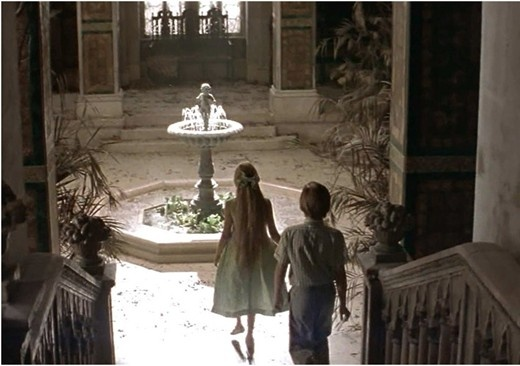
That Miss Havisham’s portrayal of transmogrification as incarnate of Dinsmoor infiltrates the filmic Satis House -the domicile of family brewery where Miss Havisham’s father produced the family’s wealth; economic designs penetrating marital relations as Miss Havisham was jilted by her lover Compeyson and the kinsman Arthur. Fallen and unfruitful paradise: large and dismal house barricaded against robbers. Thus though ‘Satis’ is the root of satiation and satisfaction become inverted into unsatisfaction and undernourishment of a barren wasteland. Dickensian descriptive language resonates bizarre eccentricity of the archetypal spinsterish lady. She [Miss Havisham] has never allowed herself to be seen doing either…She wanders about in the night, and then lays her hand on such food as she takes”.
Miss Havisham’s bridal feast commemorates a black fungus on the table where speckled legged spiders with blotchy bodies infestation occurrence ; and this rotting bridal cake metaphorically personifies Miss Havisham’s moral decay: anthropophagy revealed by the cliche: “The mice have gnawed at it[bridal cake] and sharper teeth than teeth of mice have gnawed at me”. The gothic imagery of the body and the market dynamics of Miss Havisham coalesced with the incursion of the financial world into the domestic hearth as Miss Havisham’s cousins wait to feast on the same table where the spiders feed upon her bridal cake. Miss Havisham adopts Estella who establishes sense of proprietorship in the bildungsroman hero; Miss Havisham later deals in trafficking of children instead of wine; albeit the Satis House becomes the economic nexus for the grasping members of the Pocket clan. Miss Havisham characterizes the transparent fawning of her relations as the grossest consumption, ripping the table with her stick saying: “Now you all know where to take your stations when you come to feast upon me.”
The mourning masks and the mourning jewels such as brooches and rings are grim simulations of grief and death portends the bildungsroman hero with the inherent liminality of capitalistic culture that is built upon the sufferings of the poor wretches such as the castaway Magwitch, the clandestine patron of the protagonist.
In terms of mise-en-scene the most striking contrast of the dark and the light imagery in the cinematography studies shifts film and movie audience away from the dramaturgy in novelistic adaptation. Revealing the departure scene as the epitome of the halcyon farewell in the filmic production, the hero and heroine are beneath the bridge; the camera tracking the hero as Finn walks back into the sunlight while Estella’s image disintegrates into a dark blur in the background. Extracted quotable quote illustrative of the Dickensian rhetoric used in the semantic approaches to the semiotic is thus read: “….in all the broad expanse of the tranquil light…no shadow of another parting from her”.
Estella’s reunion with Finn at the bright sunlight sea suggests the amorphous relationship and the future possibilities; there is no retreat in the darkness of the heroine tempered by motherhood and divorce; brought the daughter to view the ruins of the childhood estate of legacy. In textual and filmic language the authenticity has been intact although the mise-en-scene diverts away from Estella’s realistic characterization by Charles Dickens as the virgin, angelic, haughty, heartless, thankless, damsel beauty separated from her deceased life partner the snobbish extravagant loutish of the Finches Groove. Dialectical approaches to Dickensian film criticism would authenticate the valedictory speech act in the character of the bildungsroman protagonist and his heroine as limelighted in these exchanges:
[narratorial authoritative imperative and Estella’s declarative:… “everything else is gone from her [Estella]. The silvery mist is touched by the first rays of moonlit and the same rays touched the tears that fall from the eyes. The ground belongs to her…”It is the only possession I[ ] have not relinquished. Everything else is gone from me, little by little, but I have kept this…
[autobiographical bildungsroman protagonist’s voice: “Estella, to the last hour of my life, you cannot choose but remain part of my character, part of the little good in me, part of the evil.” In terms of intertextuality Wuthering [Cathy: I am Heathcliff] can be paralleled in the bildungsroman hero subverting the conventions of romance love making speech associated with objective identification by directly merging his subjectivity into the heroine : “every prospect I have ever seen” ideally “the embodiment of every graceful fancy that my mind has ever become acquainted with”.
Further Reading
Shari Hodges Holt’s Dickens from a Postmodern Perspective: Alfonso Cuaron’s “Great Expectations” for Generation X, Dickens Studies Annual 2007, Volume: 38, pages: 69-92
Gail Turley Houston’s Pip and Property: The [Re]production of the Self in “Great Expectations”, Studies in the Novel, Spring 1992, Volume 24, No. 1, pages: 18-25
Keith Easley’s Self-Possession in Great Expectations, Dickens Studies Annual, 2008, Volume 39, pages: 177-222
Susan Grass’s Commodity and Identity in “Great Expectations”, Victorian Literature and Culture, 2012 Volume 40, No. 2, pages: 617-641
For young people living in the world of adults, “love” is a means of defiance and resistance. Explore with respect to the literary text and any cinematic adaptation of Romeo and Juliet prescribed in your course.
The frantic pace of the movie reveals the outburst vehemence and impulsive hot-headed nature of the dwelling aboriginal of Verona as latterly foreshadowed by the rage, grief and passion of the feuding rivalries between the adversaries-Capulets and Montagues—-true to the authenticity of Shakespearean spirit. 1960s film version was focused on tragic love; the 1990s is about violent love. Shakespearean dramatis persona were the milieu of the starcrossed lovers and their inner moral dilemmas of those minds whose temperaments resonate reckless and hasty nature as the dysfunctional world of the Montagues and Capulets whose blood and honour were inseparable. Modern day mise-en-scene of the adaptation is a brilliant spectacle that marvels the accomplishing achievements through bestowal of laurel wreathed bouquets and accolades. For instance, Mercutio’s raving in the Capulet’s ball makes unimpeachable exemplary phenomenon with the bottling of acid beforehand. Romeo’s decision to end his life with poisonous drugs parallels the lifestyle of violence and addiction. The mafia clans’ fanaticism of religious sentiments as projected by their Catholic vein running through the plot juxtaposes coldblooded aggression as ironically spotlighted by the stereotypical families.
The close shot camera focusing the Shakespearean hero and heroine cloistered by the walls of Verona and confinement by window frame of patriarchal abode respectively. Upon revealing close up shot Zeffirelli’s camera angle moves to showcase Romeo attired in a deep, lilac; a Montague bereft of Capulet vulgarity and ostentation; nonetheless, pill box hat, eyeliner, flawless complexion and the flower exemplifies effeminacy. “A glooming peace this morning with it brings. The sun for sorrow will not show for his head”—–unshaved, unkempt Romeo beside swollen lips and fluffy faced Juliet in the tomb scene is the visual artifice in commitment to the ironical perspectives of the drama. Zeffirelli’s textual interpretation literally elucidates Shakespeare’s highly stylized and emotionally expressive naturalism that bestows weight to the narrative moments like Juliet’s departure epitomizing overexcitedness and emotional disorientation by the state of the physical dizziness. Here, as throughout, Zeffirelli creates a situation where visibility becomes feeling and feeling becomes awareness.
Religion of love imagery foreshadowed by the sonnet dialogue is absolutely superbly visualized filmic adaptation to cherish beneath the connotations of pilgrimage and saintliness: institutionalized and ritualized love-making courtship. The starcrossed lovers romantic love-making sonnet in the background depicted by the imageries of saints, pilgrims and statues brings the abstractest essence of martyrdom, canonization and immortality—the fabulous trappings embodying their history—their personalities and their naivetes, and their uncertainty of each other and the awareness of the social context in which they find themselves in the ignorance of perils. Choruses last six lines musical effect is absolutely inappropriate and unnecessary addition to the cinematic conventions of diegesis hovering between snapshots and painting, documentary and fiction; reconciling the present tense with the past tense of the film, ethical space with that of the cinema and history with story as profoundly replicated in Mercutio’s remark to Romeo is appropriately credible to Zeffirelli’s diegetic: “Now art thou what thou art, by art as well as by nature.”
Further Reading
Sarah L. Lorenz’s “Romeo and Juliet”: The Movie, The English Journal, March 1998, Volume 7, No 3, Teaching the Classics: Old Wine, New Bottles, March 1998, pp. 50-51, National Council of Teachers of English
Michael Pursell’s Artifice and Authenticity in Zeffirelli’s: “Romeo and Juliet”, Literature and Film Quarterly, 1986, Volume 14, No 4, pp. 173-178, Salisbury University
Examine the cinematic adaptation of Pride and Prejudice with that of the literary textuality.
Costume as well as nostalgia films engage the spectatorship through voyeurism of feminine and masculine sensuality as the technique of dramatization and the usage of focalization as revealed in the construction of Elizabeth Bennet’s and Fitzwilliam Darcy’s dramatis persona; whose body language, literary allusions, puns, metaphor, imageries and symbolisms have been layered with sexual connotations; beneath the intentionally solicited experience of repression tat imbues with sexuality: clothing, landscape, piano playing, letter writing and conversation. Evolving the Austenian filmic adaptations into modern cinema from the BBC 1995 television series, You’ve Got Mail, Bridget Jones’ Diary, Bride and Prejudice to the hallmark production of the film Pride and Prejudice 2005, which is critically acclaimed for the filmic grammar that includes: close ups, insert shots, subjective shots, eyeline matches, reaction shots.
The female body politic is fragmented and transmuted into eyes to be admired, her hair locks to be bestowed, hands to be kissed and feet to be touched as exemplified in the case of feminine fetishization in the heroine Elizabeth Bennet portrayed by Keira Knightley. Mr. Fitzwilliam Darcy in the cast of Mr. Matthew Macfadyen, in whom avowed desire for the feminine object is aroused by the romanticism through fantasizing “the beautiful expressions of her dark eyes”—–the recurring symbol of Elizabeth’s charm. The ardent love of Darcy eventually follows melodramatic marriage proposal, a refusal and latterly unexpected encounter at the Pemberley Derbyshire estate; Elizabeth Bennet’s respect, esteem, gratitude and a genuine filial affection for the welfare of Darcy is translated into a reality. […] “it is many months since I have considered her as one of the handsomest women of my acquaintance”. Love and passion have merged together into authentic and relevant feelings; there is no question of impulsive foolhardiness since the breach of etiquette can be valedictorily redressed and the truth be confessed.
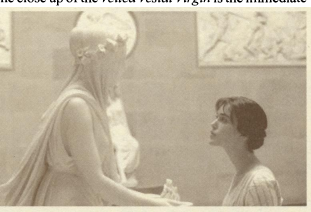
Metonymic love undercover of Austenian body politic is not always translated into synecdochical fragments; sometimes it is also deviated and transmuted into tangible and touchable substitutes of the persona in the marbled sculpture and the mantelpiece portrait found by Elizabeth in the Pemberley Derbyshire estate as transmogrified real metonymical substitute in Darcy’s real picture. Discovery of the treachery and villainy by the janus-faced Wickham is visualized in the narrative perspective: “Till this moment, I never knew myself” is representative of the objective correlativity of the attainment of truth: Mrs. Reynolds, the housekeeper’s testimony of the heroic Darcy’s impassioned defence: “He is the best landlord and the best master […] that ever lived.” Instead of the family portraits the gallery of Chatsworth House offers Greco-Roman antiquaries sculptures such as the corporeity close-up of the Veiled Vestal Virgin in the embodiment of the heroine.
Jane Austen, a subtly pervasive stereotype of defensively ironic genteel spinster wrought by sexuality fogged in bourgeoise morality as opposed to sexual vitality; in favour of frigidity as a standard of sexual conduct. Jane Austen chronicles sexual selectivity behind the wooing and wedding amidst art and nature, feeling and reason, freedom and order, individual and society as thematic plot and dialogue within the narrative. Constrained, reserved, solitary and fastidious Darcy epitomizes vanity and haughtiness, superciliousness and snobbery. Darcy’s inner dramatic dream fulfillment for dancing a reel / “feel a great inclination […] to seize such an opportunity of dancing a reel by the playing of piano by Miss Bingley. Austen stories and characters are brought to life by the landscape and panorama of the settings as wanderings of the exquisite halls and eccentric gardens; drawing rooms pulsating with society’s expectations, gardens consisting of well-wrought urns of mysteries; and the outdoors becoming the witnesses to the silence of the ebb and the flow of love and intrigue.
The narrative moment sedately stroll through parklands and cultivated gardens or accompanied walks to towns is both alluring and perturbing for being unescorted young maidens in Austenian Regency England. In this instance, the heroine walk from Longbourn to Netherfield to visit Jane Bennet: Elizabeth’s hiking over fields, jumping over stifles and springing over puddles aroused the censoriousness in Miss Bingley’s rhetoric of muddy petticoats and blousy hair to which Darcy’s defence of the narrative voice invokes “divided between admiration of the brilliance which exercise had given to her complexion and doubt as to the occasion’s meriting her coming so far alone”, acknowledgement that he does not wish to be allied with a family that frequently makes a spectacle of itself. It is an opposition of heart and head, of reason and feeling, of intellect and emotion, of control and spontaneity, of elitism and egalitarianism—-that Jane Austen ironically insists in satire —-landed gentry view versus the outlook of a gentleman’s daughter.
Jane Austen’s warding off Mr. Darcy’s wedding proposal through the verbal rape of Elizabeth that he has not behaved in a “gentlemanlike manner” is far less explicit than Jane Eyre’s assertion to Rochester that she has full as [much soul as [he] and full as much heart.” But it voices the same feminine complaint alleging the masculinity of unrecognition of the female selfhood. Even after the proposal scene, the antitheses and hostilities between the sexes bear resemblances to Shakespearean lovers in a wood, meeting evanescently for exchanging letters. However, the whole of Pemberley episode is a tour-de-force of technique and perception in which the outward action is a metaphor of inward feeling: “at that moment she felt to be mistress of Pemberley might be something.” The language of speechlessness is bereft of smiles, sparkle of wit and repartee—–Benedict and Beatrice as lovers reciprocated in the depth of the deeper sentiments of silence. Eventually the reticence and resolutions of filmic diegesis of the textual adaptation shifts the pronoun of Mr. Darcy from “I” to “you” in the statements [“In vain have I struggled”… “You are too generous to triffle with me”] to transcend his social and sexual egocentricity. Foiling Georgiana Darcy’s obstreperousness to Lady Wickham or Lydia Bennet heightens the tension harboured by too repressive or too permissive upbringing, each of which equally lead to promiscuity. Through freedom and spontaneity, Elizabeth will teach Georgiana as a corrective to her too rigid upbringing; that she will be a child of Darcy’s head and Elizabeth’s heart, of his principles and her feelings to oversimplify—-of the union of rationality and emotion that their marriage represents.
Further Reading
Roberta Grandi’s [Catholic University of Milan] The Passion Translated: Literary and Cinematic Rhetoric in “Pride and Prejudice” (2005), Literature/ Film Quarterly, 2008, Volume 36, No. 1, pp. 45-51, Salisbury University
Alice Chandler’s “A Pair of Fine Eyes”: Jane Austen’s Treatment of Sex, Studies in the Novel, Spring 1975, Volume 75, No. 1. Pp. 88-103
As they navigate darkness, guided by hope’s length.
Their stories unfold, like whispered melodies,
Echoing through time, carried on gentle breeze,
Their resilience, a symphony of the human spirit,
A reminder of the power of love, we must inherit.
Amidst the sorrow, a glimmer of light,
Kindness and compassion, shining bright,
Communities unite, extending a helping hand,
For in unity lies the strength to understand.
Let us stand together, embrace their plight,
With empathy and love, we’ll make things right,
For every refugee, a story to be heard,
Their sorrow transformed into a song, undeterred.
A Village Girl’s Journey to Education
In a humble village, where traditions held sway,
Lived a girl with dreams, eager to find her own way.
Her grandmother’s favorite, she was cherished and adored,
But her spirit yearned for knowledge, a thirst she couldn’t ignore.
In a world where grammar held no sway,
She dared to break free, to pave her own way.
With determination as her guide, she sought to learn,
To empower herself, her village, and make the world turn.
She faced challenges and doubts, but never lost sight,
Of the power of education, shining ever so bright.
She defied expectations, shattered the mold,
With each step forward, her story began to unfold.
Through books and classrooms, she found her voice,
And discovered the strength in making her own choice.
She inspired others, igniting a flame,
A revolution of minds, where girls’ education became the aim.
Her village transformed, as dreams took flight,
Girls empowered, their futures shining bright.
From tradition to progress, a beautiful transition,
Thanks to the girl who broke free from tradition.
So let’s celebrate her journey, her courage, and her might,
As she paves the way for others, in the pursuit of what’s right.
For every girl deserves a chance, to learn and to grow,
To unleash her potential, and let her brilliance show.
A Heart Full of Hope
In the depths of the city,
Amidst the hustle and the noise,
There’s a heart that beats with hope,
A heart that’s been left to rejoice.
She’s an orphan, a little girl,
With a smile that’s bright and true,
Her eyes hold a world of dreams,
A world that’s yet to be renewed.
She’s been through the storms of life,
The winds that howled and blew,
But she’s learned to stand her ground,
And she’s learned to hold on tight to what’s true.
Her heart is full of hope,
A hope that’s pure and bright,
She knows that she’ll find her way,
And she’ll make her dreams take flight.
So let us stand beside her,
And let us hold her hand,
Let’s help her find her way,
And let’s help her take a stand.
For she’s a heart full of hope,
A heart that’s pure and bright,
And she’ll show us all the way,
To a future that’s filled with light.
The Firefly’s Whisper
In the stillness of night,
I stumbled upon a sight,
A tiny being, aglow,
A firefly, my heart did glow.
I reached out, with gentle care,
To touch this creature rare,
And whispered, “Oh, how I yearn,
To shine like you, my heart does burn.”
But life is a struggle, I know,
And tears fall, where hope does go,
I wish for a brighter day,
When I’ll be a firefly, come what may.
The firefly smiled, with a twinkle in its eye,
“You’re more unique than I,” it said, “Don’t be afraid,
The hard nights and days may seem bleak,
But stars shine more in the darkness, you seek.”
The seed may grow more in the mud,
And the future may seem far,
But you’re a firefly in your heart,
A shining star, from the very start.
The stars themselves may be jealous,
Of the light that you do bear,
For your burning desire to achieve,
Is a sight that’s truly rare.
So let your struggles self-own a shine,
And let the stars in the darkness align,
For you’re a firefly, in your heart,
A shining star, from the very start.
A Cry for Life
My body yearns to live,
But every breath is a struggle,
Pain consumes me,
As my sister’s life fades before my eyes.
Thalassemia, a curse,
A disease that steals life,
Its grip is tight,
And my heart aches with every beat.
We are the roses of paradise,
Innocent hearts,
But our pain is real,
Why won’t you let us live?
Life is not equal,
Death is painful,
But for us, it’s worse,
Your ignorance hurts us deeply.
We thirst for your intentions,
We crave your touch,
We are thirsty,
Please, do something for us.
Oh moon, come to earth,
And embrace me,
For life is a battle,
And I need your comfort.
From Mud to Stars
In a humble mud house, with no toys to hold,
A girl walks in search of butterflies, her heart so bold.
She touches pigeons, smells the rain’s sweet scent,
Opens her window, sits before the moon, content.
As she sleeps, her mother feels her tears on the page,
But she studies, never giving up, fueled by her inner rage.
One day, she becomes a hope giver, spreading light,
Embracing the stars, hugging her mom, day and night.
In moments of loneliness, she finds solace in their embrace,
For love and family are her guiding grace.
Through her journey, she shines like a star,
A beacon of hope, no matter how near or far.
Anila Bukhari: The Amazing Journey of a Trailblazing Advocate
Anila Bukhari, a truly extraordinary young girl, stands out as a beacon of hope and inspiration. She is a passionate advocate for children’s rights, a tireless activist for girls’ education, a dedicated teacher, a compassionate humanitarian, a philanthropist, the youngest peace ambassador, and an accomplished writer of 11 books.
At the tender age of 10, Anila embarked on her writing journey, captivating readers in 50 countries with her powerful words. Her exceptional talent has earned her numerous awards, recognizing her remarkable contributions to humanity.
Anila’s books shed light on worldwide issues and offer solutions, with a particular focus on the importance of girls’ education. Her impact extends beyond the pages of her books as she has personally educated 1,000 refugees and orphans in Uganda and established small wooden libraries in remote areas, providing access to education for underprivileged girls.
Driven by her compassion, Anila has also donated hair wigs to cancer patients, bringing smiles and comfort during their challenging journeys. Her poems have been proudly displayed in renowned art galleries across the globe, including Florida and the Philippines, inspiring countless individuals.
Anila’s groundbreaking work in advocating for girls’ education led her to introduce the world to the Girls’ Education Awareness Day, celebrated in 11 different countries. Her unwavering determination to educate every girl is a testament to her vision for a brighter future.
Through her writing, Anila instills hope and encouragement, empowering individuals to overcome obstacles and reach for their dreams. Her impact on the world is immeasurable, and her legacy will continue to inspire generations to come.
Why? !!

Why?
Are you always on my mind?
Every second, every moment?
Are you in my soul?
You don't know ...
Why?
I can't go, you can't go either,
My pillows are wet with tears at night.
The stars are holding me in mourning.
You don't know.
Why?
Do you keep writing gazelles?
Is it a band or another beauty?
Shormikan peshonam yo azal, azal?
You don't know.
Why?
Did your love blind my eyes?
Do you have anything to do with me now?
Does it matter, spring or winter?
You don't know ...
Why?
My heart sank,
You have broken my broken tongue,
Oh, give back my poor heart.
Silent ....
Why?
Many questions, unclear answers,
It is clear that I will be separated,
Now love is abgor, feelings are broken,
No answer ...
Why?
Why?
Why ?????
You don't know ....


Sharipova Zuhro Sunnatovna (Zahro Shamsiyya) She was born on April 9, 1969 in the Nurata district of the Navoi region. Her first poem was published in 1985 in the Gulhan magazine. Uzbek publishing houses published works in the journal "Sharq Yulduzi", in the literature and art of Uzbekistan - "Ma'rifat", in various regional and district newspapers. World almanacs in Canada, -2017 in Dubai WBA 2018 "Turkish poets of the world" (Buta 3) 2019, "Muhammad Yusuf izdoshlari" 2017 almanac. She published her book "Ismsiz tuigular."
We continue to express sorrow over what’s happening in so many different parts of the world and encourage our readers to support people and the planet.
Also, we are hosting our Metamorphosis gathering again! This is a chance for people to share music, art, and writing and to dialogue across different generations (hence the name, the concept of ideas morphing and changing over the years). So far photographer Rebecca Kelly and English/Spanish bilingual poet Bridgett Rex are part of the lineup and more are welcome! This event is also a benefit for the grassroots Afghan women-led group RAWA, which is currently supporting educational and income generation and literacy projects in Afghanistan as well as assisting earthquake survivors. (We don’t charge or process the cash, you are free to donate online on your own and then attend!)
This will be Sunday, December 31st, 2-4 pm in the fellowship hall of Davis Lutheran Church at 317 East 8th Street in Davis, California. It’s a nonreligious event open to all, the church has graciously allowed us to use the meeting room.
This issue draws us into a full sensory experience, surrounding us with places and worlds larger and more vast than ourselves.
Vernon Frazer’s pieces rumble with a smorgasbord of rhythmic and clanging instruments and sounds while Joshua Martin sends up a plethora of sonic syllables. Mahbub Alam stares and contemplates the beauty of nature and the Taj Mahal. Christina Poythress highlights through tactile details the rich nightlife within the world’s soil. Kathleen Hulser draws on mathematical concepts as metaphors for how life changes affect and circumscribe our lives.
Jim Meirose illuminates the sensory experience of playing outside on the grass on a nice sunny day while Lorraine Caputo wanders off trail in South America: evenings, out-of-the-way streets, and less crowded areas.
Rafiul Islam speculates on inter-planetary relations in a society where multiple sentient species inhabit multiple planets.
Bekzod Quodirov outlines ways to make ammonium nitrate safer and more stable as a fertilizer and an industrial tool.
Even our own, more human-scale worlds contain more detail that we often grasp at first glance.
Sophia Fastaia remembers the joy, wonder, comfort and danger of childhood, all in one birthday party.
Chloe Schoenfeld’s piece probes opposites and finding and befriending one’s shadow self. Pascal Lockwood-Villa surveys a vacation in the tropics through the lens of photos that reflect different dimensions of human nature.
Susan Hodara details the common sensory experience of drying off after a shower while J.D. Nelson observes daily life and snacks within a homeless shelter.
Philip Butera describes with sensory details the underside of a circus after the show, referencing the work of repackaging the illusion.
Duane Vorhees’ work explores coupling and fertility from several big-picture spiritual and grounded, natural angles. Aklima Ankhi describes the search for an intense emotional connection with a lover that goes beyond the fleeting happiness of the everyday.
Slavica Pejovic ponders love, closeness, completeness, and connection. Aasma Tahir rhapsodizes about the subconscious worlds of nighttime, romance, and the imagination. Kristy Ann Raines describes the intense emotional experiences of love lost and regained.
While our universe can be glorious, it can also be tragic, with forces beyond our control.
Ari Nystrom-Rice reflects on the fragility of his knowledge and sense of place in his world through the metaphor of a child’s toy boat exposed to the elements.
Nilufar Ergasheva illustrates the dangers of the winter season in rural villages, with cold and wild animals on the prowl, while Christopher Bernard renders appendicitis and surgery into poetry.
Mykyta Ryzhykh probes where we can find meaning and tenderness in a war-ravaged world where death seems frequent and life seems meaningless. Atagulla Satbaev shares how we delude ourselves into thinking love is eternal: time and death separate everyone. Michael Lee Johnson reflects on his own mortality and attempts to find eternal love in living death, rather than in the capriciousness of life.
Graciela Noemi Villaverde’s piece renders grief into somnambulant surrealism, a panoply of dream images while Alden Joe evokes the pain of lost love with imagery of tigers and predation. Suleiman Gado Mansir sends up a surreal dream sequence illustrating how our minds attempt to process the world’s violence.
Sometimes, we wonder what place we have in such a large world. Will the universe overwhelm and consume us?
Alma Ryan explores the season of fall with a meditation on falling, death, and the ways we let ourselves go. J.J. Campbell’s work turns solemn this month as he ponders various kinds of death and forms of passing away.
Zahro Shamsiyya reflects on the brevity of life and the need to savor the experience. Jerry Langdon reflects on the changing of seasons and the passing of a friend.
Gabriel Flores Benard shows the tragic ways continued abuse can shape a still-forming personality.
Even apart from mortality and injustice, everyday human psychology can be a mysterious and unmapped landscape.
Zosia Mosur illustrates how we sculpt and train and also harm and punish our physical selves.
Taylor Dibbert’s speaker speculates on what his midlife decades will bring, while Noah Berlatsky highlights the common human experience of procrastination and Shirley Smothers relates her efforts to maintain inner peace.
Shamsiya Khudoynazarova Turumovna laments that real life can’t be like the novels she reads. Azemina Krehic compares herself to a linden tree and wishes she possessed its strength, but finds herself instead in the tree’s biological complexity.
Yet, we as humans do not have to be passive in the face of such a large and grand universe. There are roles we can play, even as individuals, that allow us selfhood and transcendence.
Diyora Abdujabborova’s reflects on the value of women’s leadership and nurturing roles in Uzbek society. Anila Bukhari speaks to the earnest desire of girls living in poverty to get an education.
Christina Chin and Uchechukwu Onyedikam collaborate on haikus that are translated into English, Taiwanese, and Igbo and highlight moments of people collaborating with nature. Nery Santos Gomez illustrates the joy she takes moving in unison while riding a beloved horse.
Daniel De Culla’s photography focuses on low-key ways we alter or adjust our environment: clothes, sketches, bushes we plant. Isabel Gomez de Diego illustrates moments where nature (small children and plants) integrates into our built environments.
Sayedur Rahman demonstrates the resilience and strength of refugees creating new lives in their new homelands. Jacques Fleury asserts his place in the world as a Black man, self confident even in spaces not created with him in mind.
Christina Chin and Paul Callus also collaborate on further haikus translated into English, Mandarin and Maltese that celebrate the mastery of crafts: cooking and painting.
Annie Johnson speaks to the transcendent immortality she finds through stepping out of herself to create art that will outlast her.
Mark Young reflects on the values and accomplishments of his Boomer generation in terms of shaping society while questioning the uses of similar government power today.
Z.I. Mahmud outlines Jane Eyre’s character growth and self-assertion in Charlotte Bronte’s novel while Shokirova Zarnigor Shuhratjanovna urges patience for people seeking the meaning of their lives.
Orzigul Sherova shares how she learned to draw on her fantasies as an inspiration rather than as a way to avoid achieving her real-world goals.
In Nahyean Bin Khalid’s take on a haunted mansion horror tale, his protagonist frees undead souls trapped in the home, but stays to become their caretaker rather than escaping, getting killed, or kicking the ghosts out.
Jaylan Salah reviews Daniel Radcliffe’s new HBO show The Boy who Lived, about David Holmes, his stunt double who became paralyzed after an injury on set and who worked with quiet courage and dignity to rebuild his life.
Even if our places in the universe are relatively small in the grand scheme of things, it matters how we fill our places because our behavior and choices affect those around us.
Rasheed Olayemi’s poem demonstrates how corruption at both individual and governmental levels weakens a country’s economy.
Daniel De Culla calls out the hypocrisy of people who focus more on looking good at charity balls rather than helping others, especially in wartime.
Mesfakus Salahin’s narrators are wise beyond their years in terms of their ability to love and respect and connect with other people. Salahin urges adult world leaders to hold to that level of maturity.
Elmaya Jabbarova urges the world to wake up and turn back towards life and justice.
Lilian Dipasupil Kunimasa fondly remembers her low-tech but fun childhood visits to her grandparents’ country town, and urges compassion for those with HIV/AIDS.
Family, culture, love, and heritage can be vital to grounding us and giving us the strength to withstand a rough universe.
Aziza Gayratova expresses respect for her parents and the strength family love gives her to endure life’s injustices.
Wazed Abdullah reminds us of how essential love and caring is to life while Faleeha Hassan speaks to a mother’s wish to protect her son during wartime in her poem, translated by William Hutchins.
Shahnoza Ochildiyeva offers up a colorful paean to her native Uzbekistan while Yahya Azeroglu pays tribute to Ataturk, the founder of modern Turkey.
Fahimrelates a story of courage and loyalty among Bangladeshi soldiers at the country’s founding.
Finally, to come back to nature and the vast universe outside of our own species, Brian Barbeito reflects on the wisdom of nature to outlast humanity. He also considers how mysterious the sea remains, even after millennia of sailing.
ANOTHER SPRING NIGHT IN FARMERSVILLE, OHIO

The sun is a gong hung low across the sky,
windswept.earthdirty.sunwhipped: farmers wait inside their bones
for the horizon to rise and beat the daylights out of the sun
and call them from their long dungrows for a night.

Your chastity's a song sung slow through long nights
on muffled virginals: muting babies wailing to be born:
golden arrows, a thong-strung bow        the dream night.
The night is calling: strong, gung-ho -- black hawk in flight.

(Tonight? When one earthtired husbandman works me in his hands
& periods this dry chaste day, waters these furrows hungry from famine?

But no.
             Just one more wrongtongued crow in flight.)


AH! NIGHTS

Ah! Nights you were a harem
and I the unmade Bedouin too long in the thirst.
Past the black eunuch of the night
I would steal to your tent,
unarmed save the single arrow in my quiver.
I'd draw sensuously back your damascene veil
and let fly my shaft
deep into your bulls eye arabesque--

Or: you were queen of the hive
and I a drone among the honeys
getting a buzz on and doing my job
plunging among the dusky clover
trying to pollinate the skies
to flower the night with stars.
To lose my only stinger would be to die--

Or else: you were madonna
awaiting your Jealous Commanding God,
The Spawner Of The Cosmos,
Beam Of Light Made Flesh To Hold You In Your Place
(while you shook in rapture for the coming of your Lord,
i a small choirboy would steal into your unguarded churchyard
and send a solitary firework into the cathedral's secret hole
and hope it explodes high up in those beribbèd vaults
and surprise celibate fathers from their sleep).


EITHER ALZHEIMER'S OR THE LIGHTNING BLAST

Whizzdizzyingly
cruising The Moment,
arrowing past all awareness:
highway,enginewhiine,steeringwheeltrafficWorldsmuginnnngg past
while we, preoccupied, reprise Creation,
absorb Eternity and Logos, Eden/Gethsemane, Genesis-Apocalypse
and the Night the Night,
the private bleeding into the general,
and Ouruniverse proxying for ego.
Glorious cosmic fusion in an infinite minute.
      (or so it briefly eternally seems in our infini-tiny microverse)

The ends of love
are but two

:your V8 plunges from the surface
and, crucified like a butterfly in time,
helpless consciousness heightened,
you hover in slowmotion witness
to the juggernaut earth's decay
just as your metal-again grille
begins to embrace solidity

or: doomed foresight eludes
as you rearend that lightless
semi-tr


MY WIFE

My wife is the flag
placed on climbers' highest crags.
 My wife is the mirror
who patrols my appearance
and makes sure all is fit
and I'm vetted to grace the public.
She's the armorer
who's forged our love and honor.
My wife is the ear
who grants the pre-clearance
for my poems' weight and wit
so they're ready to face the critics.
My wife is that fire
to kindle and quell desire.


WHAT I DID LEARN

My mansard roof -- its shingles
lost so very long ago.
In Lhasa at Your temple,
at that brave school in Lisbon,
I studied my imago.
My music group's hit singles
stopped so many songs ago.
I've learned my shakes and wrinkles
but still I wait for wisdom.