
Rebirth of Love

See the heart of the world
It is not imagined by lovers so called
The sun rises everyday in eyes
Everywhere the dream independently flies
Mountains travel beautiful places
The tree talks to its branches
With sweet voice fountain sings
Beauty flies on the air's wings
The sky sleeps on the flying cloud
Raindrops play like brotherhood
Love deserves loneliness
Relation builds on avoiding ugliness
Birds adore first night
Nature refreshes morning sight.
Rebirth reproduces generation's wheel
Though the world will be a shelter of nil.
Category Archives: CHAOS
Poetry from Don Bormon
In a Day of Winter

Winter is a season of cold and mist
This time dew shines on the leaves
It shows a lot of beauty of nature
In a day of winter,
I was walking on the street, I saw
The trees were dry
The leaves left the trees, I think
The leaves did not want live with the trees
The sun rays hide back of the dew
It wants to reach on the earth, I think
If I could be the sun rays!
I would come on the earth
To make happy the trees
To remove the dew and mist and make clear the sky.


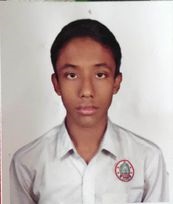
Don Bormon is a student of grade 8 in Harimohan Government High School, Chapainawabganj, Bangladesh.
Christopher Bernard reviews William Kentridge’s Sibyl at Zellerbach Hall (Berkeley, CA)
The Mouth Is Dreaming
SIBYL
William Kentridge and collaborators
Zellerbach Hall
Berkeley
A review by Christopher Bernard
The climactic event of an academic-year-long residency at UC Berkeley by the celebrated South African artist William Kentridge, was the United States premiere at Cal Performances of SIBYL, the latest example of his deeply witty, darkly lyrical, postmodernly brilliant, if intermittently satisfying (though the two last qualifiers are perhaps redundant), but exhilarating suspensions in organized theatrical chaos.
Beginning as a reluctant draftsman, and having gone through a succession of dead-end careers in his youth (as the artist has described in interviews), Kentridge finally embraced the fact that his deepest gift lay in drawing; in particular, his capacity to turn charcoal and paper into an infinite succession of worlds through the dance of mark, smear, and erasure, similar to those of a master central to him, Picasso. Through drawing, he was able to extend his explorations into other fields of interest, including sculpture, film, and theater, above all opera and musical theater, attested to by his celebrated productions of operas by Berg, Shostakovich, and Mozart.
The artist also realized that it was precisely this capacity for creation itself – though perhaps a better term for it might be perpetual transformation – that stood at the heart of what we must now call his peculiar, and peculiarly fertile, genius (a term I do not use lightly – Mr. Kentridge is one of the few contemporary artists whom I believe fully deserves the word).
The latest hybrid work combining his gifts is a theatrical kluge of disparate elements that meld into a uniquely gripping whole, though there are gaps in the meld I will come to later.
The central idea is the Cumaean Sibyl, best known from Virgil’s Aeneid and paintings by Raphael, Andrea del Castagno, and Michelangelo. A priestess of a shrine to Apollo near Naples, she wrote prophecies for petitioners of the god on oak leaves sacred to Zeus, which she then arranged inside the entrance of the cave where she lived. But if the wind blew and scattered the leaves, she would not be able to reassemble them into the original prophecy, and often her petitioners would receive a prophecy or the answer to a petition not meant for them, or too fragmentary to be understood.
The performance opens with a film with live musical accompaniment, called The Moment Is Gone. It spins a dark tale of aesthetics and wreckage involving the artist in witty scenes with himself as he designs and critiques his own creations (a key link in his own transformations), and, in two parallel stories, Soho Eckstein (an avatar of the artist’s darker side who frequently appears in his work), a museum modeled on the Johannesburg Art Gallery, and the Sisyphean labors of zama zama miners – Black workers of decommissioned diamond mines in South Africa; work that is as dangerous and exhausting, and often futile, as it is illegal. Leaves from a torn book blow through the film bearing Sybilline texts: “Heaven is talking in a foreign tongue,” “I no longer believe what I once believed,” “There will be no epiphany,” and long random lists of things to “AVOID,” to “RESIST,” to “FORGET.” The museum is undermined and eventually caves in at the film’s climax, leaving behind a desolate landscape surrounding an empty grave.
The film is silent, though its exfoliating imagery almost provides its own music, an incessant rustling of forest leaves like those of the original Sibyl’s cave. The live music is composed by Kyle Shepherd (at the piano) and, by Nhlanhla Mahlangu, choral music sung by a quartet of South African singers, including Mr. Mahlangu. The choral music is based on the hauntingly quiet isicathamiya style of all-male singing developed among South African Blacks in eerie parallel to the spirituals of American Black culture, and for similar reasons: to try to console them for a seemingly inescapable suffering caused by white masters in a brutally racist society.
The second half is called Waiting for the Sibyl, in six short scenes separated by five brief films. The live portion presents half a dozen or more singers and dancers in scenes from the life of the Sibyl acting out her half-human, half-divine mission. Several of the scenes also incorporate film projections of drawings in charcoal and pen and pencil, black-ink splashes dissolving into mysterious exhortations (some of the visuals are powerfully reminiscent of Franz Kline’s black paintings on newspaper and phone directory pages from the 1950s), and Calder-like mobiles and stabiles, the most powerful of which spins slowly for several minutes, turning from an ornate display of stunningly dark abstractions into a climactic epiphany of resplendent order: the divine oakleaves of the Sibyl upon which we can read our destiny if we are lucky enough to find the one meant for us. The claim “There will be no epiphany” is here startlingly, and definitively, denied.
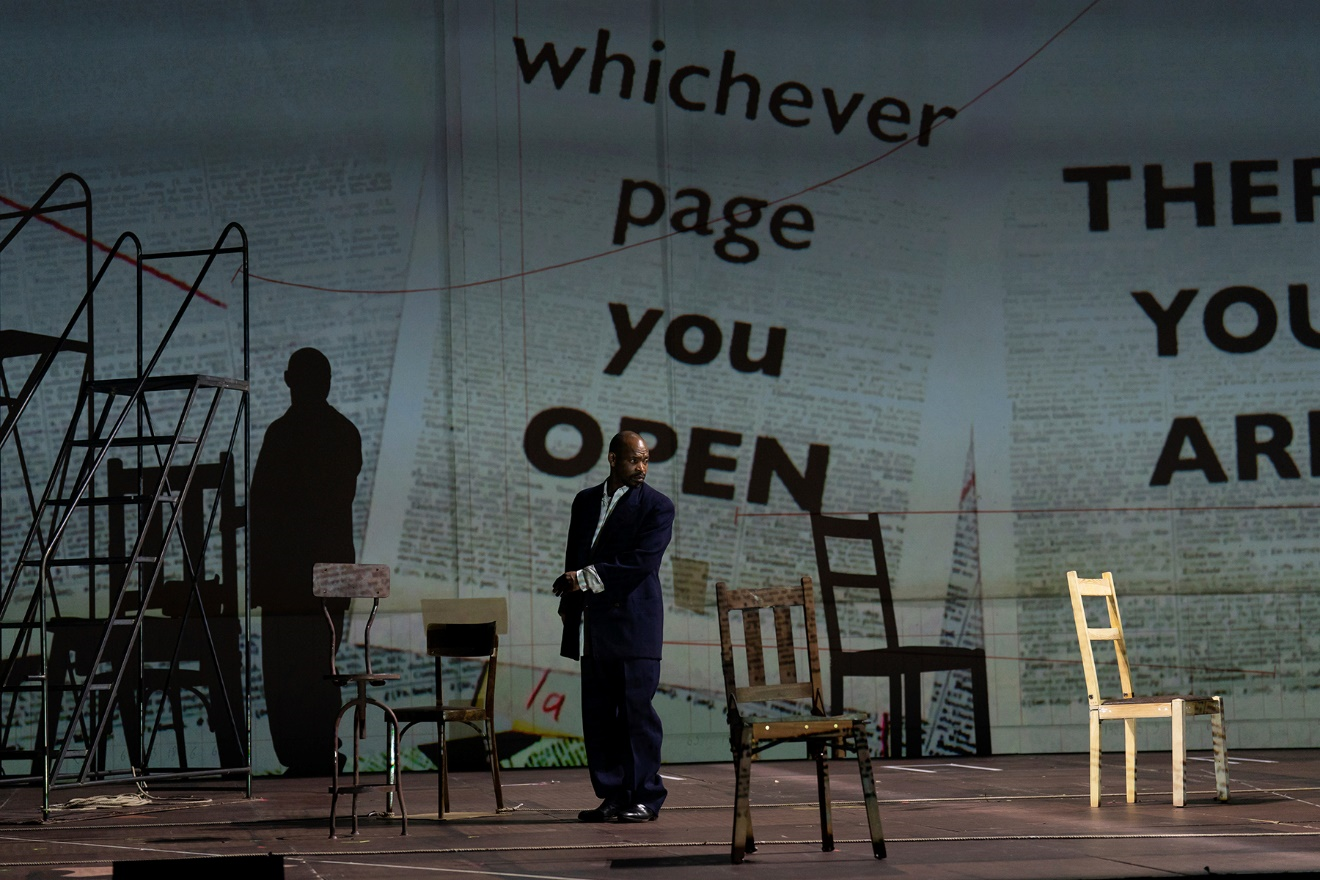
A line of bright lights along the front edge of the stage projects the shadows of performers and props against back screens and walls to effects that are both compelling to watch and symbolic of the dark side of every illumination. In several of the scenes, Teresa Phuti Mojela, playing the Sibyl herself, dances in magnificent passion as her shadow is projected grandly on the screen behind her to the right of which a flashing darkness of charcoal and ink from the artist’s hand dances beside her.
In other scenes, the treachery of the material order is allegorized in a dance of chairs moving apparently by themselves across the stage and collapsing just when a poor human being needs to rest on one from the unbending demands of the material order of living.
In another scene, a megaphone takes over the stage and barks orders across the audience, many of them transcriptions of the oracular pronouncements on the Sibylline leaves: “The machine says heaven is talking in a foreign tongue.” “The machine says you will be dreamt by a jackal.” “The machine will remember.” Though then the megaphone – stand-in for the machine – seems to turn against itself: “Starve the algorithm!” it demands, shouting over and over, to several unequivocal responses (“Yes!” “You said it!”) from the audience I was in.
One of the most dazzling of the short films is an immense one-line drawing that begins as a dense chaos of swirling squiggles in one corner that eventually builds into an elaborate, precise, wondrous, surreal but perfectly legible drawing of a typewriter. But the draftsman does not stop there, he continues drawing wildly, apparently uncontrollably until the screen is a thick liana, a fabric of chaotic twine, the typewriter slowly sinking beneath the chaos of a creation that cannot stop. This is a nearly perfect example of the perpetual transformation – one might say, of existence itself – that is one of Kentridge’s central themes.
SIBYL is filled with such brilliant and, for me, unforgettable moments, as I have learned to expect from this artist after he first invaded my mind in a retrospective I saw in 2010, and in the following years in such masterful creations as “The Refusal of Time.” But the piece is not without weaknesses. The artist admits, in interviews, that he does not know how to tell a story. And that is clearly true – and in most of his work, it doesn’t matter. But for a live performance, something like a narrative arc is required for a piece to cohere and satisfy at least this spectator. The arc can be as abstract as you please (such as in a Balanchine ballet), but it needs to be there. And it is not present in the second part of SIBYL (where it needs to be) nor, a fortiori, in the work as a whole. The production provides a fascinating evening, loaded with ore; my only complaint is that it could have been even better than it is. For example, I was expecting a fully climactic conclusion. There is none; it just stops. The ending is merely flat. Postmodernly unsatisfying.
Among the things that stay stubbornly in memory are the vatic sayings of the Sibyl herself, strewn across screen and stage as at the mouth of the priestess’s cave: “Let them think I am a tree or the shadow of a tree.” “It reminds me of something I can’t remember.” “We wait for Better Gods.” “The mouth is dreaming.” “Whichever page you open” “There you are.”
_____
Christopher Bernard’s third collection of poetry, The Socialist’s Garden of Verses, won a PEN Oakland Josephine Miles Award and was named one of the “Top 100 Indie Books of 2021” by Kirkus Reviews. He is a founder and co-editor of the webzine Caveat Lector.
Poetry from Philip Butera
Ill-Fated

I am scholarly
detached,
uncertain,
a teardrop between
uncomfortable
and not belonging.

Like a neglected wound
I am scarred
and imply,
what I don't say.
I have no illusions about distractions.
I remain
a wanderer
waiting for storms to uproot
what I find grounding.

I cannot remember a journey
without doubt
or a romance
without glossy wings,
beautiful as a rainbow
but always
ill-fated.
For
wind and time
become
errors in an abyss
refusing to concede.

As I contemplate
the unsettling darkness
of characters I've played
self-deception
curls about me.

I sought the exceptional,
but found
the visceral.
I have trapped words and used them as lures.
Outlined with silver garlands
they shimmered
giving me an advantage.
But I
distrusted precautions
and when
the stakes were the highest
I walked away
alone.


Bells That Toll

Did you hear the bells?
Bells that toll
must have a purpose
like love
or death.

The bells rang boldly
when I was a child.
I heard the bells
they captured my attention
like America,
like life.
I heard the bells
near a playground,
near a station,
on a back road.
Those bells sounded
and they
beckoned.

My mother heard the bells,
in the distance,
in the future,
she felt the motion inside her
as she wept
putting fresh flowers on my sister's grave
and my brother's.

Bells sound,
like needs
like intentions
like loneliness.
The bells sound.
They call.
They chime after a tragedy,
after a wedding,
after a war.

Bells,
bells
clang and bang
but
the silence
between rings
booms.


I see the Face of my own Ghost


The night is no friend.
It is a heavy black overcoat
hiding away
the moonlight and stars.
Alone on a cliff,
aware of my misgivings,
I ask for clarity.

I search to
uncorrupt the darkness
but the cold sea gusts
and heavy mist
ascend from
the angry waters below
to drench me
in tears.

I fall to my knees
aware
of my fright.
In the dark nothingness
I see the face of my own ghost.
I am,
an unwelcomed guest
an insignificant wisp
woven into the night's
indifference.


I Slept with Lady Macbeth


I slept with Lady Macbeth
before the witches spoke.
Her breasts were large-
milky-white kissed with pale pink.
Nude and mellifluous, our bodies met
heat and passion, exploring all desires.
How it pleased her to be touched.
Our intimacy was beyond fault,
lips everywhere without blushing.
We loved more than all the stories to be,
from time undone to moments to come.

When an author recognized her beauty,
we ran swiftly into tomorrow's distance.
To chivalry, to Arthur, to Robin Hood.
Guinevere offered us a bed, and Marion wept.
Soon a pen found paper, and we could not remain.

Binding ourselves together, we tangled-
on damp earth and shattered glass, our obsession roared.
I slept between her soft legs, her scent intoxicating.
Finally, the moon's blueness became the bookmark.
Fate is never timely, and Shakespeare had no choice.
I was erased from her thoughts, and she
became a tragic heroine searching for reality.


A Loss, Nonetheless

I trip, I fall,
I used to be sure-footed,
now
I am sure of very little.

I turn off the news,
I turn off the noise.
I turn away from what is irrelevant,
all those loud, noisy voices out there.

What I thought was background,
is now forefront,
birds chirping,
ducks gliding, squirrels scurrying,
and
rabbits on the run.

I sit and listen
to what is anchorless
to what is subject without a predicate.
Those sounds of life living
and not caring about the lies
we use for language.
I abandon all those worries
that I wove into myself
and that lightness
brings me to this lawn chair.
To a daily view of simpleness.
The sweetness of belief
beyond pretense.

The life I was living,
living, what an ambiguous word,
was just waiting
for the promise of Spring.
But I never recognized the change when it arrived
only the silhouette
in the moonlight as it sailed away.

The ducks scold each other
yet they stay together.
A solitary Egyptian Goose has a broken wing.
She will never fly again
every day I feed her.
She comes closer than the others
but we never touch
and
I realize a loss can be a win
but a loss,
nonetheless.
Philip received his Masters’s Degree in Psychology from Simon Fraser University, Vancouver, Canada. He has published four books of poetry, Mirror Images and Shards of Glass, Dark Images at Sea, I Never Finished Loving You, and Falls from Grace, Favor and High Places. His fifth, Forever Was Never On My Mind, will be out Summer of 2023. Two novels, Caught Between (Which is also a 24 episodes Radio Drama Podcast https://wprnpublicradio.com/caught-between-teaser/) and Art and Mystery: The Missing Poe Manuscript. His next novel, an erotic thriller, Far From Here, will be out Fall of 2023. One play, The Apparition. Philip also has a column in the quarterly magazine Per Niente. He enjoys all things artistic.
Art from Barbara Anna Gaiardoni

Poetry from Cheryl Snell
Death of the Teacher

You make for the lobby’s tattered chair,
your spine’s ladder a leash for collarbones
and windmill limbs blocking out the sun
patched with glare that throbs against your eyes
filled with clouds and the shadow of a thread
endlessly snapping, the blinding light stinging
until you must drop your eyes to the stripe
glowing magenta on the rug which,
if you follow it, might take you out
of this hospital, however many
possibilities braid the unspoken
with the unexplained and hold themselves out
to you as you sit there, sipping the coffee
he left when his name was called, the last thing
he ever drank, and here you are, still drinking it,
cold, trapped inside your own geometry.


Calendar


It’s spring. A punk in a convertible lops off all the mail boxes, his tires blistering the road to the exit. It’s summer. The wrecked Mustang, tires blown, sinks into grass rubbery with snakes. A crystal bottle lolls under the front seat. Maybe it’s worth something. It’s fall. Trees have faded to an ambiguous yellow, and the color confuses those of us who have already given up. It’s winter. The car, rusted through. Grass, shagged with ice. There’s a drop of Scotch in the decanter so we’ll drink that first, before we feed the piano to the flames.


Connection

He reaches into the closet. Pulls out the pink silk dress. Takes her in the crook of his arm. Unfastens her robe. Pushes the fabric from her shoulders. Watches it fall to her feet. Sighs. Tugs her onto his lap. Eases her into the dress. Slides it over her lingerie. Zips it up. Notices his tie has come undone. Asks her to knot it for him. Thanks her. Brings her the leg braces to her. Fastens them. Hands her the forearm crutches. Says “you look beautiful tonight,” holding her hand against his chest. Briefly mistakes her fingers for his own.
Poetry from Luis Cuauhtemoc Berriozabal
Frost

It was a 100 years ago
when Stopping by Woods
on a Snowy Evening
first appeared in print.
Staring out at the white
mountains on a snowy
morning, I wonder how
much of that beauty is
killing people or wildlife.
I think I know some of
those roads, though I
cannot see the houses.
I would not want to live
there. The snow and cold
would be too much. It
looks beautiful in films,
the frozen lake, the farm-
house, and starlit evening.
I shake just feeling that
cold when by mistake I
leave a window open only
just a bit. The cold wind
fills my bones. The lovely
mountains filled with snow
I see are miles away. I see
them before I go to sleep.


*


Isn’t It Nice?

Whipped cream clouds,
white out stars and moon,
yes, I know, do you?

Calm waves all day,
the red fish bleeds.

Turn up the volume
Mother Earth sings.

Isn’t it nice
that fresh air is free
when you can get it?

Bread is money
and dove is a pacifist,
chocolate, and soap.


*


Hungry Dogs Eating Flowers

Never set your eyes on the sun
as you lay in the grass facing
the sky. All around you, can you
see and hear the trees suffering?
It keeps me awake most nights.
How much pain can they take?
I keep my eyes on the draperies
that keep out night’s moonlight.
There are things going on in the
fabric, hungry dogs eating flowers.
It takes the weight off my mind.
There are men, women, and children
dressed as doves and hawks. I
worry about the flowers being eaten.