Taylor Dibbert is a widely published writer, journalist, and poet. He’s author of the Peace Corps memoir “Fiesta of Sunset,” and the forthcoming poetry collection “Home Again.”
Calypso lives as a goddess of immortality and youth upon the Ogygian island and she entraps and encharms Odysseus until the divine cosmic intervention of Zeus averted her into succumbing this lusty temptation as embellished in these lines, “By then, good bye to him, since no God can evade or thwart the will of Zeus.”
When Odysseys felt homesick remembrances of Penelope haunted him, Calypso’s immortality makes her more superior in her form, stature and appearance compared to Penelope. Odysseus’ choice of being paramoured by this enticement seemed to be foreshadowing Penelope’s susceptibility to time and decay, as metonymic for the realistic human condition he prefers unlike ‘ageless youth’ of Calypso. In this behaviour Odysseus’ choice deprioritizes idolized beauty.
“A cruel folk you are, unmatched to jealousy? You gods cannot bear to let a goddess sleep with a man, even if it is done without concealment or she has chosen him as her lawful consort.” Calypso become disillusioned by the boorish heraldry of Hermes, the giant slayer and Messenger of God; Zeus, the Lord of Hera and Thunderer doesn’t relish the fact of her conjugal union with Odysseus and thereby she releases her captive.
Odysseus cannot but be suspicious of villainous trickery of Calypso, who in intercession, chants breathtaking rhetoric, pointing Odysseus’ crafty mind. “What a villain you are to think of such a thing! It shows the crafty way your own mind works.” This happens, however, that the nymph Calypso becomes intensely emotional and elevated with sensational feelings for the hero proclaims in ingenuity of her fairness of being tender hearted soul.
“For I, after all, have some sense of what is fair; and my heart is not a block of iron. I know what pity is!”
Describe the cosmic and divine interventions of the anthropomorphic Gods in Homer’s Odyssey.
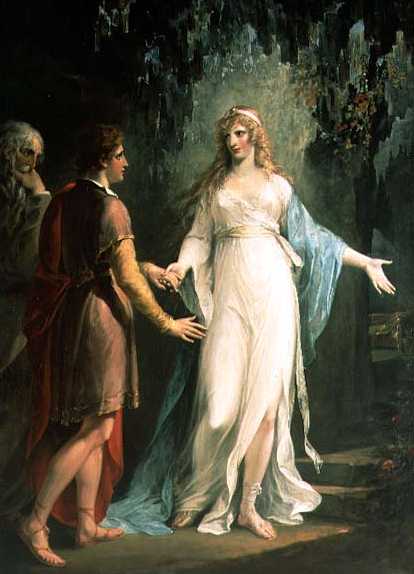
Odysseus and Calypso
Or Justify Odysseyean narrative in perspectives of man’s responsibility rather than divine malevolence
Or “The companions yielding to reckless folly invokes the wrath of the Gods. Explain in the light of the commentary.
Or “That is the God’s work, spinning threads of death through the lives of mortal men…” Explain and justify the perspectives of Alcinous’ speech through the light of divine intervention and cosmic role of gods and goddesses.
Poseidon Lord of the Earthquake and Earth Girdler incites a thunderous rivalry with Odysseus for murdering Cyclops, the mountain giant. In vengeance and vengeful spirits, he shipwrecks Odysseus as manifested by these inferences to these dactylic hexameter, “So I had only to go to Ethiopia for the Gods to change their minds about Odysseus. And there he is, close to the Phaeacian lands, where he is destined to bring his long ordeal to an end. Nevertheless I mean to let him have his plentiful of trouble yet.” In a nutshell, Poseidon is cast as the blocking force of obstacle or hindrance to Odysseus’ return and to Zeus’ will. Odysseus attributes both destructiveness and helpfulness to Zeus when he describes the culminating disasters of his travels and the shipwreck off Thrinacia.
Throughout the narratorial omniscience poaching of animals renders impending doom and life threatening stance. Zeus’ animosity of lightning thunder to strike Odysseus’ ships reflect the divine justice of his companions’ doom and furthermore, Zeus’ prevents Scylla’s reappearance. Both Teiresias’ and Circe’s re echoing of stock advisory imperatives entails foreboding apprehensions with incurring the wrath of Poseidon or Helios’ against killing their sacred cattle:
“And if you yourself contrive to escape, you will come home late, in evil plight, with all your comrades lost.” Athena aids in the favour of betterment for the future of the Ithacan kingdom and she exclaims, “I knew in my heart”.. “That you would return after the loss of all your companions, but I did not want to fight with Poseidon, the brother of my father, who has put anger in his heart in wrath because you blinded his own son.”
Athena’s magical divinity and wondrous marvels have been a boon for Odysseus’ and Telemachus’ accomplishments. Nestor exclaims after the disappearance of Mentes, that, she [goddess Athena] For never in my life have I seen the Goddesses display such open emotion as Pallas Athena had shown for the championship of Odysseus. For instance, Odysseus was blessed by a divine showering of radiance by Goddess Athena upon his brine crusted ascension to shores of Scheria from Ogygiaian isles. Arrogant and hubristic beasts such as Cyclops Polyphemus have been bestowed by Zeus’ showerings of torrential downpours for the fertility and productivity of grapes and grains in mountainous caverns, which Odysseus feels loathsome. Nevertheless, Zeus’ retributive justice to invoke wrathful vengeance in collaboration with Artemis to disenfranchise maidservant for entrapment of Eumaeus is vindictive justification.
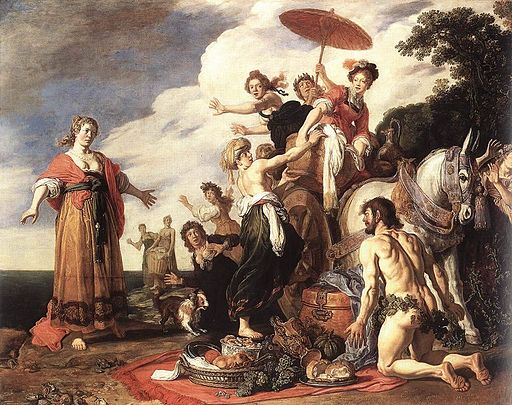
“Odysseus and Nausicaa” by Pieter Lastman
Evaluate Nausicaa’s character as a feminist threat of the Homeric epic Odyssey.
Or Explain the significance of Nausicaa’s feminist character in Homer’s Odyssey.
Or Describe Odyssus’ journey from Ogygia to the island of Scheria and eventually acquaintanceship with Phaecan princess Nausciaa. Illustrate your answer with references to family, marriage and conjugality.
Or “Good luck, my friend, and when you are in your own country, you will remember at times, since it is to me, before all others, you owe your life.” Explain the incidents of the episodes at Scherian island with Nausicaa.
Or Odysseus’ and Nausicaa’s can be considered as unrequited love in canonical literature. Explain with textual evidences.
Seafaring wanderer Odysseus acquainted himself with Phaeacian princess Nausicaa. If Homer hadn’t intended Odysseus’ eventual homecoming then this folk tale romance would evolved as a ‘tragic artistic blunder’ linking conjugality of Odysseus with the Phaeacian princess Nausicaa in the isles of Scheria. The princess attends neither courtly royal affairs, Phaeacian palace games nor Odysseus’ eventual departure. Their solitudinous solace of final meeting renders romantic anticipation. Odysseus’ impetus of Phaeacian episode falsehood rechoes to safeguard the image and reputation of the princess in King Alcinous presence. “My lord”, replied the resourceful Odysseus, “your daughter [Phaeacian princess Nausicaa] is not to blame for that [ushering Odysseus along with her attending maidens’ accompaniment], and I beg you not to take her to task. She did tell me to follow along with the servants. But in my modesty I shrank from doing so, thinking it possible that you might be annoyed at the sight.” [VII 303-307].
Nausicaa’s tactfulness and vigilance in espousal of shipwrecked foreigner Odysseus infers the imminent danger of tarnishing reputation amidst Phaeacian sailors and noble suitors Princess Nausicaa’s demeanor possesses a considerable appeal to influence Odysseus’ future prospects through the cherishing of a royal wedding and sovereignty of a dukedom.
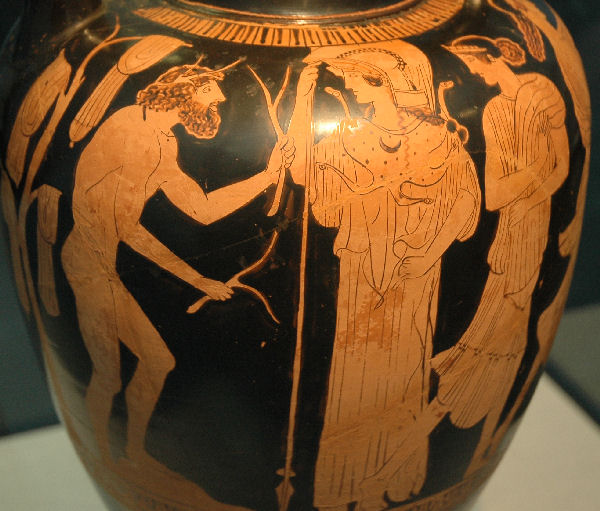
Odysseus, Athena and Nausicaa
Nausicaa is a divine deity as envisioned by Odysseus’ in spellbinding admiration of her grace, beauty and statute. “If you are one of the Gods, it is of Artemis, the daughter of Almighty Zeus, that your beauty, grace and stature most remind me.” [VI 49-52]. Odysseus’ pitiful appeal for a rag to shroud and wrap his nakedness and storytelling of the winds and tempestuous waves of island of Ogygia ensues within this phenomenal meeting. Even Nausicaa’s is hailed to be a female of wonder and veneration for a seafaring voyager like Odysseus. Furthermore, Odysseus’ prayers for Nausicaa’s future blissful conjugality assures something charismatic. Since home, husband and family will be confounding their enemies and delighting their friends. In the end, Nausicaa’s feminine persuasion, graceful eloquence, charming beauty, youthful intelligence exalts Homeric artistic triumph and Odyssean resolution.
1. Nausicaa: A Feminist Threat, Authors: Nicolas P. Gross and Nicholas P. Gross, Source: The Classical World, February 1976, Vol. 69, No. 5, February 1976, pages: 311-317 2. Poor Polyphemus: Emotional Ambivalence In “Odyssey” 9 and 17 , Author: Rick M. Newton, Source: The Classical World, January-February 1983, Vol. 76, No. 3, pages: 137-142. 3. The Role of Telemachus In The Odyssey, Author: M.J. Alden, Belfast, Northern Ireland, Source: Hermes, 2nd Qtr, 1987, pages: 129-137 4. Narrative and Rhetoric To The Odysseus’ Tales To The Phaeacians, Author: Marianne Hopman, Source: The American Journal of Philology, Spring 2012, Vol. 133, No. 1, pages: 1-30 5. The Reunion of Penelope and Odyssey, Author: Chris Emlyn Jones, Source: Greece and Rome, April 1983, Vol. 31, No. 1 , Pages 1-18, Cambridge University Press On Behalf of The Classical Association
Consensus diagnoses based on different synoptic patterns derive from a nonsense line in an old ballad. Omit that, & the two shades don’t really match.
Frictional Fiction
We lean out of the window as the car goes round the corner. Too fast but we don’t care. It’s life, it’s sun, it’s something to do as the car leans out the window as the world goes round the corner.
one of several
He was supposed to look younger than the colorful helicopters at the Museo del Aire
now that he was receiving injections of that really top notch debating technique
developed from the new high-sensitivity technology of the Stiffness Matrix.
A (slightly modified) found poem
If you’re not the biggest guy on the block, you need to level the playing field… That’s why I’m sending you this 10-million volt spam gun. It’s the best way to protect yourself against bigger, stronger attackers…
You don’t need to know MMA or jiu-jitsu… You don’t need to be accurate… You just press a button & ZAP — your attacker is disabled, giving you the chance to get away safely.
The best part is…Unlike knives & guns… Spam guns don’t cause serious damage. A lot of people would prefer to electrocute their opponent than have to stab or shoot them… So — if you’re one of those people… We’re
giving away 500 FREE Spam Guns (10 million volt) to help American families stay safe. I personally carry one for times I don’t want to use my Ruger… & I make sure my wife & daughter keep one of these in their purse when they leave the house…
It’s a troubling world out there, & it’s better to be prepared. But as I said, there are only 500 free spam guns to giveaway…So you better grab one quick if you want one. => Click Here To Claim Your Free Spam Gun (10 Million Volt).
Verse 1 On a Friday night, as I got the club, I met this damsel She was too real to be true She was so fresh n green That I couldn’t help grin Her sexy face Made me to dance As I looked through her body, I knew she was worthy As I danced towards her, I saaaaaaawwwww….that she was:
Chorus Made in heaven Made in Heaven (yea) Made in Heaven
Verse 2 I told her ‘’you’re my meat that I want to eat’’ She smiled and said, ‘’You’re got some wits’’ ‘’Alright’’ as I smiled passionately I also said to her, ‘’though I’m meeting first time, you make comfortable’’ ‘’Are you sure? How could this be possible?’’ I went on to say ‘’I simply want to know you better. My name is Peter.’’ ‘’hmmm Peter!’’ She exclaimed, giving me a warm shoulder ‘’I’m for real…’’ those were assuring words ‘’I see your will’’ her words replied me with I heralded, ‘’You were…
Chorus Made in heaven Made in Heaven (yea) Made in Heaven’’
Verse 3
I asked her, ‘’what’s your name, damsel?’’ ‘’Cristabel’’ she replied, looking seductively Right there at the club, I got a drink for both of us We drank to the point we couldn’t drink no more We got so high We started talking dirty And the rest became history One thing led to the other We were unclothed, holding each other The morning bright I looked at the body I admired And I said to myself: ‘’This is… Chorus Made in heaven Made in Heaven (yea) Made in Heaven’’
What makes us mournful at funerals? Is it the memories we’ve made with the deceased Or the memories we failed to create with them? What moves us to tears at funerals?
Is it the things we said to the one lying lifeless in the casket, Or the things we failed to say to them?
What makes us cry at funerals? Is it the good times we shared with the one about to be lowered into the Cold bosom of the earth, Or the good times we failed to share with them?
Tales of a traveller
tė Uzo chekwa ghu nwa m,
said my grandma to me
as I set forth on my journey. & her words, when loosely translated mean,
“may the road be your guide, my child.”
so here I am on the road, travelling with no distinct destination in mind,
i, a born voyager,
descendant of men
who commune with the road. who call a place far from home, home.
so I, before I drew my first breath had fellowship with the road.
little wonder why I feel safest
on the go. why my mind
only finds peace in places
far from my abode. Little wonder why only the road feels like home.
Obirija Somtochukwu is a freshman student of pharmacy at the University of Ibadan. An essayist and poet, he writes on social issues, his tribal identity and personal conflicts.
In addition to writing, he plays football, table tennis and chess.