
   To lessen is
 the lesson

   feeling is enough

My preference is
 Yours as I stand aside
   and have an enjoyable
     moment of my own

 I have a feeling
   As seeds of
      Hope take Root
To find me
   Ready to Appreciate

      To lessen is
    the lesson
Category Archives: CHAOS
Poetry from Ilyosova Zukhraxon
My mother ❤️

The pain of the world,
You swallowed, too, my mother .
The caregiver also did a great job,
Without a bone, Mom.

Well you go ,
Let's face it.
The world without you is dark,
Light and sun you, mom.

How upset I was to you,
I'm sorry, if you can.
Life with you,
You have all the - all the power!

You call me my flower,
You are a basil, a lollipop.
If two worlds are not found,
Without my paradise you, my mother

✍ Ilyosova Zukhraxon
Poetry from Tohm Bakelas
steel city

flowers bloom in steel city
where the allegheny and
the monongahela rivers
meet to form the ohio

we walk through
ghost neighborhoods
turned into public parks
where police watch
my friends and i under
the approaching noon sun

no longer a smoking city,
the mills are razed but
the cancers still linger


ukanhavyrfuckincitibak

the flames from
the cuyahoga
still burn more
than half a
century
later

and the ghosts
cleveland claimed
are still dying
after all
these
years—

known names
with snowy faces,
their shadows grow
fainter in the april sun


12 hours to lawrence, ks

4:11am and cold snow
sprinkles on cleveland,

we drive into the night
where life sleeps and
the highway is empty

billboards preach religion
and rest-stop lights
scratch the skyline

we wait for the sun to rise
to see the future


we survived i-70

846 miles from
cleveland to lawrence
to read at a dive bar that
cancelled the show without
telling anyone… met with empty
eyes and confused stares that
purchase everyone a round
from the lone man sitting
at the bar because he
doesn’t wanna see
any shit go down…
thanks man, i
guess.
Poetry from Shakzoda Kodirova
A rose

You are the epitome of beauty.
The king of flowers is the rose.
Bringing joy to the surroundings
You open rose.

If I see you, it's mine
My dust will spread.
My heart is full of joy
It opens, rejoices.

Your fragrance is all around
Gives a lot of joy
My mother who loved you
Their hearts will light up.

Your colors are also different
Yellow, pink, white, red
Always be like this
The king of flowers is the rose !

✍️ Shakhzoda Kodirova
Shakhzoda Kodirova was born on May 20, 2007 in Navoi. From a young age she was fond of literature. She started writing stories and poems when she was ten and her poems have been translated into many languages and published in many countries, including Uzbekistan, Germany, America and Belgium. She is a booklover and coordinator of Girls’ Voice. Also she is an official member of GFS and an ambassador of the Iqra foundation. Her first book My Grandfather’s Garden has been published in Uzbekistan. At the moment she is an editor of Germany’s Raven Cage magazine and of Synchronized Chaos, and she is am ambassador of the IFCH and SPSC foundations.
Poetry from Sara Sims
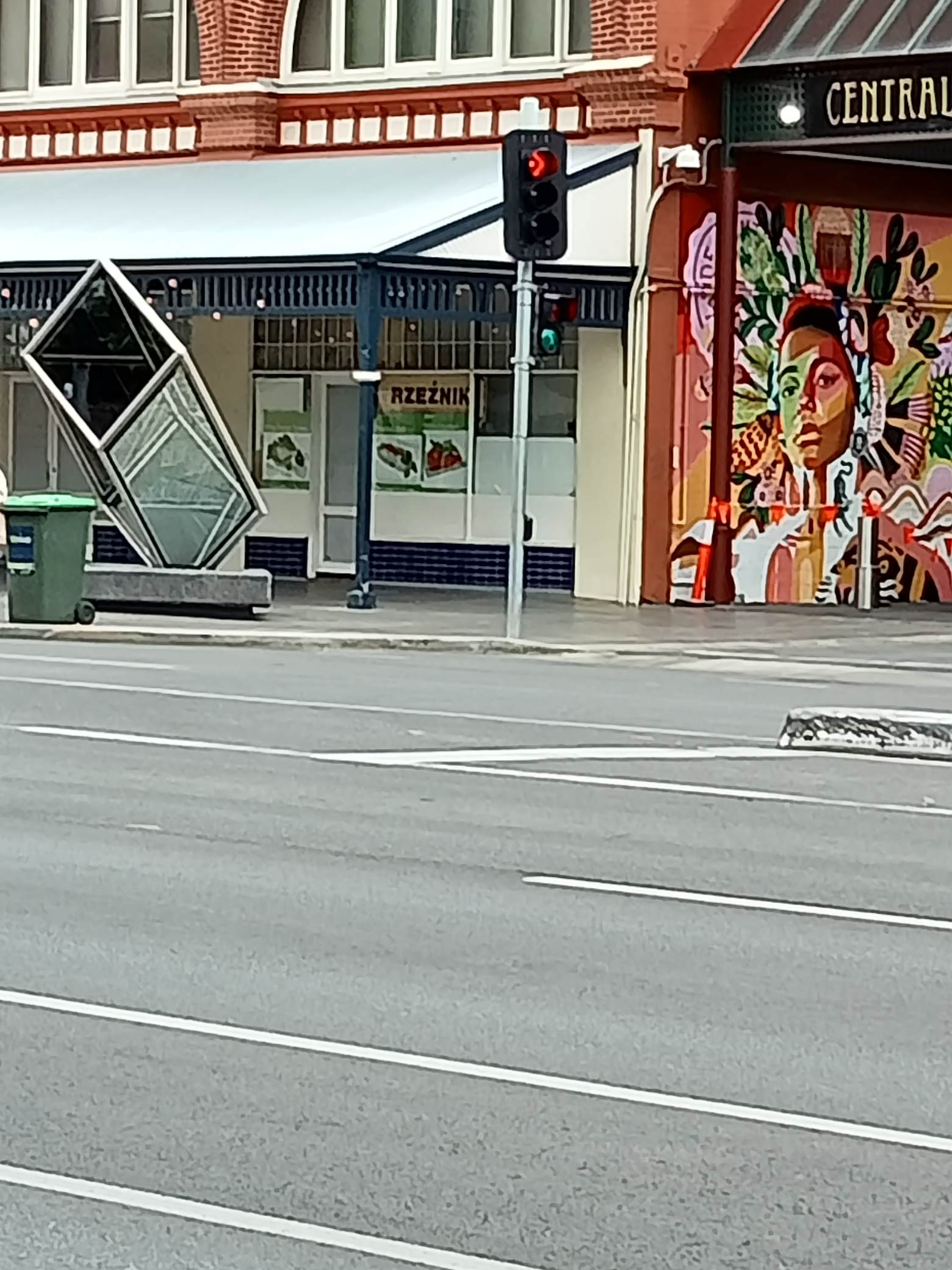
1/  On Grote Street – Lopsided

A sculpture by the Central Market


An elongated box

standing on one corner

a time machine

a spacecraft

to admire

to hop into

to hope for a different time


‘What happened to the phone box?’

she asks

‘It’s built for lopsided conversations,’

I say


for conversations across time and space

where the corner of sharpness

is buried in the ground


forming an unstable base

with the elongated box

about to topple off


unless the sharpness is

the point of contention

buried in the ground

the hatred can no longer bite

is no more

no more


for the benefit of all

and the planet


a dream

an out of space whisper

contained within glass pans

of a contemporary TARDIS


and the doctor --

will she come

will she save

this earth yet again?
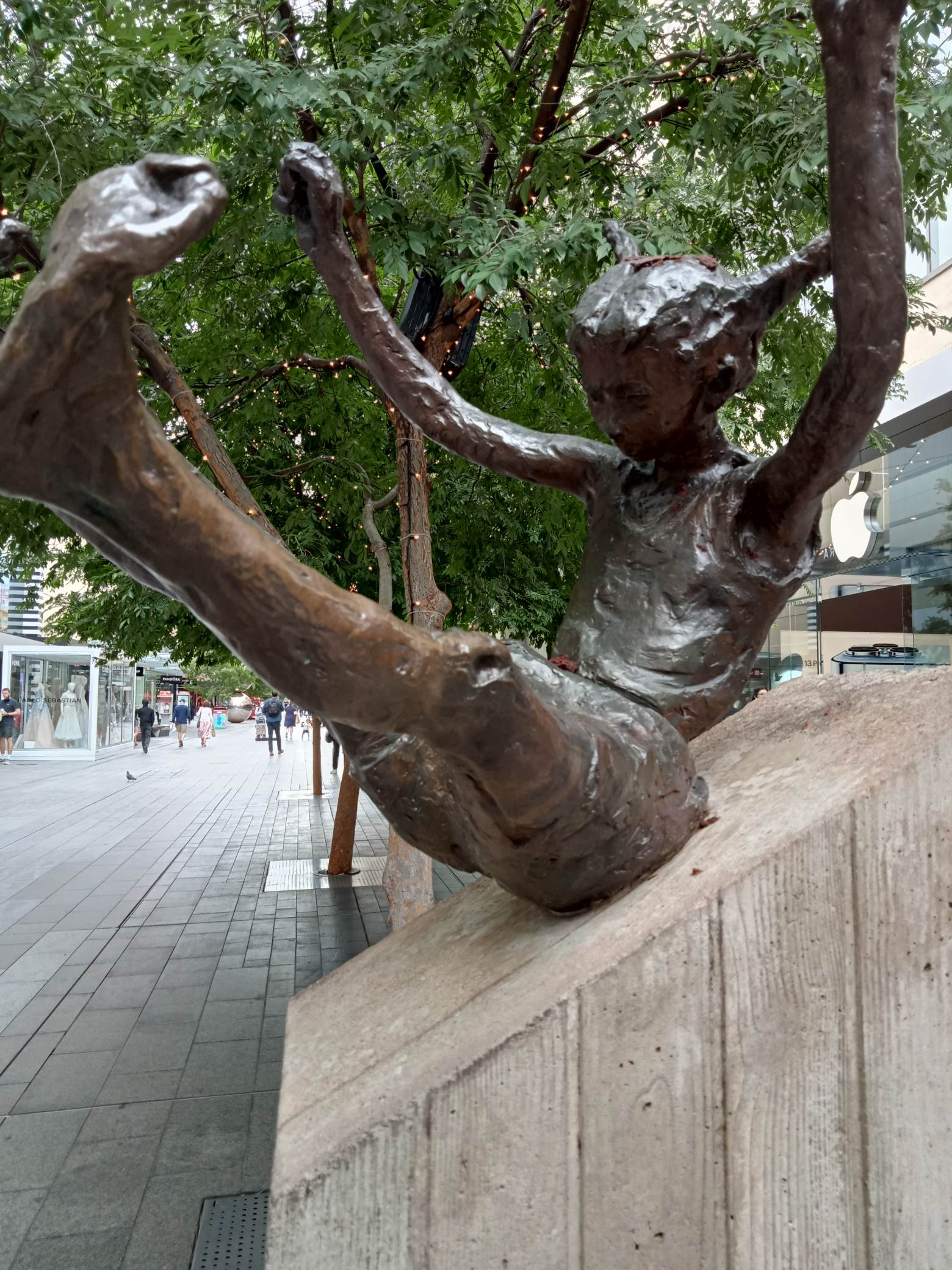
2/  Not a royal nor Grand Victory


The Girl on a Slide -John Dowie (SA), Rundle Mall

Was published in InDaily Adelaide (9th Feb. 2022)


She is joy frozen in time

exuberant, bewitching


in my photo, her left foot is enormous

kicking at phantoms


it’s the perspective, though

nothing to do with what's real


and what's real is a slight sprightly kid

cast into bronze, sliding down a slop


arms and legs outstretched

plaits mirroring limbs, blown in the air


she’s enchantment caught in mid-slide

in busy Rundle Mall


amid the rushing of shoppers

she makes me look up to the sky


a blue ribbon

a pause among concrete giants.
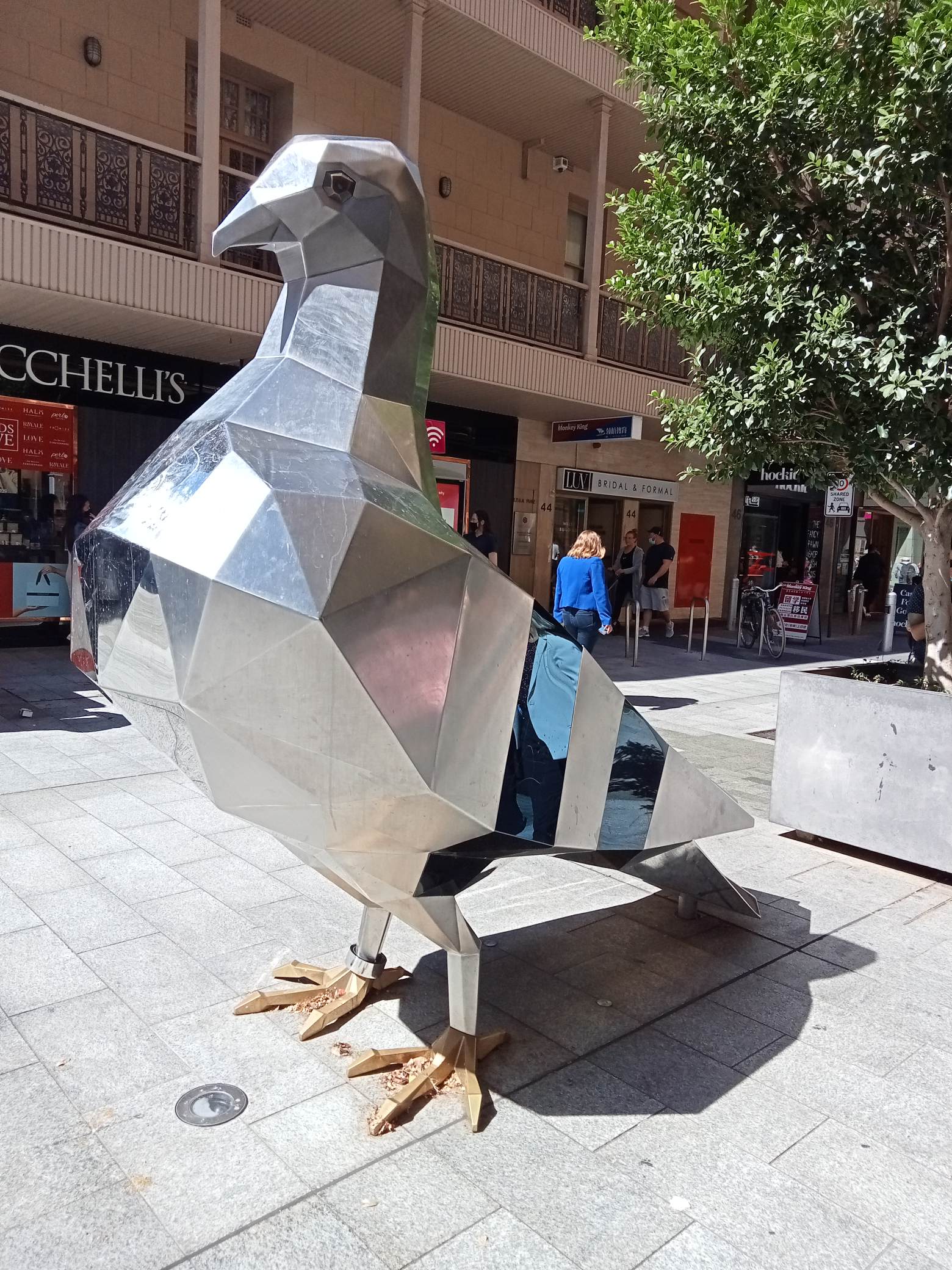
3/  Pigeon

(On Rundle Mall, SA)


Lonely letters

tied to pigeon’s breasts or legs

warmed by feathers

swept by air


some never arrive

some were never sent

left in sealed envelopes

shoved into drawers

abandoned in shoe boxes

in jars

alone or bundled with others


a lone letter is found

it’s held in trembling hands

the envelope is slit open

a thin paper is pulled out

in reverence (perhaps)


a pause

she breathes in

checking the handwriting

while shadows linger on the wall


she bends her head

a photo slides

from between pages

followed by a sigh of relief


she reads fast

rereads slowly and again

whispering groaning

tears filling her eyes


now laughter springs

while the hands

arthritic and chipped

morph into youthful grace.
Poetry from Christopher Bernard
What Is the Opposite of Politics?


A shift of rain in the trees.
A snow globe in a sandbox.
My cousin's scuffed knees.

What is the cost of mercy?
A spade of silent rust.
You'll never know if justice
is less refined than dust.

Who is that fellow singing?
I never knew his kind.
You say he's rough and tender.
I hope to live forever
if heaven is his mind.
_____

Christopher Bernard’s most recent book is A Socialist’s Garden of Verses, winner of a 2021 PEN Oakland Josephine Miles Award and named one of the “100 Top Indie Books of 2021” by Kirkus Reviews. He is founder and a principal, with Ho Lin, Steven Hill, and Jonah Raskin, of the webzine Caveat Lector.
Essay from Z.I. Mahmud
American Literature And Its Borders Interwoven Themes of Homeland, Migrations and Deportation In Tennessee Williams’ Masterpiece Screenplay ‘A StreetCar Named Desire’

Brief Biography of the contributing author and symposium paper presenter: An undergraduate student of the English and Humanities Department affiliated with Brac University. The correspondent wishes to study English Literature with profundity as his majoring engrossment. ‘Synchronized Chaos’-American interdisciplinary journal, ‘Reader’s Digest Asia’, ‘Youth Magazine’ Libyan printed and electronic editions and varieties of Indian Literary Anthologies have treasured and glorified his narratives.


Abstract Writing: Multifaceted charismatic character Blanche Dubois’ spectral specks hollers, lingers and muses amidst the epochs of twentieth century pandemic macabres. How ‘ruptures’ and ‘resilience’ will feed the lecture theater banquet hall with quintessential dialogues inversion as in the speech of Stanley and Blanche Dubois’ beauty of the mind, richness of the spirit and tenderness of the heart’s sustenance ;which have culminated through ‘relentlessness of times’, ‘sorrow’, ‘fear’, ‘recriminations’ and ‘regrets’. And how the gusto and oomps prevail in transforming stage actors as belligerent shoppers despite emerging pandemic.


Phenomenal and mercurial Blanche Dubois’ catharsis hollering with the photograph on the mantelpiece as a reminiscence of her awesome memorabilia sunken treasures. In the abyss of wretchedness the patronage and legacy of endowments languishes the fulfillment of American Dreams. Her phantom haunts like a hobgoblin in theaters, brothels, asylums and rehabilitation centers amidst the epoch of twenty first century’s pandemic macabres. The purpose of this paper perhaps might be engrossed ‘raptures and resilience’ in the canons of psychoanalysis and feminist critical literary theories. However, I wish to spotlight the facets of ruptures and resilience in the ‘diasporic migrational drift’ of this stellar feminine character.

We might wonder and marvel at the laurel lifelike character through digging her cherished suitcases, closets, attics, chests and whatsoever. In reality, she is not cynical or skeptic but hilarious and explosive; i.e. circumstances and implications foreshadowings of uncertainty, ambiguities and nihilism echoing resonance of ‘Samuel Beckett’s Waiting For Godot’s personified caricature Lucky. Unemployment crisis together with identity crisis have ironically fretted Tennessee William’s scapegoat to the menaces and diabolical: vicious cycles of life and death.

Crumbling walks upon a lakeshore, dwindling with inglorious and inauspicious memories of the past; Tennessee Williams’ Blanche Dubois’ portrayal limelights her daylight shudders to night of endless darkness. And we are reminded by the tragic events of wartimes genocides, Holocaust survivors’ horror and terror, mass graveyard burials... Are they suffice and benefice to the interiority of split personality and schizophrenic Blanche Dubois and she is sensed as a resemblance of the dear sister. Siblinghood of fraternity can cast a glimmer of unraveling the sheerness of her identity.

Through ruptures and resilience we will be stepping the stony gravel amidst an avalanche of unprecedented disruption and outbreak of pandemic. The lecture theater hallway by this gravity of the situations’ momentum will be drinking with thine eyes of eerie creature Blanche Dubois’ wit of impishness and caprice. In the prevalence of epidemics’ insurgency had the playwright twisted motifs and plots of what would be likely interpretations in fancy of will-o-the-wisp will foster food for thought in the banquet hall.

 Pathetic fallacy benignly fascinates the aura of imagery in the readers’ imaginative minds with the line, ‘ajar on a sky of summer brilliance’. Blanche utters a moaning cry and throws herself down away from the bathroom beside Stella in a  sense of hysterical tenderness and chastises her for being fondling and affectionate to Stanley-brother-in-law and Stella’s brutish husband. Gaudy pajamas of Stanley hanging from the threshold of the bathroom and the act of Stella’s picking broom to sweeping, swirling and twirling as if idiosyncratically justifying the frenzied attitude and sheerness of absolute lunacy of Stanley. To Stella’s being Stanley’s defense solicitor, she argues to justify that the defamed Stanley being preyed upon by victimization on the pretext of the condition that ‘men drinking and playing poker can do anything[inverted dialect would be: ‘Since there's a blazing unemployment crisis from layoffs amidst lockdown, we, men are justified in wine toasting and billiard pastimes’}. Further like Stanley, Stella’s preoccupation and fancy with movies and bridges acquit the blamed Stanley free of stringent estrangement.

“This shuffling about and mumbling-one smashed tube, beer-bottles, mess in the kitchen’’-as if nothing out of the ordinary has happened’’ This Blache’s quotable quote dramatizes the climax of the scene four with stupendous and stupefying humor, irony and sarcasm when paralleled with Stella’s counterfeit. “He [Stanley] snatched off one of my slippers and rushed about the place smashing the light-bulbs with it. ’’

Figurative tropes and figurative techniques have been embellishing the incredibly insightful read of this very scene with emerald treasures of metaphor, simile, personification and hyperbole. ‘He [Stanley] was as good as a lamb’ highlights the simile of Tennessee Williams in depiction of the naivety and innocence of Stanley Kowalski’s personae. Christmas Eve holiday seasons, Blanche Dubois’s gala with Shep Huntleigh- getting on his Cadillac Boulevard long drive touring through the dusky Biscayne Boulevard. Intimating college acquaintance character’s hyperbolic and metaphorical descriptions of personage, trip of investment since meeting ‘‘someone with a million dollar investment’’ and ‘the City of Texas’ literally ‘spouting gold in his pockets’’.

Belle Reeve is a persisting hackneyed influence of Southern state of St Louis Mississippi Antebellum aristocracy with plantation of cotton and tobacco employing marginalized African American minority diaspora [ethnic community subjugated by oppressive and suppressive culture of exploitation through slavery]. However, post antebellum New Orleans and the Elysian Fields Kowalski villa the emerging absurdist playwright’s modernity plastic theater evidently becomes a thriving society to breed characters like Blanche Dubois. Blanche, the ‘destitute mammoth’ of Belle’s provision of pocket money, family allowance and public relief in the worst nightmarish Stanley household incites modern day contemporary readers with the paradigms of Blanche figure with morale as depicted by the illustrious repertoire of Stella upon extending five dollars share [from the ten dollars gifted by Stanley to smooth things over]. Blanche’s anachronistic bigotry is a striking prejudice; which, nevertheless, demarcates the reality of Stanley's appearance of character. Not a ‘‘particle’’ of ‘’gentleman in his nature’’ exhibit bestial and animalistic force of Stanley upon Blanche Dubois embarking brutal desire- “Desire!’’—that name of the rattle trap street car that bangs through the Quarter, up one old narrow street and down another….’’

Eventually climax and resolution of the drama have been showcased through the red letter day of Blanche Dubois’ trapped maidenhood at stake because of Stanley’s bestial interference in her privacy; and the subsequent admittance of the former’s to the mental health infirmary by the vigilance of Doctor and Nurse.

Bathos; the ironic use of banality through hyperbolic exaggeration that results in the failure for satiric or humourous effects. ‘Egyptian Queen’ might and perhaps transcends allusions to ‘Desdemona’; yet Stanley- the king wearing silk pyjamas shirtless fulfills the illegitimate and adulterous affair of sexual gratification through rape of Blanche Dubois. Shep Huntleigh’s fantasy, sensory illusion and hallucinatory delusion, awkward fancy attire such as the rhinestone crown of Blanche  -the ‘lurid’ reflections of ‘grotesque’ and ‘menacing’ ambience.

Tragic heroine, Blanche dupes a vindictive claim in assertion of her chastity and virginity- “A cultivated woman, a woman of intelligence and breeding, can enrich a man’s life-immeasurably!’’ To herself, she boasts of her beauty of the mind, richness of the spirit and tenderness of the heart which increases to grow as ages reach maturity.

This scene further highlights the identity crises and classes of diasporic cultures prevalent in post world war modern times. The tragic figure Blanche throws further light upon her lunacy as intimidating encounters with the Doctor and Nurse. “Oh, my God! What have I done to my sister’’-the loyal and devoted sisterly Stella Dubois’s sympathy and empathy coincides despite the triumphs of two brute forces between the clashes of different cultures. In the world of Stanley, a moth chameleon doesn’t exist. On the contrary, the world of Blanche has reservations for fantasy and magic and the abolition of reality.

The breaking down of ‘silver mirror’ and the symbolic attire of ‘white satin robe’ manifests cataclysmic catastrophe that ruins the prospects of Blanche Dubois’ survival turning her as a destitute of the asylum. ‘Relentlessness of time’, ‘sorrow’, ’fear’, ’recriminations’, ‘regrets’ and so on by the reflections of “wrinkles’’ and ‘’bags of the eyes’’ casted upon her silvery mirror.  Eminent Indian literary critics of noteworthy publication interpreted her depressive melancholy with ‘mental malady’. Imaginative fictional myths of mothlike figures aren’t tolerated in the Kowalskis' apartment. Therefore, bestial Stan disdains her upon fabrications of Sheep Huntleigh’s fantasy cruise to the  Caribbean and Mitchell’s flower bouquet of apology.

Minor characters are symbolic representations of Tennessee Williams’ A StreetCar Named Desire. Tennessee Williams will be endowed homage in his repertoire of symbolist movement. After the Mexican lady and here comes the symbolic Negro woman stealing the vanity bag of the drunk raped prostitute. In this anticipation, the desecrating robbing of Blanche’s privacy and honor by Stanley is embellished. Furthermore, the Western Union symbolically features the breakdown of civilization and cultural catechism. And the swelling music of the blue piano resonates comical relief meant to underscore the undergoing violence that is being penetrated on Blanche. Finally the drama witnesses anticlimax through the blue eyes of Allan Grey-the former deceased admirer remembrances by Blanche. Further Blanche’s epilogue ‘’Whoever you are, I have always depended on the kindness of strangers’’ leaves no stones unturned in foolishness of wits and impudence of lunacy.

‘Ruptures and Resiliency’ are entombed and enshrined by vessels of literature heralding the eminence and prominence of Tenessee Willaims’ brevity of theatrical production and lucidity in  film adaptations. Dear audience, I proclaim in ecstasy of glee, “Ah, Tennessee Williams shall be unhackneyed dimestore even in context of quintessential evolutionary viral outbreaks.” The reportage of Guardian mesmerizes subscribers when they are tantalized by the iconic commentary of Gillian Anderson; whose claim “I was hanging on to a reality by a thread” whilst her shopping errands would be effervescent ether hadn’t she possessed the belligerence of mental strength.