Sky Burial

 Soldiers all heard the stories, folklore of the shaped-
 charge monster, unbeatable IED, flipped an Abrams
 on its back, the fable goes, until it's like they're
 waiting for it, for today, for the sudden protean
 flower of sand and flame, what a second before
 was the lead vehicle -- now a rain of shrapnel
 against bulletproof glass of Humvees that follow,
 now a fiery-dark windstorm blowing up a desert floor.

 The long second where one's intake of breath stops
 for an under the breath "God," a place where you
 can only watch, in the long second before radio talk
 between vehicles, frantic security halt, bracing
 for secondary IEDs, possible complex attack, in
 that second I imagine three soldiers calm like yogis,
 shamayim all around in the sudden sky, I wonder
 is it a journey to nowhere -- in the long second.

 The recovery team, later, finds nothing, not a piece
 of skin, no bones, nothing to ship home, come back
 with a pretzel-shaped steering wheel they show
 to officers around camp.  And I think, these three
 are burned into the desert now, a Shroud of Turin,
 never going home – home, where a memorial service's
 beauty of flowers is nothing to say goodbye to –
 nothing to cling to but a folded flag.

 Home, where memory of a face, sound of a strong
 voice, are offered as a gift to eternity, grief stopping
 speech, silently -- the idea of a place where loved ones
 continue to be loved needed to let a heart keep beating,
 let lips open to mouth a silent "goodbye."


 Widow

 One of the peaceful places in Kabul, outside
 the grounds around Embassy Row, an open
 stretch of grass, a few trees, and chalk-colored
 stones, was my convoy's frequent lunch stop,
 pulling the Humvees under the limbs of cedars.

 We'd eat the spicy lamb meat, rolled fajita-like
 in naan bread, then rolled up in the flowing script
 of a daily newspaper and bought by our interpreter
 from his street-vendor cousin, in the shade
 and sound of songbirds.

 The first day there I was glad to stop in this quiet,
 away from the ripe stone street channels of sewage,
 the congestion of busy markets and honking horns,
 past an Afghan checkpoint that kept out most traffic,
 but as Americans we could go anywhere,

 So, I watched the eager sergeant major who'd
 been commanding this Kabul patrol for two months
 unroll the food he was unafraid to eat, in this quiet
 of cedars, wondered if the paper's stories were Pashto
 or Dari, looked at the hazy mountains that ring the city,

 And at the woman in full blue burqa that billowed up
 in gusts of wind as she sat in the high green grass opposite
 the dirt road from us alone.  After a while the interpreter
 took a lamb bolani from the unrolled paper on the hood
 to her, and an arm appeared from the burqa to take it.

 So I asked who she was, and Hashem said she's a widow,
 her husband was an Afghan soldier killed in an outlying
 province.  The next day we fed her again, and I asked
 why she sat here, and Hashem said, "to beg."  The soldiers
 who patrolled let her stay because of her army husband.

 And the next day I wanted to ask where she went nights,
 but part of the purpose of lunch was the mission brief
 by the sergeant major for the rest of the day, so I just
 wondered as SGM Sanchez talked about itinerary
 and ammo counts,

 Imagining a mudbrick house where she was barely
 tolerated by relatives, driven out in the day to beg
 in her blue ghost costume, seen on every woman
 outside the city, but less so here in Kabul.  Every day
 for a month she was there.  One day she was gone.


 Late Friday Night at the VFW Bar

 When beers become gradients of time, gradually
 taking good-natured men at a corner table back
 like years from baseball scores and current politics,
 loosening stories from those lives that led them here,
 to the days when their hearts were full of darkness.

 An Iraq vet recalls firecracker sounds of small arms fire
 from windows, the flip flop clomping of tank treads
 as it pulled up and wound its turret, its round devouring
 a building's walls, turbaned men thrown like dolls, falling
 with collapsed masonry over the sandy street.

 A Vietnam vet tells of sudden ambush in a delta fertile
 with green trees and rice paddies, unloading magazines,
 afterwards finding his spent casing sprinkled over a buddy,
 and when he kneeled down to brush them off, saw
 his own reflection in his stilled friend's staring eyes.

 These are men who can conjure violent figures,
 in nightmare worlds where all options seem bad,
 where no parables are found that guarantee survival,
 only heroes that may have saved a buddy's life
 to die themselves in a mutilation of any happy ending.

 Last call, and they rise from their stories, glancing
 at the American flag tacked to the wall beside a reflective
 Michelob sign, and it gives some relief, some meaning
 as they head for the door under the red exit sign, outside
 to lead normal lives and keep terrible secrets.


 The Ironised Voice of the Soldier's Ghost, 500 Years
 After His Desertion

 "A skeleton was discovered with sword and knives under the old
 Dubingiai bridge in Lithuania's Lake Asveja. Scientists with Vilnius
 University examined the body and said that the person was male and
 died in the 16th century, though they don't yet know why he died."
 --November 12th, 2020


 I expected to lie down in battle by the bodies of men, the dark
 folding me as death already folded them.

 Bemused by the play of light on ripples I tripped awkwardly
 on the bridge, my inner eye looking for my heroic future.

 The shock of the cold water was like a klaxon cry as my armor sank me
 into this ethereal world.

 These five hundred years below water, only fishermen's boats appeared
 disappeared by day above in the distance.

 At night, well above me pinwheels of stars spun their ancient patterns,
 But in the gloom I never saw them.

 Mourner's eyes be pools of sorrow for loyal knights who die
 for the kingdom, unlike these eager eyes that now pick and measure.

 With what is left of me I tell you my pain was not in death or drowning
 but that no blow flies came to buzz and whisper:

 "You are dead on the field of battle" -- embarrassment my pain,
 like the water it still saturates me.


 June 4, 1937

 Picasso adds the last thing to Guernica
 a light bulb gives unity to chaos:
 bodies bend and bruise
 wrack and burn
 scream at the sky
 sword broken
 baby dead
 arms outstretched

 The highest figure the bull
 still on its feet
 tail floating
 like Luftwaffe
 in the sky above

 People forever trampled in firebomb winds
 of shrapnel, Basque victims
 of other people's wars

 A light stays on forever
 lest we forget
A US Army combat veteran, Steven Croft lives happily on a barrier island off the coast of Georgia on a property lush with vegetation and home to various species of birds and animals. His poems have appeared in Liquid Imagination, The Five-Two, Ariel Chart, Eunoia Review, Anti Heroin Chic, Synchronized Chaos, and other places, and have been nominated for the Pushcart Prize and Best of the Net.
Five Poems
Words by Hongri Yuan
Translated by Yuanbing Zhang
A Mysterious Giant
There is another sun in the body of earth,
it is the light of lights, cool flames.
Where the palaces and pavilions are golden and transparent,
houses a mysterious giant.
Last night I heard a call in my dreams
and came to his vast hall.
His smile made you to forget yourself,
reminded me of a ancient poetry—— “the rising sun has just risen”.
2.12 10.2015
神秘的巨人
大地的体内有另一轮太阳
它是光之光 清凉之火焰
那儿的宫殿楼台金色透明
住着一位神秘的巨人
昨夜我梦中听到召唤
来到了他那巨大的殿堂
他的笑容让你忘了自己
令我想起古人之诗 旭日始旦
2015.2.12上午10时
Gold Civilization in Prehistoric
Fifteen million years ago,
there was a civilization of gold on the earth.
The sun wrote the words of gold,
the moon wrote the words of silver;
all things on earth had its own language.
Where do the gods live in now?
They have never disappeared,
they house still on the earth,
just you aren't able to see them.
5.19.2013
史前之黄金文明
一千五百万年前
大地上曾有过黄金的文明
太阳写下黄金的词语
月亮写下白银的词语
万物皆有自己的语言
那些神人们现在何方
他们不曾消失
他们仍然在大地之上
只是无法看见
2013.5.19
Giants' Homes
The fleets of stars were speeding towards me,
They came from the distant galaxies.
In prehistoric times, they were the ancient gods,
their ancient kingdoms existed in the depths of the earth.
Oh, they gave me the rolls of gold books,
let me to seek the swords of gods.
The ancient earth will be golden and transparent,
hold up the newborn homes of giants.
2.3.2015
巨人的家园
星辰的舰队向我驶来
他们来自遥远的星系
在史前 他们是古老的诸神
在大地的深处 有他们古老的王国
哦 他们赠我一卷卷金书
让我去寻找那一把把神剑
这古老的大地将金色透明
托起新的巨人的家园
2015.2.3
I Saw a Golden City
I saw a golden city
made itself invisible in the earth.
Those ancients were still alive.
I often visit them in my dream.
Their eyes were very bright.
as if they did not know the passage of time.
I saw myself in ancient times,
he told me that the world just was a phantom.
He gave me an ancient golden sword,
let me to go and kill the greedy Python.
These demons ruled the world.
let the mankind forget the ancient ancestors.
6 .23, 2011
我看见一座金城
我看见一座金城
隐形在大地之中
那些古人还活着
我常在梦中去做客
他们的眼睛格外璀璨
仿佛不知时光的流逝
我见到了古代的自己
他告诉我人间只是幻影
他赠我一把太古的金剑
让我去击杀贪婪的蟒蛇
这些妖魔统治了人间
让人类忘记了古老的祖先
2011年6月23日
He is My Immortal Soul
The eyes of years are the maze of stars.
In a gigantic palace,
I have seen the God of Gods.
He is smiling at me in heavens.
I'm thousand years in the world, which is just his moment.
He is my immortal soul,
and the universe——transparent crystal ball, in the palm of his hand.
6.6.2016
他是我的不朽的灵魂
岁月的眼睛 是星辰的迷宫
在一座巨大的殿堂
我见到了 那诸神之神的上帝
他在天庭之上向我微笑
我在人间的千年 只是他的瞬间
他是我的不朽的灵魂
而宇宙 透明的水晶之球 在他的手掌之上
2016.6.6
Bio:Hongri Yuan, born in China in 1962, is a poet and philosopher interested particularly in creation. Representative works include Platinum City, Gold City, Golden Paradise , Gold Sun and Golden Giant. His poetry has been published in the UK, USA ,India ,New Zealand, Canada and Nigeria.
Yuanbing Zhang (b. 1974), is Mr.Yuan Hongi's assiastant and translator.He is a Chinese poet and translator, works in a Middle School, Yanzhou District , Jining City, Shandong Province, China. He can be contacted through his email-3112362909@qq.com.
Email:3112362909@qq.com Hongri Yuan Phone:+86 15263747339Address:No.18 middle school Yanzhou District ,Jining City, Shandong Province, China
  Apocalypse Now:

 Just like Apocalypse now, heavy breath - 1,2,3, controlled and focused.

  Descending steps sounding loud and crisp, only deep reflection floating on top.

  In the mind a painting appears, dark, mysterious, Black and Tan.. light too in the center. Don’t disturb this.

  A heavy white page is now turning, a story in its own right with no explanation or talking needed.

  A sudden revelation emerges but it’s too sudden and too revealing .

 Turning another page now.
THE GRACIOUS ROAD

 They would talk now. The time had finally arrived. He had gotten what he desired, a chance to express all the hurt and confusion caused by her reckless behavior, a betrayal. She often told him he was so gracious and kind. He would not be today. He would hold her accountable now.

 The heart in hiding was now unexpectedly stirred by her voice. A meek hello as she answered the phone. Damn, where were the notes he had meticulous jotted down, his shopping list of topics to be covered? Each point meant to be delivered with just the right tone and effect, causing some uneasiness in her, and yes, some hurt, too. He found his pace and words poured out in a frenzy like rapid brush strokes he applied in one of his paintings. He wasn't just saying it, he was reliving the whole relationship. Her silence indicating she was finally taking him seriously. Then he heard a small groan from her, followed by tears. This did not bode well for his script.

 It felt good...no, it felt bad. This was not his nature.
 This was a love lost, but not forgotten. Now he did what he had always done in her time of distress. His heart rose to take the wheel, his intellect pushed to the backseat. His voice, his words, comforted them both like a bird's sweet song. She felt better now. He did too, finally.
 He suddenly located his notes, but realized they were not needed on the gracious road.
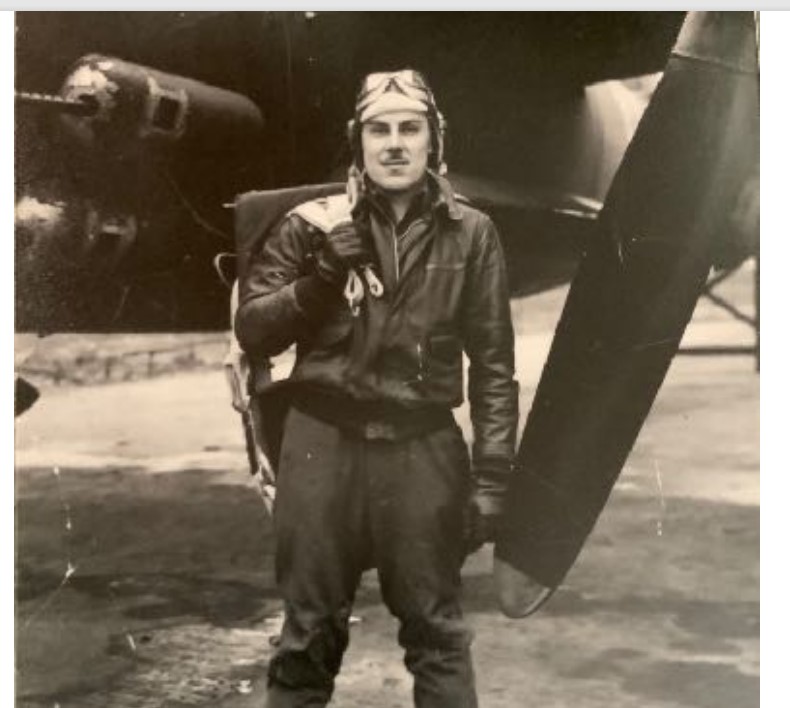
My father, Technical Sargent Stanley F. Thomas flew a total of 60 missions as a bombardier and tail gunner on a B-26 Marauder, twin engine bomber in World War II. The minimum Air Force requirement of missions to be served was 25-30. Since my father never discussed the war with his children, I never knew whether he exceeded the mandate out of patriotism, or he was just an adrenaline junkie. In either case, along with an Air Medal, he was awarded the Distinguished Flying Cross. The medal bracket on his uniform also held numerous unit citations with oak leaf clusters. Along one side of the front of his leather jacket, a number of bombs were stenciled indicating direct bombing hits, while an adjacent row of swastikas evidenced enemy planes downed by his unit in combat.
The B-26 Marauder was designed and put into production a number of years prior to the bombing of Pearl Harbor. The Army Air Corp 1 (AAC) prepared itself for any possible contingency. Specification for the plane included a speed of between 250-350 mph. Because the plane was to be used as a strategic bomber, the plane had to be able to out pace the then known top airspeeds of German and Japanese fighters. The plane also had to have sufficient arms to repel any attack by fighters as it performed its mission. Thus, both nose and rear 30 caliber machine guns, as well as a top turret gun was mandated. Later, the 30 caliber guns were replaced by 50 caliber weapons. Additionally, the plane had to carry a sufficient load of bombs, enough to cause significant damage to designated targets. This meant that weight was of crucial importance. The desire for maximum bomb load resulted in a short wing span. A shorter wing meant greater takeoff and landing speeds. Since the landing gear of the B-26 were in a tricycle-like position, particular attention had to be paid to making sure the rear wheels touched down first, with the nose wheel gently allowed to touch down last. This was no easy feat when coming in at 150 mph or better. Doing so in a damaged plane made the task even more difficult.
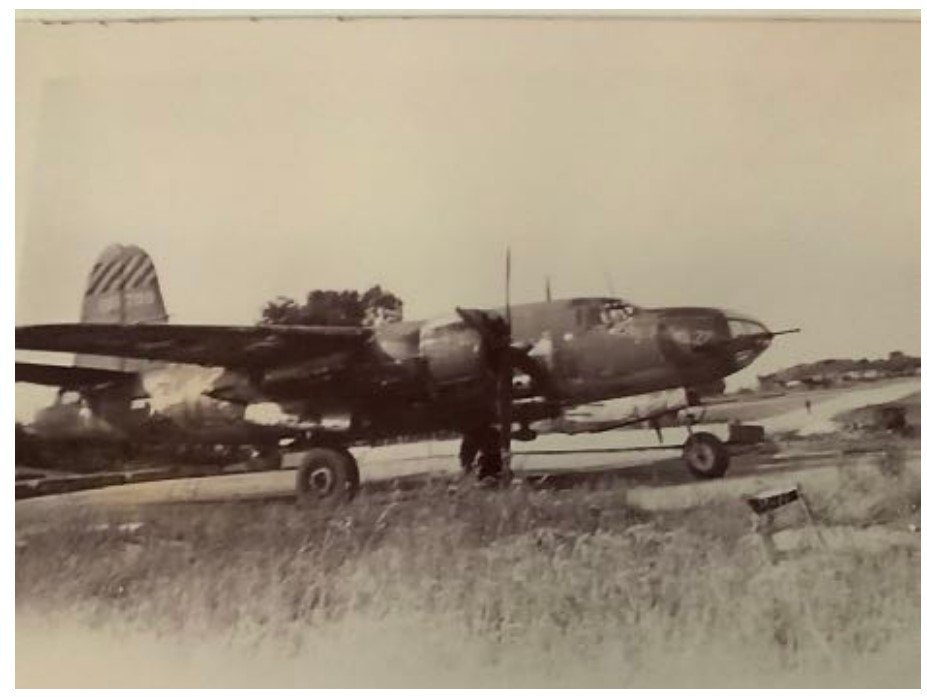
Crews treated their planes as if they were their own possessions. Nose art with pet names became a standard, giving the crew and plane a personal identity. My father’s crew named their plane, Kizio Pofoth 2nd, Eaglet. The name consisted of the first letters of the last names of the all the crew members (See airplane above photo). Strategic bombing was considered crucial to any successful outcome in a war. Before any major offensive (D-Day) the enemy’s ability to counter attack had to be thwarted. This meant destroying war materials factories, to limit their production of armaments and supplies; bombing the enemy’s airfields to minimize their dominance of the airways; and to knock out transportation venues such as roads,
Devon Francis, Flak Bait (Duell, Sloan and Pearce, New York, 1948), xi-xvi 1 10T Sgt Stanley Thomas
bridges and rail yards to keep them from moving supplies and troops into areas of combat. However, at times, given unforeseen circumstances, other targets may have to be considered a priority. This proved to be the case when Germany began implementing the V-1 rocket attacks on England. The V-1 emplacements were scattered across the coastal areas of France and the Netherlands, and had to be taken out, diverting the B-26s from other strategic targets.
The mission of the B-26 units in WWII was to provide strategic intervention, both prior to and after D-Day. The 387th Bombardment Group to which my father was attached, was eventually based in 10various areas of England. A total of 36 or more planes from this group flew out each day. My father’s squadron, the 557th was stationed in Chipping Ongar, located thirty miles northeast of London. From Chipping Ongar, daily sorties of planes flew out over the English Channel to areas of France, Belgium and the Netherlands.
Every mission was fraught with danger, not only from possible mechanical problems that might render the plane unable to fly, but also from enemy fire. Anti-aircraft guns protected many of the target areas. These guns sent up shells that exploded at a given height. Many of the B-26s were damaged and or brought down by barrages of flak exploding at the height of the planes. B-26s often came back to base riddled with holes, their crews sometimes injured or dead from shrapnel wounds. While less frequently encountered, enemy fighters were also a challenge. In cases of fighter attack, the skill and dexterity of the gunners was crucial to the crews lives. Although, occasionally, the Americans had friendly fighter escorts run intervention for them. These escorts extended only as far as the fighters range, which were far less than the B-26s flew to reach their targets. Luck also played a part in the crew’s survival. My father had to abort one mission due to severe illness. His replacement came back deceased from a flak hit.
In addition to operating the tail gun on a B-26, my father had the responsibility of preparing the bombs for deployment. A safety fuze pin had to be removed from each bomb before release. The fuze pin consisted of a cotter pin, to which a paper tag was attached. A short safety notice was printed on one side, while the other side of the tag was blank. For each mission flown, Sgt. Thomas saved one tag, upon which he wrote notes related to the mission. Each tag indicated The number of mission; the name of the target; sometimes the weather conditions; enemy fighter encounters; amount of flak; number and size of bombs dropped; and occasionally other personal comments. The tags became a diary of his missions.
I sorted all of the fuse tags in order from his first mission to his last, with only five tags missing. Rather than describe his experiences in narrative form, I have decided to let my father’s own words tell his story. Below are his notes as he wrote them for each mission:
1) August 16, 1943, Bernay-St. Martin airdrome, first mission, James Michael’s first gift (New born 1st child), more to come. 2) September 3, 1943, Lille-Nord Airfield, fighter airdrome, heavy to medium accurate flak, all safe. Dropped 6, 500 lb. bombs. 3) September 14,1943, Lille-Nord Airfield, fishing trip, plenty of flak, target under cloud cover. 4) September 14, 1943, Lille-Nord Airfield, turned back when over target-weather bad, went fishing, light flak 5) September 25, 1943, St. Omer-Longuenesse Airfield, target under cloud cover, couldn’t see results, cold as hell, 6, 500 lb. bombs dropped. 6) September 21, 1943, Beauvais-Tille Airfield, two ships hit by fighters, one lost, one made belly landing on airfield. Also one single engine landing. We were jumped by 18 FW 190s. Engineer of one ship bailed out when ship was hit and set afire. Dropped 10, 300 lb. bombs. 7) October 3, 1943, Woensdrecht Airfield, inaccurate flak, bombed alternate target on coast. Dropped 10, 300 lb. bombs. 8) October 22, 1943, Evreaux-Fauxville Airfield dispersal area, direct hits, beautiful morning takeoff, Little flak, no fighters. Sweated out landing, sick as a dog. Dropped 6, 500 lb. bombs. 9) October 22, 1943, Cambrey-Epinoy Airfield, raining-fog-soup, did not drop bombs, rear 18 shot down, FW-190, could not see 100 yds in front, Cambai/Epinoy. 4 1000 lb. bomb load. 10) November 3, 1943 St. Andre de L’Eure Airfield, flak intense, lost 2 B26s and 1 Spitfire. Saw FW 190, Got in some potshots. Dropped 4, 1000 lb bombs.
11) November 5, 1943, Mimoyecques V-1 site, excavations between Calais and Boulogne, France, flak intense and accurate, one B26 lost from 386th. Six boxes of 36 planes on this target- secret 12) November 26, 1943, Cambrai-Epinoy Airfield, target X, overcast, just got into the coast. 13) November 29, 1943, Cambrai-Epinoy Airfield, target X, Buildings of workers, good hits registered. Typhoon cover, short trip in and out, pas La Calais, flak heavy, bomb stuck in bay. 14) December 1, 1943. Cambrai-Epinoy Airfield dispersal area, hit her right on the button, flak over target-light, fighters on way out, spitfires engaged same. Dropped 6, 500 lb bombs. 15) December 1, 1943, did not drop bombs, in over coast and out. 16) December 2, 1943, Did not Drop bombs? 17) December 30, 1943, Le Meillard-Bonniers V-1 site, target 2X, tour of France over the Pas De Calais area. Had a good dose of light flak It was terrifying. Could not locate target. 6, 500 lb. bombs. 18) December 31. 1943, Cormette V-1 site, Pas De Calais construction works no bombs dropped 6, 500 lb. bomb load. 19) January 23. 1944, Le Grismont V-1 site, no ball (Code for V-1) target in Pas De Calais area, no flak, no fighters, spitfire escort fair bombing. Dropped 5, 500lb. bombs. 20) No tag?
21) February 9. 1944, Belleville en Caux V-1 site, no ball in Pas De Calais , cloud cover, made two penetrations, bomb not dropped, landed at Friston-emergency-weather bad. 6, 500 lb. bomb load. 22) February 10, 1944, Poix Airfield, no ball in Pas De Calais, cloud cover, hit airfield no flak, milk run. 6, 500 lb. bombs dropped. 23) February 11, 1944, Amiens marshalling yards at Amiens, France, cloud cover over target, hit no ball in break through clouds-12 bursts of flak only in rear of formation. 6, 500 lb. bombs dropped. 24) February 24, 1944, Leeuwarden Airfield, Holland, base of 60 single, and 60 twin engine fighters. Good bombing results. 10 miles from German border, light to heavy flak. 30, 100 lb. bombs dropped. 25) February 24, 1944, St. Josse Au Bois V-1 site, no ball Pas De Calais, St Josse Au Bois, dropped 8, 300 lb. bombs, no flak, no fighters.
26) February 25, 1944, Venlo Airfield, Holland on German border, first glimpse of Germany, light- heavy flak. Lost 4 B26s over north Sea to fighters. Box in back of us saw whole show 5 miles back. Dropped 10 250 lb. bombs. 27) No tag? 28) February 28, 1944, Ray sur Authie V-1 site, no-ball Pas De Calais cloud cover did not bomb. 8, 500 lb bomb load. 29) February 29, 1944, Behen V-1 site, no-ball Pas De Calais hit target, no flak milk run. 8, 500 lb. bombs dropped. 30) March 3, 1944, Montdidier Airfield, hit field, flak accurate, received 8 holes, pilot hit by flak in arm. Really sweated on this one. 14 250 lb. bombs dropped.
31) March 5, 1944, Ray sur Authie V-1 site, no-ball Pas De Calais. 1032) March 6, 1944. Bois de Huit Rues V-1 site, no-ball Pas De Calais, no flak, no fighters.10, 500 lb. bombs dropped. 33) March 20, 1944, Criel marshalling yards, France, flak inaccurate, fighter-none attacked, Saw Paris Eiffel tower. 14, 250 lb. bombs dropped. 34) (no date) Criel marshalling yards hit target perfect, light flak, no fighters. 10, 500 lb. bombs dropped. 35) March 23, 1944, Haine St. Pierre marshalling yard, hit target perfect, light flak, no fighters, 10, 500lb. Bombs dropped. 36) March 26, 1944, Ijmuiden E-Boat pens, Holland, Marauders drop 600 tons of bombs. Flak intense, 2 men killed in lead ship, 4, 1000 lb. bombs dropped. 37) April 10. 1944, Le Havre coastal defenses, gun emplacement, hit target right on the button- flak intense and accurate, no fighters, 4. 1000 lb. bombs dropped.
38) April 11, 1944, Bonnieres V-1 site, no-ball, hit target, flak intense and accurate, lost first ship in our squadron, Lt. Pratt- 2 chutes seen, 14 250 lb. bombs dropped. 39) April 12, 1944. Dunkerque coastal defenses, gun emplacement, hit target, flak intense and accurate, lost lead plane-colonel Caldwell, no flak holes, really prayed on this one, 4, 1000 lb. bombs dropped. 40) April 30, 1944, Bois d’Enfer V-1 site, no-ball Pas de Calais, Good bombing, flak accurate, aileron shot up, no fighters, 4, 1000 lb. bombs dropped. 41) April 30, 1944, Somain marshalling yards, didn’t release bombs, tour of France, no fighters, no flak, 4, 1000 lb. bomb load. 42) May 1, 1944, Monceaux-sur-Sambre marshalling yards, bombing fair, no flak, no fighters, 4, 1000 lb. bombs dropped. 1043) May 1, 1944, Louvain marshalling yards, good bombing, no fighters, flak on bomb run, 8, 500 lb. bombs dropped. 44) May 11, 1944, Hardelot coastal defenses, short of target, flak hole in right wing, no fighters, 4, 1000 lb. bombs dropped. 45) May 12, 1944, La Parnelle coastal emplacements, short of target, no flak, milk run, no fighters, 4, 1000 lb. bombs dropped.
46) No tag? 47) No tag? 48) May 20, 1944, Benerville coastal guns, direct hits on target, no flak, no fighters, visibility poor at take-off, 2, 2000 lb. bombs dropped. 49) May 20, 1944, Fecamp coastal defenses north of Le Havre, no flak, no fighters, P47 area cover, 4, 1000 lb. bombs dropped. 50) May 22, 1944, Barfleur/Panelle France coastal gun emplacement, short of target, bombed on pathfinder, flak moderate, no hits, no fighters, P 38 escort, 2, 2000 lb. bombs dropped. 51) May 24, 1944 Barffleur/La Parnelle gun emplacements, France, direct hits, flak, no fighters, pathfinder tech, P 47 cover, 2, 2000 lb. bombs dropped.
52) May 24, 1944, Etaples-St. Cecily coastal gun emplacements, direct hits, no flak, no fighters, P47- cover, 2, 2000 lb. bombs dropped. 53) May 26, 1944, Chartres Airfield, France, hit dispersal area, flak heavy-accurate, lost Smith, #199 road-on single engine, no fighters, 2, 2000 lb. bombs dropped. 1054) May 28, 1944, Liege-Renory bridge, Belgium, hit north span, flak accurate, nose hit at gun, no fighters, long haul, 4, 1000 lb. bombs dropped. 55) May 28, 1944, Maison La Fitte R.R. bridge, Paris, France, missed bridge, flak terrific-several holes, prayed like I never did before, No fighters, 2 2000 lb. bombs dropped. 56) May 31, 1944, Bennecourt highway bridge. R.R. bridge France, Seine, overcast did not bomb, no flak, no fighters, 2, 2000 lb. bomb load.
57) June 2, 1944, Eperville-France, coastal gun emplacement, fair bombing, no flak, no fighters, 2, 2000 lb. bombs dropped. (June 6, 1944, D-Day) 58) No tag? 59) June 10, 1944, St. Lo troop concentrations, St. Lo R.R. bridge France, invasion area, hit target area, meager flak, no fighters, 14, 250 lb. bombs dropped. 60) June 11, 1944, Pontaubault R.R. bridge, France-invasion area fair results, no flak, no fighters, 2, 2000 lb. bombs dropped.
I have no information regarding whether my father returned home after his 60th mission, or if he remained in England participating in other duties until the end of the war.
 Sanctions

 I walk my dog four times a day.
 There is nothing special about such a routine,
 but if I tell you I feed my Loulou Spitz
 at the expense of my nutritional intake,
 would you call me insane?

 This is my outfit for these daily strolls,
 a woolen jumper to match her fluffy coat,
 a baggy jeans due to heavy weight loss,
 and hair in a knot for absence of gloss.

 We wait for justice to ascend its throne,
 for sanctions to be lifted
 for a sun-born dawn,
 for wreckage to be sifted
 to salvage unburied bones,
 for the return of electricity to current-less bulbs,
 for the advent of bread to hungry households
 without the discord that long queues invoke,
 for our dignity to be restored.


 If I fly, I will first class

 For eleven years, we have played our portion of the Hunger Games,
 and having survived these plights,
 who says I am ready to depart
 from my own homeland
 for a better world?

 I might,
 but not before I am equipped with a beautiful, stone house
 and a well-fed bank account,
 a life to return to
 should you humiliate me as you did in past times,
 for we will always be refugees in your own misapprehending eyes.

 If I fly, I will first class,
 but I am done with flights.
 They evoke a poor student’s unhappy times.
 Instead, I shall travel in a luxury car
 and have as many stops as there are stars in our night sky,
 accompanied by my un-quarantined little dog,
 even if it takes years to reach the designated house,
 which should be totally devoid of other inmates
 and accessories that remind me of a poisoned past.

 You will probably respond by stating that I am in position to dictate what I like
 I say: “Suit yourselves, for having blasted our lives,
 you cannot make things any worse”.
 Bonne Chance !

 Reminiscence
 [In memory of my father]

 A few words would sum up my childhood:
 strawberries, chocolate, toys, and a rowing boat,
 a chimney whose logs roaring glowed,
 the huge mirror before which I danced in our hall
 and rivers across which we tried to build bridges of stone.

 My dad had Da Vinci up the wall.
 He played his golden trumpet and silver saxophone.
 He prepared our breakfasts, our evening popcorn
 and set up a banquet for us before he dined outside our home.

 He never grew tired of wearing blue,
 enchanting us with his aftershave and Brut,
 and I could not help wearing his expensive perfume
 despite his gentle pleas to stop depleting his fragrant store.

 His few business trips abroad
 brought us accounts of travel that enthralled,
 the Château of The Count of Monte Cristo
 and the glamorous yachts of Monaco.

 He looked like Rock Hudson in his teens.
 Some opt for resemblance to James Dean.
 I say regardless of his handsome mien,
 he was the most generous dad that ever breathed.


 Finales

 Finales vary in their various tints:
 the tragic, the comic, and the open-end.
 Very few can boast an apocalyptic bend
 or a happy content.

 Those that are weaved on misfortune’s wheel
 appeal to the lachrymose, the morose, the realist,
 who attribute their plights to a vengeful god
 like the afflicted Mayor of Casterbridge.

 Those that are blessed with a humorous twist
 lend each mishap a sardonic concept,
 breeding a troop of permanent grins
 on contorted lips.

 The open-end titillates each wit,
 some wishful thinking to compete with a naturalistic trend,
 leaving the interpreter caught up in net
 of inner conflicts.
“Honestly, the closest I can think of them, as well made as they are, with actors doing the best they can under the circumstances, is theme parks. It isn’t the cinema of human beings trying to convey emotional, psychological experiences to another human being.”
So, Martin Scorcese compares Marvel movies to theme parks. And honestly, what a mood.
True, this isn´t exactly the newsworthy material, Ricky Gervais discussed Scorcese´s top-notch diss of superhero culture movies during his monologue at the 2020 Golden Globe Awards.
But it recently popped up in my recommended videos because the Youtube algorithm works in mysterious ways and got to thinking – is it just about shallow screenwriting and the allure of cheap CGI action, the mindless fun?
And I realized that the problem of Marvel storytelling runs even deeper than the genius director conveyed to us out loud – that it heavily influenced the type of novels we get to read – and it´s not exactly Marvel´s fault … Not entirely.
ONE-DIMENSIONAL CHARACTERS
One-dimensional characters or flat characters do not change or grow from the start of the story to the end. Their purpose is to highlight the main character, to be a plot device, or a tool, and they typically are simpletons with a one point of view on life – they only see one dimension – hence one-dimensional characters, hold a simple and small perspective about life or the situation in the story. Their character is often used as a literary device to keep the narrative moving – many times when the script has written itself into a corner, or the writer has run out of effective ways to move the plot forward.
Now, Marvel, from the three-hundred and seventy-two movies total from which I´ve seen eighteen, does not suffer from one-dimensional characters on the hero side of the story. All the good guys go through trauma, they learn, they grow, they develop new opinions (ehm-ehm- some of them).
Marvel has been criticized for sucking at writing an effective villain but the problem is not the villains, the problem is the root of the Marvel storytelling – the good guys are good and the bad guys are bad.
One would think that they would take their own advice and write all the villains the way Loki is written – which is the reason (not the only one, yeah, Tom Hiddleston is awesome and all that) why audiences flock to him so much. He has a strong motivation, he´s smart and his character is a rainbow of personalities – just like a regular human being, which makes him likable and most importantly, relatable.
But Marvel is not the inventor of one-dimensional characters.
William Shakespeare is.
Benvolio from Romeo and Juliet, Gertrude from Hamlet, Shylock from The Merchant of Venice very effective plot devices with one stubborn character feature that poses an obstacle to the protagonist.
However, Shakespeare didn´t have Hollywood studios behind him to balance out the lack of personalities in his stories with raging beam in the sky and generic CGI armies. To give a complete experience to audiences, he had to support the narrative by creating strong protagonists, interesting antagonists, and villains with complex personalities (Lady Macbeth, Hamlet, Portia). And when you do that, your story not only allows for the one-dimensional character to make sense, it makes it even more immersive and realistic – because we all know that one blank person who is just sort of … there. Existing, with one opinion on all the debatable, morally grey, complicated stuff we deal with in life.
And that´s why people will never have such a raging allergy if a Marvel movie turns out bad and will keep watching them and paying for the next one and the next one and the next one.
Low stakes, low damage.
Now compare that to a show heavily driven by character development where there are no villains and heroes like the Game of Thrones.
Feel like re-watching it? No? Me neither. And no one can blame us. That show became un-rewatchable due to replacing the complexity of the human heart with a hero vs. villain storytelling and adding some explosive Marvel-type action as the final lethal, cyanide-like icing on the cake.
IN BOOKS
All the teenage apocalyptic series. Thank you for your time, good night.
….
I really didn´t want to get into this but there is no better example than the popular doomsday book series where children hunt each other in a world that no longer resembles a rational society. And they gave us all the subsequent movie franchises in which those very same teenagers are at least twenty-six years old, of course.
However, there is a silver lining on the horizon in a form of Shadow and Bone. I´ve never read the books but the popular fantasy book series The Grisha has been picked up by Netflix and the first book has been adapted in a form of a limited TV series.
And if the source material is as strong as the adaptation, we might just be plunging out of the lazy storytelling brought about by the likes of Twilight and 50 Shades of Grey.
DOES I AM CECILIA DO BETTER THAN THAT?
Cecilia used to think that being born to a small fortune, accompanied by chrysanthemums on the way from the hospital and surrounded by exploding fanfares of affection, would set her up for a never-ending life of lottery wins, parades without rain, and smooth slides on the slopes of adoration. She never realized how slippery that slope of adoration was. Maybe money was not the root of all evil. Family dysfunction was.
An Excerpt from I am Cecilia by Zara Miller
As promised last time in the first article, I would reveal a little bit behind the story and the inspiration behind writing this YA novel.
The hero vs. villain in the Marvel movies is something that was always on my mind and tried to avoid during writing. Blurring the lines in the protagonist/antagonist/villain/anti-hero characterization. Not just because it´s a lot of fun but because it makes for a rich experience.
When you find yourself disliking the hero yet rooting for them anyway, or loving the villain yet understanding that they have to be stopped – the writer is probably doing it right.
You can follow me on Instagram @zaramiller_author, or on LinkedIn under Zara Miller for more news and swoon-worthy fiction content. Looking forward to meeting you all!
White woman in a brown top with brown hair and grey pants squatting down.
 Universes In The Sky

 Lying upon obsidian ground
 A Pneuman child stares at universes
 Like stars in the night sky
 The spiraling of galaxies and the crashing of cosmoses
 Are but flickers
 Explosions of physics and feelings
 Are but distant episodes
 What comprises totality for many
 Is just a point of amusement
Anthony David Vernon's publishing credits include A Great Fire (2020 Cabinet of Heed), The Warrior King (2020 The Mindful Word), Seven Scripts (2021 The New Mystics), and An Echo An Echo (2021 The Drabble).