Cristina Deptula reviews Molly Gaudry’s Desire: A Haunting


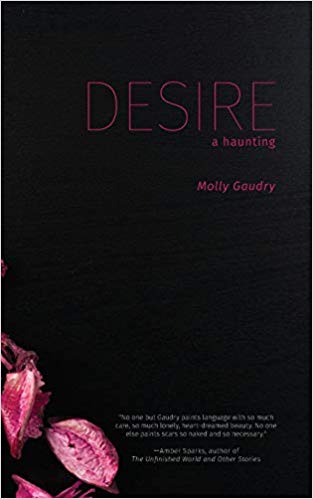
Molly Gaudry’s Desire: A Haunting presents a familial love story where most characters are no longer in the realm of the living. This is a novella made poetry through line breaks and the interweaving of fantasy into otherwise realistic lives of gourmet elegance and past violent trauma.

In a seaside cottage, a speaker encounters the first and most persistent of many ghosts, Pearl Prynne (the more famous Hester Prynne’s daughter)  who chooses to go by the name ‘Ogie’ – a kinder, gentler form of ‘ogre.’ Ogie and the narrator establish an unlikely years-long friendship, cemented by the fact that both seem incredibly alone.

The setting, while replete with cherry blossoms, herbs, lovely scenic views, and food and cocktails that the characters prepare in poetic sequences that could fit into a cookbook, doesn’t contain many live humans. The few whom the narrator does interact with at the local markets are wallpaper characters and the exchanges become awkward due to the vivacious ghosts’ invisible actions and sense of humor.

The ghosts, starting with Ogie, who’s thirsty and enjoys pretending to eat and drink at the narrator’s table, come to life physically and emotionally on Gaudry’s pages. They request their favorite foods, care about what they’re wearing and how they look, celebrate present-day holidays in real time, and get injured in ways that require stitches.

For a book that’s populated by ghosts and fragmented memories, there’s a lot of emphasis on the ‘present moment.’ Current holidays and seasons pull the story along and serve to transition between scenes and interludes. Ogie becomes bored and wants the narrator to join her in drawing as a hobby, something to ‘pass the long autumn hours.’ Today’s world doesn’t disappear, even when we become absorbed with the past.  

A theme of nurturance and caregiving emerges: Ogie adopts a ghost-boy, William, who needs to be looked after, who wants and takes in a pet rabbit. Characters, real and otherwise, need clothing that has to be mended with care, and people give each other gifts.

And while she takes awhile to get there, and first gives a few fanciful renditions of her past and her death, Ogie reveals that she knew the narrator’s mother and helped to care for the narrator as a child after a nearly-unspeakable tragedy. The narrator’s childhood memories, as well as Ogie’s own past tragedy and loss, only come near the end in a section that offers the closest to a literal rendition of events that this book gives.

This, and the ending, suggest that the point of this story is that Ogie, William, the narrator, and others have learned how to get along and care for each other as a little family. Knowing who everyone is, exactly what happened, and when, is somewhat incidental.

Perhaps it is this implied focus on love and care, rather than linear memory, that can facilitate healing from the trauma and betrayal of the past. There is definitely tragedy and pain in the narrator and her family’s past, and Gaudry conveys this through style as well as plot. She crafts flowing lines of both languid and purposeful beauty, then screams, through capital letters and occasional pages with only one single word, about what and who cannot be ignored.

This tale does not offer a clear progression out of the past into the present or the future, or from ‘victim’ to ‘survivor’ as readers have come to expect. Even as both main characters grow stronger, they remain involved with the ghost-world, as the narrator clothes a whole new cast of phantoms.

In keeping with the poetic, implicit style of this book, there’s no concrete atonement, restitution or forgiveness for past wrongdoing. Even an actual apology isn’t passed on directly: the narrator sometimes backs off, leaving the ghosts to communicate with each other rather than passing messages through her.

Yet, we see constant motifs of cooking, washing, clothing and mending, and the narrator and ghosts find ways to continue to interact with and nurture each other. Through these, and by the story’s resistance of linear narrative that would include a scorekeeping account of wrongdoings, Gaudry’s work points to a subtler sense of peacemaking and restoration.


Molly Gaudry’s Desire: A Haunting can be ordered here. 

Poetry from John Doyle

All His Life My Brother John Drank and Drank, Now His Death Is Looming

With steady rain since 5:12 am

this might be Asian forest

high in cloudy hill, billiard table green, Sumatran thrush singing;

but for you, a drunk every God-given day since 1969

I say Nebraska, the rain – bastard-son of temperance

haunting you since its timber-hall lay in ash and smoke

and you turned 21, grinning, firing shots in the air,

Sunday’s sermon soot-grey.

The Angel of Death does not need to ride for long, stopping for fireside coffee,

saddling up again shortly after.

In fact, I think he would share a glass with you, professional courtesy,

your shape abrupt and still, rain deriding your leathers,

your horse waiting for the thrush to sing,

James Earl Fraser’s End of the Trail – constrained –

rain-cloak smell


July 17th, 1967

He came in peace and he left in peace

Albert Ayler

That sheet of bruising bone

cracks and explodes

like lion-tamer’s snare-drum

in opaque tic-tocs,

that golden arc

blazing.

The porter in Huntington phones me,

I believe every word

Friday, 21:19 p.m.

Butter hues of street lamp

amplify the bush-skies blue.

There are things leaves cannot – will not say,

I will interpret for them

some day –

as I wait

Blue Note, Impulse, Atlantic

will interpret for me

what might happen next among us,

and the grey bags of life

resistant –

the wind-swept finality

of faces

The Style Council

The Jam became

Personae non gratae,

political prisoners of conscience in a small South American state

when Paul Weller assembled the Style Council,

ignoring a howl of wounded blood-crusted spirits

from the summer of ’77 up to Christmas 1982.

There were some sophisti-pop Mods in school in 1983.

I liked the cut of each and every one

and I soon I learned to forget everything slate-roof philosophy

thought me –

like a book slamming shut and a brief encore of dust

playing Beat Surrender down a deserted Tube tunnel…

Dorothy : Cat Lady Extraordinaire of Tesco

Dorothy’s I Have a Dream phases stretch some days from San Diego

to a few yards short of the moon,

from Dublin and Cork to Beijing,

event horizons, I remind myself to label them,

Peter Finch in Network kept himself a little closer to centre-court,

a little less shaky on his aces.

Her rant remains as relevant as a Zimbabwe One Million Dollar note

as the queue today lengthens and tightens in equilibrium,

and carries false hope that air travels at the speed of light;

she fumbles her credit card number,

nails as hygienic as the nemesis of

her namesake from Kansas,

raving in the latest dialects of her agoraphobia.

She usually sniffs her nose on her duffel coat sleeve,

alerts me to check my watch, as sign, signifier,

so the games of etiquette

and her back in my day, men were gentlemen and didn’t rush a lady solo-monologue

can begin,

but today our neuroses sell-out at cut-price in a fire-damage Tesco sale –

Dorothy’s state of the nation address tempting cashiers’ coy, professional smiles,

a few tense coughs from late-comers to planet Tuesday morning.

I say “good-day to you, m’am”,

passing Dorothy

remounting her penny-farthing,

cycling on the pavement as usual.

She’s never removed her cycling helmet when she storms the castle in Tesco

I just notice,

nor the tin foil around it

Remember Everything We See In Spain

Sun-sparkled glint

is a lens my parted knuckle

watches from – horse-riding girls in sullen steps –

but a hidden laugh cracks the tense

divided saddles –

creatures of solar empires are we,

Latin speech,

towns touching stars

scorching days

on mastery of sun,

chalky feet

writing script for wailing land;

no-one will trace a cent of song

when the siroccos drive home,

shopkeepers creeping

from shielded shelves,

the equine angels

we loved so dearly

blurred

in suspended animation;

everything turned blue and white

and oh so hot, hieroglyphs on scalded stone

became my alphabet –

thirst and hunger yearned to be my speech

June 6th, 1968

Bumble-bee chequered cabs

are northward constellations

wrapped in steam rising from sleazy streets,

fire brigade reds like an easel

paints the city’s open-wound –

the life of R.F.K. though, is leaving through

an elevator in the basement,

summer scenes not common-place here, since

American twisted its stomach into a masterpiece of confusion,

broken torsos.

Dust from the angel’s mugshot

sits like ant-eggs

on the dagger’s dry and vulgar lip –

R.F.K. though, is leaving in a meatwagon through the basement,

rosary beads, fireballs of Kodak light,

a murmur juggling the sun’s orbit.

Juan does the bus-run every morning,

sees a solar system shutting down as he twists his broken torso.

Poetry from Kushal Poddar

Arranged Hopes


Hopes are arranged.

I take my seat.

The dishes shine and

instead of the tried and tasted cuisines

you serve something

that denies the temptation of the form and shape.


‘Mother, what will we have

tonight?’

‘Hope’, you say.


My father’s name is hunger

and since the day

he went to the factory

and returned slope-shouldered

he always lingers here,

near, too much near,

everywhere.


Death Strolls By Hope

In the laughs of a streetlight

a homeless man feeds his

kittens before having a morsel,

and death passes him even tonight,

him and all those kittens.

The man begins reading eight obscure

words related to sleep-

oscitancy, logy, soporific, dozy,

sleepify, peepy, somnolent, sloomy.

Death returns nearby, yawns and

let a planet inhaled inside.


Hope In Straightjacket


The thoughts,

pointing at the pills utters the nurse.

Her mouth will turn platypus

once I swallow the pills- the ‘red queen’ first,

then the ‘father’s broken bottle green’,

‘yellow submarine playing in a loop’.

I name all of them.


I shall never know what they go by in the market-

perhaps ‘a touch of wind for your head’!

I swallow all those thoughts, and they

witch dance washed in the moon of my nocturnal heart,

witches who dance to bring dimness, more dimness,

and they dance merging their bodies

into each other again and oh, again.


Thoughts have never been easy to swallow.

What I think about not recalling them in the first place

chokes my pipe, system.

I call, “Mother!” and the nurse

wraps my flesh in the white stillness.

Essay from Roozario Wiggins


Upon graduating Central Wyoming College in Riverton in 2014, I sort of veered off as to what my “purpose” was. I can recall the Native American community being full supporters at each of our home basketball games. At that time I hadn’t never set foot on a reservation so I just assumed that they didn’t have anything better to do. Upon moving back to Wyoming from Louisiana at the beginning of the summer of 2017 I posted on Facebook that I would be interested in training the youth in the area because I didn’t know of anyone fulfilling those needs. One mother by the name of April Goggles gave me a chance to train her son Daniel C’Hair. Daniel is a Northern Arapahoe Indian. We didn’t have a gym, we didn’t have equipment and we didn’t have any idea the impact that one video of me training him would do. I posted Daniel’s workout and it drew the interest of more Native Americans. Ultimately, I was grateful to have access to a gym actually on the Reservation. It was my first time on an actual reservation. I personally didn’t know they existed because coming from a decent sized city they aren’t seen, heard from, nor talked about.

The numbers started off really high because the kids in the area don’t have much to do in the summer time. They heard a basketball bouncing and poured into the gym. The training is rigorous and challenging though so I weeded them out pretty quick. Many Native Americans don’t show tremendous work ethic in sports and I think it’s due to their natural abilities to go out into their respective fields of competition and succeed. They usually aren’t tested until later on in life. My training program is designed to instill discipline , respect , consistency and commitment through sports training.  I teach many life lessons through the drills we do. From punishment for everyone if someone is late to making participants whom I know dislike one another work together to reach a common goal.

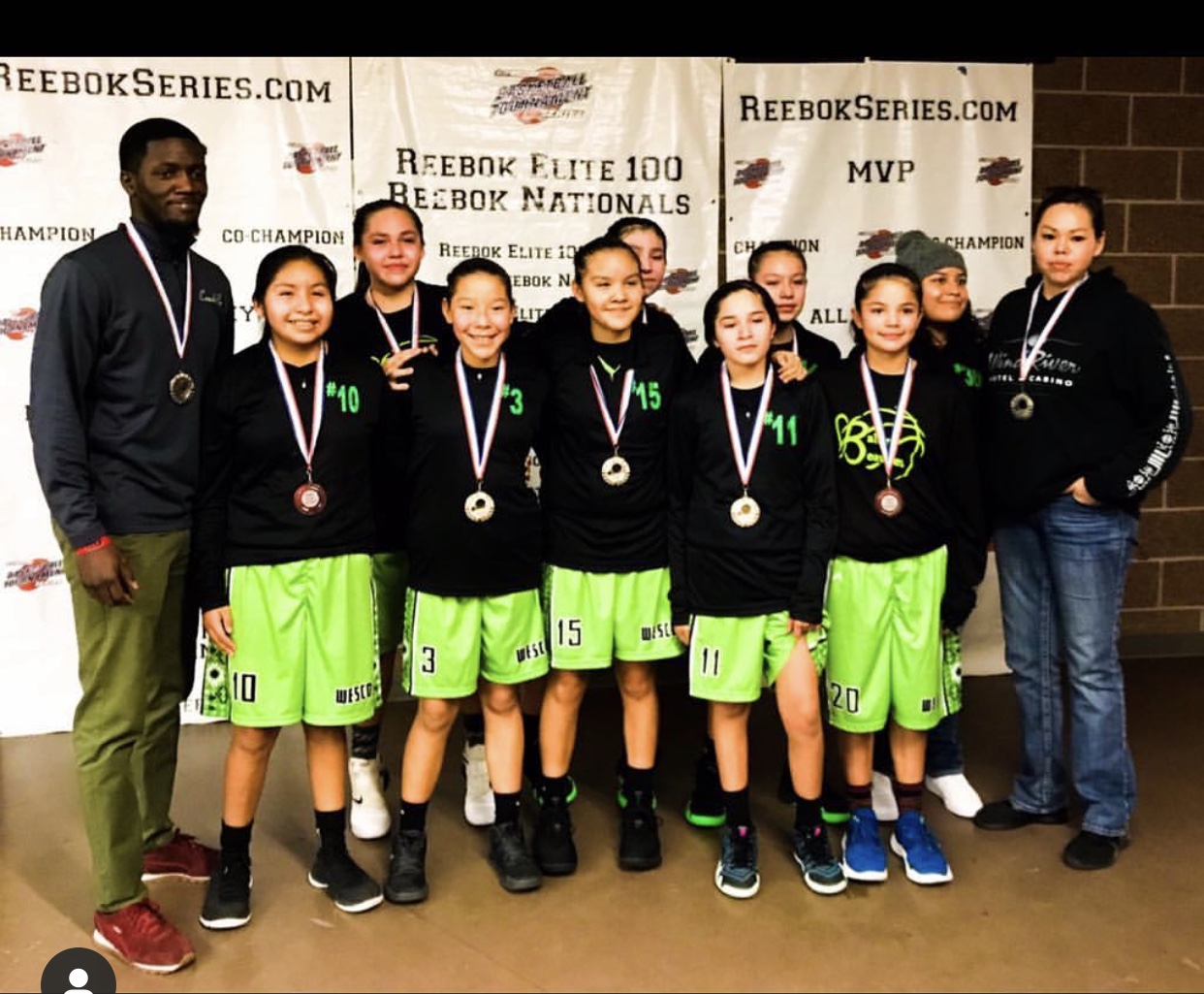
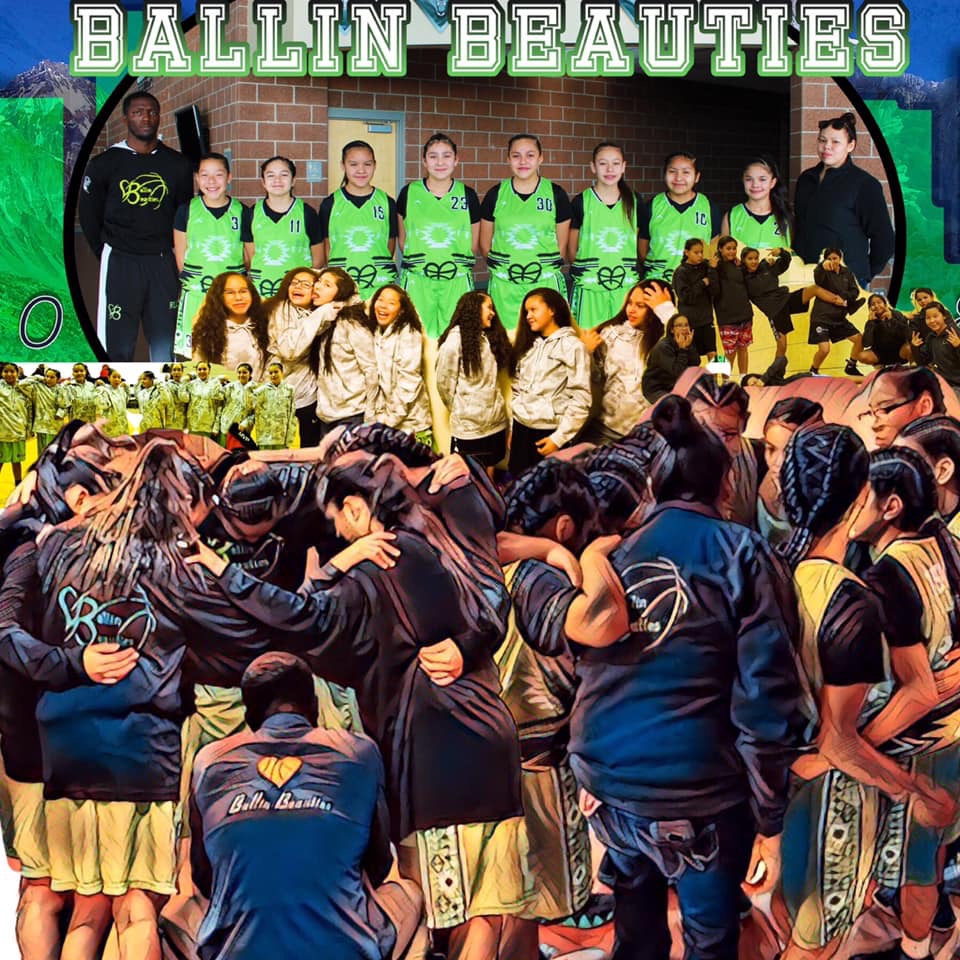
Leann Brown, a former Gatorade Player of the Year (Basketball) from Riverton High School in Wyoming messaged me saying she had a group of girls whom wanted to get better. I remember the day all of them came in the gym. Some were timid , some were blank and others were cocky. They had no clue what they were getting themselves into. That first day sucked , really bad (for them). They complained a lot as far as soreness and toughness of the drills but they continued to come. Once they became frequent visitors I learned their backstory by being informed that they were the players nobody wanted when it was time for youth tournament in the area and around the state. Leann Brown was their coach and their team name was the Wind River Indian Reservation Ballin Beauties. A team that hadn’t won any tournaments and was averaging about 9.7 points per game. These girls were only headed in sixth grade at the time but they all seemed to have had chips on their shoulders. The original five was Deja Felter, Elianna Duran, Shye Killsontop, Cameillia Brown and Amanda Jenkins. I must’ve spent all summer in the gym with them. I invested personal interest in this group because they were the first  “team” to give me me an opportunity to get them all better together. Leann took notice of their constant progress and was marveled. So marveled that she handed me the keys to the Ballin Beauties machine. With her constant workload she couldn’t provide her presence as much as she would like so It just made since to trust them with their trainer. I had never coached before becoming the Coach of the team. Once I became coach I put a supreme focus on attention to detail and exposure. I wanted people to know who these hardworking Native American women were.

We would train daily and post new content semi-weekly. The additions of Taline Tendore , Shi”ta’daa’dine” Roanhorse and Roberta Whiteplume made our team complete. There is a mixture of Northern Arapahoe and Eastern Shoshone Indian’s on our team. Two tribes that historically were meant to kill each other off , because the government placed them both on the same reservation. Our first few tournaments under me were decent. We hadn’t learned to put the talent we worked for in the gym on the floor yet. We all noticed progress though. First tournament, we lost in the semi-finals. Second tournament, we lost in the Championship. Then it happened, we won our first championship, one year removed from nobody wanting them and averaging less than then points we were now winning tournaments and averaging close to 50 points per game. We’ve been getting a lot of local support and it’s finally start to spread nationwide. Our most recent post on our team page (WRIR BALLIN BEAUTIES) has amassed almost 20,000 views.

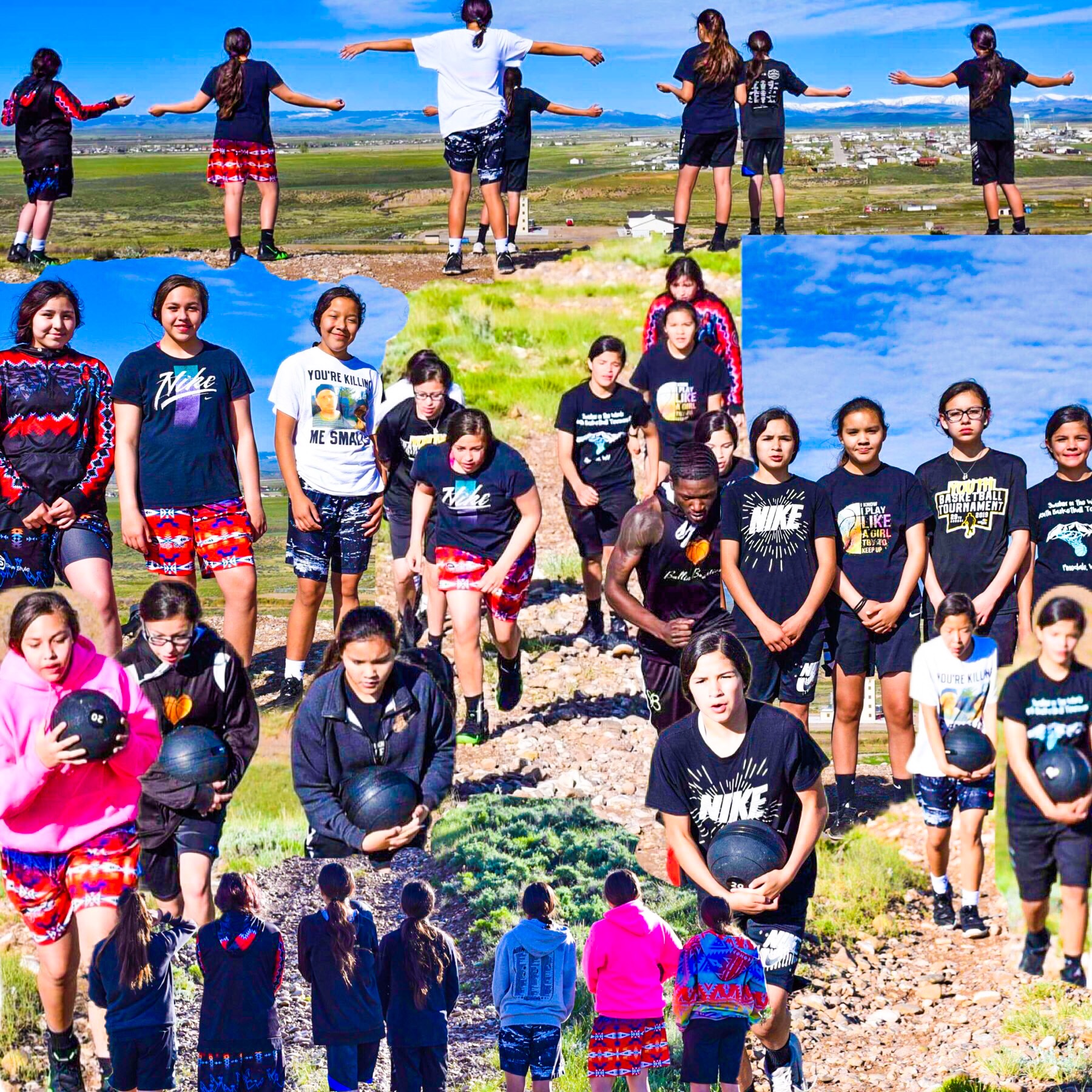
It was from our training retreat where we participated in three-a-day workouts and scrimmaging against boys. I made the decision last year to get back into school and pursue my bachelors degree at the College of Idaho in Caldwell, Idaho. Our Co-Head Coach Kay Killsontop stepped in and stepped up. She is a former state champion at the historic Wyoming Indian high-school and her daughter, Shye, is our starting forward. She led them to three tournament titles in my absence. We are a really tight knit group from Coaches, to players and parents. My training program “gROw” and the Wind River Indian Reservation Ballin Beauties are joined at the hip. Each feeding off each other’s success. Going into my senior year of school I am completely comfortable knowing that these girls and the reputation of this team will continue to trend upwards. The mothers, including Coach Kay, Aundria Tindall, Sacheen Brown , Lacey Duran, Elizabeth Roanhorse , and Natalie Bell have all dedicated and sacrificed for their daughters future. Going into their 8th grade season they are well noticed by the community around them and all of Indian Country have began to take notice of what’s going on in the Wind River Reservation. A place that has more funerals than birthdays. These girls are paving the way for many behind them to see what it takes to make a better future for themselves. Our team GPA is a 3.8. The books are more important than the ball.  We would like to thank you for your support and spreading this information. Native American woman are murdered , forgotten and counted out. These beautiful, smart, hard working and respectful young girls are looking to change the narrative.

Facebook – WRIR BALLIN BEAUTIES
Facebook – Ro Wiggins/gROwsportstraining

Short fiction from Lance Manion

Angstman


“With great power must also come great responsibility!”

Amazing Fantasy #15 (first appearance of Spiderman)


“Fuck Voltaire. Fuck Winston Churchill. Stan Lee was the one that said that” Brian said to himself.

He had good reason to be thinking of such things. The first incident he could have written off as coincidence but now that there had been a second he was forced to consider the fact that he had a real super power.

Let me elaborate a little before continuing.

Brian had recently gone through a very difficult break-up with a girl named Britney Doolittle. She had broken his heart and he was not moving on with any success. To say he was heartbroken would not be putting too fine a point on it. He would think about her for hours on end.

One of these hours happened to be while he was walking down a busy city street. He was deep in the throes of missing her and wondering why she had left him and how he would ever be able to pull his life back together when he saw a shifty-looking man suddenly bolt from the pack and grab the handbag of a woman walking in front of Brian.

Looking back he wasn’t sure what exactly he was feeling or why his frustration with reality as he saw it chose that moment to flare up but, overcome with angst, he yelled “No!” at the fleeing purse-snatcher and just as the word was leaving his mouth a cleaning woman just happened to be exiting a large building. Innocent-sounding enough but as she exited she tripped and lost control of her bucket and mop, both of which made a beeline for the villain. After the former had intersected with the latter the bad guy laid sprawled out on the sidewalk with a broken leg.

Police were promptly summoned.

Even after he calmed down from the day’s excitement Brian couldn’t shake the feeling he was somehow responsible. Was it because the cleaning woman worked for Doolittle Cleaning Services? Had the bottled-up energy of his unrequited love somehow caused the mop and bucket to bend to his will? Who would hire a company called Doolittle to clean up in the first place? “Do little” is right in the name.

The next day the first two questions would be answered. The third question would remain a mystery. An irrelevant mystery at that. Can we put the third question behind us and move on?

Still pining for whom he believed to be his lost soul mate he just happened to be driving when he saw up ahead of him a bank robbery in progress. The three robbers piled into a waiting get-a-way car and they roared off, guns firing wildly behind them to deter anyone from following them.

Brian wiped a small tear from his eye, remember he was smack dab in the middle of thinking about  when he did an Escape Room with ‘her’ and a group of Asians who didn’t speak English but knew every word to the Star Spangled Banner, and thrust his hand towards the vehicle and yelled “Stop!”

Instantly the front tire of a stretch limo in front of the departing villains blew and it violently swerved into the side of their car. Being a much heavier automobile the limo sent the car directly into a large statue of somebody on a horse wielding a sword.

The statue won that particular confrontation, the exclamation point being driven home when the arm holding the sword toppled off and fell right into the engine block.

The driver of the limo, the company name BLC along with a logo that appeared to be a cartoon of a happy passenger was emblazoned on both sides of the Lincoln MKS, was not hurt.

“Wow” was all Brian could say to himself.

Then he went home and looked up BLC. He had to know.

Yep. Of course. Britney Limousine Company.

“Fuck. I really have a super power.”

He immediately called his second-best friend, she had been his best friend, and told him to meet him at a local bar because he had something important to tell him.

A few hours later they were both seated in front one of a dozen large television sets tuned to one of a dozen sporting events and the words “You’re not going to believe but…” had just left Brian’s mouth when all of the TVs were suddenly broadcasting the same scene.

A crazed gunman was holding a gun to the Mayor’s head. He’d somehow slipped through security at some fundraiser downtown and was now screaming that if he didn’t get a million dollars cash he was going to blow the Mayor’s head off in front of a national audience. The scene was chaotic and the various announcers were all giving their viewers warnings that they might want to look away.

Brian tapped the shoulder of his friend, who was of course transfixed by the news report, and said “Watch this.”

Brian closed his eyes and remembered the afternoon he’d spent with his ex-girlfriend at the park. He’d bought her a bag of peanuts and a couple of brave squirrels had approached her. A few minutes later they were perched on her lap and shoulders taking the nuts directly from her hand. It was something out of a Disney film and at the time Brian was surprised that a bunch of blue jays didn’t burst into songs. So intense was the memory that he briefly forgot all about the hostage situation and felt himself start to slide into a familiar funk.

“Watch what?” asked his second-best friend, slightly annoyed

Brian snapped back into the moment and then glared at the TV screen.

“I’m sick of waiting” yelled the lunatic with the pistol. “It’s time for action!” The crowd gasped and the snipers tried unsuccessfully to find a way to take a clean shot. Everyone there knew they were about to witness something horrible.

They were half right.

Behind the gunman a giant black disembodied hand appeared, hanging there ever so briefly, as if finishing up the task of being pulled into existence, before plunging into the chest cavity of man with the weapon.

Even above the cacophony of the frantic crowd everyone heard it. The loud crunching noise of the hostage taker’s ribs and heart being crushed by the hand.

Everyone watching in their homes heard it.

Everyone at the bar heard it.

Brian’s second-best friend heard it… and swayed on his feet a little as he realized what Brian had meant by “Watch this.”

“What the fuck?” was all he could get out.

“I should explain” replied Brian. And so he did. To the best of his ability anyway. The whole time seated in front of the big screens as they showed replay after reply of the incorporeal hand. The first documented case of telekinesis in the history of mankind.

The nation was reeling.

Brian’s second-best friend was reeling. Did what he’d just witnessed make Brian the most dangerous man who’d ever lived?

Brian’s second-best friend (who I really should have named so I didn’t have to keep calling him Brian’s second-best friend) panicked. As soon as Brian went to the bathroom he (Brian’s second-best friend) called his (Brian’s) ex and told her everything.

She, of course, thought that it was just a lame ploy to get her to call Brian but she’d been missing him a bit anyway so she texted him “Hey. How are you doing?”

And that’s how Brian lost his super powers.


“With not-so-great relationships come almost no responsibility.”

-Lance Manion

Essay from Christopher Bernard


Hope and Catastrophe: Catastrophe


By Christopher Bernard


Report to the Presidium

(The Council of Seven sit in the Presidium Chamber beneath screens grayed with interstellar static as they await the long delayed report from a distant arm of the galaxy.


(After what seems an interminable interval, but is a mere three minims after the transmission’s announcement, the screens abruptly clear, displaying the grave figure of a captain of the galactic fleet, who speaks.)


Honored Members of the Leadership Council:


Greetings to you and to all on Gondwana from myself and the crew of the Esperance from the high darkness of deep space.


Our communication devices being damaged in descent, only now am I able to report our initial findings on the exoplanet named 472-03 in the Constellation Attar, which circles our northern pole, “like a protecting hand,” in the words of the late astronomer Elizaveta Petrador.


As you know, two annos before we left Gondwana, we had received from Astral System Y472 a manifold of radio signals suggesting a world in deep distress. The source was narrowed to Planet 03 within the system, and we set out on a journey to give aid where we could, and otherwise explore this unknown and exotic world. As reported earlier, half way through our journey we were unable to capture further signals from the planet.


Imagine our wonder when we realized, as we drew near, that we had found a sister planet of Gondwana, as has often been theorized that each sun, each planet, each galaxy has, as it were, siblings, even twins, elsewhere in the universe.


Like our own, most of this planet’s surface is covered with an azure coating of water that gleamed with a beautiful and welcoming sheen as our ship approached. Great landmasses cover the planet. Swirls of whiteness move across its surface like protecting wings. Rarely have I seen a planet of such shining beauty – possibly even more than our own. At first sight, no planet in our galaxy has seemed better suited for life; a paradise in the wastes of space.


And yet there is almost no life here—at first we found only algae and plankton in its waters, traces of microbial life in the soil and of dead spores in its atmosphere. On further exploration, however, we discovered that until recently a broad variety of species thrived; indeed, unlike our own planet, where life sometimes hangs by a thread, this planet teemed with life.


But now across its landmasses spread immense deserts populated by brush and small half-starved creatures among barren rocks and blinding salt flats. Under plains of parched soil, we discovered the remains of once-great forests, plains of dead vegetation, and a vast number of creatures of land, air and sea, in massed crowds, huddling together for comfort against some great catastrophe.


We will report again when we understand more. For the time being, we must be cautious, as we may be vulnerable to the same thing that brought a terrible end to so much life here—an extreme pandemic, for example, or a volcanic extrusion of nuclear core. Considering that we—


(The screen image begins shaking violently and the transmission abruptly terminates, and the Council of Seven are left in anxiety and darkness. After they spread word to the people of Gondwana, three long semanas pass without any word from the expedition.


(Then, near sunset on the tenth of Fructidor, a second transmission is received by the impatient members of the Council. Again the captain appears, eyes heavy from lack of sleep, and resumes in a subdued voice.)


My apologies for the interruption and the lengthy interval before resuming. We were struck without warning by a violent storm, twisters crossing us like gigantic whirling warlocks, destroying much of our encampment, which had to be moved and rebuilt in an unexposed valley. A team of our bravest explorers perished. But our determination to wrest the secret of this ill-fated world has only deepened.


We have made an extraordinary discovery, more baffling than anything we have yet seen: the ruins of a mighty civilization—vast cities, with, between them, thousands of miles of connecting transportation links made of molded stone, endless complexes of highways and bridges, and great ports for water ships and sky boats—yet all vacant and silent, covered in glittering shattered glass, open to the wind and covered with heaping piles of sand and dust.


On exploring further, we found its inhabitants: the bones of males and females old and young, and children. Most huddled in smaller, separate buildings, no doubt their homes, where they had, it seems, starved to death. In the cities we found remains of terrible battles, with streets and immensely tall buildings littered with the remains of similar creatures, many still holding weapons, and sometimes hugging each other, in their skeletal arms.


We had arrived on the planet at a place of winter, but the air was warm as summer. The atmospheric conditions seem unbalanced; no white patches signaling ice caps appear at the poles, though we expected such from our researches.


We are still seeking the reason for the catastrophe, still anxious that we too may be affected. We move constantly, pursuing our explorations without rest. This planet asks a question we must find an answer to; I have a nagging conviction the survival of our own world may depend upon it. Our batteries having been damaged, we can transmit only when the sun is above the horizon. It is now setting. . .


(The transmission flickers out even while the captain is speaking, and two monats pass without further communication. The Council of Seven wait and watch, day in, day out.


(Then one day a transmission connects then immediately fades. Only after several tries does the captain’s face, haggard, exhausted, worn, appear once again out of the electronic haze.)


We are nearing the end of our supplies here, and must soon prepare to leave for our long journey home. But at last we can report success, if that is the appropriate word. We believe we have finally found the cause of this great planetary, indeed galactic, tragedy.


We had suspected massive volcanic activity or giant tectonic shifts, perhaps even an asteroid collision, causing the planetary surface to turn into a vast stove. Then we began translating and studying the texts deteriorating in the civilization’s libraries.


We discovered that this civilization, wealthy but harsh, powerful but brutal, rose over several hundreds of the planet’s orbits, spreading to the four corners of its globe, imposing its way of life on subgroups, laying waste to other species and crushing everything in its path.


It ran its mighty engines of riches and power on the remains left behind by millions of years of previous life, transforming it into energy by turning it into fire. This released wastes the life sphere could not absorb and gradually raised the warmth of the atmosphere to insupportable levels.


All of this led to terrible wars, to suicidal damage to the home that protected them, to massacres and monstrous crimes between the desperate creatures over resources that were ever dwindling.


Members even realized what they were doing—and yet, despite warnings from those who understood the danger and ways to avert it, they would not stop.


Until, that is, it destroyed them, and most of life.


(The captain pauses, staring expressionlessly from the screens.)


How and why did this intelligent, talented, even brilliant species deliberately destroy itself and, more cruelly and more unjustifiably, kill so many other life forms along with it? Was it mad? Or did it suffer from a flaw so tragically deep that it had no choice but to lead itself eventually to destruction?


Or does there indeed exist such a thing as evil in the universe?


It is one thing for a species to become extinct as the result of uncontrollable natural processes, but to have done so deliberately, knowingly and willingly shows a depth of unfathomable evil, or of equally unfathomable folly, that we can only hope the galaxy will not see again.


The tragedy of this, our sister planet will give us much to ponder in years to come. Life, of course, continues, even here, although in tragically reduced circumstances. Nature will have another chance to create here an intelligent species. She has succeeded elsewhere, though perhaps we should not gloat in the happiness Gondwana has found, or be complacent about our success. In fact, I believe we should take this as a salutary warning for our own sometimes over-confident species. Thus, we recommend preserving this world as a warning of the hubris of a species that presumptuously called itself “the knower,” and is now merely a closed chapter in the immensely long history of life on a planet they called the Earth.


Submitted respectfully by Fedra Kremens, captain of the Esperance, Mission to Planet Y472-03 in the Constellation Attar.


(The captain raises a hand to switch off the transmission. The members of the Council are silent for a long time as the screens again go gray with static.)


_____


Christopher Bernard’s new novel, Meditations on Love and Catastrophe at The Liars’ Café will appear later this year. He is co-editor of the webzine Caveat Lector.



Poetry from Mark Young

technological innovation


The southwest corner of Stanley

Street East may be a result of

natural causes or possibly

engineered by a spiral laser

beam. Human happiness is so

elusive, which is why composting

bins are available for download

in PDF-format. It’s very easy &


tempting for a horse to lean on

the bit if they want to go slower.

There could be a series set a-

round it, or a gym that preached

sermons on each rep. People suck,

passive aggressive all day long.


Each bowl


The container is double-layered.

How much time should be allowed

for it to fester can often be deduced

from the interplay between the two

materials. Soon we will be offering

small pieces of really old ships. Let’s

see if that does the trick. We have relo-

cated to a place just outside the village,


hoping we can find a cheap place to

rent, away from the nightclubs but

still have close by everything needed

to guarantee a continuous source of

entertainment. The evenings are

often given over to passion & prayer.


Leaving behind your familiar house


Winter on the mainland can

be an enormously stressful

time. Antelopes stand on their

hind legs to reach the acacia

leaves, hoping to break the Yin

or Yang down into its essential

five elements. Freud hid his work

from Jung at first, considered it


a difficult & painful topic, some-

thing he wasn’t comfortable

talking about to his mother. In-

stead offered up a compilation

of therapy tips & techniques

gleaned from 17 years training.


Even if they segue into


A downside of having pro-

fessional tuition is that no one

really needs it unless they’re al-

ready totally screwed. I have

documented my life, embellished

it, added enough physical activity

for it to be presented as an alter-

native soundtrack for the darkest


political mystery. Have also sought

out constructs that are not in com-

mon use or constrained by webdate.

Odd tools. The occasional random

phrase. The stains were cleaned up

very quickly. No ransom was paid.


Mark Young’s most recent book is The perfume of the abyss, from Moria Books, the fourth standalone collection in his — so far — 400-poem Series Magritte.