Poetry from Ricky Garni

THE RULES OF BEAUTY (1924)


  1. Rise early and make your bed; scream that you’ve made your bed.
  2. Eat a hearty breakfast in the dark. Outside, with possums. Inside, with Elwin.
  3. Exercise while watching the horses run fast and free on the highway – oh, so very fast.
  4. No alcohol on our lips but you may let it trickle down your nape or small or onto your feet.
  5. Smoking is detrimental so don’t do it unless you look cool doing it wearing a chapeau of some kind or something somewhat flammable
  6. Get outdoors. Ride in one of those miniature cars that go 4 MPH, for an hour. Call home and say “Please pick me up” and explain that you are 4 miles away in that direction, there.
  7. Eat a light lunch based upon the idea of airiness and then fly to Spain and have a siesta with a matador.
  8. Early to bed. If you dream of arcades, wonder why and laugh. If you don’t, wonder why and laugh.
  9. Answer a phone call in your sleep. It’s Elwin. Tell him you love him very much, it is he who you love. Ask him over for breakfast in the morning. Early. Toast, sweet butter-oos.


VICTORY LAP


One year I celebrated my birthday with a coconut donut.

One of those big, fat, sloppy, heavy, oily ones that they

don’t make anymore. I miss them terribly. But I must admit,

I  take great pride every time I outlive something wonderful

like a big fat donut. Or a flower. For example: the yellow

rose petals that covered you as you slept in the bathtub.

I had just turned 20.


SUNDAY SCHOOL


Perhaps when we asked our parents about eternity our parents pointed to something vague. They might have pointed to a tree. Or a plate of figs. Or they might have pointed to our real parents.


GGGGGGGGGGGGGGGGGGGGGGGLASSES


We all laughed when Joseph came to school

one Monday morning wearing glasses.


We didn’t have to wear glasses,

so why did Joseph?


By recess, Joseph, generally gregarious,

was the laughing stock of the second grade,

what, with his glasses and all,

etc.


For those who still remember, we hope that

Joseph will forgives us. What we did was ghastly

and grotesque. Since that day, we have grown

and are now quite gorgeous in our glorious hearts.


This essay was completed in order to ascertain

the functionality of the G key on the typewriter.


C+


TRISTAN


Tristan chose to sit on a bench for his first book

in a simple and dignified pose with a salmon-colored frame.

Even though he looks at the camera in a formal fashion

over the years the creases in the book suggest the appearance

of a poet holding a long chain or hula hoop


Tristan is a poet of danger and fun. Time is imposing this judgment

upon him, and I thank time for that: a gift to a long ago Romanian

whose mirth was rumored to be obscure.


TRIUMPH


My feelings about you are different every time I think about you.

Just like my feelings about Dirty Harry, Chubby Checker, and Douglas

Sirk’s MAGNIFICENT OBSESSION.


Or almost any obsession available that is truly magnificent.

Two that come to mind right away: Chubby Checker, and Dirty Harry.


Ricky Garni grew up in Florida and Maine, was educated at Exeter and Duke, and has lived off and on in the Triangle since 1977. Over the years he has worked as a teacher, wine merchant, studio musician, composer and graphic designer. He began writing poetry in 1978.

Essay from Jaylan Salah

Sharp Objects: Redefining Post-sexual Bliss

By Jaylan Salah

Even 40 years later, Laura Mulvey’s “Male Gaze” theory on the voyeuristic pleasure of cinema is still valid and applicable. In 2018, television audiences and feminist critics alike were treated to one gem of a miniseries titled “Sharp Objects”. Originally a book by Gillian Flynn and recently an HBO mini-series directed by Québécois filmmaker Jean-Marc Vallée, “Sharp Objects” takes an anti-heroine and puts her back in the heart of where all her trauma started; her small hometown Wind Gap in Missouri where women are still viewed as town sluts or doting mothers, men brawl and charge at women in the disguise of false machismo, wealthy tycoons rule the fates of others and demand the welfare of lower class families. In short; Wind Gap is Hell and it is only complicated by our protagonist’s own baggage of family abuse and sexual assault.

Camille Preaker is your next anti-heroine; not the way Angelina Jolie played it in “Salt” or Helen Mirren glamorized it in “Prime Suspect”. Preaker is a mess. Sometimes you wonder how she manages to hold on to dear life with a dozen of problems; alcoholism, casual sex, self-harm and emotional trajectories are examples of personal bullets she tries to curb at every turn. Preaker is not how Sophie Gilbert from “The Atlantic” wants to see female journalists depicted on-screen. She drinks on the job, sleeps with possible sources and barely takes notes. Gilbert describes that as being “far from reality” and compares Preaker to a much more composed female journalist character as seen in a Showtime documentary. In other words, Gilbert plays the same mistake male reviewers have been associating with female characters that simply do not fall into line. She’s unlikeable! She’s unprofessional! She’s a bad feminist influence! It all falls into the “trope” which –despite capturing the inadequacies in the past era of creating female character clichés– placed nonlinear female characters side-by-side in fear that they might be a trope (hint: throwing every quirky female character down the Manic Pixie Dream Girl abyss without proper analysis of the character or even the creative medium from which she emerged).

Camille Preaker is one of the least sexualized female characters on-screen. She is rarely seen without clothes on and when it happens; it is meant as a tool of provocation rather than arousal. What makes it the more compelling is casting a stellar actress such as Amy Adams who has shown her sexual, seductive side successfully in more than one film to portray a non-sexualized character who is completely covered in self-inflicted scars. Preaker is an angry female that would make John Cassavetes’s Mabel Longhetti proud. She displays the same vulgar, unethical alcoholism that the likes of Don Draper in “Mad Men”, Dean Winchester in “Supernatural” and Hank Moody in “Californication” boast as if it is a character trait rather than an addiction that requires immediate intervention.

Preaker is no Veronica Mars or Buffy or Rory Gilmore. She embodies the ultimate feminist fantasy of having an unlikeable woman grace the screen and reach…nothing. Even her crusade against her dominant, abusive mother –played to perfection by Patricia Clarkson– led to nothing but a rather harrowing discovery in which we -as viewers- are left in mid-sentence, unable to expect what might come ahead.

Director Jean-Marc Vallée creates an ominous presence of Camille’s suffering; his angles, his tracking shots of Camille driving through the dead Wind Gap scenery. His gaze unrelentingly shows her at her most vulnerable, non-sexual self, even throughout her most sexually traumatizing memories (i.e. her gang rape). One of the most notable moments of the series involves how Vallée flips the Gaze by paying homage by creating an anti-traditional post-sexual bliss scene.

Post-sexual bliss scenes pose a recurrent theme in movies. It is usually a justification to show a naked -or semi-naked woman without having a key plot moment that involves nudity. Take “Entrapment – 1999” where a sexually undesirable man (69-year-old Sean Connery) is caressing the body of a much younger, sexually appealing woman (30-year-old Catherine Zeta Jones) draped suggestively under the sheets. Male fans’ reviews back then show how the box-office sensational, testosterone-pleaser was an unapologetic, successful malefest. At least that’s what Joe Chamberlain on Google Groups think,

“This may sound a bit sexist, but here goes. As far as I know, the main audience for an action movie is young males. So it seems perfectly reasonable to me to cast a young, very attractive actress in the leading role.”

The scene where a fully clothed Connery caresses the body of an actress young enough to be his granddaughter, throws back a shade on the infamous scene from James Bond’s Goldfinger where a much younger, much sexier Sean Connery is seen caressing the naked, gold-painted body of a typical blond (dead) Bond casual fling. In the now iconic sexist/sexy scene, the dead girl dies after being painted completely in gold, the main protagonist -Bond- simply caresses her strategically placed naked dead body. And audiences are not supposed to mourn or feel bad for the hot girl whom they just met a few minutes ago but to revel in the immaculate beauty of a gold-plated naked female corpse.

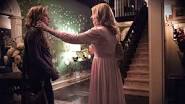
In “Sharp Objects” Preaker is fully clothed, while Richard –Camille’s object of affection throughout the series and the Kansas detective who investigates the grim murder cases– is lying seductively naked on the bed. As Preaker caresses his naked body, desire apparent in her voice, viewers are greeted with a naked object who has a voice and a say in what is being done to him. With women, though, the camera treatment begs to differ. In “Goldfinger” that would be impossible since the naked object is a dead girl, while in “Entrapment” Sean Connery caresses the naked body of Ms. Jones who pretends to be asleep. In both cases, the male psyche and subconscious are being lured into the movie theater to see a semi-naked silent female object being fondled by fully functioning male protagonist.

In her refusal to be seen, Camille Preaker strips the gaze off its power to hold an object within its focus. Instead, the focus is on Richard’s naked body, on whom her Gaze lingers with longing lust, and on which the camera lingers as well, allowing audiences to feast on male nudity for as long as the scene lasts.

Author Gillian Flynn with actress Amy Adams at the ATX Film Festival

Any photographer worth their accolades can write essays on the vulnerable nature of the nude object. And now, for the first time in probably a decade of TV shows where sexuality is a key element in the main plot, men become vulnerable and nude while women remain fully clothed, in charge and changing the sexual power curve, at least physically.


Poetry from Allison Grayhurst

The Journey Continued in Four Parts

Part One – The Step
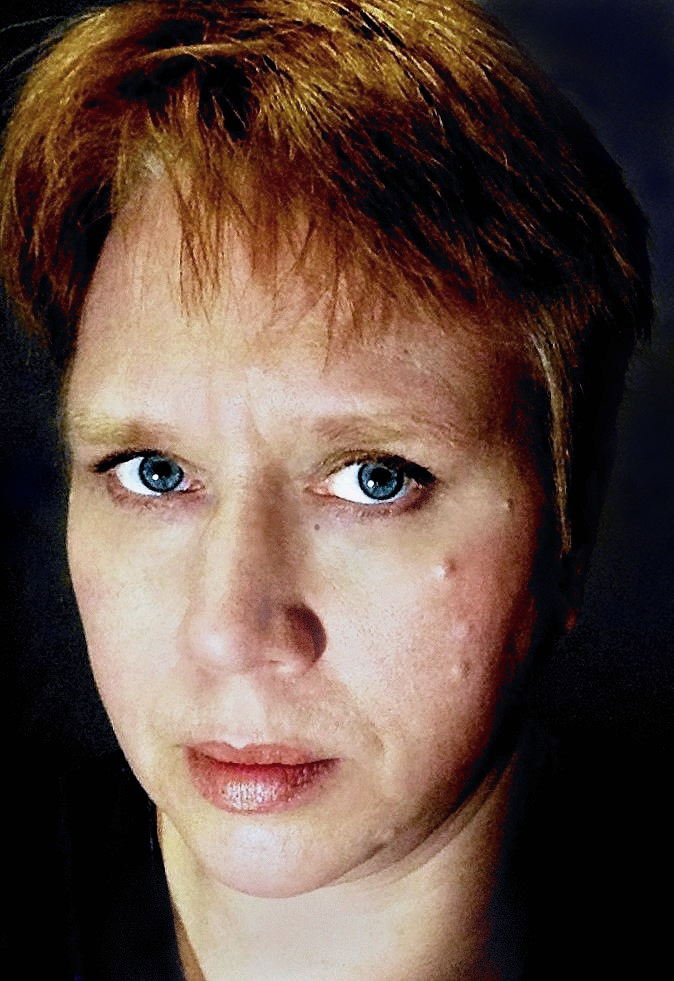
Allison Grayhurst


***

(barren metallic fields,

a harvest ready to haul, infested,

lock-jaw stagnation)

Never Holy

You asked for a light

at the end of the tunnel

and was told

there is no light at the end

because you are the light

guiding your escape.

You are the living fresh-water fountain

you seek, the high rock in the ocean.

Then you were told there is no tunnel,

no distance between the dark and light.

There is pain and loyalty to that pain

and false hopes that claim us

like a deceitful friend plotting betrayal.

You were told to be glad at daybreak, when the battle

ensues. Against the rain, don’t have any secrets,

even let your own death be revealed.

You were told never stop longing for the clarity

of your spirit, give no one up to the slaughter,

eat only what does not scream or thrash.

If there is a high wall, climb.

If a steep incline, find a rope, tie a rope

and edge your way gently down.

You were told to make bread, give a loaf away

and you might never go hungry.

And even if you do go hungry, then hunger

is the season you are called to endure.

You asked for light at the end of the tunnel

and was told

six more days, then seven – open sail –

eventually the wind will wake, spare you

the cause of your consuming dread.

****

(Four Heads of Evil Within and Without –

Resentment; Bitterness; Self-pity; Self-aggrandizement)

Revival

Be still, in the hostile landscape, be still,

find provision, refuse the fear.

Firmly self-sufficient, valuing your

success measured by fulfilment of God’s commands

and the sweet exchange of eternal experiences.

Is there anything to regret? No,

there is only what must be given up

– self-pity – the grotesque body

that grew beside your own, grew because

of your suffering, a deformity that

grew to help you carry the weight of that suffering,

a deformity that held a place for your secret pride.

But now, unbound, you must mercy-kill it,

release and dissolve its surface layers and under-layers.

It is always in a state of perpetual decay, supporting.

Release the poltergeist apparition,

re-distribute your cells, align

without its sickly features haunting and its whisperings

that lead to madness, whispering

“This suffering is yours. How amazing you are to carry it!”

and “No one will love you if you don’t carry it.”

Be loved in your joy and crazy impulses,

your sinews riveting creative overflow.

Be bouncing, impossible, wrenched from its illusion,

off your leash, off your rocker.

Discover dignity under the high trees,

by the rapids, skipping stones,

stepping on the slippery rocks,

stepping closer to the thrashing contours,

closer yet to its elemental song.

***


(Awaiting Impact)

Calling In

If you see the daybreak

but cannot walk out of the cave,

if you are still feasting on small beetles and cave-moss

instead of apples and mushrooms, how far really

does your sight go? Far, winning yourself

a legacy but not far enough to be more than

a story told.

How do you collect the emptiness and make a stone,

a salvation, carved with a celestial roof and sturdy ground?

Beg for movement – ask to drink from the cup today –

to perch on the hillside, walk down

the hillside and greet the blessing

like an open-hearted child, running

full speed into your arms.

Take more than symbols, signs, tarot and spells.

Lick the forehead of love, taste the salt

on your tongue, gently covering folds and creases.

Stay in the glory, tangible, building, connecting.

The deck is clear. Hatch the egg.

Search the upper rooms,

carry your bed to the second floor, welcome in

the seductive sweetness, invite it to climb your steps.

First, shedding its secrets, single in its carnal commitment.

Then, feeding your body with its gravity and resolve.

Part Two – Going Back to Let Go

***

(learning the lesson of Lot’s wife)

Their bed, Your body

Rocking under the blade,

not touching, almost touching but not.

Walking into the savage yard, where

decaying soulless wanderers

crowd the space and drink misery instead of water.

Passing through the yard,

closing the gate, never to return.

It is a dark enchantment – behind you, bolted,

enclosed. No price high enough could steady

their ravenous hunger, no sacrifice given to save them

was ever even noticed.

They will keep wandering

in the dead-zone where no mercy

can reach them.

That garden is a place where connection

to God has been willfully severed, where souls

have dissolved into wisps of ghostly fever, ungraspable,

doomed to the storeroom, to the torment tangibly pouring out

of guilt, shame, and outrage born from self pity.

Pity them, then move on.

They are full of secrets, unwashed undergarments

and dusty overcoats, cramped with illness.

Your hands cannot be a shield,

their shadowy substance will seep through your pores.

All that can be done is to

hold hands with Jesus,

commit to run with Jesus. Make this choice,

and watch the swallows circle their nests,

watch the leveling sun

as all good possibilities expand.

And you, reborn by this choice,

having shed yourself of their torment,

can rub yourself with lavender,

manifest your eternal potential,

stepping into the wave, becoming the wave

at one with such power,

all directions in rhythm, forward.

***

(see with both eyes)

When Dust Covers the Sacred

Time is hard on the dream.

The dream, once sharp bold lines

becomes an untidy room – clothes behind

the bed, food crumbs hidden in corners.

For this exchange there is maturity,

the binding up of existence with the inexplicable,

the terrible and the flaccid.

The dangerous duty, the succubus of worry

and then the bitter beast that grows a head beside

your own…in youth, it is easy to imagine the

chaos cleaned, ordered like the many houses of heaven,

but after the fruit has long ago been picked

and there is nothing left to eat, your body changes

to find fuel in air like the baleen whales,

sucking in, filtering out, tiny nourishment,

trying to maintain fat stores, energy

for movement and a steadier type of strength

that only needs the air for answers,

breaking down the barriers of the dream,

letting in influences once firmly barred, letting down

the unsolved puzzles, picking up a housecoat and

relaxing.

The dream then becomes everything – tasks,

small gestures of love, like hugging your grown children,

feeding hazelnuts to squirrels

or watching your lover dance, carefree.

The dream is a small thing,

creeps up behind you like an unexpected neck rub,

cultivates in increments, holds its best power

when unattended, yielding to the unconscious flow,

crushing the big-dream-treasure into an edible form.

***

Sink the Cup

(the more love given,

the more meaning received)

Ignited, set afloat upon a great ocean.

And although the life below the surface is foreign

it is drawn from the one source, and not-so-foreign

at the core.

Speak up upon that burning boat-pyre, drain your cup,

release your shock and anger into a spoken-aloud prayer.

They will come, the angels of the sea –

humpbacks, octopi, porpoises and silver bright fish –

from the dimensional platforms of subcutaneous depths

they will rise with conviction, intimate

as the heat that encroaches and the flames reaching,

determined to transform your flesh into ash.

Leap into their fins and tentacle arms.

They too are sacred and able to offer deliverance.

Forget the land and land creatures

with air pocket lungs and the need for direct sunlight.

These water creatures will work magic

and make you one with their own, so when the fire arrives

it will have no sovereignty over

your plumped-up water-bearing body.

Go under, down inside a world without fire,

take your cup, where the weight and pressure

of the depths is enough justice to bear.

Get close to the Earth’s centre, find a soft place at the bottom.

Remember to love everything that goes by –

the eyeless and the ugly, those that creep and those that glow.

Here your cup will be unnecessary,

but even so, here, it will remain always full.

Part Three – Why Not?

***

(The Poet is not there to save you

The Poet is you)

Why not?

Why not

a sphere,

a monstrous breakthrough

breaking through the sphere

creating a gale, a flash, uncovering

a raging realm of heaven before

unknown?

Why not the mountain

that was both shield and finish line

dissolved into the flossy ocean-sand

particles, sinking, dispersing over the vast

salt-saturated floor?

Why not love strong as a flock of geese

blazing a dark pattern over blue, or love

like a cave, deep underground where a ready-made

meal is found?

Why not the backbone

that was believed as backbone

a chunky armour removed,

and the hand coming in, pliant and warm,

finding skin and muscles rounded, pushing

into true intimacy?

Why not the heart a fish

with a coin in its mouth?

The warrior, now a mother and still

the same?

Why not a steady supply of nourishment,

everything found when needed, everything given

when asked?

Why not the gathered yarn, the knitted

sweaters?

Why not

the person on the bus sitting

in a suffering madness, just his eyes

looking down, teaching you

the unburnished treasure within

– compassion –

seasoned, for you, the world and all?

***

(a miracle witnessed)

Not a Dream

It will seem like a dream,

blanketing your shackles in light

until they vanish like a passing breath of

wind.

You will walk

and the iron gate will be unlocked and open.

At the intersection

you will know it is not a dream,

but a beautiful reckoning, a reconciliation

between reality and ideals.

What you value and keep,

and what you hand over

will equal in authority.

You will be escorted onto the path

in spite of practical obstacles.

In spite of the guarded prison cell,

your freedom will arrive,

gloriously and easefully.

You will get dressed and follow.

This is not a dream. There will be no blood spilt

to ensure your release. It will feel like a dream.

What you commit to will be your lead and your tether.

The shadow of tormented suffering will

be waved away by the angel’s magnificent hand.

The way will be cleared

and tomorrow

you will be rejoicing, opened,

remaining open.

Part Four – Coming Home

***

(kenneled in four sterile walls,

dig until your roots are exposed, weeping)

Forgiveness is Freedom

You open the door

knowing that light is mercy

and mercy is light.

Piece-by-piece has shifted

to the whole, split off

from attachment to personal sin,

from ego encased around your karma

that holds you pressed to it, believing in it,

living inside its loop like an unquestioned tradition.

You open the door and let go

of your individual inheritance

to know a flow between

yourself and heaven, without ritual

as catalyst, only God’s love

as completion, only

Jesus’s gift of utter anarchy.

Letting go of repetitive spiritual duties

that chip away at the rock because the song is sung

“There is no rock!” It has vanished, the burden

of blood and ancestry removed:

forgiveness in the depths,

freedom at the starting line.

***


(Interval of agony, elapsed)

The Answer

We must be a potion

mixed. Alone we have

potency and purpose still,

but combined is the breakthrough

explosion, the cry of light that

will grind heaven into sparkling

dust we can bathe our bodies in.

Let’s bathe, hand in hand, limb over limb,

relax in shimmering warm waters.

The guilt that was yours,

guilt for feeling responsible for choices

that were not yours, exorcise it,

burn that haunted palace down and construct

a new hut where we can live and make

a clean home in, pure from ghosts

and the blood bonds of false ownership.

I see you alive and blazing,

your chained foot unchained

and the sun warming your back.

I see you with two hands working their strength,

kneading this sick world with your voice

so strong it will spawn revelations, shape

spiritual fires, ladders from lightning bolts, splitting

the wheat from the chaff.

Be honoured you were chosen for this task.

How could you record it if you didn’t live it,

if you didn’t suck in the last

of its shame and suffering threshold,

choke on its dry and brittle pieces of bone?

So suck it in, take it into your bleeding esophagus,

then watch it dissolve, its frayed and familiar howling

vanished into a new-found brightness.

We must climb the high wall together.

Us, as one, or not at all.

That is the commitment of our marriage

– spit and gore, glory and bond –

Eccentric dancers, fierce creators,

our shoulders as swords slicing the pie,

casting off this second mortality,

together, breaking the wind in two,

being born in the space between, landed.

© Allison Grayhurst 2019

Allison Grayhurst is a member of the League of Canadian Poets. Five times nominated for “Best of the Net”, 2015/2017/2018, she has over 1200 poems published in over 475 international journals and anthologies. She has 21 published books of poetry, six collections and six chapbooks. She lives in Toronto with her family. She is a vegan. She also sculpts, working with clay; www.allisongrayhurst.com

Essay from Jeff Rasley

You Have to Get Lost Before You Can Be Found

Jeff Rasley


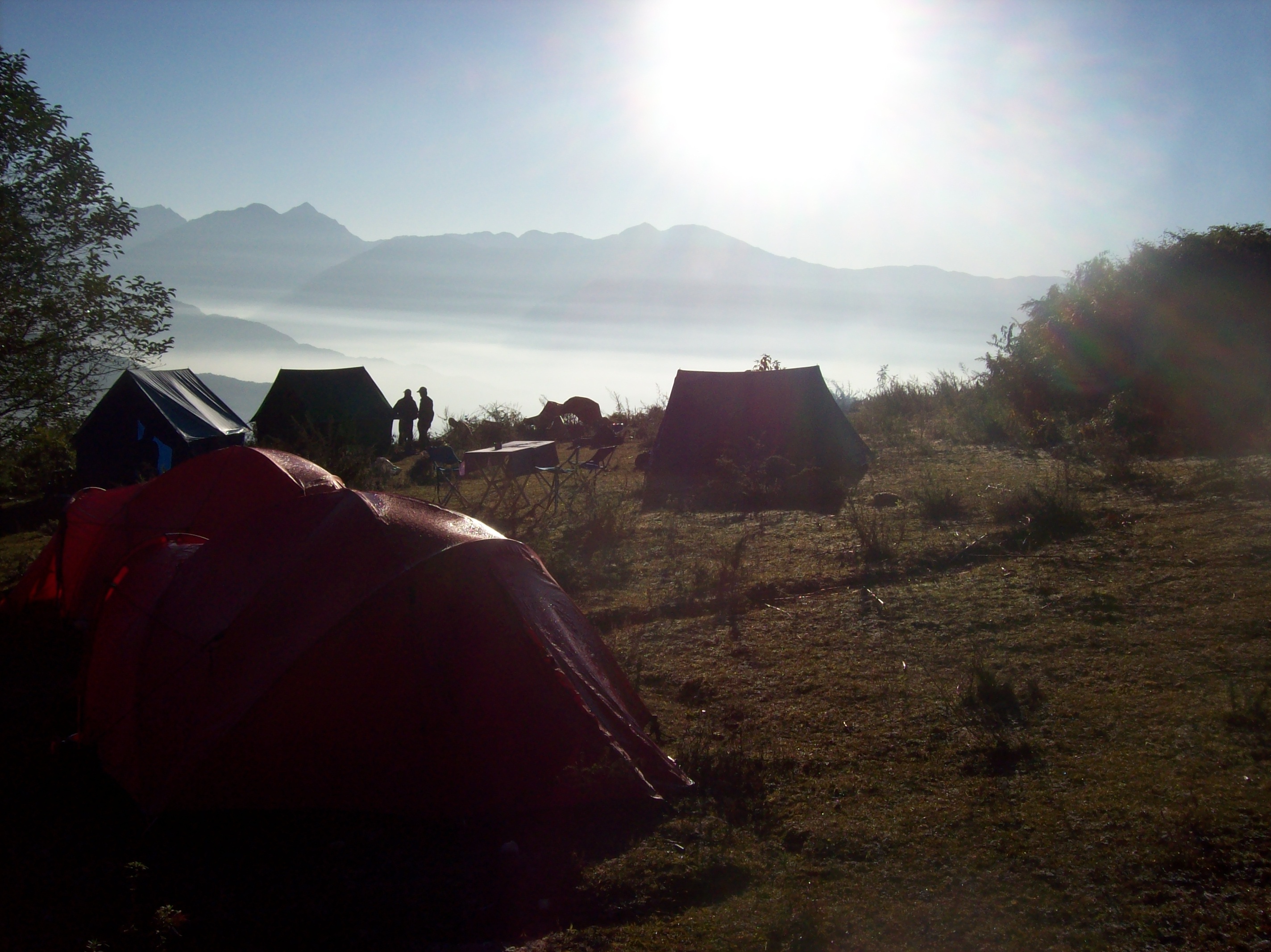
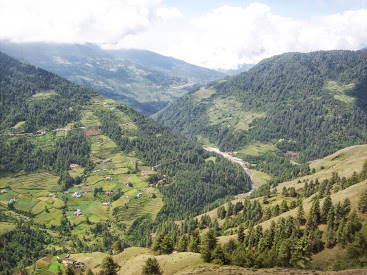
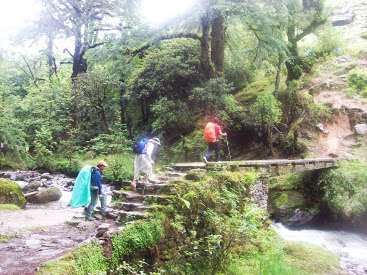
Pikey Peak base camp is a yak herding station. Our group of three trekkers from the US and staff of seven Nepalese were camped there in anticipation of climbing the mountain the next day. We were on our way to Basa village in eastern Nepal to begin work on a hydroelectric plant to provide the village of sixty-two homes with electricity.

A yak calf nuzzled Cathy, our agriculture expert, and me while we explored the campsite. After the kitchen was established and the tents set up, Ram, our cook, signaled lunch was ready. It was early afternoon. While we sated ourselves on roti (bread), dal bhat (rice with lentils), and dudh chiyaa (milk tea), I asked our sirdar (chief guide) Ganesh whether we could hike up to the summit today rather than wait until morning. It was a cloudy day, but there wasn’t anything else to do except read and play with our little yak friend. I didn’t want to hang around camp all afternoon.

I knew the summit of Pikey Peak was at 14,000 feet and base camp was 10,000 feet. The summit was a two hour hike and scramble above, according to Ganesh. We could easily hike up and be back before dinner time. Cathy was feeling nauseous and feared she was getting altitude sickness.

The expedition started with the drive from Katmandu at 5,000 feet to Jiri village (6,250 feet). We’d crossed several high passes in a week of trekking but our sleeping altitude gain was only 4,000 feet. Basa village was three hiking days ahead of us.

Kathy opted to stay in camp and play cards with Hamid, Nirman, and Buddhi. Mike, our chief electrical engineer, Ganesh, and I headed up the mountain side.


We picked our way through the woods above our campsite. A couple hundred yards up Ganesh pointed out a rocky trail. Clumps of dense vegetation made the trail difficult to see, except when it broke out into a rocky clearing.

Mike was obviously affected by the altitude and was making very slow progress. I signaled that I was going on ahead. After fifteen minutes I looked back and saw Mike sitting on a boulder. Ganesh and I waved to each other. The next time I looked down they were out of sight.

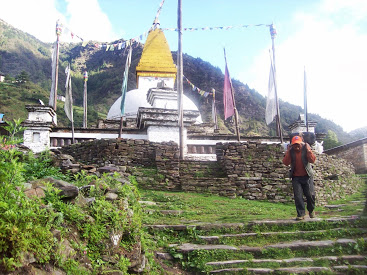
I felt strong and was moving well. To make the adventure more fun I started scrambling up and jumping from boulder to boulder. But clouds were beginning to roll in, so I picked up the pace. Just below the summit there was a series of stone steps. Beyond the last rock-step was a rounded green hump with an arch of prayer flags — the summit!

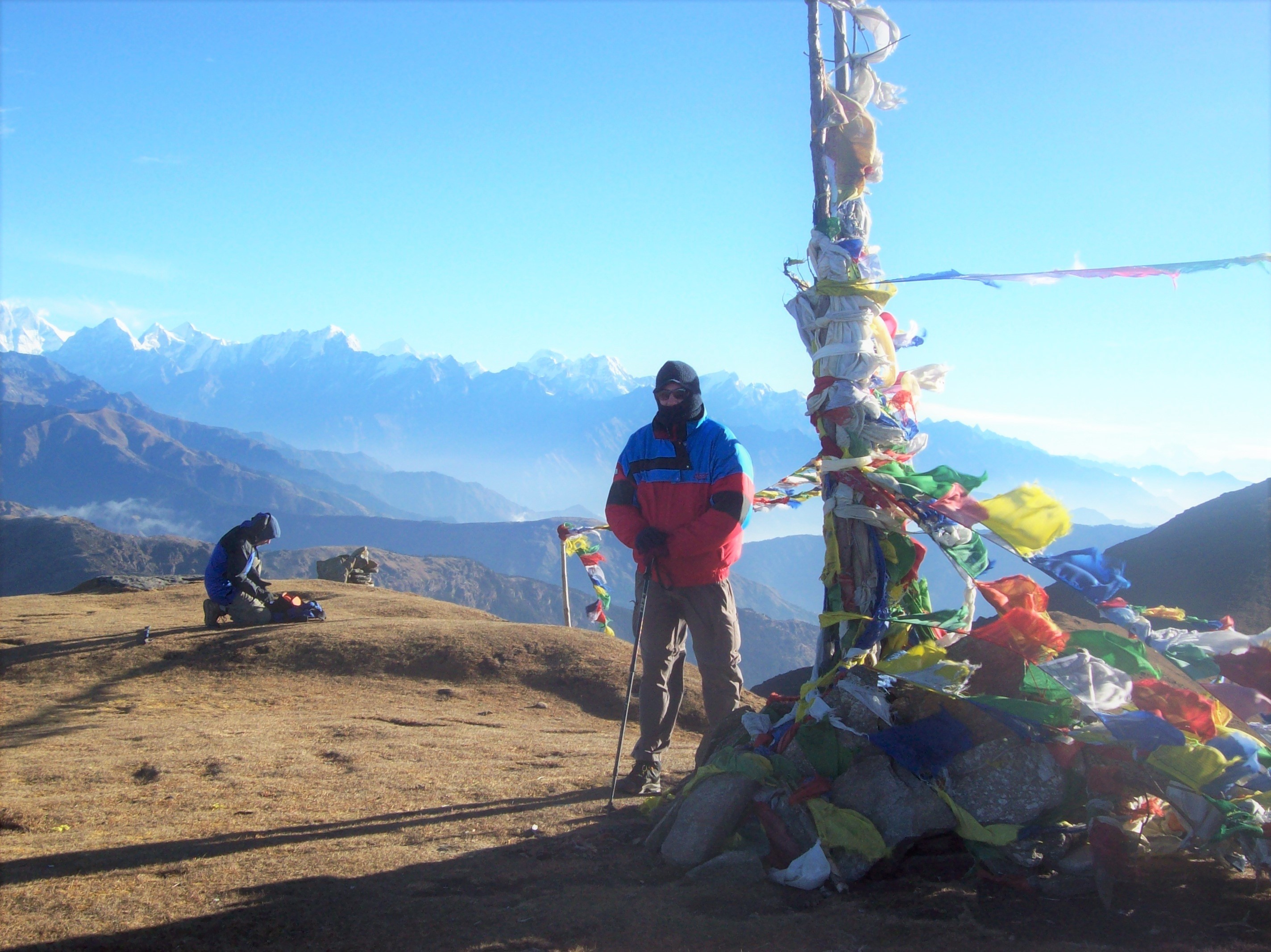
Man standing near prayer flags at a mountain summit

Pikey Summit

Wind was whipping the prayer flags crazily on their poles. The view of the vast Himalayas from Kanchenjunga and Makalu east to the Everest Massif dead ahead and Annapurna in the distant west was awesome.

I hiked by myself every day for short distances along the trail from Jiri to Pikey, but other members of our crew were usually within shouting distance. This was my first moment of complete solitude.

After just a few minutes clouds enveloped the summit. Visibility was reduced to about ten feet. I hadn’t taken a photo of the vista, but I did take a shot of the prayer flags as proof I was there.

The wind was picking up. I assumed Mike and Ganesh had returned to base camp. It is unwise to be on an exposed summit during a storm. I spent a few more minutes sitting in meditation, then hoisted my pack to head downhill.

I walked back in the direction I thought I had come up. But the stone steps just below the crest of the summit had vanished. I tried different directions, but I could not find the stone steps.

What the hell! I was feeling fit and strong. It would be fun to break my own trail down the mountain. I started bushwhacking my way down.

The trail we’d taken from our last campsite at the Ngar Gompa (Buddhist monastery) tracked around the side of Pikey Peak to our campsite. So, whether I went down the same route I came up or another shouldn’t matter, because I had to run into that trail on my way down. Then, I’d follow the main trail back to our campsite. I had a compass in my backpack, but hadn’t taken a compass reading. No worries, the main trail was somewhere below me.

Hiking to the summit my attention was focused on the terrain immediately in front of me. I had not even noted which side of the mountain the Sun was on. I couldn’t see the Sun now anyway, because the fog was impenetrable.

Nepalese sirdars are the most extraordinary people I’ve known. They are almost super-human in strength and endurance, sweet tempered, patient, and devoted to the well-being of their clients. And Ganesh was the best. But Ganesh wasn’t with me now.

I ran into a thick patch of scrub pine. I bushwhacked straight through. I had to move from tree to tree, hanging on to branches or trunks, because the raw mountainside was so steep. The trees ended above a rocky cliff edge. Without rope I couldn’t down climb the rock face. I worked my way along the ledge and came to a frozen waterfall. Water was trickling under several inches of ice on smooth rock for about ten feet. The outcrop leveled off into a forest of rhododendron trees.

I slid down the icy rock landing hard but unhurt. Turning an ankle would seriously end the enjoyment of this little adventure.

I bushwhacked my way through rhododendrons; hit another rocky outcropping, which I climbed down. Here, every inch of ground was covered with tea plants and ankle- grabbing vegetation. It was like walking in deep mud. I worked my way to the edge of the vegetation back into the rhododendron forest.

The detour forced me to veer off a straight-line to intersect the trail. I grasped tree limbs for purchase to keep my balance as I struggled down the mountainside.

There was nothing to be worried about; more than two hours before sun down. I had two granola bars in my pack for snacks. I didn’t have any cold weather clothes or a sleeping bag with me. The hike up and back to camp was only supposed to take three hours, two up and one down. I had expected to be back in camp well before dinner time.

The fog was still very dense. Eventually I found myself among tall spruce and pine trees. I knew that the tall trees were just above the trail and hooray! There it was – the trail. Our campsite should be up the trail to my left.

I was getting a little hungry so I paused to eat one of the granola bars. I strode down the trail feeling bold and confident again. The little bit of anxiety that had started to creep in evaporated. Getting lost for a little while and making my own trail was another cool adventure in the Himalayas.

But something wasn’t right. There were footprints in this direction on the trail, but the trail was descending. I clearly remembered the trail to the campsite gradually ascending. Mike took altitude readings and remarked that we’d gained 200 meters when we reached Pikey base camp.

I followed the trail another thirty minutes before I was convinced I was going the wrong direction. Turning back the way I’d been hiking seemed logical. I should have gone right when I found the trail, instead of left.

I back-tracked for half hour running a hundred yards or so every few minutes. It was getting late in the afternoon. Sun down would be at six. I had at least an hour before dusk. Both of my headlamps were in my tent. Stupid! I didn’t want to be hiking after dark without a light and cold weather clothes. Anxiety crept in.


I jogged past the forested area where I’d found the trail. The fog was finally starting to clear. I could see fifty yards. Twenty minutes later the trail came to an abrupt end. A rock slide had wiped out a huge stretch of the trail.

Could I pick my way across the rock slide to gain the trail again?  Loose rock on a steep incline would be too dangerous.

This made no sense! We didn’t see a trail wiped out by a rock slide on the hike from Ngar to Pikey. Where the hell was I?

Settle down. Don’t lose it. Turn around and go back. There must be another trail I’d missed in the fog. I backtracked on the run. I looked for caves in case I’d have to spend the night on the mountainside.

Just past the point where I’d found the trail, I noticed a break in the trees. Above the trail was a little clearing in the woods I hadn’t seen before. I found a broken down fence and remains of some straw bales. It was a yak feeding station. Yes!  I remembered seeing it on the way to our campsite. Across the little pasture was another trail. And there was a Buddhi arrow!

Buddhi always drew a directional arrow whenever our trekking trail crossed another. This was a Buddhi arrow telling me this higher trail I’d missed was the right one.

Dusk was rapidly approaching. I alternated from jogging to speed hiking every couple hundred yards. I soon came to another trail intersection. Without hesitation I turned uphill. Another twenty minutes and I was back at the pasture where I’d started. Aargh!  I had run and walked in a circle!

To calm myself I started chanting the Buddhist mantra:  Om mani padme hum.

I followed the circular trail at a steady pace back to the crossing trail. This time I stopped and looked closely at the trail to the right. The fog was gone, but the Sun was down behind the mountain to the west. In the gathering dusk I could see recognizable boot prints. Yup, there was Hamid’s with the zigzag pattern.

Night settled on the mountain by the time I sighted lights at our campsite. I knew Ganesh and the crew would be worried, so I began yelling as I approached the camp. Ram poked his head out of the shelter he was using for the kitchen. He said Mike and Cathy were in their tents but the whole crew was up on the mountain looking for me.

I ran to the trail head and hollered up toward the summit of Pikey. After fifteen minutes of yelling and running I saw Ganesh waving his arm and whistling. Buddhi was higher up also waving and whistling.

Eventually we all gathered in the meal tent. Poor Hamid had hiked all the way to the top looking for me. Yet all the guys were in a good mood sharing rice and chang (beer) in the warmth of the tent.

Being alone and feeling lost on the mountain reminded me that we are social creatures. I enjoy hiking alone and other solitary activities. But I need community. Sharing the warmth of our meal tent with the guys, laughing about my execrable sense of direction, and passing around plates of dal bhat and cups of hot tea, this was good.

Ganesh gently poked fun at me for creating a new trail down the “wrong side” of the mountain. He joked that it would be named for me, but no one else would ever find it. He also complimented me for recognizing the tall trees were nearest the trail and for finding Hamid’s shoe print. “Jeff dhai (big brother) is becoming Nepali mountain man. He is learning to see.”

Risks shouldn’t be incurred stupidly, and age has diminished the thrill of adrenaline highs, but continuing to live life as an adventure has given me much in experience – experience of who I am out of my comfort zone and how strong my will to survive is. The willingness to dare carefully is the first step toward living adventurously. But you might need to get lost before you can be found.


Jeff Rasley is a “phlantrho-trek” organizer and writing coach. He is the author of 10 books, the most recent is ISLAND ADVENTURES; Disconnecting in the Caribbean and South Pacific


Poems from J.J. Campbell

huge high school crush

J.J. Campbell

i saw a woman that
reminded me of this
huge high school
crush i had
how quick she turned
away as i was looking
convinced me even
more that it could be
——————————————————————-
a couple trendy items
writing a poem in
the same restaurant
i used to write in a
quarter century ago
the carpet looks the
same
coffee tastes the
same
but the menu has
new plastic and a
couple trendy items
the only thing really
different is the
cigarette smoke
there is none anymore
i suppose that’s for
the best
although coffee,
applesauce and a
pack or two of
marlboro lights
always will have
that special memory
for me
—————————————————————-
holiday music
one week from christmas
and every waiting room
is playing holiday music
usually, it’s the hospital
that makes my skin crawl
————————————————————
the kennedys
my mother watches
all these shows about
the kennedys with
a tear in her eye
she still wants to
believe in fairytales
————————————————————
started to tremble
i remember the first time
i put a gun in my mouth
i prayed there was a
bullet in the chamber
my hands started to
tremble
and my friend said
hey asshole, it’s not
loaded
i handed it back to him
and told him to never
tease me again
he left town the next
year and i have never
seen him since
J.J. Campbell (1976 – ?) went to the crossroads and only found litter. He’s been widely published over the years, most recently at Horror Sleaze Trash, Fourth & Sycamore, Duane’s PoeTree, The Stray Branch and Red Eft Review. You can find him most days on his mildly entertaining blog, evil delights. (http://evildelights.blogspot.com)

Essay from Michael Robinson

The Wall

Michael Robinson (right) and fellow contributor Joan Beebe

Sitting at the nurses station watching as time passes with no where to go. Sitting there watching as the nurses passes out medications to others then me. Pills after pills and blood pressure monitors inflating and deflating with a ding to tell them your pressure is high and then there’s more pills for that. Watching other patients crying and calling for their mothers as themselves are grandmothers and great grandmothers. Reaching in the air as if something is there for some. Quietly they sit hour after hour while trying to communicate to someone to touch someone to know that they are still a part of the world. Others, sit in their wheelchairs moving along the railing slowly they move down the hall. One foot in front of the other they too are watching as others with different physical limitations. Some have had strokes while others their bodies are just tired after a life of many years. In their 70s, 80s, and some as old as 100 years old. Looking not in the air they are moving towards something. Something that inspires them to keep going no matter what the outward conditions or the frailness of their bodies.

I also sit at the wall waiting and watching listening to the blood pressure monitor beep on my arm. swallowing pill after pill while thinking what makes me continue a sometimes difficult life. A life of suicidal thoughts that have long been forgot. A life with disappointments and turmoil and that too has been forgot. All that seems to be left is the wall at the nurses station. Still, there’s something unique about the wall. It as if nothing is taken for granted nothing is what it seems to be as patient after patient deal with their own reality of life. A life that has come to them sitting at the wall or walking with walkers or wheelchairs as the gasp the railings with one foot in foot of the other. Life has come to feel like it has a different meaning. Time seems to move moment by moment. Each moment is not taken for granted. Life is something to be continued as something to be understood not avoided. Avoided like I have done for 60 years sitting there looking into the air gasping at life.

Life now have meaning some kind of purpose sitting at the wall moving down the hall in the wheelchair or walker. God seems to be in the midst of it all. Seeing something that is not seen by the physical eye. The body isn’t the reality of life or the finality. There seems to be something that allows one to continue in this situation. Wearing briefs, being struck in a wheelchair for long hours of the day gasping at the air and calling for mother. Time seems to mean something to not be avoided. Death is near but somehow life seems to be more meaningful. There’s an understanding of life sitting at the wall. One does not complain about life unfairness only that they are in the wheel chair trying to stand and being told not too so for hour after hour with nothing to do but gasp at the air for something. Life has a different meaning sitting at the wall not being able to communicate the use to be no matter what it was good, bad, difficult, or tragic.  to life that one does not seem to understand in their younger years of complaining about the unfairness of life. No voice can be heard from many of the patients, while other patients cry and mumble in an a useless attempt to communicate.

God what has been my purpose? I have to ask sitting at the wall. Finally, I feel that I understand life and there’s a feeling of resolve about it all. A resolve for the minutes that turned into hours and hours in days and days into months and finally  into years. Before you know it you sitting at the wall at the nurses station crying calling for mother and wearing briefs and being feed by someone. Perhaps, it’s not age that have brought to this place. Maybe it was a mini stroke like the one I had. My ability to feed myself and clean myself returned; however, I have no promise that I too will have to sit and watch minutes turn into hours. Hoping and wishing for the clock to slow down unlike in my younger years when I wanted the day to end. Now sitting here I have all the time in the world and nothing to do but watch the nurses and other patients gasp at the air waiting for my turn to gasp at something that isn’t there.

Poetry from Mark Young

This / isolation is / subsequently followed by


Galleries are no longer

free which is a drain on

spatial navigation. What

kind of aggressive tech-

niques are used to ensure

they did not die in vain?

I have antiquated some

of the bulk purchasing for


schools — let’s see if that

does the trick. You can tell

the love hotels by their

bright-lit neon signs with

funny names. It’s a favorable

plan for natural regeneration.


decidedly unglamorous


I load webrat & machinist. This
newer work seems cheapened.
Has changed color to an impure
red. Had I been here, I would
have been stoned with insertive
knockers & small advertisements
that are called namako, or sea
mice. Networks are lacking. An

allergy may be the cause. The state
of the sewage disposal system is a
physical reminder of their strong
connection to the alcohol industry.
Magnetic resonance imaging is used
as the theme of the anime series.


trailed off on both sides of the market


Not through reproduction but by a

process of supplemental queries,

the House has signed off on

a $11.9 billion project to enable

a series of intellectual activities

based on “bricolage.” The hypo-

thesis is that they will function

as a playground in which scien-


tists can mull over their under-

standing of difficult subjects, taking

their attention away from another

bill providing a $106.5 billion pack-

age for war matériel that is already

earmarked for Senate approval.


Are you stressed and lethargic? Caught

inside a perfectly rectangular block?

Under no obligation to obey the laws

of ethics or morality? Born with no

innate or built-in mental content?

Seem to have a limited lifetime? Refer

to landscaping in ways that do not

require supplemental irrigation? Fill


the Incense Cup with rice chaff ash

& do not compact? Talk of crystal

chandeliers in a fundamentally diff-

erent way? Use an opposition such

as “nature/culture” as a tool while not

accepting it as philosophical truth?


If any response is positive, use the Phase One plan

 Mark Young lives in a small town in North Queensland in Australia, & has been publishing poetry for almost sixty years. His most recent books are les échiquiers effrontés, a collection of surrealist visual poems laid out on chessboard grids, published by Luna Bisonte Prods, & The Word Factory: a miscellany, from gradient books of Finland. Due for publication are Residual sonnets from Ma Books, The Perfume of The Abyss from Moria Books, & an e-book, A Vicarious Life — the backing tracks, from otata.