
Same Old, Same Old, or Up the Spiral

Same Old, Same Old, or Up the Spiral
Primavera
By Christopher Bernard
The afternoon lies across the air
like a page of ice,
dazzling and shadowless.
You walk across it,
through it, beneath it,
looking for a crack in the light,
trying, without success, to hide.
The eyes you meet are gray as ashes.
The words you hear disappear like clouds.
A scarf lies abandoned on a curb.
Somewhere there is the sea,
a party’s laughter, and someone is singing,
and summer holds the night in its arms.
But not here, and not now.
You scratch on the ice a forgotten name for spring.
____
Christopher Bernard has published two volumes of poetry: The Rose Shipwreck and Chien Lunatique. He is co-editor of the webzine Caveat Lector.

Interior of Notre-Dame de Paris after the fire of April 15, 2019
A Memory of Notre-Dame
by Christopher Bernard
I had been traveling for many hours from Philadelphia when I was seventeen on my first trip to Paris as part of a package tour for high schoolers I had worked much of the summer the year previous to afford.
It was spring and, despite the exhaustion and excitement after the long journey (my first by plane), when we got to the hotel near the Place Bastille, I decided there was no way I was going to sleep before in some way meeting Paris face to face. So I took my handful of francs and my high-school French, snuck out of the hotel (unknown to our chaperones), scurried down the local Metro stop, and took the first subway to the Île de la Cité.
After arriving at my destination without dropping off despite my first experience of jetlag, I wearily climbed endless levels of exit stairs into the late afternoon. And stood, rooted to the spot, staring almost straight up at the austere towers and the façade known to every schoolchild, and saying over and over to myself for a long, sleep-deprived moment: “Notre-Dame de Paris, Notre-Dame de Paris, this is Notre-Dame de Paris,” before dreamily crossing over to the front steps, and ascending them while taking curious, creak-necked glances up at the tympanum, and then walking gingerly (I wasn’t even sure, as a non-Catholic, I would even be allowed in) through the entrance way – surprisingly small – into the dark, unexpectedly cool interior.
As I entered, the organ burst into music. No services were going on that I could see, and I supposed the organist was rehearsing for Sunday. But it was one of those moments of mystery and magic in one’s life that seem to happen with some frequency in youth, and then less and less often with passing time. My fatigue and caution seemed to fall away. I walked into the cathedral and remember taking a very deep breath, then walked into the music and shadows.
____
Christopher Bernard lives in San Francisco.
The Paradoxical World of R D Laing
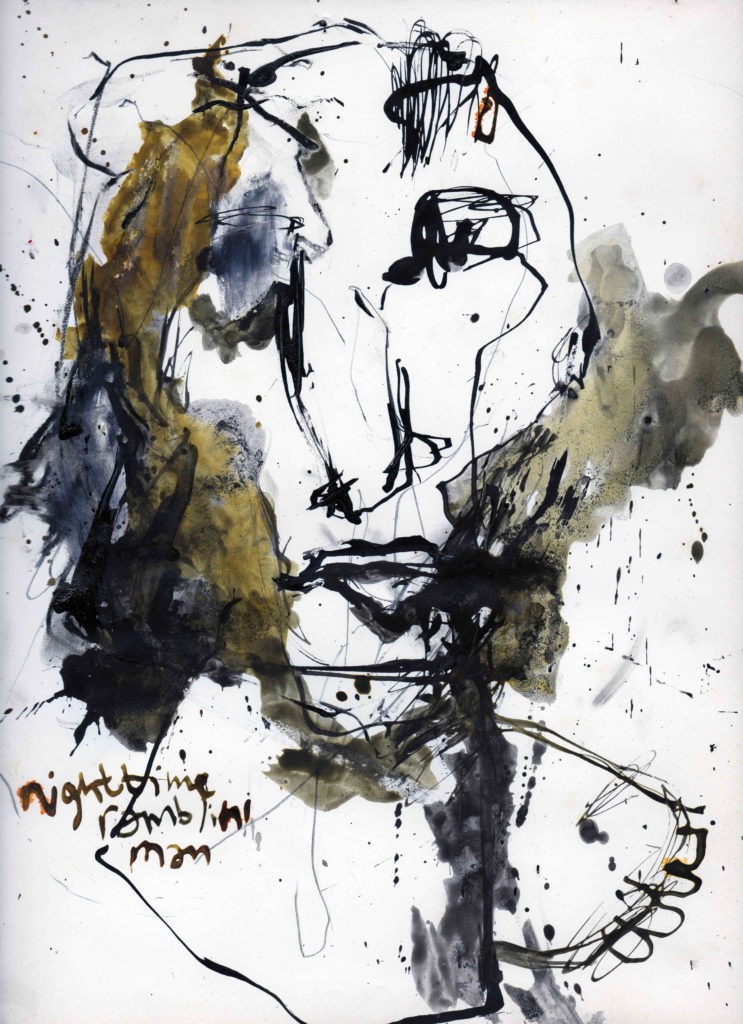
Nighttime Rambling Man by Marcel Herms (Netherlands, marcelherms.nl)
You, who talked of a heart full of ashes and lemon peel, you swept through the world in a flurry of words you pulled apart and reconfigured. You, who wielded an unconventional mind and stole fragments from the universe. Sometimes the journey of your existence looks like one long paradoxical interjection. Your maverick rhetoric was synchronized chaos washed down with a tide of LSD and claims of insight and breaking through. Smoking your way through session after session, you once said that existential psychiatry was just: ‘talkin’ to a bloke and listenin’ to what he says.’* You knew it was never that simple. It’s good to challenge, though and you questioned what is real. You even said that expression of distress was the way to real self-knowledge, that it was the way to change and develop. Yet you left some people more confused than they were before, and I can’t help wondering whether the whole thing was a huge double-bind.
*This is a line from the book ‘Zone of the Interior,’ by Clancy Sigal. Sigal was a good friend of R D Laing, and fictionalised his experiences with Laing in the book.
Henry Bladon is a writer of short fiction and poetry based in Somerset in the UK. He has degrees in psychology and mental health policy and a PhD in literature and creative writing. His work can be seen in Potato Soup Journal, Entropy, Mercurial Stories, thedrabble, Tuck Magazine and Spillwords Press, among other places. His novel, Threeways, was published in 2017 and his recent collection, Donald Trump’s Hair and other stories, published by Alien Buddha Press, came out this year. Henry also runs writing support groups for people with mental health issues.
sleep shatters
my sleep shatters
neath a diamond moon
my eyes sting
in dim bedroom light
white walls like velvet
welcome me home
my embrace
is only warmth
my heart is a vacuum
hoping against dawn,
hoping
at least
for a longer night
cheap nights
the Law & Order theme
reminds me of
blood stained walls,
little flecks
faded orange,
from a dull needle
as I pushed
water through
smoke alarm calling
to disinterested occupants
increasing the panic
and then
hunting a girl
who cut herself
where no one could see,
love
just a mirage
in a personal
desert
hand rolled cigarettes
built
from the tobacco of acrid butts
waiting for the continental breakfast
at a hotel
I couldn’t afford
learning
hunger trumps
shame
the Law & Order theme
the most natural beauty
found
of cheap
nights
in rented
rooms
lady justice
“There is far too much law for those who can afford it and far too little for those who cannot”
Derek Bok
it’s not a crime
to tell a cop to go
fuck himself, not a
crime to film a cop
as he arrests a bum
nor is it a crime
to appear in court
wearing a lip ring
but crimes are betrayals
of the law and nothing
to do with justice.
the law does not care
to have its heart broken
and the jails are full
of proof
the juvenile delinquents
piped in
the people stuck in the system
for 10 years on a 1 year
probation sentence
are proof.
roads are built and police
cruisers are bought with
the fees and fines given
verity by the honor bestowed
to a man with a badge
and the dishonor
we are born with when
we are born
without money.
lady justice,
behind that blindfold
she just weeps.