Carol Smallwood interviews Nancy Smiler Levinson
Interview with Nancy Smiler Levinson

Minnesota born, Nancy Smiler Levinson, after majoring in journalism, worked at newspaper and magazine composition as well as an editing house in New York City; after marriage, she moved to California and had two sons. She has written many books for children and appears in several journals such as: Poetica, Third Wednesday, and Drunk Monkeys. Nancy’s included in Volume 140, Something About the Author: Facts and Pictures About Authors and Illustrators of Books for Young People.
Smallwood: You remarked: “Writing for young readers was the most joyful and challenging work I have ever done.” Please share with readers how your first fiction came about.
After gaining a “track record” with two nonfiction books as part of a series developed by a small publisher, I was able to sell a young adult novel to a New York house. Having written several stories for magazines, I dipped into longer fiction with a story that came from my inner youth, which became “The Ruthie Greene Show.” The book jacket said that the author “offers a humorous, engaging account of how an ingenious young girl learns to star in a supporting role.” I might add that I enjoyed laughing at my teen self. I was fortunate being able to work on several other books (fiction and biographies) with Ruthie’s editor.
Smallwood: Please tell us about your most recent nonfiction book for children.
I can’t call it recent because the book was published before my dozen years of full-time caregiving for my husband, during which time I had to lose my work researching and writing for young readers. Having said that, the last title published is “Rain Forests,” a science easy reader published by Holiday House, beautifully illustrated by Diane Dawson. As easy-readers may look breezy to write, they take a great deal of research and much work at paring down to the essence of the topics, using beginning vocabulary, and super kid-friendly “fun facts.” A struggle, yet with satisfaction and reward in the end.
Smallwood: I smiled when noticing women are subjects in several of your children’s books. What motivated you to select them and do the necessary research? What are some of the steps?
In the 70s, at the cutting age of publishing women’s stories, a small Minnesota publisher began a series on women in varied fields like art, education, science. . . and after communicating with that office, I was offered the opportunity to write about women in business. This would be my first book. Following the format, chapters of five women, I whole heartedly dug into the research (remember there was no internet then). I used my city library, as well as making direct “long distance” phone calls to some of the women or their offices, for further questions and fact checking.
Recognizing the need for a range of businesses and not all on the east coast, I so enjoyed researching both a bevy of women and the wide span. And then, more fun than that, was writing each chapter narrated as a story, creating scenes, rather than taking a straight journalistic path. A banker, a pioneer in the food-packing industry, an advertising agency owner . . . even the creator and producer of Sesame Street, Joan Ganz Cooney.
Smallwood: You give credit to Sheila Bender for “…her encouragement and Writing It Real for helping me….” How did you meet and what was this help?
Sheila and I were in a writers critique in Los Angeles some years ago. Her contributions were always wonderful, and her critiquing insightful. When she moved to Washington state and I began my decade-long poetic memoir I got in touch with her and asked if she would look at a section of my alleged manuscript. Not knowing if it worked at all, I awaited anxiously for her aye or nay. Happily, she gave it a nod and with my new membership in her on-line community, Writing It Real (WIR), she did a super job of advising deletion of the repetitive MS, as well as suggesting the pulling together of chronological divisions. Then she worked at line editing. MOMENTS OF DAWN finally saw the light. I remain ever gratetful to Sheila and her encouraging me to write poetry, which helped me to reinvent myself.
Smallwood: Tell us about being nominated for a Pushcart.
An essay that I wrote, “On Line Dating in the Golden Years,” (yes I did give that a try when I was 75, after my husband’s passing) appeared in an anthology simply called “Getting Old.”
After its publication the editor called and asked if she would have permission to nominate it. First, I was stunned at the nomination, then amazed at learning that a writer needs to give permission. (I don’t know if this is always the case).
Smallwood: Please share what you are working on now and where readers may see your books.
WIR has been most helpful to me with guidance in turning grief into art. So I have been working on such poetry and happily can boast a bit that some has been published in literary journals both in print and on-line. I’ve also moved on to subject matter beyond illness and death and find that I can tap into my wit, which has always rather been there. I continue in this vein, and from time to time find myself also working on essays and short stories.
Since my kid-lit dates far back, most of my books are in libraries. Still in print after three decades are “Clara and the Bookwagon,” and “Snowshoe Thompson,” both easy-to-read historical fiction chapter books published by HarperCollins. “Moments of Dawn”is available on Amazon or directly from me, the author.
Smallwood: Are there sites readers may read more about you?
Website: www.nancyslevinson.com
Carol Smallwood, Marquis Lifetime Achievement Award recipient, is a literary reader, judge, and interviewer.

Poetry from Vernon Frazer
Poem from Phillip MacDonald
Poem from Michael Noel
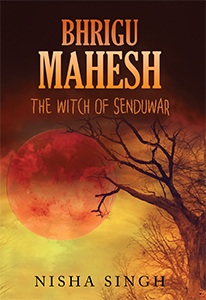
Cristina Deptula reviews Nisha Singh’s Bhrigu Mahesh: The Witch of Senduwar
Bhrigu Mahesh: The Witch of Senduwar left me thinking for months, recalling plot twists and character insights to see if I’d missed anything from Nisha Singh’s brilliant novel. The tale reminded me of Sherlock Holmes’ The Hound of the Baskervilles, not because of any similarities in the storyline, but due to the theme of seeking real-world, logical explanations of mysteries.
The story takes place in Senduwar, a real rural village in northeastern India somewhat near the more famous Varanasi. As I am also a writer and come from a somewhat out-of-the-way place, I was intrigued to see this book pop up right away in search results for the town, as I can imagine putting my own hometown of San Lorenzo, California on the map. The village was described effectively enough to give me, as a person who has never been to India, a feel for the society. Singh conveys coexistence among Hindus and Muslims, varied ways of life and ways of earning a living in the area, and the persistence of traditional attitudes even as some residents embrace modernity.
One of Bhrigu Mahesh’s greatest strengths is how each character’s motivations seem plausible. Some act out of fear, others out of altruism, or snobbishness, or insecurity – but all make sense given their personalities and life experiences. Also, in this book, how characters view each other depends a lot on their own perspectives. We can’t take characters’ descriptions of each other at face value, in most cases not because someone is lying, but just because there are different sides to each story.
Bhrigu’s best friend and partner, Sutte, is a journalist, which I appreciated, as I’ve pursued that line of work myself and enjoy seeing a reporter hero. And his nemesis, along with the criminals he outsmarts, is a bossy elderly aunt from whom he constantly vows to declare his independence. This subplot fills out his character, making him more human, and adds some comedic relief to this work of literary fiction.
The storyline isn’t predictable. I didn’t guess the ending or the identity of the murderer, although it made sense at the end given the person’s actions and words. The story is well-paced, not terribly slow but not hyper-fast as too many suspense novels are, whizzing from one explosion to another. This is appropriate for a story about a detective who relies on contemplating human psychology to solve his cases. And I enjoyed discovering the hidden purposes for some of Bhrigu’s actions later on in the book, such as one instance where we find out what he’d actually observed while seeming to interrogate suspects about certain topics.
The story carries a thoughtful tone throughout the book, sophisticated without consciously seeming so. Dialogue, action and description are all well-balanced, and each character speaks differently in ways that reflect their character. And it was good that Bhrigu Mahesh did not dwell on gruesome details of crimes or present an unrelentingly dark view of human nature. Nisha Singh has kicked off a now three-book series quite well without resorting to the sensational or macabre, and I look forward to seeing her continue.
Nisha Singh’s Bhrigu Mahesh: The Witch of Senduwar can be ordered here from Book Venture Publishing.
Poetry from Steven
Main-à-Dieu
I.
The Maritime epitome
leaks sensational exchanges
between moon magnets at play
Telephones open your eyes
Remember sweet nothings
stumbling shy and evasive on shore
and spraying its stones with cobalt kisses
‘ere tucking it in with the tides
II.
Without having consciously channeled
the Scottish mind for gesticulations
or affable sense of fashion
the hairs on my frame oscillate
in the unitary itch of a synthesis
Clouds shuffle in and shower me
with quaint accents
of Lambert and Connery
Dad’s origami of tape
in the Highlander VHS shell
A kind of magic
III.
Lock on and scoop up
the small islands swimming
like virtual pets in the jittery wilderness
of the ocean
Up the road the wharves exhale
eager to recast their splintered designs
on the ship-mother gut of Mira River
A blessing awaits its suitors
cruising in fresh paint
smoking Cape Islander uniforms
Water on water
recovers the fleet
to out-see the ragged red
floor denizens again
IV.
Old is alive
Small is endurable
Fishermen of a place old and small
are sponge toys under this sky’s
humdrum faucet drip
V.
Sample the pond in the womb of the meadow
Filter the fertile Atlantic stream for its insular
rock jewel
Let the screens show and suggest
that highlander fishermen still live here
Highlander could have been lived here
—–
BIRTH OF AN ALCHEMIST
Teacher there are toothless
piranhas
swimming in my math
I can see the gummy
little jaws scheming
to bogart the breath
of my righteous integers
One can only solemnize so much
the rash double-booking
of funeral and festival
No initiative need
be exhausted
on a self-serving verification
As a man of words
I implore you
to pad your own occupation with your wares
as I plunge a thumb and forefinger
into this obtuse order
of operations and unveil
a morsel of insurgent fusion
for my impressionable stomach
—–
LINGO DROUGHTS
I.
Notify the pillars of the patriation
Apply the secret knock
to your underground interpreter’s door
We are older than before
We have shed the preface training wheels
and are coming for the polish
of your most climactic chapter’s respect
II.
No unveiling revelation cloned itself
in self-assuring day planner pages
nor did debonair winks of rhetoric
attain attention for the eyes
while our secret sign language
seared a path through the brush
sapped of moisture’s ink by youth
infused lingo droughts
III.
We are what an appetite looks like
Invisibility made visible
with the couture of the inevitable
reincarnating as the natty trends
your acronyms cannot keep up with
—-