Cinema Critique: The Revenant by Rui M. Carvalho (28 March 2016)
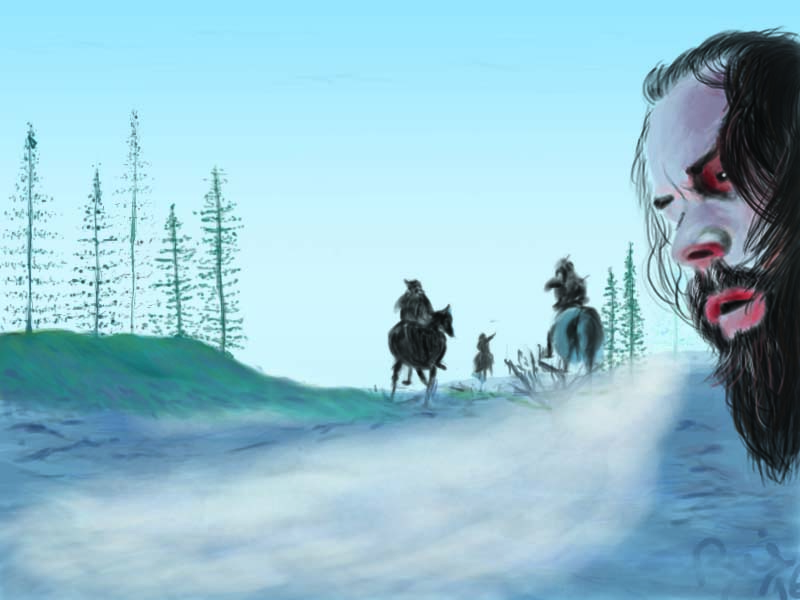
Inspired by true events, The Revenant, a movie directed by Alejandro Iñárritu, is an example of a film whose trailer alone makes us feel it has a significant message to transmit. Visually, it might be considered almost a new genre of western, which we might call the “frozen western.”
The sentence “I’m not afraid to die any more, I done it already” surely creates on us a deep first impression, expressing the idea that there’s no turning back: only a landscape in front, and a shadow behind the speaker. This dramatic first impression is further emphasized by the contrast between ice — dominant, mostly blue and grey — and, sometimes, small dots of fire, mostly yellow and orange. A human tragedy plays out in the course of the movie, in which divers persons confront the meaning of their lives; this being especially obvious during one of the last scenes, in which the aggressor, played by Tom Hardy, speaks with the hero (or surviving victim, if you please), played by Leonardo Dicaprio, and confronts us all with deep questions: What is justice for? What types of justice are there and what are the ones we want? Should justice be a constructive process?
This type of reasoning is an example of what some cinematic theorists consider to be the psychological role of film: as a tool to give new significance to reality, to educate and influence the citizenry. The Guardian asserts that cinema can be valuable for children’s and young peoples’ learning and cultural experience (The Guardian, 28 March 2016). And this can be seen as a detail of a big process of civilization, which “is not linear and conscious” (Cultural Studies Now, 28 March 2016).