Poetry from Emma Bernstein

Chained Woman

By Emma Bernstein

Andromeda,

Flesh spun into stars

Crooked limbs

Stretched like galaxies across blueberry-velvet skies

You tremor above pavement

Cast your frail glow on autumn evenings

Andromeda,

My lonely sacrifice

Appease our gods

With their ice-carved features

Find me absolution for my sins

Andromeda,

My wayward flame

Bound to stone

Bound to constellations

Plush lips bellow mournfully

As I watch from my window

Forgive me,

My darling Andromeda

I have fallen from grace

My wings are dust

White ash drifting listlessly

Through gray fingers

And I fear you are my redemption

Essay from Ayokunle Adeleye

Again on the ASUU Strike. (ASUU: Academic Staff Union of Universities)

There are hints, yes, insinuations, that the President, if ASUU rejects his next (perhaps, last) offer, will forcefully open the Universities- and perhaps Polytechnics, since ASUP is also on strike.

I’m forced to ask (myself), Can that happen? Will he drag the lecturers back to class or will he teach us himself?- I particularly look forward to a lecture on Schistosomiasis since he had a shoeless childhood.

But I answer my own question from my recollection of national events a mere score and two months ago when he let soldiers loose on our streets and shut down our (peaceful) protests against the petroleum product subsidy cut. Can he do that again? Can’t he?

Only the weeks ahead will tell. But if history is anything to go by, we have a President who resorts to force once he feels he’s at the wall. We’ve wondered if his is a pseudo-military regime. We just might get the answer soon enough- disappointingly.

As I pray it wrong the opinion that “the only lesson men learn from history is that men learn nothing from history”, I also pray that our President doesn’t have the Biblical Jonathan’s temper- or feel at wall, hands on throat and choking away. For we know how that ends.

Or do we now? With our colonial masters wondering just what to do with us, corrupt and rather corruption-ridden- and our rather enticing resources. With the former President tactfully silent- and silently tact. With the Military yet waiting on the lord- and renewing their strength.

God help us.

Amen.

Ayokunle Adeleye. Sagamu, Ogun State, Nigeria.

Poetry from Leemond Dollins


A day on the Mat

A pill in my hand

and four on the floor.

The sage stretches forward and down

to release the hips and something

more, something collective and shared with

the group.

A yogi wet dream seems to

slip between the mat and

the breath.

Truth

soothes.

The truth

is the pill;

pills make the pain dawn

upon land soaked in mania.

He takes his place in the hell that designed depression.

Downward dog deletes the ego.

The truth comes to him.

Energy

is the

hope

spring.

Catalyst consists

of potential that

exists as waves of motion.

Change from tradition

is a logical

decision. Downward dog

massages the truth that

circumnavigates the pill.

The four on the floor that

give birth to greater pain

are left there with

disdain. The future

forgotten and the past foreseen

realize that now is the truth

that one’s wish designs.

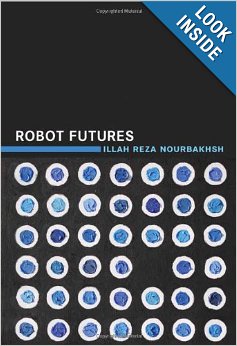
Charlotte Shea reviews Dr. Illah Reza Nourbakhsh’s Robot Futures


I attended a robotics media panel recently and was disheartened when the topics were announced. Three public voices central to communicating the complexities of robotics were about to engage us in an hour-long discussion on the two most contrived topics: drones, and robots taking our jobs. I patiently sat to indulge the predictable concerns, hoping someone might enlighten me with something new.

Just a few days later I read Illah Reza Nourbakhsh book Robot Futures and found what I was looking for. I believe Nourbakhsh would have been similarly unenthused with the topics, though the the contrast of profound contributions would have been refreshing. This situation is symptomatic of the nature of the hazy field, a moment he calls “robot smog.” Perpetually just beyond our reach, the existing technologies don’t offer much else to discuss but the relevant controversies.

His ethical probings consider the challenges and benefits of interacting with robots; the new spaces of augmented reality; and how, someday, our very bodies will be littered with nanobots. He does so from the expert perspective of a Carnegie Melon University engineer, and with great humility.

To inform the world of what is to be expected from robotic innovations over the next few decades, Nourbakhsh sets out to describe the haziness of this “ragged frontier.” The varying innovative paces of the key robot ingredients, from hardware to networks, make predicting what will be deemed a “robot” in the future nearly impossible, though worthwhile. His knowledge of the technologies, juxtaposed with his sci-fi vignettes, offer a glimpse of the future and of the author himself. Nourbakhsh creates a space in which we can begin to grasp our future. He reasons that, though much of the technology now seems superfluous and confined to places humans don’t want to be, we ought to thoughtfully consider their potential.

We have every reason to believe that we will embrace robots and other interactive media the way we have our smartphones. We were born multitaskers, and hang on our friend’s every recommendation for flash card, cloud storage, and babysitter apps. We can’t help but yearn for the kaleidoscope of ways to expedite our daily to-dos. Imagine how the average robot—smarter than the average human—could help and work with you.

Nourbakhsh describes intelligent systems that are already engrained in our society. Adbots—data-mining algorithms for ad-placement—bridge the digital and physical worlds in profound ways. When your regular news source websites start showing you overstock.com products that you were scrolling through the day before do you feel a little twinge? What will these dynamic marketing strategies make of our free will? Aren’t they judging our actions—our search results—to feign knowing us?

This is the unsettling aspect of our future with robots. They will know more than and about us, using their seeming omnipotence to give us superpowers. Our masterful multitasking will only feed the billowing innovation. The human-machine interface will grow exponentially indecipherable, and our roles on the planet will look as foreign as the profession of computer programmer might to a pilgrim. Perhaps every life will become, as Nourbakhsh puts it, the “CEO of Me Incorporated”, in which physical limitations disappear and we are in multiple places at once. Institutions will be similarly enhanced.

The majority of research happening today is government funded, and much of it won’t effect the lives of the American public any day soon. Nourbakhsh himself has devoted his time and talent to developing interactive media to educate the public of technology, thereby effecting their daily lives. He encourages creators to seek altruistic motivations and funding.

What Nourbakhsh manages to emphasize amidst his frank depictions of possible futures, is a vote for humanity’s ability to adapt as we have in the past—an idea often overlooked by popular media and the panel alike. What he sees in this new human-inspired race is an opportunity “to affirm the most non-robotic quality of our world: our humanity.”

Charlotte Shea is a science journalist from the San Francisco Bay Area, and may be reached at aline4shea@gmail.com 

Robot Futures may be purchased here: http://www.amazon.com/Robot-Futures-Illah-Reza-Nourbakhsh/dp/0262018624/

Poetry from Charles Mazzarella

The Mystery of Written Word

From deep slumber does this pen arise
But cause the motion giver to be evermore a blither.
For sleep does at times but whisper my name,
Though I answer not its call.
Important more for me is this:
That the words upon which you now gaze,
Create themselves from brain to ink
And allow my mind, for now, a chance to rest.
Words flow within my head
As waves upon uncharted shores.
Amazed am I at the result
Though the author of them, I am not.
Inspired by God or someone beyond the grave,
I take the credit nonetheless.

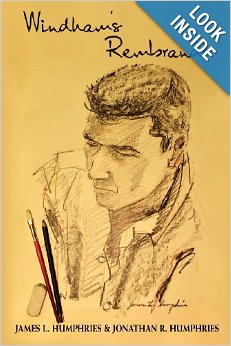
Kimberly Brown on Jonathan Humphries’ Windham’s Rembrandt

Kimberly Brown on Jonathan Humphries’ Windham’s Rembrandt, a memoir of his ex-Marine father’s work as Texas’ first prison art teacher

A noble and peaceful man embarks on an adventure when he decides to take a job in a Texas prison.

James feels privileged to be able to teach art. However, by teaching art in prison, James encounters some of the greatest challenges of his entire life.

James was initially going through problems of his own when he first started working at the prison. But he soon decided that if he was going to provide aid in any way to these prisoners, he had to let go of his own inner demons. He had to deal with everything that caused him to stumble and get into a sober mind to deal with the prisoners regularly.

James, newly divorced and a stone cold alcoholic, put all that behind him, to find God, to serve prisoners, and to find love.
Although reluctant at times about whether or not he would continue to work at the prison, James stuck it out as long as he could. Before he would leave the prison, he would see men so depressed that they would kill themselves. He would be pranked by his art students on many occasions. And he would also stay in touch with a couple of his students from the past. James gave his students, through an art class, an outlet to release and express themselves.

Although what James saw behind those walls at the prison pained him daily, he would return. And he would often be surprised and amazed by his students, some of whom possessed a professional level of talent for drawing and art work. James would grow to love to help his art students in the prison. He even found a tough, threatening inmate student willing to be his own personal ally in times of prison trouble and someone who came to defend him against attacks from other convicts.

James would become more involved and meet more prisoners from different walks of life. Many surprised him because they had what seemed to be normal lives before prison. While others, whom he could hardly bear to see and teach, had committed brutal crimes.

James and his students made history. James was a pioneer in creating that art class in that Texas prison and making it work for he and his students. In life, we all go through our troubles, and James refused to let his personal life get in the way of the compassion that he had for teaching art to his troubled prison students. James carved a path for many of his prisoners, inside and outside of the class. He was a great man who spent over a decade serving them.

Kim Brown lives in East Palo Alto, CA, is a mother and businesswoman who may be reached at kimbrown_kimronice@yahoo.com 


Short story from Irving Greenfield


THE SORROWS OF SANTA

by Irving A Greenfield

With the exception of a white beard, he wore the red uniform of his calling. We shared a small, round table in Starbucks, a short distance from the department store where I was sure he worked. A portly man, with a large square head, and large facial features, he looked as if he were deep in thought or sad, possibly both. If smoking was allowed, I imagined he’d be smoking a curved pipe.

Ordinarily, I keep to myself. I’m an observer, a people watcher, and Starbucks is a wonderful place to do that – – watch people. Perhaps it was the excitement of the season that caused me to say, “How’s it going, Santa?”

He gave me a baleful look, and in a deep voice said, “It’s a good gig.”

From the sound of his voice, I thought that any conversation we might have had was aborted before it could begin. But I was wrong, because after a pause, he said, “I’m not sure I can take it anymore.”

I immediately thought he was responding to an overbearing supervisor. I knew nothing about the world of Santa Clauses, other than that they were supposed to be jolly. But the man sitting opposite me was far from being jolly; he was in fact morose.

I sipped my coffee. The man didn’t seem to be in a conversational mood; and I wasn’t about to intrude on his private time. My attention shifted to a lovely looking young woman, seated diagonally opposite from me. She too, was sipping from a cardboard cup with a plastic top. There were two very large shopping bags close by, on her left side. Despite my age, I enjoyed looking at her. She wore very little makeup, and her cheeks were still rosy from the cold outside.

Young women, especially good-looking young women, possessed a gaiety about themselves that young men of a similar age seemed to lack . . . Had I been years and years younger, I might have been brash enough to introduce myself to her, and let the proverbial chips fall where they will. But now the pleasure was completely voyeuristic, and maybe a little imaginative. Aging changed many things, but not my gender.

“I have to make a decision,” my table companion said abruptly.

My attention switched to him. I waited for him to elaborate. But he was in no hurry to continue; and his reticence gave me the eerie feeling that we were engaged in a conversation, but I knew that wasn’t the case. I sipped more of my coffee, while I waited for him to speak. I was tempted to look at my watch, and count the seconds or minutes before he spoke again. But I didn’t. Instead, I looked at him, and silently began to count. When I reached a hundred and he still hadn’t spoken, I returned my attention to the young woman. She was prettier than he was, with his pockmarked face and doleful expression.

For courtesy’s sake, I made another count after a few minutes, and reached eighty, before he again said, “It was a good gig.” Obviously, he was weighing the financial benefits of his job, against whatever else was on the other side of the scale.

“And my boss doesn’t bother me,” he added a few moments later.

That eliminated one of the possibilities I had previously thought about.

“It’s the kids, the poor ones, whose mom or dad paid five dollars for me to lie to them.” His eyes became watery, and he brushed each one of them with the back of his hand, before taking another sip of his coffee.

Suddenly, I was in deep water, doing a mental doggie paddle. I did know how deep the water really was, or where the shore was.

“Those poor kids want what other kids want. You know what I mean. And there’s no way in hell they’ll get anything but a poor substitute. . . .”

I was a child during the depression years, and my family was poor. Yet somehow, my mother managed to scrape together enough money for me to visit Santa Claus, and asked him for a set of electric trains. But when Christmas morning came, I wound up with a set of wind-up trains, a sad substitute for what I’d envisioned, which was either a set of American Flyer or Lionel. No matter how hard I tried, I couldn’t convince myself that my wind-up trains were better than either of the possibilities I believed I would get. I lost my faith in Saint Nick, and I am sure that betrayal started me on the road to the cynic I became – –

Barging into my thoughts, the man said, “Sometimes I feel like jumping up and yelling, ‘I’m a fraud, the whole thing is a fraud, especially when I get one of the really poor ones.”

I shook my head, “That’s not the way you want to go.”

He didn’t answer. Instead, he looked at his watch and announced it was time for him to leave.

I watched him disappear into the crowds of late afternoon shoppers; then I looked at the table, where the young woman was sitting. She was no longer there. But two young men wearing woolen stocking hats, sat opposite one another. Both had ragged looking backpacks nearby.

Finishing my coffee, I sat at the table awhile longer, thinking about the man dilemma: if he quits, he loses income; if stays, he’d have lost something of himself. Which would be the greater loss to him? I felt my lips tighten. I didn’t like a problem that put me or other people between a hammer and an anvil, the rock and a hard place, which was where he stood. There was nothing I could have said, or done, that would have helped him chose. That he would have to do on his own.

My interest in the man’s problem waned, and I drifted into my people-watching mode. Starbucks was crowded, and the noise level was up. It must have gotten colder outside, because people who now came in, were more bundled up than those who were here earlier. Twilight had already settled on the street. Headlights were on, and the street lamps glowed, their bases resting in pools of yellow light.

I looked at my watch; it was time for me to go home and tell my wife about my day, which was not much different from my other days, except for having met a disenchanted Santa. I disposed of my empty coffee container, and walked to Seventh Avenue, where I was lucky enough not to have to wait for a number twenty downtown bus. The streets we passed were festooned with holiday decorations, and practically all of the passengers were holding the results of their Christmas shopping.

Suddenly I felt tired, a bit weary. Traffic was slow, and became slower when we approached the streets leading to the Holland Tunnel. But as soon as we passed them, we moved quickly, and I was shortly at my apartment door. It opened before I opened it, and there was my wife, Irena. She threw her arms around my neck and fiercely pressed her face to my chest. Ordinarily, not an overly emotional woman, she was sobbing and simultaneously telling me the police were looking for me. I seemed to have become “public enemy number one.”

When I was finally in the apartment, and managed to calm Irina, I learned that I was allegedly responsible for hypnotizing a man, who caused mayhem in Macy’s toy department.

Suddenly, I started to laugh. I laughed so hard tears came to my eyes, and I began to hurt.

“I listened too long,” I managed to sputter and continued to laugh. But then I realized it wasn’t funny; it was sad, and I stopped laughing. He needed a reason, an excuse to do what he wanted to do and I was it.