Poetry from Leila A. Fortier


~Abrasions of Artifice~

and she broke me…

Pried from the refrain of words…the posture of a white page and crystal silence~ Snapped back like a wet towel of reality~ I know not all the reasons for my crying~ Something in the welling of moments left unsung~ Testimonies of the broken, falling silent as stars—settling into dust beneath floorboards~ Our moments are squandered by intrusions of light~ Where the moon hangs paled and reticent against midday sky~ Let someone else swallow eternity, we say…before stepping back blindly into abrasions of artifice~

~Alone with the Formula~

*

It

Is low tide:

Native fishermen

Scatter—seemingly walking

On water~ Simplicity of nature~

Skimming only the surface of that

Meridian between sea and sky~

I am drowning in the high

Tide of a numerical equation; less than zero; a negative

Sum~ There is no breath~ No light within

These depths where nature has

Left me alone with

The form-

ula

*

/ Divide /

*Inspired by Kirk Morgan’s “In Prayer to His Goddess”

I

Have not

Cherished him enough

For that which he understands

Above all others~ This preservation of

Mystery~ Covenant of the sacred~ Guardian

Of the ineffable~ This absolute of necessity~ For

That which hands were never meant to touch and

Those words never meant to be spoken~ Tainted

By breath and defiled by the kiss of mortality

Destined for devastation by crafters

Who would exploit the dream~ Only waking dormant

Nightmares~ Adding insult to injury~ The clutched

Words we drive into the earth…soiling the

Sacred~ Damn these roots that

Have forged this

/ Divide /

Between him and I…interrupting

Ephemera~ Where all things

Transitory have no

Beginning

And no

End

~

~Infinitely Smaller~

Ripples break

The silence somewhere

Between rush and fatigue~

All is swallowed and spewed

By the sea~ Whitewashing the

Arrogance of material being

Stone, glass, porcelain~

Hollowed shells

And bullet

Casings

The

Lone

Rubber

Boot has a

Story~ Polished

In decomposition~ Even

The cigarette butt has meaning

I remember when I used to smoke~

Or when I used to eat meat~ I wonder

How many more things I will release

Kiss goodbye without blinking

In becoming infinitely

Smaller

~No Prison in the Poem~

~

You

Plead for more

Of this beautiful nonsense~

Wrapping yourself in my abstractions~

Like cocoon and chrysalis~ You take it all to

Heart~ Take it personally~ But I cannot be

Imprisoned…even within my own poem~

My silence eludes you~ You

For understanding~ You see…I have tucked

The answers outside my own reach~

Thrown away the invisible

Key~ A mystery

Even unto

Myself

~

Leila A. Fortier

Leila A. Fortier is a poet, artist, and photographer currently residing in Okinawa, Japan while pursuing her BFA in creative writing through Southern New Hampshire University. Her sculpted poetry is often accompanied by her own multi-medium forms of art, photography, and spoken performance. The use of italics in her text forms a symbolic representation of inner dialog while the tilde lends to the fluidity and continuum of her thought processes. Selections of her work have been translated into French, Italian, Spanish, Arabic, and German in a growing effort to foster cultural diversity and understanding through poetry. With over one hundred publishing credits, her work in all its mediums has been featured in a vast array of publications both in print and online. A complete listing of her published works can be found at: www.leilafortier.com

Elizabeth Hughes’ Book Periscope

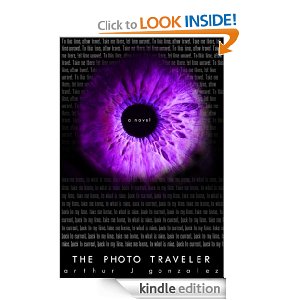
The Photo Traveler is a really good book. I highly recommend it. If you like sci-fi thrillers, then this is a book for you. Even if you don’t, I am sure you will enjoy this book tremendously.
The Photo Traveler starts out with Gavin, who has been adopted by an abusive family. He believes his parents have been killed in a fire. The adoptive father had not always been abusive until his wife was murdered at a store, while she and Gavin were out shopping with their daughter, Mel. After that day, Jet, his adoptive father, blamed Gavin and made him pay by beating him.
Gavin finds out he actually has biological grandparents that are still alive, and sets off to Washington DC to find them. Once there, they tell him that he is a Photo Traveler, and his parents may not indeed be dead. He also finds out that there are people after them for vials that contain a liquid that will allow travel at any time, not just through photos taken in the past. With those vials they could change the world. Gavin goes through many surprising journeys trying to find the truth of his life, and the lives of his grandparents, and to find out how the vials are used to change history and possibly the future.
I very highly recommend The Photo Traveler and cannot wait for the second book to come out. Thanks for the great book, Mr. Gonzalez. The Photo Traveler is definitely my cup of tea!!
The Photo Traveler may be ordered here: http://www.amazon.com/Photo-Traveler-ebook/dp/B00BI4KEQC/
Elizabeth Hughes is a reviewer from San Jose, CA who loves suspense, mystery, action and books of all sorts. She may be reached at hugheselizabeth@rocketmail.com and seeks paid freelance writing opportunities. 

Essay from Ayokunle Adeleye

In Defense of the ASUU STRIKE.

Resolved: ASUU strikes are utterly ineffective, totally uncalled for,
profoundly senseless, and the students are always the only victims.

Defense: It is no news that the Academic Staff Union of Universities
(ASUU) had, for the past three years, embarked on shorter warning
strikes over the non-implementation of its Agreement with the Federal
Goverment (FG) with the general public- and market women- haplessly
looking on and seemingly enjoying the show; after all, silence means
consent. Finally, the perpetual stimulus has reached threshold
potential and the whole nation runs amok over a long-foreseen and
imminent tetanic contraction. Abaa!

Where was the Senate during those calmer, but innoculating, times when
ASUU yelled and none responded. Wasn’t this the same Senate that would
rather cut off our petroleum product subsidy than starve their obese
allowances? Now that ASUU has thrown away its hearing aid we blame her
for a deafness we all share(d), a deafness we stubbornly refused to
acknowledge before now. Did we not know that following prior
innoculation, the (immune) response tended to be faster, stronger and
of longer duration? Did we think all was well with our ailing
varsities and the half-baked, hardly employable, products they churned
out- overcrowded and antiquated ovens that they have become?

Alas! It is now that we realise that the guillotine is not the cure
for the hailing head. The FG can spend N350m to renovate a residence
(of the permanent representative to the UN, we are told) but our
universities can rot for all they care! And ASUU must not go on
industrial action? Then who will?- and what will?

If U don’t want strike then what do U want? Silence? Mona Lisa
attitude: sad and smiling; suffering and smiling? That we Nigerians
have been known for the world over- and for a long time now? Dialogue?
Who, in their right minds, would dialogue with a blind government-
blinded to and by corruption in unthinkable quarters and to
unspeakable depths? Or why would an elected official hide behind
bullet-proof doors if not to hide his/her stench from the malnourished
polity s/he has lived off, an undying parasite that s/he is? And why
would a governor deny his own country, his own people, legal import
duty on the wealth he extracted from us anyway? And now that he
perceives we’re wasteland we must not benefit from his huge purchase-
nor must our professionals be employed on it. Greed. Greed. Greed. And
greed! But the river that forgets its source shall soon dry.

Alas, in Nigeria, your rights are not pre-ordained; you fight till you
are reckoned with. That’s the Nigeria we’ve come to see. (A Nigeria
where 16 trumps 19 in a majority vote. Where Governors enjoying
constitutional immunity cannot meet peacefully without invasive Police
interruption in their lodges. Where ordinary Nigerians cannot assemble
to protest unfavourable FG policies- and inactions on corrupt
purchases- without pervasive military occupation in our streets.)

So, if ASUU hadn’t gone on this strike would the Almighty Bros J- the
other, human, J- meet with them for 13 hours? If U think that’s a Yes,
why then did it take him 4 whole months? Not to be missed is the
fire-brigade approach- typical of Nigeria, alas not only in Sports-: a
lingering, festering, 4-month-old strike was to be called off in the
twinkling of an eye when the Paramount Ruler would not bat his eyelid
for 123 days- just because he has finally said so!

Nigeria we hail thee…

Oh, and to say that all students are the victim(s) of this strike will
be to commit the famous Fallacy of Composition: Alas, not all students
are jobless- and joblessly roaming about the streets- some of us have
actually taken this time-out to try our hands in some business or the
other, learn a trade, or practise our calling and sharpen our skills.
Life is tough, life is a competition; and strikes are just one of
those volcanic eruptions by which the strong and sturdy are separated
from the weak and feeble!

Perhaps another are those election violence we have to be part of
because our (literal) grandfathers still wallow in politics and will
not just dive in and be meals for the fish. They’d rather we wear life
vests- riddled with the holes of their mischief- and dive in to save
their sinking, stinking, political careers. So they can be President
or Governors, and Senators, and Honourables at all cost- human lives
not exempted!

Everything aforesaid is in my opinion, as is this: Anyone older than
the country Nigeria has no business whatsoever ruling in whatever
capacity. We’ve had enough of you; you’ve overstayed your (stolen)
welcome. An actor leaves the stage when the ovation is loudest, to
stay a second longer is for, in the words of the immortal Tai Solarin
which I will undoubtedly jumble up, the housefly to meet the toileting
bushman yet toileting. Ẹ lọ sẹ́mpẹ́. Una don try. Au revoir!

Ayokunle Adeleye. Undergraduate. Ogun State.
adelayok@gmail.com

Poetry from Emma Eisler


Flight and Fall


Give me a ticket to your carnival show

I want to watch you whirl through the big-tent

I’ll sneak in; ride on the wave of ten-dollar perfume and fallen dreams

Perpetual chatter, ersatz happiness

Performers whose illusions lure only the lonely

I’ll wait with you backstage

You’ll whisper in my ear,

That’s the boy who flies the highest, but he’ll fall the fastest

That’s the girl who started out selling pocket candy and possibility”

And which are you?” I’ll ask

You’ll look away and answer, “The girl who loves to dance”

But I already knew that

I’ll look at your arsenic eyes and licorice hair

At your tapping foot that’s itching to be free

Just like the rest of you

You’re the girl who loves to dance

So much she’ll die dancing, frail legs spinning

Hummingbird heart whirring in her final thrill

The lights and colors pull you away, on stage

And you never bothered to ask, “Which are you?”

Too entranced by the circus of your desire

Tunnel vision of all you wish to do

But if you’d asked, I’d answer,

I’m the boy who loves to watch, so much he’d die watching,

Drown in the scent of cotton candy,

Spiraling flight of trapeze artists wishing for wings”

But even if you asked, you wouldn’t hear me anyway

Because for you, love has always been a softer shade

Than longing 

Poetry from Amina Aineb


A Bizarre Way of Walking to a House

How bizarre it was to walk from the Bazaar,

the gypsy night parade to my abode

and the tiptoe of trepidation.

No longer do I know

daisy dew in darling day

so I’ll scream it all in some bizarre way:

A girl, walking, folded into a defensive pounce.

What lurks in these

forests of houses?

She paces herself and tries not to look vulnerable.

Step beat pause sweat. Soon,

her march slain by the meander—

the sharp sidewalk, the dying spotlight glow of streetlights,

the animal in that house’s alley, the tall swinging beings

that carry no torches, rubber meshing with asphalt in tires, on her feet,

spacious air and night humidity licking her shoulders and she

runs

how could she not know

runs

of this spirit world

runs

I’ll die with no requests from my abode.

In the day, I’ll sleep eagerly

And in the day, perhaps you might see me,

the stranger smiling on the street.

Martin Rushmere on Marin Onstage’s production of Ibsen’s Doll’s House

(printed early to catch readers before the show ends)

A Doll’s House

Marin Onstage

Directed by Ron Nash

Little Theatre, St Vincent’s, Marin

Through November 17

Brave Nora? Poor Nora? Selfish Nora?  The strength of Marin Onstage’s production of Ibsen’s A Doll House is that the acting and dramatization are of such quality that they leave the audience free to make up its own mind whether Nora is justified in slamming the door on a marriage plus three children.

The production is so good that the questions Ibsen asked 130 years ago about women’s place in the world and home get beneath the skin and make a modern audience question its own complacency about marriage, the home and personal duty.

 As ever, 75 percent of the success or failure of the production lies with the lead role, and Stephanie Foster’s wonderful performance ensures the success. Her girlish twitter completes the impression of a naïve “little lark” concerned only with frivolous spending and making her husband happy. As Krogstad’s blackmail net draws closer the twitter is heard less often and becomes more forced. Director Ron Nash brings out the particular power of Foster in the frenzied tarantella dance rehearsal, timing the long pause at the end exactly to bring out the sense of impending doom that awaits Nora.  

But Foster could still show more steely resolve in the showdown with Torvald to prove that the “little lark” has flown away for ever.

Gabriel Ross as Torvald in fact is the more powerful in the final scene, particularly in forbidding his wife from having any future contact with the children and stopping her from reading Krogstad’s letter, even though it is addressed to her. The success of his own performance is ensured in the declaration “I would gladly work night and day for you, Nora–bear sorrow and want for your sake. But no man would sacrifice his honor for the one he loves” – shocking and thought-provoking at the same time.

Her retort restores the balance of power. “It is a thing hundreds of thousands of women have done.”

 Jim McFadden brings out a fine measure of whining, crushed resentment against the world as Krogstad, making the observer reluctantly feel some compassion. But a greater sense of menace is needed to show he will destroy her husband if Nora does not meet his demands.

Bill McClave dons a competent persona as Dr. Rank, the family friend secretly in love with Nora. Their own denouement falls short of convincing however, almost as though McClave is not fully concentrating on delivering his admission – which sets the pace for the whole scene — with the right mix of emotions.

Kelsey Sloan as Mrs. Linde works up power and moves into her character as the scenes unfold. Her first scene elicits an “uh, oh, is she up to the part?” but she gains confidence and shades Krogstad in their big encounter.

Regardless of performance, Ibsen almost always brings out the bleakest aspects of humans. The comments on religion and suicide make us despair of our whole existence.

Ron Nash’s production proves that local companies (with the exception of a certain Marin group) do have the ability to stage the classics,which should not be the preserve of big city groups only.

A personal plea to directors and producers the world over. Why, ohhh why, are the slam of the door and the letter in the mailbox,   the enduring symbols of A Doll House, so often portrayed OFF STAGE? Just putting the mailbox on stage ratchets up the tension – and gives Nora a greater range of opportunities to show her state of mind.

Martin Rushmere is a writer and journalist from Sausalito, California and may be reached at martinzim@earthlink.net


Synchronized Chaos November 2013 – Mapping the Inner and Outer Cosmos


“You are not obliged to finish the task; neither are you free to neglect it.”  –  Pirkei Avot 2:21

Welcome to November’s issue of Synchronized Chaos Magazine.

Many cultures view the last few days of October and beginning of November as a special time to remember and honor those who have passed on, to reconnect with history and heritage. We wish a happy Day of the Dead, Samhain, Diwali, and Halloween to those who celebrate.

We also mention some insightful, courageous writing from longtime contributor Jaylan Salah, from Alexandria, Egypt. She recently had a piece published in the Elephant Journal about the freedom in being authentic: http://www.elephantjournal.com/2013/10/nakedly-naked-jaylan-salah/ and another on poverty and sexism within modern Egyptian culture: http://guardianlv.com/2013/10/egypt-the-country-you-know-nothing-about/ Please feel free to take a look at these short pieces.

This month we voyage out into the vast expanse of the universe, looking to culture, history, science and geopolitics for insight.

Charlotte (Capaldo) Shea reviews Robot Futures, Dr. Illah Reza Nourbakhsh’s book on the scientific promise of robotics research. Rather than repeat skepticism and fears about ‘robots taking our jobs,’ Nourbakhsh takes a more optimistic and curious tack, exploring various technical possibilities and holding out faith in humanity’s ability to adapt.

Regular neuroscience columnist Leena Prasad reviews Dr. Eric Chulder’s Neuroscience Haiku, a collection of thoughts on brain science expressed in the traditional Japanese poetic form by the University of Washington researcher. Dr. Chulder communicates modern findings through a form of expression that goes back centuries, engaging us as we learn about the frontiers of research.

Leemond Dollins’ poem, “A Day on the Mat,” where a speaker combats depression through yoga and medication, plays with form, varying line lengths according to a Fibonacci sequence pattern often seen in nature, such as within the structures of pine cones, seashells, and leaf and flower petals.

Nigerian medical student and essayist Ayokunle Ayk Adeleye discusses the university staff strike in his home country and warns his government against violent solutions. His piece provides a view of current affairs from a local citizen’s perspective.

Also, and sometimes at the same time that we look outward, we peer within, to our minds, hearts, and desires. These submissions express our wishes for transcendence, our longings to go beyond our own lives and circumstances and connect with something larger than ourselves.

Sages and philosophers have admonished us for ages that if we want to unveil beauty, solve the mysteries of existence, or teach others about living a meaningful life, we must first confront our own issues. While that makes sense, it is difficult to figure out how to deal with ourselves – prompting another maxim, that the problems facing our age may not be solvable by the minds that created them.

However, we need to start somewhere – we may be imperfect when it comes to understanding and moral strength, but sometimes we are all we’ve got! Even when we turn to faith, there is still some element of human responsibility in terms of understanding and living out the values of our spiritual traditions. The mere fact that something is difficult, or even impossible in its entirety for us as mortal creatures does not necessarily excuse us from the duty to attempt it. And this month’s contributors, when their thoughts turn inward, make attempts at honest reflection and self-analysis.

Charles Mazzarella celebrates the creative journey in his piece on the writing process, going beyond his own work to discuss the art in general and setting a tone for this issue.

Sophie Mazoschek highlights the brevity and fragility of each of our moments, and each of our lives, in her imaginative rendering of a San Francisco bus ride. Her vignette extends the life of a small slice of time. Jack Savage graces us with another dream image, reaching into his subconscious to create an interesting striped animal.

Kamila Boegedal expresses her speaker’s desire to touch the cosmos, to expand her circle of thought and concern beyond her own daily matters. She longs for the freedom to reach up to the heavens and to share the relative permanence of trees.  She yearns to expand, to connect to something larger outside herself.

Sue Barnard chronicles literal journeys in this issue, to the less-frequented Roman ruins of Ostia and to a Swiss independence day celebration. Yet these travels represent something more than just a personal diary, reminding us why we go to visit historical places. Apart from intellectual curiosity, we are acknowledging that we are part of something larger, that humanity existed before us and will continue after our passing. We are not so unique as to have never faced many of the vagaries of human life and nature before, yet we are important enough to play some part in leaving a legacy for future generations.

Emma Bernstein also looks to mythology in her poem Chained Woman, evoking images of the stars and the cosmos, as well as classical Greek tales, in her piece on the constellation Andromeda. Science here is a modern day myth, re-infused with the idea of sacrifice and redemption.

Bill Vernon provides an earthy, humorous look at one man’s dedication to Latin translation, choosing the elevation of the mind over the needs of the body.

James Humphries, Texas’ first prison fine arts teacher, as described by his son Jonathan in the memoir Windham’s Rembrandt, and reviewed here by Kimberly Brown, had to deal with his own issues before being able to serve others. This became a practical necessity as well as a psychological platitude, since he realized he was also vulnerable to some of the same life issues and temptations facing his students. Mr. Humphries develops empathy for the inmates as he encounters his own problems, and becomes able to teach them without either judging them as human beings or coming from a superior position to pity them as poor victims. The book honors the humanity of its characters – in and out of prison – without ignoring or excusing negative actions on their part, by illustrating their capacity for reflection, growth and change in the face of internal and external obstacles.

David Toussaint’s book DJ: The Dog Who Rescued Me, also deals with self-examination, with a protagonist who finds his way out of depression. Reviewed here by Elizabeth Hughes, and illustrated by Piero Ribelli, the book shows a narrator who avoids the pitfall of self-absorption even as he tackles his own personal issues by staying connected to the larger world through caring for a rescue dog. Dealing with ourselves doesn’t have to mean neglecting our responsibilities to each other, or completely isolating ourselves from others’ needs, and can be a mutually enriching process.

Hughes also reviews Paul deBlassie’s The Unholy, a novel using the paranormal genre not as an escape but as a way to explore the spiritual, the psychological, the world beyond what we can see. DeBlassie aims to promote values of life, healing, nature and nurturing through his work, as opposed to greed and lust for control, and the horror aspect of the book highlights the real harm caused by selfishness and ignorance, and shows the need for and power of the beauty and grace within the story.

Daniel Jacobs’ The Eyes of Abel, as reviewed here by Fran Lewis, shows a journalist learning to confront and tackle his unconscious political biases, and those of the rest of his media organization. Charlin is well-meaning, brave, and determined to expose the truth, but must first make sure he understands the complete picture. The novel suggests that peace in the Middle East may become possible when we hear the perspectives of all involved and grapple with the deeper economic roots of the conflict.

Irving Greenfield also addresses inner reflection in his melancholy short story, “Sorrows of Santa.” The piece suggests there is a price to pay for losing the illusions that have become ingrained in and possibly necessary to our society. How much would fall apart if things got examined, if we faced reality? Do we need to live a lie? Conversely, how could we find and provide hope while telling the truth to ourselves and our children?

Greenfield’s next tale, “Toward a Darkling Plain,” shows the pain that can come from facing reality, as a lonely man’s adult worries resemble his childhood terrors. As James Humphries dramatizes in Windham’s Rembrandt, we are only so strong, whether in the face of inner weaknesses or external threats. That is part of why we turn to myths, heritage, faith and the larger world for transcendence – not just for personal strength, but for the reassurance that life will continue after we are gone, that something will outlast us even when we lose our own battles.

Please enjoy this month’s issue of Synchronized Chaos Magazine, and please feel free to leave comments for our writers and artists!