Poetry from Akhlima Ankhi

Young Central Asian woman with a peach headscarf with decorative jewels and a pink top standing outside in front of trees.
Akhlina Ankhi

Encumbrance of Beings
 
Being hot the Earth is melting like a Candle;
Again being ice somewhere!
Nature is restless by unwise deeds
So, humans how will you be tranquil ! 

Man, Be careful.
Today, your show-off civilization is disconsolate.
Europe is almost naked by heat wave.
Often  and often America stays in cold ICU.
In Asia flood fest is going on
Reasonless diving and swimming here and there.
Embracing drought and hunger Africa is on palpitation.
Amazon or Australia is on wild fire. 
Please, tell me.
Whose fault?

What do you feel?
Laments of the rotten heart of Earth
Throbbing like a raped girl.
Carrying the punishment of this sin in your mind and brain;
Pulmo with hundred prick marks 
Sobbing with intense fever–
Because of humans fault.
Yeah, only because of the sin of humans fault.

Being a child of this world how do I forget the sins of Agnate. 
Taking all of responsibilities on my shoulder, to live and to save from the curse of innocent Earth.
Singing hymn for the healthy World.   

Aklima Ankhi, poet, storyteller and translator from Cox'sbazar, Bangladesh. Born in Mymensingh, Bangladesh. She has a published poetry named "Guptokothar Shobdochabi" written in Bangla.She is a post graduate in English Literature. As a profession she is a Lecturer in English.           

Poetry from J.D. Nelson

dried-up sunflowers
in front of the house next door—
last week of summer


—


early autumn dusk—
the dog turns his head towards
the honks of the geese


—


the trees at the park
beneath Jupiter & stars—
a cool, moonless night


—


bio/graf

J. D. Nelson is the author of ten print chapbooks and e-books of poetry, including *Cinderella City* (The Red Ceilings Press, 2012). His first full-length collection is *in ghostly onehead* (Post-Asemic Press, 2022). Visit his website, MadVerse.com, for more information and links to his published work. Nelson lives in Colorado, USA.

Essay from Muhammad Ehsan

Empathy: The Last Refuge of Human Suffering

ehsankgp@hotmail.com

In a world where divisions and disputes often characterize our interactions, empathy is one of humanity’s most fundamental and defining characteristics. It is a massive force, a sort of refuge, that crosses boundaries and provides comfort to people in need. Empathy or the ability to understand and share the emotions and feelings of others, is undeniably important in easing human suffering, making it not only an appealing but also a deeply essential topic for discussion.

Empathy is a universal language that transcends beyond linguistic, cultural, and geographical barriers. It acts as a link between people, enabling us to see how our common human experiences tie us all together. It is the thread that runs through the fabric of our shared existence.

At its core, it brings comfort during times of personal disturbance and suffering. When we feel understood and supported by others, our suffering becomes more manageable. It’s the soothing knowing that we are not alone in our troubles, a reminder that our pain is a part of the human experience shared by many others.

Empathy is a bridge builder, uniting people who would otherwise be isolated. It promotes connection, building relationships of understanding and compassion. We can reach across racial, religious, and ideological barriers with empathy, finding common ground even in the most difficult of circumstances. It serves as a reminder that we are all human beings with our own worries, goals, and dreams.

In the face of trauma and unfortunate circumstances, empathy is critical to the healing process. It gives survivors the affirmation and support they need to process their experiences and move ahead. Therapists and counselors acknowledge the transforming potential of empathy and use it as an integral component of recovery, providing a safe space for people to address their pain.

However, empathy is not a passive force; it has the potential to generate substantial change. We are driven to act when we empathize with the suffering of others. It motivates us to give our time, donate to humanitarian causes, and fight for policy reforms that reduce human suffering on a greater scale. It is a positive change catalyst, motivating us to make the world a better place.

Empathy serves as a reminder of our shared humanity. It reinforces the idea that, at our core, we are all vulnerable imperfect humans going through the complex landscape of existence in a world that frequently highlights differences. Recognizing our common vulnerability fosters empathy, compassion, and a shared commitment to alleviating suffering.

Finally, empathy is the last refuge of human suffering. It is a guiding light for us as we face challenges in life, providing a means to connect, heal, and make the world a better place. It is the ultimate refuge for human suffering, reminding us that even in the face of hardship, we have the ability to inspire and encourage one another. Let us celebrate empathy as the power that brings us together and allows us to rise beyond our collective difficulties.

Bio of Muhammad Ehsan

Muhammad Ehsan, a dedicated Pakistani educator and researcher, wields a profound influence in education and empathy. With extensive teaching experience in secondary education and a research-focused mindset, he molds young minds and contributes as Freelance Venue Staff at the British Council, excelling as a Fiverr content writer. 

Currently pursuing a Ph.D. in Education at the International Islamic University Islamabad, Ehsan's research delves into the integration of microcredentials into degree programs in Pakistan, building upon his M. Phil research exploring the impact of teacher's classroom behavior on students' learning at the secondary school level. His scholarly achievements shine through six published research papers in reputable journals. 

Additionally, Ehsan's international exposure includes participation in the prestigious Teaching Excellence and Achievement (TEA) program at Virginia Tech, as well as completing an Online Certificate in Advanced Writing from the University of California, Irvine. He has expanded his knowledge through various online courses in higher education and governance, financial education, marketing, and AI tool utilization. 

Beyond academia, Ehsan serves as a co-founder of the Pakistani American Teachers of English Network (PATEN) and holds the position of Director of Outreach and Accessibility in PATEN, where he fosters collaboration and mentorship among educators and professionals, underlining his unwavering commitment to fostering positive change in education and society.


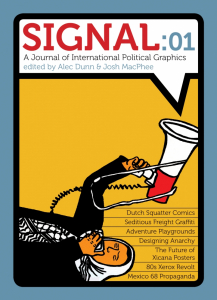
A. Iwasa reviews Signal: 01 A Journal of International Political Graphics, edited by Alec Dunn and Josh MacPhee

Signal: 01 A Journal of International Political Graphics

Reviewed by A. Iwasa

The first issue of Signal starts with the words, “SIGNAL is an idea in formation. “It is a response to the myopia of the contemporary political culture in the United States, our blindness to most things beyond our national boundaries, and our lack of historical memory.”

When Signal first landed on my radar, I assumed the editors were just going to phone it in with a well curated, coffee table style art book full of sexy Leftist propaganda images like those from the Spanish Civil War. That written, I was still amped about it but I couldn’t have been more wrong. Since its inception, Signal has been an examination of how the arts play a prominent role in enforcing the status quo, though also serving a similar role as part of social change movements attempting to undermine the way things are. It’s exactly the sort of material I was practically dying for in 1999 as I pivoted the focus of my creative work from making music and writing lyrics to do doing ‘zines.

I’ve found a great deal of the material printed on questions about the role of the arts in social change movements to be lacking for the most part. But folks with Signal hit the ground running, by framing some of these questions in larger contexts, such as in this issue by interviewing a Xicana print making project’s three members, the Taller Tupac Amaru collective, interspersing their artwork with photographs.

“I think about it in terms of evaluation. I’ve been asking, ‘Is my work really making an impact?’ And then I’ve been taking a couple of steps back and wondering if I’m even asking the right questions,” said Melanie Cervantes, a member of the Taller Tupac Amaru collective as their conversation moved from arts education, work under capitalism, social movements both mass and highly localized, and much more.

This was followed by an interview with a long time Dutch punk vocalist and comic artist, Johannes van de Weert.

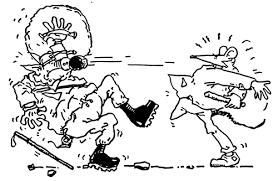
Black and white pencil drawn cartoon image of a mouse slapping and nearly knocking over a pig.
Art from Johannes van der Weert

Afterwards is a photo essay of freight train graffiti, something I’ve long enjoyed as the merger of two of my favorite things. It’s all art by IMPEACH from the crew ALB, that took its name from the Communist Party’s Abraham Lincoln Brigade who fought the fascists in Spain during their civil war. This is actually the second time the Spanish Civil War has come up in the text: Johannes van de Weert did a comic called No Pasaran about Dutch anti-Fascist volunteers who fought in the war.

The following interview adds to Signal’s internationalism, but also even further depth by bringing in a veteran of the 1968 Mexican Student Movement, Felipe Hernandez Moreno, a printmaker who had been involved with Grupo 65. The interview is heavy for a number of reasons, but I think perhaps most important are his descriptions of Grupo 65’s organizational forms as they produced posters that were illegal, and put themselves at tremendous risk posting and distributing them, themselves. It’s not hard to imagine a future US where this sort of information will be invaluable. Here I can’t emphasize enough, all of the interviews and articles are interspersed with top notch visual art and/or photographs. It’s sharply laid out and engaging.

Next is an essay about adventure playgrounds, child built playgrounds that emerged in Copenhagen during the German occupation of World War II, with the Emdrup playground started by the Copenhagen Workers’ Co-operative Housing Association. The essay compares and contrasts how children relate to the formal settings of conventional playgrounds vs. the DIY aspects of adventure playgrounds.

This issue closes with an interview with the primary cover artist of Anarchy: A Journal of Anarchist Ideas, Rufus Segar. The journal went from 1961-’70, so as you can imagine, Segar has some good stories about working in the era’s art industry, volunteering for the journal on the side, printing, and the creative process in general.

When PM Press sent me the complete run of Signal, I originally thought I’d review #8 standing alone since it was new, and try to do an overarching deep dive about the first seven. But these journals are too good and need individual attention.

They can be ordered here from PM Press.


Poetry from Kendall Snipper

Mold Internal

The ultimate image of self-doubt:

The glass separating me and my reflection

Is shrinking my skull ever-so-slightly

Removing the inversion from my retina-like delusion

My pupils widen as they do not recognize

The molding sponge in the mirror


I pulled off my skin in the mock and ate it

Underneath were wrinkles shaped like varicose veins.

The mirror shattered as I bit it with crooked teeth

My stomach acid rose, beginning to digest 

A parasite in the glass shards


I felt decomposing skin flakes floating through my intestines,

They repopulated in my body becoming

An umbilical cord, pulsating in my uterus

Watching my stomach grow in disgust

As Aconite bloomed in my carbons.

throwing myself down the skyline, belly first. 

Eukaryotic cells bled from my body like defeat

Scorching the pavement with toiled stems

The Aconite pieced itself together 

Atop my coked body, with bruised and torn buds.


Poetry from Filip Zubatov

A Moment of Hesitation Named Warmth


A moment of hesitation named warmth;

I found myself in this cradling cocoon

The night before’s promise bounces around my head,

“Wake up at 7:00”

I watched the hands on the clock 

Tiptoe past the hour

I lay netted in my bed

Good intentions for myself

They slip through the strainer of wakefulness

like grains of sand

I didn’t wake up at that time.

Could’ve.

Should’ve.

Didn’t.

A moment of hesitation named warmth;

The cocoa sits in the depths of my stomach

“Don’t drink it. I drank it.”

The cup poured like an hourglass

Ticking into my body

I was aware

But I guess I didn’t care.

Like silk threads

Wants weave through my mind.

More sleep, more cocoa, more problems

But my judgment is clouded

Self-doubt continues to rise

And planes rise through those clouds 

Casting shadows over my resolve

I doubt I’ll ever make the sacrifice

Do what’s best for me

I’m unreliable

I guess I don’t want change enough.

Poetry from Gabriel Flores Benard

When you read this,
I will be no more than a memory,
a whisper in the wind,
an abstract perspective
held in the palm of your hand.

I am nothing
but what you make of me,
an image born
from neuron synapses:
brain birthed from brain, 
mind melded with mine.
I shed individuality
in the arms that caress
my words, thoughts, prayers.

When you read this,
I will be gone;
In your eyes, I begin anew,
an idea anchored by
ink and page.