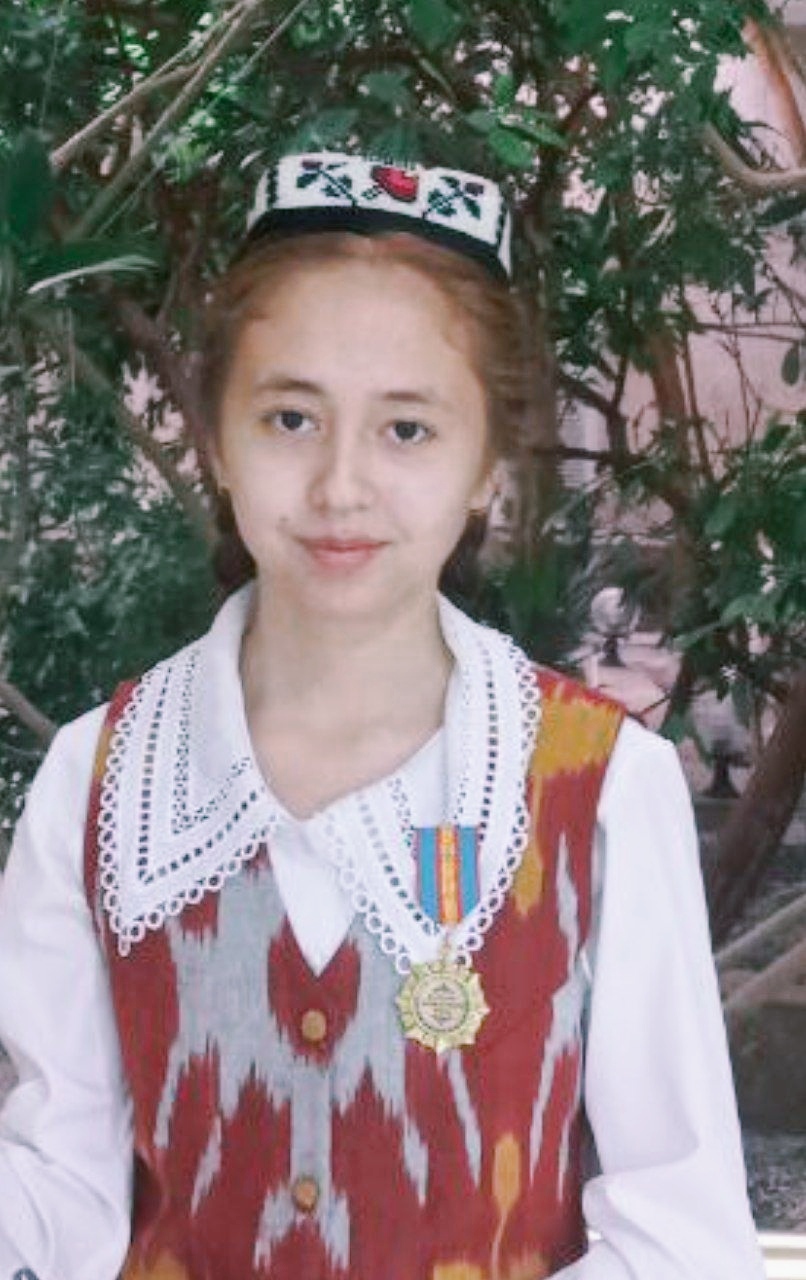
Poetry from Davronbekova Sevinch

Central Asian teen girl with straight black hair behind her head. She's in a white collared shirt and a black vest.

            Broken trust

When we trust with a pure heart, 
They always find a way to break it. 
Maybe my heart is a piece of art, 
So sometimes I try to fake it. 

Trust is something fragile, 
Never touch it, please! 
Do not be with it agile, 
You can hold it a squeeze. 

My trust is not for sale, 
No money is able to buy
Something that has been broken inside, 
It is priceless compared to your lies. 

Hundreds of years are not enough
To earn a broken trust once more. 
It could be obviously tough
To treat a person to the core. 

It takes a second to lose
All the trust you have earned before, 
Even tons of excuses
Can't take back it anymore.
 
                   ✍️Davronbekova Sevinch


I was born on September 13, 2006 in the city of Urgench Khorezm region. Currently, I am a student of the 11th grade of the 18th school. I have been attending the bead decoration at the Barkamol Avlod children's school for 3 years. In this direction, I have been taking pride of place in regional and international competitions. Every week I will be a guest on Khorezm television. I have many more dreams in the future.

Poetry from John Sweet

and we all know whose fault it was


ask her if she fools around, if you
can get her number, and
she laughs, and you ask if she has any x,
if she has a friend who puts out and
get it where you can, right? and it sure as shit
wasn’t creeley who told me that,
wasn’t cirino or eliot, cuz all the fucking 
poets ever did was lie

all that asshole tony ever did was 
keep the acid for himself, and it was your father
who taught you how to pull the trigger,
sure,
but he would never let you
take the blindfold off

would never tell you who you’d hit

and he had that guitar autographed
by pettibon, had that girlfriend your mother
never found out about, and did you
cry when he died?

did you go through his pockets 
of his sunday jeans
looking for cash or a credit card?

and i remember you kept telling me he
owed you something, but you were
always a pussy, always thought you were
missing out

always thought the future was
just around the corner

said you wanted to be ready for the
moment that would change everything,
but the moment had already 
come and gone


no religion

my whole life spent waiting for
everything to go wrong, and i end in this
house, on this day, setting fire to the
past while the roof collapses

i end up too old to die young,
and with mixed emotions about it

i end up terrified of the fact
that i might not live forever

that i might end up nothing more
than the person i’ve become


defacer’s blues

and all the pretty girls dead of
accidental overdoses, and all the
parties you were supposed to
meet them at

the ones where you show up alone
already drunk and stoned,
where you fade into the darkest corner,
and it’s a gift, always being the
ugliest person in the room

it’s a thankless job traveling everywhere
with a shovel and a holy book, 
with a can of gasoline and a book of matches,
but none of these corpses are
going to take care of themselves

none of your freedoms are going to
last forever, and it always feels strange
pretending to give a shit
about the state of the world because,
seriously,
what the fuck are you possibly
going to do to stop war,
to put an end to starvation
or genocide?

who are you going to kill to
assure the rest of us a
lifetime of peace?

seems like you should’ve
thought of something
by now


in the garden of dying stars

or junkie truth,
which is not the truth

a victim’s idea of power

grey sun in a grey sky

and this old man sleeping in his
hospital bed looks like me,
                              like my father,
like the spaces that grow between us,
and hope matters,
            of course,
but let’s not fuck around here

the false king is a dead man

the poet without a gun
really has nothing to offer

and i remember telling you this on
the day before your lover’s suicide,
and i remember all of the reasons
you gave for hating me

i remember silence

young boy crying in the middle of
main street, and
then the scream of brakes

only a small loss,
                  right?

gotta look at the bigger picture

gotta build better bombs

the poor can take care of themselves,
and tough shit if they can’t

no one starves in
a nation of corpses


no one needs god 
when a holy man can 
fuck them just as good

understand this, and you might
just turn out okay


[we danced to save them all]


this boy with the knife in his throat thinks he
has something to say,
but he is beyond words

he is a prince and a king and a corpse,
and we are all trying to
forget his name here in the kingdom of nil

we are tell his sister
we love her

we are telling her she belongs in movies,
but she won’t take her clothes off for us

she won’t get in the back seat

and the blood is on our hands,
is in our smiles and our dreams, and
none of the bibles we’re given ever
have anything intelligent to say

none of the children
playing out in the streets
have parents

none of them have homes

and the soldiers laugh as they hand out candy,
and they laugh as they open fire because
no one can ever get revenge if
no one is left alive

no one sings as sweetly
as the hangman’s latest lover

no one’s life ever ends up
being worth very much at all


John Sweet sends greetings from the rural wastelands of upstate NY. He is a firm believer in writing as catharsis, and in compassionate nihilism which, as luck would have it, has all the best bands. His published collections include NO ONE STARVES IN A NATION OF CORPSES (2020 Analog Submission Press) and THERE’S ONLY ONE WAY THIS IS GOING TO END (Cyberwit, 2023).

Poetry from Christopher Bernard

Eyeless in Gaza

Strong, blind, he stumbles over the broken land.
His teeth are black. Boots crush a few innocents.
What does he care? His old wounds crowd his mind.
“Make everyone pay! Who pitied me? No pity!
Kill the children! Kill the mothers! Kill the men,
above all, who blinded me! Wipe them out!”
His fists hurl through the darkness.
				          The YouTube videos
show children
left behind his boot,
sand packed in their eyes, crusting their lips like dirty glitter,
the black-scarved mothers hysterical with grief,
the sunlight like a scar.

No pity, no pity – an eye for an eye,
and the whole world has gone blind. Evil
stalks men. It eats them. Then it spits them out.

Pity
         everyone,
 		   all of us –

or who shall pity us?


Aaron Bushnell, Martyr

At attention, in battle fatigues,
he stands before the concrete
cube within which
the ambassador sends his dispatches
between capitals. “The president
may say what he wants. The alliance
holds. Only the funds matter.
Gaza never existed anyway.”

He is staring at you.
His clothes are slick
as though he were standing in the rain.
There is a movement of his hand.

The ambassador
looks up, startled,
by a strange smell
as the man outside
becomes, for a moment,
fire.

_____

Christopher Bernard is an American poet, novelist and essayist. (“Eyeless in Gaza” first appeared in his collection Chien Lunatique, but he feels it is even more relevant today than when it first appeared.)

Essay from Tolipova Zebuniso Ulug’bekovna

Young Central Asian woman with a headscarf over her hair. She's got a black sparkly sweater.
Tolipova Zebuniso Ulug’bekovna

Teaching students with styles

Tolipova Zebuniso Ulugbek qizi

Andijan state foreign language institute,

tolipovazebuniso814@gmail.com

Annotation; In this article, it is written about what kind of lessons should be taught to the students. In addition, feedback on education is highlighted.

Keywords; educational of harmoniously, development, learning, teaching, learning style, teaching style, English,

In Uzbekistan, special attention is paid to educational of harmoniously developed young generation and ensuring in all stages of educational process the training of high skilled physically healthy and mentally rich personal that can take worthy place in the society. Our president believes us that’s why we young people, students should work hard, should study well in order to justify our president`s confidence. All the doors to the youth are open. All opportunities are given for the youth “Sh.Mirziyoyev – youth education is one of the most important issues”.[1]

The President of Uzbekistan Shavkat Mirziyoyev signed a decree “On Uzbekistan’s Development Strategy”. The document has approved Uzbekistan’s Five-Area Development Strategy for 2017-2021 which was developed following comprehensive study of topical issues, analysis of the current legislation, law enforcement practices, the best international practices, and following public discussion. The strategy is to be implemented in five stages, each of which provides for approval of separate annual State program in accordance with a declared name of the year. The fourth stage is devoted to education.[2]

Improving the national education and enlightenment system, accelerating scientific advancement have been discussed at a video-extended government meeting chaired by President Shavkat Mirziyoyev.

As the head of state had noted in his speech on the Teachers and Mentors Day a month earlier, science, education, ethical upbringing are the cornerstone of sustainable development, a force that consolidates the eminence of a country.

Therefore, significant efforts and funds are directed in Uzbekistan at the comprehensive development of the education system, for training qualified specialists across spheres and industries. Qualitative changes are underway in the systems of preschool, school and higher education, as well as in the activities of research institutions.

“We are a people who has always strived for enlightenment, respected and honored the teacher. When I speak of the teacher, the mentor, I mean the most cherished and beloved people, intelligent and modern, sincere and kind individuals. After all, it is the educator who teaches us everything and enlightens us along with our dear parents,” the President said, opening the session. “Today we are laying the foundation for a new era of development in Uzbekistan. In this process, our closest assistants are teachers and mentors, scientific and creative intelligentsia.”

The head of our state noted that the life of every family, every child is inextricably linked with school, and the school issue is a matter of paramount importance for the entire society.

As Shavkat Mirziyoyev put it, “we all entrust teachers with our most valuable wealth – the life and fate of our children. Therefore, we all must pay due attention to these admirable people who look after this priceless good and create the future.”

Effectiveness of the current processes of modernization, success of reforms and transformation, it was stressed, depend on school education and training of specialists of a new pattern. Therefore, a lot is in the hands of school principals and teachers, the selfless people who bring knowledge, culture and spirituality to villages and cities. The school should be not merely an educational institution, but also a cultural and intellectual center of the mahalla.

As you may know, a draft presidential decree has been developed in order to rationalize the education and upbringing system of the country, to accelerate the development of science. The document was posted on the portal regulation.gov.uz and is currently widely discussed, including in local kengashes (councils, local representatives bodies of government) and school teams with the participation of parents.

The draft decree sets out the goals whose furthering is expected to allow for solving the current issues in education, provide for anticipated results within the next five years, and it contains guidelines for qualitative advancement.

In particular, concrete solutions are proposed on such issues as boosting the authority and status of teachers in society, revising school curricula and methods, effectively linking the general education with the next stages of education, creating conditions and encouraging the teachers for self-development, freeing them from redundant paperwork, improving the infrastructure and ethical environment in schools.

An important role will be played, as it was underscored at the meeting, by a radical change in the approaches of local leaders and local kengashes to these issues, by the introduction of mechanisms of responsibility and accountability.

The meeting served to deliberate on persisting problems in the education system and ways how to raise the quality of education.

The head of state emphasized that it is essential, first of all, to revise the teaching load and the number of lessons in schools, to create a methodology aimed less at strict memorization of the material and more at encouraging students to reason and analyze.

The experience of Finland was cited as an example. This Scandinavian nation is one of the most advanced in the world in terms of general literacy, science and mathematics.

“If we fail to change the learning methodology in schools, neither will the quality of education transform,” Shavkat Mirziyoyev suggested.

The President stressed the importance of examining the brightest curricula around the world and introducing them in our country’s general school education. The Ministry of Public Education was instructed to devise a national curriculum banking on the experience learned and launch its experimental implementation in the learning process starting from the 2021/2022 academic year.

For the effective introduction of new approaches, all school teachers will be trained via video communication with the participation of foreign experts. Pedagogical institutions will be instrumental in the process, and the methodology for training the educators will be updated. The best foreign textbooks on school subjects of mathematics, physics, chemistry, biology and computer science will also be studied thoroughly.

The President reminded the hokims of their personal responsibility for solving such economic issues of schools as renovation of buildings, delivery of better conditions, guaranteed heating.

Shavkat Mirziyoyev insisted that school graduates who have failed admission to higher education institutions be engaged in the process of mastering technical professions or acquiring and honing entrepreneurship skills. To this end, it is planned – from the next year – to introduce the practice of enquiring into the interests of schoolchildren and stage-by-stage career guidance starting from the 7th grade. Local industrial, agricultural and service enterprises will be assigned to schools.

The head of our state indicated the need to develop a rating of schools and, on this basis, to compile a ranking of the quality of education in the context of districts, towns and regions. It will assess the performance of school principals and their deputies, teachers, hokims and their advisers on education issues.

Principals who have secured their school’s way to the top five of the rating will be paid a supplement from the local budget. In particular, headmasters and their deputies are to receive incentive payments ranging from 3 to 12 times the minimum wage. In addition, the chiefs and methodologists of local public education departments, school directors and two leading teachers who earned the first and second positions in the district rating, will be provided with two-week vouchers annually to sanatoria at the expense of trade unions. Hard-working teachers will be stimulated also by other methods.

Improving the qualifications of school educators was discussed in detail, too.

Today, teachers undergo advanced training every 5 years, and management personnel – every 3 years. However, this is barely enough to fully cover all tutors around the nation. Thus, an experiment is underway this year, whereby all 11 thousand school teachers of the Syrdarya region are taking distance courses for advanced training.

Next year, similar distance learning is expected to be organized for their colleagues in Bukhara, Samarkand, Ferghana regions and the city of Tashkent. The Tashkent State Pedagogical University has been determined as a base institution for advanced training of school faculty. The Avloni Institute for Advanced Training will function as a research establishment for intensive study of problems in the national education system.

The President maintained that the procedure for determining the professional category titles of teachers be radically revised.

Of the more than 490 thousand instructors working today in the public education system, as few as 4 percent have the highest category title, and 15 percent are awarded the first class. The current four-stage certification system remains utterly bureaucratic.

To mend this situation, officials in charge were instructed to simplify the procedure for assigning categories, to switch to a two-stage system that allows for assessing the proficiency of teachers throughout the year.

Another problem is the lack of load in some schools, their under-attractiveness due to the low quality of education and insufficient material and technical base. Thus, in 32 schools in the city of Tashkent, the level of enrollment is rather low.

Thanks to the opening up for private education, the head of our state therefore proposed to transfer – as an experiment, next year – the unloaded, unattractive schools to trust management on a competitive basis.

Introduction of modern management style in general education is as vital as never before. Hence, from now on, school principals will be appointed on a competitive basis and in agreement directly with local kengashes. Nominees and/or aspirants will have to submit their own program of vision to improve the school’s performance over the next three years, and, once appointed, annually report to kengashes on the progress.

The purpose sought from these measures is to arrange for the efficient operation of schools, do away with illegal interference in the work of principals and prevent staff turnover.

School is not only an educational institution, but also a place for ethical enlightenment. The head of state pointed to the need to invite local poets and writers into this work, and secure monthly payments for their activities from school funds and local budgets.

It is important to deliver healthy competition in higher education and increase coverage, Shavkat Mirziyoyev insisted, and establish at least one non-state university in each region.

“The issues discussed today demand a high level of responsibility from leaders at all levels, namely, from school principals up to the Prime Minister. This seemingly imperceptible work will become a powerful source capable of radically changing the face of the entire country in the next 10 to 15 years,” the President suggested.

Members of the national parliament and local kengashes were advised to bring changes in the education system to the attention of the population and boost a sense of involvement in the entire process, oversee the execution of the decree once it is adopted and provide practical assistance with their experience.

Hokims, university rectors, school headmasters and teachers expressed their views on improving the quality and effectiveness of education in Uzbekistan.

Young Children Learning brings together current thinking on young children’s learning, with ideas about the curriculum for children aged 0 to eight years old. Areas covered in this book include: play; health and physical development; early intervention; stress; children understanding their worlds; bilingualism; children’s spiritual development; national identity; young children as natural scientists; assessing learning; the needs of parents, children and teachers; and childhood in changing societies.

Written by experienced practitioners from the centre for International Studies in early childhood, Young Children Learning shows that in the earliest years of childhood, all children should experience the delight which can be part of effective pedagogy – pedagogy which takes account of the child’s individuality and development, in the context of changing socio-cultural constructions of childhood.

Children’s Learning Styles

Learning styles is a term that refers to different ways in which we learn, process, and retain information. All young children learn through meaningful hands-on experiences—through touching, doing, and moving. And children also learn through seeing and hearing. As you observe your child, you will begin to identify strengths and preferences that tell you something about your child’s preferred learning style.

You want to foster your child’s strengths, but remember that it helps to challenge him to grow as well. Your child can excel in a variety of areas. Therefore, offer a variety of experiences to help your child develop new strengths and interests that will broaden his or her understanding of the world.

Types of Learning Styles

These are the four main types of learning styles:

  • Visual (learn through seeing)
  • Auditory (learn through hearing)
  • Tactile (learn through touch)
  • Kinesthetic (learn through doing and moving)

Visual learners learn through seeing. Children who are visual processors tend to observe a parent’s or teacher’s body language and facial expressions for content and learn through demonstrations and descriptions. They tend to have well-developed imaginations and often think in pictures. Too much movement or action in a classroom may cause distraction for them. For older children who read, written instructions may help clarify verbal directions.

Auditory learners learn through listening. Children who are auditory processors learn through participating in discussions and talking things through. Verbal directions may help clarify instructions or written information. Too much noise may be distracting and children with this strength may learn best in a quiet environment.

Tactile learners learn through touch. Children who are more tactile prefer activities or projects that allow them to use their hands. Your child may prefer doodling or drawing to aid memory.

Kinesthetic learners learn through moving and doing. Children who are more kinesthetic learn through physical sensations and may have trouble sitting still for long periods. A hands-on approach that allows your child to actively explore her physical world helps her learn best.

 You can Determine Your Child’s Learning Style.

The best way to learn about your child’s learning style is to observe what he or she is doing. Actions, interests, and preferences will provide information about how he or she is processing information.

If your child has developmental delays, you may find that you often focus on what your child isn’t yet doing. Instead, try to focus on his strengths and favorite activities. All children, even the most challenged, have interests and preferences. Identifying these helps increase a child’s motivation for learning.

Speak with family members and your child’s team to develop an inventory of toys, objects, and activities that are meaningful for your child. Ask yourself questions like these:

  • What types of toys does she prefer? Does she prefer quiet activities or lots of movement?
  • Does he like to read books and draw pictures? Does he prefer to be shown how to do something rather than being told verbally?
  • Is she active? Does she like to move and participate in more active activities?
  • Is he drawn to numbers and patterns?

You can Support Your Child’s Learning Style.

Parents and teachers have a tremendous influence on children. Understanding how a child learns can improve how we teach them. Early childhood programs are often organized in a way that supports the range of children’s strengths and needs.

This includes having:

  • Adequate periods for movement
  • Group circle and music time
  • Learning centers in the classroom that include a myriad of experiences (for example, reading corner, block area, manipulatives/fine motor area, outdoor play, and art)

This supports participation of children with a wide range of learning styles, while also exposing children to experiences they may not typically seek out.

As adults, we can help children better understand their strengths and individual differences, while supporting challenges. You can seek out real-world experiences that extend your child’s learning. For example, if your child is interested in fish and aquatic life, visit an aquarium. Your child will retain more information and develop a broader understanding of the world if information is meaningful and presented in a way that meets his or her individual learning style.

References:

1. Mirziyoyev Sh. Presidential Decree of the Republic of Uzbekistan № PD-2909 “On measures for further development of Higher Education System”. 20th of April 2017

2. Mirziyoyev Sh. Decree “On Uzbekistan’s Development Strategy “. – 2017- p.2

3.Gardner, H. (1993). Multiple Intelligences: The Theory in Practice. New York, NY: BasicBooks.

4.Edwards, L. (2002). The Creative Arts: A Process Approach for Teachers and Children. Upper Saddle River, NJ: Merrill Prentice Hall.


[1]Mirziyoyev Sh. Presidential Decree of the Republic of Uzbekistan № PD-2909 “On measures for further development of Higher Education System”. 20th of April 2017

[2] Mirziyoyev Sh. Decree “On Uzbekistan’s Development Strategy “. – 2017- p.2

Poetry from Farzona Koshimova

Central Asian teen with her hair up in a bun and a headband. She's got a red top on and is standing in front of a colorful mural.
Farzona Khoshimova
WAY- WAY... she said

One day at 12 o'clock my grandmother and I got on the bus. There were two other women with us. Since there were no empty seats, both my grandmother and the other two women stood. Not far from us, two female students were sleeping. After three or four stops, the female students "suddenly woke up" and got out at their stops. Grandma and an older woman took the empty seat. 

At that moment, one of the women who was sitting with her partner started insulting the female students. The first: "Don't be too hard on them, they are uneducated girls."  But the other one said, "She didn't give me a place, my legs hurt." 

I wondered why the girls didn't give room to the old women. Could it be that their parents or teachers did not teach them about public transport etiquette? In any case, it affected me deeply.

With our people, there is a proverb that says that manners are learned from you. I drew the necessary conclusion from this incident.

I am Farzona Khoshimova. I am a pupil in the 6th grade in the 18th compulsory school in Fergana. I was a presenter of kids’ programs on Fergana TV station. Since 4th grade, I have been a member of a children`s club which is opened under the Republican children`s library. So far more than 10 of my articles and stories have been published in magazines and newspapers. By participating in several online competitions in telegram I have got many valuable presents, diplomas, and books. My future ambition is to become the best journalist.

Essay from Z.I. Mahmud

Cover of Toni Morrison's Beloved. Title in script font, cover is black with Toni Morrison's face illuminated on the front.

“Anything dead coming back to life hurts” Discuss how Toni Morrison’s Beloved explores remembering and forgetting with reference to this statement.

Or
Analyze the importance of storytelling in Beloved as a novel that grapples with “unspeakable thoughts, unspoken”.
Or
Critically examine the portrayal of slavery in Beloved. How does Morrison show Paul D and Sethe as self-defining agents of their own humanity?
Or
“Slave life; freed life—everyday was a test and a trial. Nothing could be counted on in a world where even when you were a solution you were a problem.”

Or
How does Toni Morrison portray the dehumanizing effects of slavery in Beloved?
Or
“This is not a story to pass on.” Discuss the relationship between individual and community, remembering and forgetting with references to the conclusion of Beloved.
Or
“He wasn’t surprised to learn that they had tracked her down in Cincinnati, because when he thought about it now, her price was greater than his; property that reproduced itself without cost.” Critically examine Toni Morrison’s Beloved in the context of female slavery.

Postmodernist bourgeoise Western tradition satirizes African American historicization of black community through the open-ended perspectives of fragmentations, absence and negation as embodied in the dichotomies and/or antitheses between living and dead, past and present, present and future, freedom and captivity, individual agency and the society. Toni Morrison abstracts as pamphleteer of protest writers epitomizing symbolically oppressive voices  within the marginalized narrative framework of subaltern readings. “Negroes”, “underclass” and “slaves” are implicated to be colloquial idioms to burlesque the psychological as well as spiritual deficiencies bereft of internal intricacies and psychic motifs. Paul D’s contemplative outlook of the substantial perceptivity and critical receptivity in the literary mindscapes of Sethe succinctly explains freedom as accessibility towards desires by the autonomy of the self-empowered will and/or wishes. This fiction chronicles the prosaic challenges of the slave narrative encountered by Margaret Garner whose paradoxical motherly love traumatized by the enslavement of political institutions, “Freeing yourself was one thing, claiming ownership of that freed self was another.” Stamp Paid’s body might be enslaved but his mind was elsewhere alludes to the ex-slave character that uses debt based images. Babby Suggs deconstructs history by disremembering of the bodies that result in the acrimony of one’s flesh: “here”, she said, “in this place, we flesh, flesh that weeps, laughs, flesh that stands on bare feet in grass. Love it. Love it hard.” Babby Suggs’s conviction blooming springfield of racial prejudice that personal empowerment cannot completely transcend the power of unjust societal laws and customs. Sethe’s butchering of Beloved or “crawling already” emanates  the analogies embedded in the  striking extermination of sexual perversities and metaphorical resistance to the perpetuating effectuation of slavery through captive breeding. “Nobody had her milk but me […] The milk would be there and I would be there with it.” Morrison personifies the milk of Sethe’s motherhood as the apropria of monetary worth that resonates slave owners proprietorship of disremembered body appendages. “Beloved was making her [Sethe] pay for the hand-saw […] Sethe was trying to make up for the hand-saw.” Beloved is the embodiment of rememory on the repository of African American cultural heritage as diasporic amnesia—–spirits of the phantom horror genre with realistic skin and eyes resembling naivete and innocence in the exultation of sweet honey in the rock, the trees and the water. Thus, the act of feeding the dead and pouring the libations are meant as symbols of communion, fellowship and renewal. Thus, continuity of genes cannot be dissociated from sustenance of memorabilia of the “living dead” and tragic wrenching of being and/ or non-being as anticipated in the epilogue, “although she has claim, she is not claimed […] it was not a story to pass on.”

Denver is the character of the third generation of the trinity that explores the African American cosmological trajectory of the future and Morrion’s insurmountable thesis of freedom and ownership. Denver will venture out of the yard and encounter the community in the reconstruction era as transvalued by the proclamation of Paul D in cognizance of Sethe: “We had more yesterday than anybody. We need some kind of tomorrow.” In her final soliloquy in the celebrated “She’s mine” section of the novel Denver reminds us of the perilous effects of disremembering : “I’m afraid the thing that happened that made it all right for my mother to kill my sister could happen again I don’t know who it is, but there is something terrible enough to make her do it again. Whatever it is, it comes from outside the house, outside the yard and it can come right on in the yard if it wants to.”  Satya Mohanty’s aphorism in “The Epistemic Status of Cultural Identity” , “The cognitive task of rememory is dependent on emotional achievement, on the labor of trusting oneself, one’s judgements and one’s companions” revives Valerie Smith’s critique redressal of the “inability of the text to convey the experience of what can no longer be spoken.”

Present epoch unspeakable racism of blackness is equivalent to a usable, marketable body politic as collectivized by narratological and dialogical positioning of Baby Suggs’s language that reveal the metaphor behind “We Flesh” associated with the return of dead bodies. These black bodies are euphemistically emphases of scarred, beaten, burning, pregnant, aged and growing as insidious symbols of commodities and machineries of reproduction in nineteenth century America that effulgently reviews reclaiming of dead bodies by Valerie Smith. Morrison’s politicization of corporeality and spirituality interweave body and spirit to be emphatically integrated by the visceral identity of the flesh sermon in the self-love dialectics of Baby Suggs. “And O my people they do not love your hand. They only use, tie, bind, chop off and leave out.” Critic David Lawerence describes the way in which this gesture of musicality, theatricality and linguistic reclamation put forth through the call of Baby Suggs underpins the connection of the seemingly alienated Sethe to the rest of her community: “This striving to claim self-ownership links Sethe’s own horrifying story to the story of the community. Central to the pursuit of self-ownership is the articulation of a self-defining language that springs from the flesh and blood of physical experience and that gives shape to the desire so long suppressed under slavery.” Baby Suggs’s sermon functions as the open and clear metaphor to relink flesh, desire and narrative. Sethe’s denial of death seems commensurate with the world that Morrison invents. There is a world of difference between Morrison’s insistence on remembering and acknowledging and even temporarily resurrecting the dead. Sethe’s desperate claim that nothing ever dies. In other words, the memoirs of the blackish holocaust must never be overlooked or disremembered. However, Seethe initially denies that anything passes on whether a memory, a feeling or a dead laughter. For Sethe, the static figure of her past is a picture or space into which anyone might offer her a temporary loophole out of loss and mourning and privileges for a denial both of personal responsibility and the inevitability of time itself. As Beloved consumes Sethe, Sethe loses herself to the embodied memory of Beloved until the community’s “sounds that broke the back of words”, snaps this cycle of repetition and returns Sethe to the history and Beloved to the oblivion of her death, in which she is literally dismembered—–”disappeared, some say, exploded right before their eyes.”

Toni Morrison’s depiction of the resurrectionist Beloved spotlights both state of remembering and disremembering through crisis and opportunity, that posits contours profoundly public and communal. Sethe literally becomes the superimposed dark face in Beloved’s self-reflecting gaze: “I see the dark horror that is going to smile at me […]It is the dark horror that is going to smile at me.” The unpunctuated language reinforces the profound desire to merge; the language itself resists separation and differentiation. Amy Denver’s scar as metaphor of Sethe’s back is associated with the chokecherry tree passage: “A chokecherry tree. See, here’s the bark———–it’s red and split wide open, full of sap, and this here’s the parting for the branches. You got a mighty lot of branches. Leaves, too, look like, and dern if these ain’t blossoms. Tiny little cherry blossoms just as white. Your back got a whole tree on it. In bloom. What God have in mind, I wonder.” In this context, Denver’s tree image is not relegated to her own racial imperative since Sethe’s assertion to Paul D: “I got a tree on my back” vindicates the narrative cultural impasse. Claiming her body and claiming her history become tantamount to Sethe’s learning that she is her “own best thing” linked both to community and to the forces of history.

Literary archaeology excavates the memories from the site of memorabilia and antiquaries, depositories, souvenirs and collectibles, which generate an archive of mental images and metaphors. Memories within are the multiaccentuated psychic space of Morrison’s soil embedded in the unconscious realm as the interior recollections of the unspeakable and repressed.  Sethe memorializes the surface imageries that mystifies the language in Beloved: “I got a tree on my back and a haint in my house, and nothing in between but the daughter I am holding in my arms.” That historically and culturally inscribed metaphoricity of articulation subsequently described or divested within postcolonial discourse into the amplification and/ or exemplification of Sethe’s mystery and Morrison’s text. Chokecherry tree the performative metaphor suggests and/or implicates historically and politically matrices of narrative modes of identity-formation as embodied by the textual field to be undergoing binaries in the polarization of African American history, race, gender, slavery, and white dominance/ white supremacy/ white ethnicity and black communal practices.Poisonous and astringent chokecherry mainly indigenous as flora in the landscapes biodiversities of Virginia and Carolinas associate the textual field/ etymological field/lexical field and semantic connotations fostering Beloved’s endeavor to liberate towards a vindictive stance through desperate and possessive longing for love and expiation. Sethe’s altruistic maternal affinity and Paul D’s retellings of slavery when his tongue was held down by an iron but. Morrison extrapolates the metaphor so that fragmentation and dissolution are reciprocated by literalization and performativity within postcolonial space avenues/vistas . Homi Bhava critiques this social and “interpersonal reality … that appears within poetic images as if it were in parenthesis” furthering Judith Butler’s gender identity that argues, “performativity appears to produce that which it names, to enact its own referent […] This productive capacity of discourse, a form of cultural reiterability or rearticulation, a practice of resignification but not  creation ex-nihilo.”

Chokecherry Tree symbolically signifies the disintegrated identity of a regressive past that anticipates the violent consequences slavery but also denotes the ambivalent locus for the production and reproduction of colonial desire, fantasy and fetishism. In other words, both mutilation and dispossession of the black bodies have become Morrison’s unspeakable historicity. Sethe’s own mutilation repeats her mother’s disfiguration through slavery. Sethe’s pregnancy becomes the site of dispossession by the brutality and inhumanness of the schoolteacher allegorically symbolic of the loss of subjectivity, and, therefore, in narrative terms, the absence of metaphor as identity incidental to Sethe’s dehumanization and breast milk thievery. The underworld and the heavens furthermore mythologized as chokecherry tree connects Sethe to the spirit of Beloved and hints at the possessive and desperate relationship between them. Neither Sethe entirely associates nor entirely  dissociates herself from the past[ness] and detachment and estrangement becomes existential crises.

Amy is like the Ariel creature in the context of being half slave, half human, half master, mediator or traitor and full of tales and songs and lackadaisical temperament, full of songs and tales and possessed by her lucrative aspirations —-the struggle for independence. Both Sethe and Amy Denver chronicler of their own story of survival and healing—-the latter points the verbal image of chokecherry tree after being conscious of dehumanization and mutability by the atrocities and ferocities of slavery underwent by the former’s enslavement and/or captivehood. Historical and psychological fragmentation of feminine subjectivity encapsulated in the doubling and divesting processes of metaphor that simultaneously Amy Denver’ aestheticizes performative narrative in so far as the connotations of birth; proselytizes the literal birth of Denver for which Amy Denver acts as a midwife. 

Further Reading
Barbara Christian’s Beloved, She’s Ours, Narrative January 1997, Volume 5, No. 1, pp. 36-49, Ohio State University Press
Cynthia Dobb’s Toni Morrison’s Beloved: Bodies Returned, Modernism Revisited, African American Review, Winter 1998, Volume. 32, No. 4, pp.. 563-578, Indiana State University Press
Heiker Harting’s “Chokecherry Tree[s]”: Operative Modes of Metaphor in Toni Morrison’s “Beloved”. Ariel: A Review of International English Literature, 29:4, October 1998. University of Calgary Press.

Poetry from J.D. Nelson


the humans come out
& so do a few loud crows
after the snowstorm

—

tail end of winter
pretty warm in the sunlight
too cold in the shade

—

green buds have appeared
on Mom’s lilac hedge out front
first full day of spring

—

two deer & then three
in someone’s yard on Iris
missed the bus again

—

slept all day & night
I wake up past eleven
disoriented

—


bio/graf

J. D. Nelson’s poems have appeared in many publications, worldwide, since 2002. He is the author of eleven print chapbooks and e-books of poetry, including *purgatorio* (wlovolw, 2024). Nelson’s first full-length collection is *in ghostly onehead* (Post-Asemic Press, 2022). Visit his website, MadVerse.com, for more information and links to his published work. His haiku blog is at JDNelson.net. Nelson lives in Boulder, Colorado, USA.