Poetry from Lorette C. Luzajic

Edward Hopper's famous painting Nighthawks. Four people in suits and hats and a lady in a red dress sit at a cafe at night. There's a huge window and this is on a city street at night with a tall building across the street.
Edward Hopper’s Nighthawks
Thirteen Ways of Looking at a Night Hawk

after Nighthawks, by Edward Hopper (USA) 1942

1. Nighthawks: Postcards From Easy Street. A foggy night. Tom Waits choking on the microphone. Eggs and sausage, toast. Warm beer and cold women. Dewana, fading burlesque queen, bumps and grinds through another round of late night jazz. Her husband, in his taxi outside, collects the strays and malcontents and takes them elsewhere, or home, if they have one.

2. May 13, 1942. Mr. Edward Hopper, S. Washington Square, New York. Chicago. Night-Hawks. 3000, less 33 1/3%, 1000. 2000, less photos, 29.00. Check $1971.

3. “The loneliness thing is overdone,” Hopper said himself.

4. Sometime around 1992, stone cold winter, inside McDonald’s, somewhere in New York, waiting to warm. Drifting, in those days, from town to town. A gangly sort, his face a sharpened street corner, slid his tray over, sandwiches and fries. It could have been Ric Ocasek but he said his name was Voltaire. All I had on my mind was running away backwards, homewards, or if my boyfriend would come back for me after whatever business he was up to, but I distracted myself with the little salt packets heaped high in hopes of skinny fries. I was half-starved, but toughed it out by grumbling about the un-green meal I’d been given. Voltaire was unruffled, but he did have a lesson to teach. You chose this place, he said. He picked up the little white envelope and folded it until it broke open and salt snowed over the Formica. Besides, this little packet’s whole purpose is your fries, and in wait of that, to hold the essence of the world... I’d never thought of it that way before, but never thought of it any other way again. 

5. On a winter’s night, a traveler: hair full of Jupiter and copper pennies. She’s a long way from Nacogdoches and she can’t sleep. She inspects her nails, lets her new friend in the fedora edge his fingers closer to hers. He seems nice. She nods for more coffee, dreams of rum and grenadine. 

6. Another diner, a dime a dozen. A woman is writing a song. Another woman hitches up her stockings, ducks into the dawn and wields her umbrella against the rain.

7. Kaldi’s, New Orleans, Decatur Street, our meeting place. Chicory in heavy pottery. Tourists and trombones and vampires. 

8. Nine years after Nighthawks, the ballad of the sad café. 

9. Café des Nattes, Sidi Bou Said, artists gathering above the sparkling Tunisian sea for shisha and mint tea for 300 years. For one afternoon I join them, squatting down on the red and green floor mats like I lived there. A German tourist next to me is reading Hesse and on the other side, some young women are arguing amicably about the origin of tajine cookery.

10. 1990. The fleet of puffy shirts and pointy boots line the north window of the all-night Yonge and Carlton Golden Griddle like some kind of pirate wedding party. 

11. Night + brilliant interior of cheap restaurant. Bright items: cherry wood counter + tops of surrounding stools … good looking blond boy in white (coat, cap) inside counter. Girl in red blouse, brown hair eating sandwich. Man night hawk (beak) in dark suit… holding cigarette…Sign across top of restaurant, dark—Phillies 5¢ cigar… Note: bit of bright ceiling inside shop against dark of outside street—at edge of stretch of top of window. Descriptive notes for her husband’s work by Jo Hopper

12. Everything Hopper painted was a kind of movie still. 

13. A clean well-lighted place, a cafe church, an American prayer.

Lorette C. Luzajic reads, writes, publishes, edits, and teaches small fictions and prose poetry. Her work has been published in hundreds of journals, and translated into Urdu and Spanish. She was selected for Best Small Fictions 2023. She has been nominated several times each for Best Small Fictions, Best Microfictions, Best of the Net, the Pushcart Prize, and Best American Food Writing. She has been shortlisted for Bath Flash Fiction and The Lascaux Review awards. Her collections of small fictions are The Rope Artist, The Neon Rosary, Pretty Time Machine and Winter in June. Lorette is the founding editor of The Ekphrastic Review, a journal of literature inspired by art, running for almost nine years, and the brand new prose poetry journal, The Mackinaw. Lorette is also an award-winning mixed media artist, with collectors in more than 40 countries so far. 

Essay from Saida Ismoilova

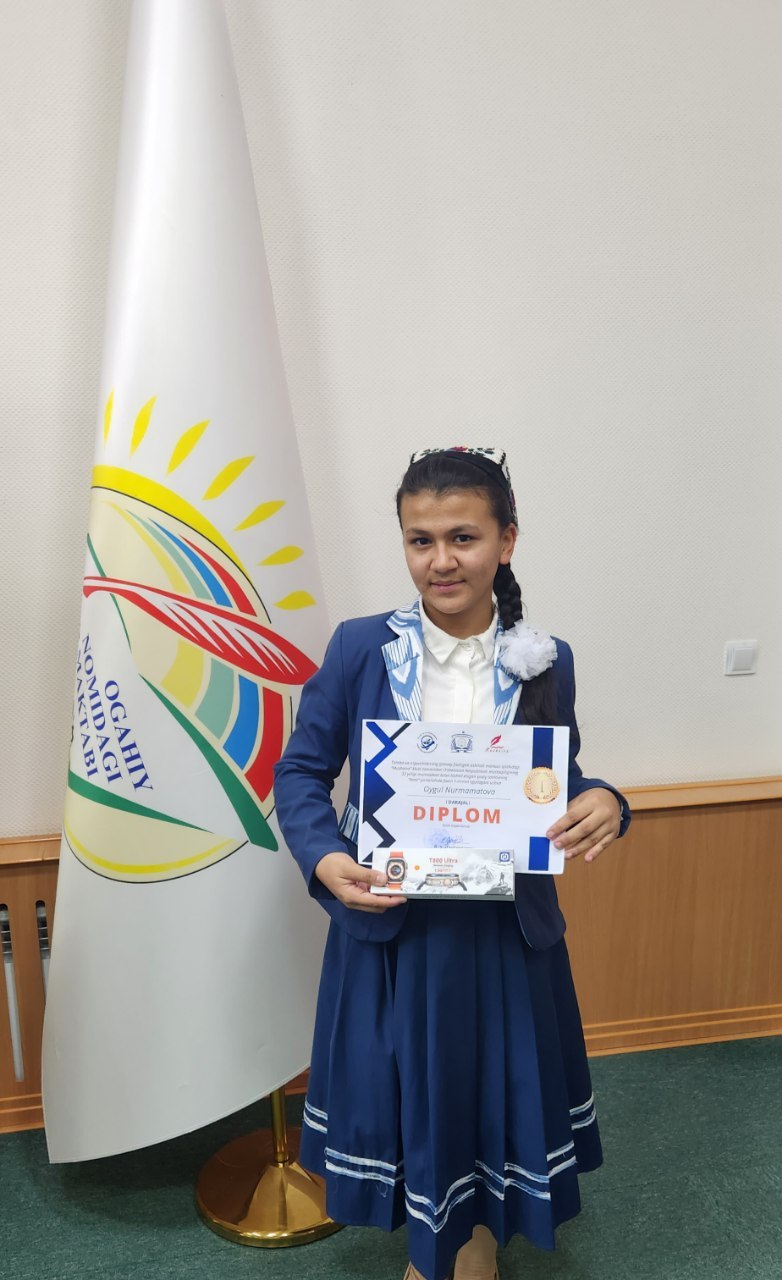
Young Central Asian woman with long dark hair and a white buttoned shirt and black and white dress pants, holding a certificate.
Saida Ismoilova

Plan:

1. Let’s make dreams come true together.

2. Life without dreams is boring.

3. My dreams are my life.The most important question is who do you want to be? It doesn’t matter if someone tells you: “It’s impossible.” It doesn’t matter how many such people you meet in your life. The most important thing is that you are the only person who says these words.

Know that even if you are on the right path, even if they step on you, even if you do not move, even if you sit on the road! Don’t waste your life on trivial things. Be interested and strive with your being for something higher than you, higher than your experience. go on, your life is like that.

Every person, without exception, has the power to move towards his dreams and imagination. Every time you allow yourself to dream about something great, you allow yourself to be evaluated, your self-esteem is strengthened, and you allow yourself to be more helpful and proud.

Such dreams improve your self-image. Buy confidence in yourself. They will increase your personal self-respect, internal pride and emotional level. High dreams and high imaginations have a power that enlivens us, inspires us, and encourages us to act faster than before.

for this to destroy your dreams into traps. The first life is a big trap: “Never allow yourself to think that it is over!” Know that if you don’t follow your dreams, no one will do it for you.There is nothing more interesting in our life than walking towards our dreams. The hopes of a person who ignores and forgets his dream will be dashed. People who have not forgotten their dreams stop for a while and ask themselves the following questions:

– Am I pursuing my dream?

Such people know that they can plan their future. They build a decent life for themselves. The more we dream, the more power we have. A wise man said: “People often do not want to believe that they have everything they need to become the person they want to be.” That’s why they get used to what they don’t deserve, and we forget that it is necessary to pay a fee to achieve a dream.

Many times we make many goals in life but we do not try to achieve them. A simple example is that your goal is to study at a higher educational institution, and your biggest dream is to become a mature and good doctor in the future. Now, in order to achieve this dream, first of all, you need to pass the university entrance exams. For this, you need to go to a tutor or take additional classes to prepare for the exam. This, in turn, requires a certain amount.

From this we can see that you have to pay a price to achieve your dream. Therefore, a simple formula arises by itself. That is:

Goal+Payment=Dream

There are different dreams in human life. Small dreams and big dreams. All this is a dream.

I Saida Ismoilova was born on January 10, 2005 in the village of Ovshar Hazorasp district Khorezm region.

 Currently, I am a 1st-year student at Berdaq State University.

I am currently engaged in writing books, and I have been preparing to publish my books.

Story from Bahora Boboyeva

A TERRIBLE DAY

(The story about a fearful incident that happened in Sardoba, Syrdarya region of Uzbekistan)

Aunt Anora got up early in the morning and went into the yard. The yard was sprinkled with water, the smell of basil wafted around, and the bride was trying to bake bread until everyone woke up. The aunt walked towards the yard and went to the house which was built for her youngest son. The house was finished, but there were still some drawbacks. She struggled to build the house on her own, because her husband was dead a few years ago, but her children also looked after her. She really missed his advice. Aunt Anora has not shed tears so far, but today she cried a little because of some reasons.

Taking thought, she could not see how her grandson Fayzullah was coming. His calling her like “Bubidon” makes her happy. Every time she was with her grandson, and this time the sweet voice of this little boy made her wonder. She thanked God for his presence. Anora wanted to make a spectacular wedding for her youngest son and to pamper grandchildren. In fact, this was the dream which she had with her husband.

Heated bread was just baked. Aunt took two loaves of bread and went to her neighbors’ house and gave to them. Despite the fact that they disagreed, she let them to take the loaves of bread:

  • Bless my daughter-in-law, God willing, second bride will be just like she.

Everyone gathered around the table. After breakfast, the members of family went to work. Aunt Anora and her grandson stayed at home.

***

In the morning Aunt Anora woke up because of a terrible scream. She tried to turn on the light, but she could not find a place to switch on it. The screams got louder, the voices made her more anxious. Someone slammed the door and she was not able to manage and say who it was. There was her youngest son Mirkomil:

  • Mother, are you okay?

The mother was confused for a moment, she did not understand what her child was saying. Mirkomil took her hand and she saw Fayzullah sitting in his father’s arms in the yard and her daughter-in-law running from place to place, not knowing what she was doing, what she was getting, what was happening.

– Mum, hurry up, hurry up. Sardoba… Sardoba is cracked, – Mirsadik could not say another word. He tried to say something but he was not able to.

– Mirkomil, hurry up, brother, hurry up, – putting Fayzullah, he ran into home, tried to pack the various things as soon as possible and urged his wife to hurry:

– Did you get our passports, Komila, did you get passports? Mum, faster, faster!

Neighbors’ voices came from outside, and they cried to one another to hurry, that if they could not leave from there soon, they would be in trouble, so they called everyone to hurry. Furthermore, the police cried by urging people to leave their homes as soon as possible and that time was running out.

Mirsadik hurried, carrying a bag with his son in one hand and a small amount of money and passports in the other, followed by him Komila brought her son’s clothes, and Mirkomil also tried to take something what he saw. They went out the gates. A bus arrived to evacuate people, and the neighbors were getting on the bus one by one.

Mirsadik started looking for his mother. Aunt Anora was gone, he looked around, searched among the people, but her mother was gone. He went back to their house, then to mother’s house to find her, but there was no one. Then he cried: “Mother!”, but there was no sound. He walked towards the yard, went into their bake house, went into the kitchen, shouted “Mother”, and from the yard “Yes, son,” came a silent voice. Aunt Anora was sitting in the house, which had just been built for Mirkomil. She was daydreaming, imagining her future bride, remembering her difficulties which were during the life.

– Mother, what are you doing here? Mother, let’s go, we must leave, – said Mirsadik, trying to bring her up.

– No, my son, I am not going, leave me, I will sit at home, I am not going anywhere, kiss my dear Fayzullah, I love you, – aunt Anora insisted that she will not go.

– No, mommy, you will go with me, if you do not go, we will not too. Let’s go, mother, we need you, mom, let’s go,- said Mirsadik.

At that time Mirkomil came and they left their beloved home getting on the bus.

During the way aunt Anora could not think or imagine anything, she did not stop praying for a minute, she could only wish good luck to her nation, brothers, children…

A terrible situation had happened…

Uzbekistan state world languages university                                                                                         the third year student of the faculty of English Philology                                       Boboeva Bakhora

Essay from Davronova Lobar

In fact, eloquent people who give speeches on big platforms and can freely express their opinion in front of the public are born with this talent “infected” by God. One out of ten people who do not shy away from the public eye can be found today. So, is it possible to overcome this fear and what are the methods? Let’s discuss this topic!

 First of all, we should treat this quality as a talent, because every person has a unique and appropriate talent. After all, if he doesn’t do it himself, it’s useless! In the words of Hazrat Navoi, the psychology of people who speak “little and nothing” is generally more subdued than others. In some cases, this condition is explained by the inability to express one’s thoughts and speech in the language – written speech is good and oral speech is not well developed, while in others it is defined as a character that is passed from generation to generation. This is also the reason why the verb “pulled to so-and-so (grandfather, father…)” is used.

 But on the other hand, in most cases, overcoming this fear is not “incurable”. In my opinion, a person who is afraid to express his words in front of an audience has grown up in an environment where his opinions are not listened to and his views are not taken into account. Only a child whose mouth is immediately closed when he tries to speak, and whose questions remain mostly unanswered due to neglect and indifference, can grow into such a panic-stricken person in the future.

 As a solution and conclusion, I would ask parents to listen to their children in any situation, to raise them in a free environment, not to set excessive limits and prohibitions… In addition, as a young representative of society, I recommend to my peers to read more fiction books and works. After all, there is no doubt that a person who has read a lot of books will have a fluent language, a fluent speech, and a clear life path.

 Davronova Lobar. Uzbekistan

Poetry from Cheryl Snell

Freeze

While the husband plunges in the needle.
While his wife’s pain takes flight.
While his girlfriend waits downstairs,
arranging roses. This is a house for secrets.
No one knows what happens in a corner.
She stands under the porch light.
Photographs the building across the street.
Its door is boarded up, dimpled with knotty pine
or bullet holes. The man reappears and she offers
a bowl of ice cream to him. He pushes the scoops apart.
Hands back the bowl full of winter. He’s waiting
for the thaw. That’s always the way isn’t it─
you agitate anything and it all comes down to puddles.

Different Kinds of Cold

The raw kind that will kill a fly overnight;
that delays buds, shoves them back to earth;
the frosty kind that helps the snow’s weight
tug bough to ground, so the buds persist—
sometimes unsure, like the freeze of our backyard flood,
sometimes deliberate, like the veins etched by blades
on the finished rink. We follow one another
in the kind of cold that bites, and having bitten,
leaves fingers and earlobes with a childhood memory
we return to years later, convinced there was something
we left behind, something we would recognize
if we ever saw it again.

Cheryl Snell’s books include several poetry collections and the novels of her Bombay Trilogy, but her most recent writing has appeared in Does It Have Pockets? Switch, Gone Lawn, Your Impossible Voice, Necessary Fiction, Pure Slush, and other journals. A classical pianist, she lives in Maryland with her husband, a mathematical engineer.

Poetry from Mark Young

Today the post-
woman brought
me the ceiling
of the Sistine
Chapel. Dam-
aged in transit,
so I’m having
it repainted. A
really dark
blue, & then
I’ll paste some
stars on it.
*
Today the post-
woman brought
me three
of the four
humors. “Sorry
about the
missing one,”
she said,
phlegmatically.

Today the post-
woman brought
me a book en-
titled What is
Peripheral
Vision? I didn’t
see her come
into view.
*
Today the post-
woman brought
me the catalogue
raisonné of a
Flemish Master
who doesn’t
yet exist. I’ve
conceptualized
his creations
with the names
that are listed in
the catalog. I’m
still working on
his creation, am
using that fictional
detective from
Los Angeles as
his working name.

Today the post-
woman brought
me a lifesize full-
color effigy of
Donald Trump. I
put it in the back-
yard to keep the
fruit bats at bay.
My plan backfired.
So much orange
that the fruit bats—
dare I say it?—
went bananas &
have started
arriving in ever-
increasing numbers.

Poetry from J.D. Nelson

ink ink ink & we leave it

lemon face
thoughts, maybe


—


tomorrow counts for corn

june goose

legendary large
amounts of truck stop


—


voices in the mire

howdy, dave!

centimeter schwa
chaco canyon


—


[major houlihan]

beginning &
lake toe supreme


—


five-doppler footlong

three flowers later

pecos
pecan
pecos


—


bio/graf

J. D. Nelson’s poems have appeared in many publications, worldwide, since 2002. He is the author of ten print chapbooks and e-books of poetry, including *Cinderella City* (The Red Ceilings Press, 2012). Nelson’s first full-length collection is *in ghostly onehead* (Post-Asemic Press, 2022). Visit his website, MadVerse.com, for more information and links to his published work. His haiku blog is at JDNelson.net. Nelson lives in Boulder, Colorado, USA.