Essay from Maftuna Umaraliyeva

Language and culture in English classrooms: ways of addressing, idioms

Qodirov Xalilullo Rahmatullo o’g’li

the teacher of Andijan State Institute

 of  Foreign Languages

Mamasharipova Shahnoza Ahmadjon qizi

the 3 rd course student of Andijan State Institute

of  Foreign Languages

Umaraliyeva Maftuna Zohidjon qizi

the 3 rd course student of Andijan State Institute

of  Foreign Languages

Abstract

Common European system of reference created by the Board of Europe advances the thoughts of remote dialect securing coming about within the successful proficient and regular communication with individuals from other nations and societies. It evacuates the accentuation from what the understudies know approximately the dialect to what they can do with the dialect.

Lexical competencies make up an imperative portion of the in general dialect competences. Educating them includes instructing figures of speech as well. The display paper is devoted to the questions of instructing English figures of speech, containing appropriate names as their constituent component. We are fascinated by culture manifestation within the idioms’ semantics and within the ways to reveal and exchange it to the understudies. For the last mentioned reason, a few tried within the students’ gathering of people strategies, and strategies are advertised. Learning figures of speech are both challenging and useful. The challenge is stipulated by the idioms’ semantics complexity. Being units of auxiliary nomination, they include the settled within the etymological dialect signs, orchestrate them in a particular way generally not to appoint the objects of reality, but to assess them, depict and characterize, express the enthusiastic demeanor to them.

Key words

English language, culture, addressing, idioms, reference, teaching,techniques

Common European framework of reference developed by the Council of Europe promotes the ideas of foreign language acquisition resulting in the effective professional and everyday communication with people from other countries and cultures. It removes the emphasis from what the students know about the language to what they can do with the language (Common European Framework, 2017). The claim goes in conformity with a modern competence-based approach to foreign language teaching which has been realizing in this country in the last decades. Much work has been done in this sphere by Russian scholars (Khutorskoy, 2003; Zimnaja, 2004; Shadrikov, 2006; Efremova, 2010).

Lexical competencies make up an important part of the overall language competences. Teaching them involves teaching idioms as well. The present paper is dedicated to the questions of teaching English idioms, containing proper names as their constituent element. We are interested in culture manifestation in the idioms’ semantics and in the ways to reveal and transfer it to the students. For the latter purpose, some tested in the students’ audience methods, and techniques are offered. Learning idioms are both challenging and beneficial. The challenge is stipulated by the idioms’ semantics complexity. Being units of secondary nomination, they involve the fixed in the linguistic language signs, arrange them in a specific way largely not to nominate the objects of reality, but to evaluate them, describe and characterize, express the emotional attitude to them.

The primary objectives that guided the study were the following:

  • To reveal the way cultural value in idioms’ semantics is displayed
  • To work out and implement a system of tasks and assignments for idioms’ teaching in the student’s class
  • To check idioms ‘acquisition by having students write an essay using 7 idioms of those studied and assess the results by five criteria (usage of idioms, correct usage of idioms, coherence, language literacy, spelling, and punctuation).
  • To test the reliability of the obtained results by statistical significance t-test.

The language material – idioms containing proper names (94 units) – were selected by random choice from different sources (Oxford Dictionary of  Idioms; Collins Cobuild Dictionary of English Idioms, 1997; Longman Dictionary of English Idioms, 1994; The Penguin Dictionary of  English Idioms, 1994). We resorted to the methods of idiom identification, dictionary entry analysis, observation and comparison in working out the most effective ways of learning idioms through better awareness of their cultural origin and background.

An expression most regularly reflects the national specificity of the individuals. It may be a metaphorical elucidation of reality and an enthusiastic demonstrate of communication. Figures of speech are exceedingly intuitively things. They are solid and colorful cases of cross-cultural relations. The source of their beginning is now and then troublesome to find out. They are solidly acclimatized in various languages and have gotten to be part and the total of these societies. The most trouble is whether an figure of speech is suitable within the given setting when a non-native speaker tries to translate an idiom from his local dialect into English. It may befuddle a audience. The issue is often one of collocation, which could be a central characteristic of the dialect in utilize. The way local speakers utilize English within the genuine world is generally idiomatic and it accept that a familiar non-native speaker ought to be so also informal. When indeed exceptionally great learners of the dialect talk or compose English, the impact is marginally odd. Since figures of speech assess the total story summarizing the most occasions or opinion,a local speakers’ oblivious information of collocation is an basic component of their informal and familiar dialect utilize and is, hence, an imperative portion of their communicative competence.

The Lingua-cultural approach of educating expressions broadens social mindfulness of understudies; they learn not as it were dialect but the conventions and traditions of the English individuals, they ended up more tolerant of other societies, they begin to regard other people’s convictions through the crystal of Georgian lingua-cultural heritage.The Lingua-cultural strategy incorporates two perspectives of communication – dialect and cross-cultural. Our understudies are at slightest bi-cultural as far as anyone knows effortlessly guided in national highlights, history, culture, traditions of two nations, civilizations, the inward worlds.Statistical strategies pointers affirm that the cutting edge world always talks with allegories counting figures of speech. That’s demonstrated by their broad utilize in verbal or composed communications. Subsequently, these days, modern epochal challenges and effective social extension, raise the significance of learning remote dialects for communicative purposes. Scientists believe that the foremost vital information is the think about of “phraseological language” (L. Buckingham) of distinctive societies in order to decide their different capacities in several cultures.

Reference

Bukingham, L. (2006). A multilingual didactic approach to idioms using a conceptual framework. Language Design. Journal of Theoretical and Experimental Linguistics, 8: 35-45 (elies.rediris.es/Language_Design/LD8/2-Louisa-multilingual-LD8.pdf)

COLLINS COBUILD DICTIONARY OF ENGLISH IDIOMS. 1997. The Univ. of Birmingham: Harper Collins Publishers Ltd. ISBN 0007134010.

Idioms: A View from Cognitive Semantics. September 1996 Applied Linguistics 17(3)

 LONGMAN DICTIONARY OF ENGLISH IDIOMS. 1994. London: Longman Group Ltd. ISBN978-0-582-30577-9.

 OXFORD DICTIONARY OF IDIOMS. 1988. Oxford University press. 392 p. ISBN0-19-852711-X

THE PENGUIN DICTIONARY OF ENGLISH IDIOMS. 1994. London: Penguin Books. ISBN-10: 0140514813.

Essay from Barnokhan Ruziyeva

Central Asian teen girl with straight dark hair, black eyes, and a white collared shirt and black coat. School photo with a blue background.
Barnokhan Ruziyeva

Ibrat Academy

The 21st century is the age of information technologies. Today, we cannot imagine our life without these innovations. Their scale is developing not by the day, but by the hour.

It is possible to easily send and receive information from one end of the world to another, and even communicate freely with them. Such news and innovations could not even be imagined by mankind 100 years ago.

In the global community, language is the most effective tool for mankind. Learning a language opens up so many possibilities that we can’t even count them all. Knowledge of the language helps not only in communication, but also in achieving success in the world. The level of the IELTS-language certificate is high worldwide. A certificate is also required from the candidate to get a visa when going abroad or to get a new job.

A new “Ibrat Academy” project aimed at improving the level of knowledge of world languages was founded in Uzbekistan. Before it was announced, this project reached a million views on social networks: You Tube and Telegram. “Ibrat Academy” is a project based on free, high-quality and creative teaching of foreign languages. In this project, people of any age can learn a new language, improve their knowledge, and take part in tests based on their knowledge.  In order to make it more convenient for students, an official application was created, which includes useful video lessons by qualified experts. It creates an opportunity to learn the language easily in any case, at any time. More than 20 language courses and thousands of tests took place from this project. Of course, another basis of language learning is vocabulary. In the project, this issue has been thoroughly considered, and a section of dictionaries has also been created. Each learner can track the scores collected by completing the tests in the “Leaderboard” section. There are even many young people who have won many prizes through their knowledge. Each learner who completes a new language course will receive a certificate. At the last stage, all knowledge is tested and determined by artificial intelligence. Learners can also communicate with the artificial intelligence, even observing its mistakes and shortcomings, giving some instructions.

The heads of the project are Alisher Sadullayev and Rustam Koriyev, and in order to achieve the goal of the project, they and their team are working together to promote actions throughout the republic. Among them, G’iduvan district of Bukhara region strengthened its rating at the republic level. In this matter, the contributions of the district governor Sh. Ashurov, project leaders H. Tokhtayev, Sh. Sharipov, Y. Asadov, etc. Extensive work is being done in the field of education in the district.

It is no exaggeration to say that the expected goal has already been achieved in this project. The project is not only limited to language teaching, but also helps to add Uzbekistan to the ranks of developed countries.

I am also one of the captains of the Ibrat academy of Gijduvon district. Our team has been leading the way in the promotion of the project since the beginning of the project in the republic. We, the youth, are worthy children who will be a strong foundation for the future of the Motherland, and we will strive bravely towards the noble goal set before us. And of course we justify the trust given to us.

Ruziyeva Barnokhan was born on November 28, 2006 in Gijduvon district, Bukhara region of the Republic of Uzbekistan. She writes and translates poems in her free time. In 2017, the poetry collection “Nurli koshona” and “Mehrigiyo” was published in 2020. Her poems were published in the Turkish language in the Turkish anthology organized by Turkey, Uzbekistan and Azerbaijan.’’Motivations for your success” is published in English by the JEF publishing house of the Republic of Moldova. It is available for sale in 26 countries of the world. In June 2023, a poem and an article were published in the German “Raven Cage” magazine. Today, she is a member and ambassador of several organizations. In Uzbekistan, about 20 of her creative works have been published in magazines and newspapers.

Poetry from Lilian Dipasupil Kunimasa

Light skinned Filipina woman with reddish hair, a green and yellow necklace, and a floral pink and yellow and green blouse.
Lilian Dipasupil Kunimasa

Friends Are Here

Never shall one say she is late
Her smiles and tears do not berate
There's no such thing as hopeless fate
Life's but a box of chocolate
Your lies cannot fool nor castrate
Friendship's love stronger than soulmate
No rats to take a cheesy bait
Hunger for heaven who can sate
Your craftiness don't overrate
Knowledge is not only for hate
Love can defeat any debate
Truth always come to those who wait
Let go of all your useless rage
Emotions are truly uncaged 
Hearts tied so tight wiser than sage
All are reading from just one page
Faithful friends whatever be the wage
To any war they shall engage
Not leaving one alone on stage
Golden cage's key they'll forage
True friends' frantic calls can she hear
That they will leave her never fear
Let not iron prods her skin sear
Heavy veils they will gladly tear


Bells of Life

How lonely are the words that your lips loved to sing 
How those bones in solitude cry out in mourning
I'll close my eyes until the bells of life shall ring
Of season's change be it summer winter or spring
No matter how it tries no love can a grave bring
I'll close my eyes until the bells of life shall ring 
Come see how those clean barren canvas are crying
Come see just how colorless is such a painting
I'll close my eyes until the bells of life shall ring
Let in those tiny robins that keep on singing 
Truly life before the grave is fascinating
I'll close my eyes until the bells of life shall ring 
Know that in world of cold grave there is nothing
Even if green grass from the grave begin sprouting
I'll close my eyes until the bells of life shall ring 
Bury those gray ivory bones and let them rest
Let the various colours of Life live in your nest
I'll close my eyes until the bells of life shall ring 
Life is for those who walk the uncharted paths daring
For those who listens and future drums are hearing
I'll close my eyes until the bells of life shall ring.

Lilian Dipasupil Kunimasa was born January 14, 1965, in Manila Philippines. She has worked as a retired Language Instructor, interpreter, caregiver, secretary, product promotion employee, and private therapeutic masseur. Her works have been published as poems and short story anthologies in several language translations for e-magazines, monthly magazines, and books; poems for cause anthologies in a Zimbabwean newspaper; a feature article in a Philippine newspaper; and had her works posted on different poetry web and blog sites. She has been writing poems since childhood but started on Facebook only in 2014. For her, Poetry is life and life is poetry. 

Lilian Kunimasa considers herself a student/teacher with the duty to learn, inspire, guide, and motivate others to contribute to changing what is seen as normal into a better world than when she steps into it. She has always considered life as an endless journey, searching for new goals, and challenges and how she can in small ways make a difference in every path she takes. She sees humanity as one family where each one must support the other and considers poets as a voice for Truth in pursuit of Equality and proper Stewardship of nature despite the hindrances of distorted information and traditions.

Poetry from Sayani Mukherjee

Divine Plan

Heaven's fiery ash 
My new found isle of Poppies
 Little big enough 
For a magic maker 
A big believer, A winner 
The earthly paradise of 
Golden paradigm 
My heavenly fire of sea scapes 
The Supernatural benused art 
We call her a religion
A religious art 
Divinely separated truly for the best 
She's our heaven 
A little butterfly
A  white tale 
No She's a divine plan
Rightly suited. 

Poetry from Taylor Dibbert


That Dog


He still regularly

Looks at photos 

Of London

On his phone,

He could be anywhere

When he does this,

That dog was

Thirteen pounds

Of amazing.


Taylor Dibbert is a writer, journalist, and poet in Washington, DC. “London,” his second full-length poetry collection, is due out in March.

Poetry from Maja Milojkovic

Younger middle aged white woman with long blonde hair, glasses, and a green top and floral scarf and necklace.
Maja Milojkovic
YOU
 
You turn my mind around you 
as a rosary in prayer 
When you surrender your soul to God 
my step towards you is moving. 
You buy me without money 
You call me without invitation 
I'm coming unannounced. 
Pray, I am closest to you in prayer.


FIND ME 

YOU unknown man who prays to God 
I am sending you a message 
through my dreams, find me, my knight! 
I raised ramparts of self-protection from all people, 
so high that I could neither see the sun nor the moon.
I dance in a circle with silk threads 
and skillfully wrap myself and 
separate myself from everyone and 
I'm already suffocating from my own darkness, 
recognize me that I am a soul in need of deliverance 
find me, take me, and set me free me from slavery. 
I don't know what love is, I don't even know what marriage is,
all those aspirations of other people are foreign to me. 
Find me and take me I need you!


Maja Milojković was born in 1975 in Zaječar, Serbia.
She is a person to whom from an early age, Leonardo da Vinci's statement "Painting is poetry that can be seen, and poetry is painting that can be heard" is circulating through the blood.
That's why she started to use feathers and a brush and began to reveal the world and herself to them.

As a poet, she is represented in numerous domestic and foreign literary newspapers, anthologies and electronic media, and some of her poems can be found on YouTube.
Many of her poems have been translated into English, Hungarian, Bengali and Bulgarian due to the need of foreign readers.
She is the recipient of many international awards.
"Trees of Desire" is her second collection of poems in preparation, which is preceded by the book of poems "Moon Circle". 
She is a member of the International Society of Writers and Artists "Mountain Views" in Montenegro, and she also is a member of the Poetry club "Area Felix" in Serbia.

Essay from Gulasal Ne’matjanavna

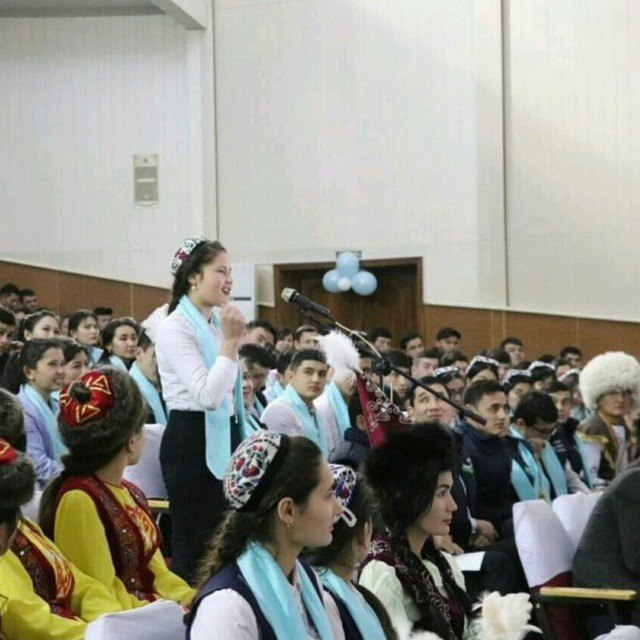
Young Central Asian teen girl stands with a woven headdress and a blue sash over a white blouse and black pants in an auditorium of similarly dressed girls.
Gulasal Ne’matjanavna

The future of the young generation has always been at the center of Uzbekistan’s state policy. Even today, large-scale reforms in all spheres are being rapidly carried out in order to eliminate the problems that have arisen in our country, to create conditions that positively affect the development and education of young people.

Uzbekistan is truly a country of youth. Young men and women growing up in this country have many dreams and goals. The initiative and support of the head of state will help them realize these goals. President Shavkat Mirziyoyev said: “As we have set ourselves the great goal of establishing the foundations of the Third Renaissance in our country, for this we must create the environment and conditions that will educate new Khorezmians, Berunis, Ibn Sinas, Ulugbeks, Navoi and Baburs.” In this, first of all, development of education and training, establishment of a healthy lifestyle, promotion of science and innovation should serve as the main pillars of our national idea”, – his words opened the way for young people to achieve great goals.

Many reforms are being implemented in order to effectively spend free time of young people, introduce them to the rich heritage of our ancestors, and instill love and pride for the motherland. In particular, we are witnessing the opening of many doors of success by the Republic Youth Affairs Agency. Special projects for women, development classes, new decisions, new stages of support are becoming more and more popular. That’s why it is worth saying that today our youth is strengthening the foundation stone to build their goals and future. Young people are recognized as an active layer of society in all spheres. In particular, the fact that this recognition has been doubled today is a great result. The reason is that their role was incomparable in the period of the Eastern Renaissance, in the activities of the moderns, and in the renewal of society. In this respect, this regularly forming layer requires constant guidance and support.

Analyzing the reforms implemented in the field of youth policy, we can see the inextricable connection between the state and the youth. Employment of young people continues in every direction. Necessary conditions are being created for boys and girls to develop in all aspects and get education. This is important for them to become a generation that will contribute to the development of the country in the future.

✍Gulasal Achilova, 19 years old

Anastasia: About today’s “Opportunity in Uzbekistan”.