Song Offerings Gitanjali
“Tagore’s philosophical and spiritual thoughts transcends all limits of language, culture and nationality.” Discuss with reference to the poems you have read from Gitanjali.
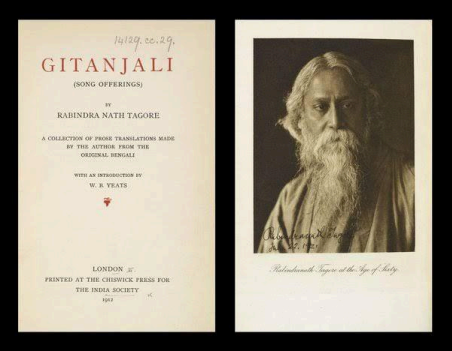
Gitanjali Song Offerings is poignantly immemorial literature by the oriental mystic visionary avatar laureate Rabindranath Tagore. This anthology is phenomenally devotional poetry indulging in the poetic aesthetics in order to chant and showcase the recital and versification for the passion of the love of God. The choruses musings evokes invocation as relatable to intense emotionalism associated with motifs and symbolisms excerpted from devotional tradition such as mysticism and / or spirituality blended to finest transcreation of pristine purity in the Bengali vernacular transcendentally sung throughout the Bengal presidency bridging the gulf between
the wester and the oriental poetry —bejewelled with ornamental adorations, crowned with priceless stones and precious metals, especially effulgent in efflorescence of sensual imageries, subtleties embodied within intricacies and obscurities of the Westerners/ Europeans like dewy crystals and still water, the most crystalline and most perfect medium of thought associations and word imageries whether diaphanous texture, musical quality, plasticity, glamour as if “unites th mellifluousness of Italian with the power posses by German of rendering complex ideas” unravelling the veil of maya and dispelling the illusions of the world. Gitanjali is bereft of polarities, binaries and antitheses in the trajectories of constraints and restraints, animosities and hostilities, conventionalities and disparities, dichotomies and dogmas. The bittersweet pastorales of the Georgian poets are substituted by the revelations in the lyrics of Gitanjali as contemporary blank verse of translation literature within the sprawl frowning “London bridge is falling down falling down falling down.” Emergence of evolutionary poetics superimposes the metamorphoses of Indianization in the Whitmanian whispers of the Heavenly Death enshrine the recluse mystique Tagore by transfiguration and /or transvaluation towards attainment of charismatic angelicism and divine evangelicalism.
Rabindranath Tagore embellishes the grandiose affair of literary craftsmanship in Gitanjali through figurative speeches as evidenced by symbolic imageries which tend to be illustrative, emotive, evocative, decorative and ornamental. “I simply felt an urge to recapture, through the medium of another language, the feelings and sentiments which had created such a feast of joy within me in present days”. Tagore wanted to recapture the aesthetic poetic mood of the native tongue[Bengali vernacular] in the English tongue with all the splendour and beauty of that recollection or memorialization. Tagore distinguishes translation to be word for word transference from one language to another while rewriting to be sense for sense transference that leads to rebirth or reincarnation of the original in the target language interwoven by the “essential substance” of the unfathomable, mysterious and poetic core of the original. Jacques Derrida’s translation theory restitutes translation to be original creative work: “It is a productive writing called forth by the original text” that leaves the reader as much alone as is possible and moves the author towards him. Buddhadev Bose is so moved by its ‘miraculous transformation’ in the English language that he calls it as “the work of a great English poet.” Rabindranath Tagore explains transliteration in the Evening Post in New York on 9 December 1916: “The English versions of my poems are not literal translations. When poems are changed from one language to another, they acquire a new quality and a new spirit, ideas get a new birth and are reincarnated.” Tagore produced effortlessly and endlessly words and melodies at the same time through poetic talent and musical erudition and knowledge of the vernacular [mother tongue and native language] as a cosmopolitan internationalist aficionado and pastoral visionary mystique have endowed incarnation of life giving deity. In other words, mystical universal serenity of life-giving force has been recreated by retranslation of Gitanjali’s verses dismantling and disgruntling preconceptions, misunderstandings, dust and cobwebs.
“Light, oh where is the light! Kindle with the burning fire of desire! It thunders and the wind rushes screaming through the void. The night is black as a black stone. Let not the hours pass by in the dark. Kindle the lamp of love with thy life.” [Gitanjali verses 27]
“In the early morning thou wouldst call me from my sleep like my own comrade and lead me running from glade to glade. Only my voice took up the tunes, and my heart danced in their cadence. The world with eyes bent upon thy feet stands in awe with all its silent stars.” [Gitanjali verses 97]
Further Reading
May Sinclair’s The “Gitanjali” : Or Song-Offerings of Rabindranath Tagore, The North American Review, May 1983, Volume 197, No. 390, pp. 659-676, University of Northern Iowa
Mary M. Lago’s [University of Missouri] Tagore in Translation: A Case Study in Literary Exchange, Books Abroad, Summer 1972, Volume 46, No. 3, pp. 416-421, Board of the Regents of the University of Oklahoma
Radhey L. Varshney’s Tagore’s Imagery, indian Literature, May-June 1979, Volume 22, No. 3, Aspects of Modern Poetry, pp. 86-96, Sahitya Akademi
Subhas Dasgupta’s Tagore’s Concept of Translation: A Critical Study, Indian Literature, May-June 2012, pp. 132-144, Sahitya Akademi
Viktore Ivubulis’s Reviewed Works: Rabindranath Tagore: Reclaiming a Cultural Icon By Kathleen M. O’ Connell and Joseph T. O’ Connell, Bulletin of the School of Oriental and African Studies, University of London, 2010, Volume 17, No. 2, pp. 326-328, University of Cambridge Press on behalf of School of Oriental and African Studies
Hanne-Ruth Thompson’s Reviewed Work: Gitanjali, A New Translation with an Introduction by William Radice by Rabindranath Tagore, Bulletin of the School of Oriental and African Studies, University of London, 2012, Volume 75, No. 1, pp. 183-185, Cambridge University Press on behalf of the School of Oriental and African Studies

Bimla’s journey from self-absorption to self-realization involves a painful recognition of the limitations of her conjugal life. Do you agree or disagree with the statement? Explicate.
Or
“This is a wonderful story, a story where passages must be read and reread so that you may savour their imagery, their language and their wisdom.” Examine Anita Desai’s novel in the vein of this critical comment with references to the heroic aspirations of the protagonist.
Anita Desai’s Clear Light of Day embodies and interweaves postcolonial/thirdworld/subaltern literature with themes such as loss of innocence, loss of identity, loss of culture, loss of customs, loss of tradition, loss of language and quest for identity and postcolonial resistance within the discourses and ideologies of contemporary cultural premises and associated Indianness. Krishna’s dance dramaturgy and the theatricality of the cowgirls of Vrindavan inferences/references to the adulterous love-making by the Jamuna riverbed allusive of ubiquitous themes Hindustani culture which encompasses medieval lyrics of sudras and miras, paintings and sculptures of Radha and Krishna stationed in divine destinations, Indian classical and folk music and finally echelon of Indian films and film songs. Herein after religious ecstasy, communal fraternity, pastoral harmony, sexual freedom, equanimity of women reclaim the overwhelming plenitude as suggested by Sudhir Kakar, “In psychological terms, he [Krishna] encourages the individual to identify with the ideal primal self, released from all social and superego constraints. Krishna’s dream is like that of Dionysus in ancient Greece, is one of utter freedom and instinctual exhilaration.” Anita Desai suggests that explicit sexuality of Krishna and Radha is no exhilarating feat as allegorized by the revelries and merriments beckoning the Misra sisters, Jaya and Sarla. “The poor Misra sisters so gray and bony and needle-faced, still prancing through their Radha Krishna dances and impersonating in order to earn their living” […] the cathartic plight of these love-lorn maidens have extinguished “ecstasy”, “fluidity” and “gracefulness” from their lives to be atoned by “attainment of the infinite” and the “absolute bliss in the Brahminical.”
Bakul snobbish diplomat of the Indian consulate and mission in Washington, wedded to Tara afterlife of holocaust and post partition era expounds bureaucratic language: “What I feel is my duty, my vocation, when I am abroad, is to be my country’s ambassador […] I refuse to talk about famine or droughts, or caste wars or political disputes […] I choose to show them and inform them of one of the best, the finest.” The refinement and polishness of the exquisite nationalist culture that government agencies proliferate their demagoguery and propaganda machinery with the purposiveness of freezing their pastness in missions abroad such as New York and Moscow. Anita Desai furthermore satirizes the historiography of Indianness uncovering the themes of patricide, fratricide, religious bigotry, partition, exodus and migration and patriarchal misogyny. Obliteration and extinction of Islamic culture and Urdu literature is revealed in the relinquishment of Raja’s abjuration of educational ventures in Islamic Studies at Jamia Milia and the ironical lost effulgence of his sisters in re-enacting Urdu verses. Anita Desai imitates and mirrors transfigured self-sacrificial sentimentalist heroines popularized by the stalwarts of Bengali literature as evidenced by the assertion of Bimla: “I shall work —– I shall do
anything —– I shall earn my own living —–and look after Mira Masi and Baba —– and be independent.” Bimla absconds singularity with Dr. Biswas and leads a virgin life by radicalizing herself through boldness in subverting stereotypical femininity—–empowered self-hood dismantling the culture specific of gender femininity as object of guilt and pity [heroine who remains to be unappreciated by ungrateful family and ends up in sanatorium].
Despite Bimla’s face “dried clay that had cracked” resonating subtleties of indifferences in perspectives or outlook, there is affinity of togetherness with her and Tara’s binaries divested apart during the parting farewell of the American immigrants family. “Old Delhi is a cemetery, every house a tomb. Nothing but sleeping graves” reanimates the graphic narrative of these dilapidated ruinous state of the locales and settings despised and detested in the stream-of-consciousness of the mentee whom Bimla tutors. Parenthood and caretaking of the diseased and even burial and cremation of deceased bodies and bereaved souls were incumbencies of befallen upon the protagonist. Abandoned in a forlorn macabre she was living a damnable hectic life except the accompaniment and association of the neurosis and psychosis patient brother Baba listening to “Lili Marlene” and “Don’t Fence Me” on the antique gramophone.” Desai is striving to universalize the predicament of the hypersensitive feminine temperament into a kind of existential crisis and feminine vulnerability and frangible decadence. Self-introspection, spontaneity, plainness, brusqueness, altruistism and simple living high thinking reinforces her claustrophobic life to be reining in the newfound adulthood as Raja evades siblinghood responsibilities and familial obligations, she venerates herself to devotional fulfillment of promising family caregiving associated with the rent to be paid […] the people to be fed everyday, Tara to be married off, and Baba to be taken care of for the rest of his life.” Dr. Biswas’s assertion takes the cudgels for the testimonial: “Now I understand why I do not wish to marry […] You have sacrificed your own life for them [family].” Frustrated and enraged, Bimla interposes being “misunderstood and misread”. The headstrong and eccentric sprinterish lady History college lecturer, Bimla has become nonchalant in incidental events whether allocating funds in seed banks aftermath of the garden being fertilized by dumping manure or professing consent to the matrimonial alliance of the family physician. Messy, festering, disturbing and scathing domesticity however, transforms this self-absorbed heroic protagonist in banishment of past grievances through reading of Aurangzeb’s epitaphic requiem: “Many were around me when I was born, but now I am going alone. I know not why I am or wherefore I came into the world. Life is transient and the lost moment never comes back. Now I am going alone. Every torment I have inflicted, every sin I have committed, every wrong I have done, I carry the consequences of it with me. Strange that I came with nothing into the world and now go away with this stupendous caravan of sin.”
Bimla’s reminiscences reflect a feminist consciousness: her desperate frustration with the limitations placed on her as a feminine personae and her fierce haughtiness to be unencumbered by marriage. “I won’t marry…I shall work—-I shall do things—-I shall earn my own living, and look after Mira Masi and Baba, and be independent.” Bimla venerated her private pantheon of saints and goddesses in the emulation of Florence Nightingale and Joan of Arc as archetypal exemplary feminist revolutionaries. As a feminist heroine, Bimla explores the issues of freedom of choice in whether to marry or to remain a bachelorette and of
independence vs subservience, thereby questioning the “conventional associations of gender and behaviour.”
Further Reading
Arun. P Mukherjee’s Other Worlds, Other Texts: Teaching Anita Desai’s Clear Light of Day to Canadian Students, College Literature, February 1995, Volume 22, No. 1, pp. 192-201
Shouri Daniel’s Reviewed Works: CLear Light of Day by Anita Desai, Chicago Review, Summer 1981, Volume 33, No. 1, pp. 107-112.
Renu Juneja’s Identity and Femininity in Anita Desai’s Fiction, Journal of South Asian Literature, Summer Fall 1987, Volume 22. No. 2, Essays On Indian Writing In English, pp. 77-86, Asian Studies Center, Michigan State University
Ruth K. Rosenwasser’s Voices of Dissent: Heroines in the Novels of Anita Desai, Journal of South Asian Literature, Summer, Fall 1989, Volume 24, No. 2, pp. 83-116, Asian Studies Center Michigan State University
Elaborate your discussion in depth examining the character of Baba in Anita Desai’s novel Clear Light of Day.
“There was something unsubstantial about his long slimness in the white light cloths, such a ttal absence of being, of character, of clamouring traits and characteristics. He was no more and no less than a white flower or a harmless garden spider.”Schizophrenic, psychotic, autistic, neurotic
and lunatic lamb like cupid of the Das family household. Dualism in the visage of the character Baba justifies Bimla’s resistance to postcolonialism and Tara’s modernistic liberalism recoiling from silences and shadows representative of decadence. A misanthropic that misfits into either
old and cultural paradigms. “Lili Marlene” and “Don’t Fence Me In” are Baba’s passtime gramophone antiques symbolically predilection harboured by the derelict house. Graham Huggan suggests that “silences and music in several postcolonial texts can be seen…as providing that alternative non verbal codes which either subverts and/or replaces the earlier over determined narratives of colonial encounter, in which the word is recognized to have played a crucial role in the production and maintenance of colonial hierarchies of power.”
Fluidity of Baba is neutralized by the brethrenship amongst the companionship of the familial bonds despite that silent shadow dire-like existentialist angst and/or existentialist pangs. In Playing in the Dark, Toni Morrison examines the ways in which Africanism has historically done the work of constructing whiteness in American literature and concludes, “Africanism is the vehicle by the American self knows itself as not enslaved, but freed; not repulsive, but desirable; not helpless, but licensed and powerful; not history-less, but historical; not damnable, but innocent; not a blind accident of evolution, but a progressive fulfillment of destiny.” Toni Morrison furthermore declaims that tentative fluidity and subjective revisionary process engenders echo, shadow, silent force that cannot be articulated but mystified as observable even in Anita Desai’s Clear Light of Day, in corresponding to Baba’s organic disintegration. “The writer’s response to
American Africanism often provides a subtext that either sabotages the surface text’s expressed intentions, or escapes them through a language that mystifies what it cannot bring itself to articulate.”
Further Reading
Cindy Lacom’s Revising the Subject: Disability as “Third Dimension” in “Clear Light of Day” and “You Have Come Back”, NWSA Journal, Autumn 2000, Volume 14, No. 3, Feminist Disability Studies [Autumn 2002] pp. 138-154
Write a short note about the personality of Mira Masi in Anita Desai’s novel Clear Light of Day.
Aunt Mira Masi is the widowed alcoholic drunkard ushered by the Das family household to be exclusively caregiving their youngest nervous breakdown and mentally deformed offspring Baba. Being bony and angular, withered and wrinkled; she was soft, scented and sensual like a cracked pot, a torn rag and a picked bone of the Das family household. In linguistic metaphors, Mira Masi is associated with the metonymic allusions to stick or ancient tree. “A drudge in her cell, sealed into a chamber. A grey chamber woven shut. Here she lived, here she crawled from cell to cell, feeding the fat white larvae that … swelled on the nourishment she brought them.” Aunt Mira Masi is discarded as a worthless commodity because her utilitarianism profiteering motif has been diminished and the corporeal viscerality exposed her to be “shabbier”, “skinner” and “seedier”. Desai offers the decadence of biological disintegration as appendages to patriarchy and misogyny and furthermore, emblematically symbolizes surrogacy through the eloquent articulation: “she was the tree that grew at the center of their [childrens’] lives and in whose shade they lived”. “Soon they grew tall, soon they grew strong. They wrapped themselves around her, smothering her in leaves and flowers. She laughed at the profusion that this little grove which was the forest to her, the whole world […] She would just be the old log, the dried mass of roots on which they grew. She was the tree, she was the soil, she was the earth.” Pathos of widowhood and spinsterish virginity have cast a looming dirge-like- sepulchral straitened condition. In lucid language imagist novelist Anita Desai’s stream of consciousness as a narrative technique dexterously recaptures feminine sensibility exhibiting existentialist loneliness and the temperamental distances merits feminine neurosis portrayed by Aunt Mira.