
a rainbow halo
around the bright moon tonight—
somewhere, a dog barks


neighbors’ Christmas lights . . .
Orion reclines as he
rises in the east


cold, dark December—
is that a jet way up high
or the space station?


power lines ripped down
by high winds before the storm—
first day of winter


eleven below—
the two chickens have to sleep
in the humans’ house


silence at midnight . . .
six inches of heavy snow
weighs down the tree’s boughs


-------------


bio/graf

J. D. Nelson (b. 1971) experiments with words in his subterranean laboratory. His poems have appeared in many small press publications, worldwide, since 2002. He is the author of ten chapbooks and e-books of poetry, including Cinderella City (The Red Ceilings Press, 2012). Nelson’s first full-length collection is in ghostly onehead, published by Post-Asemic Press in December 2022. Visit MadVerse.com for more information and links to his published work. His haiku blog is at JDNelson.net. Nelson lives in Colorado, USA.
Category Archives: CHAOS
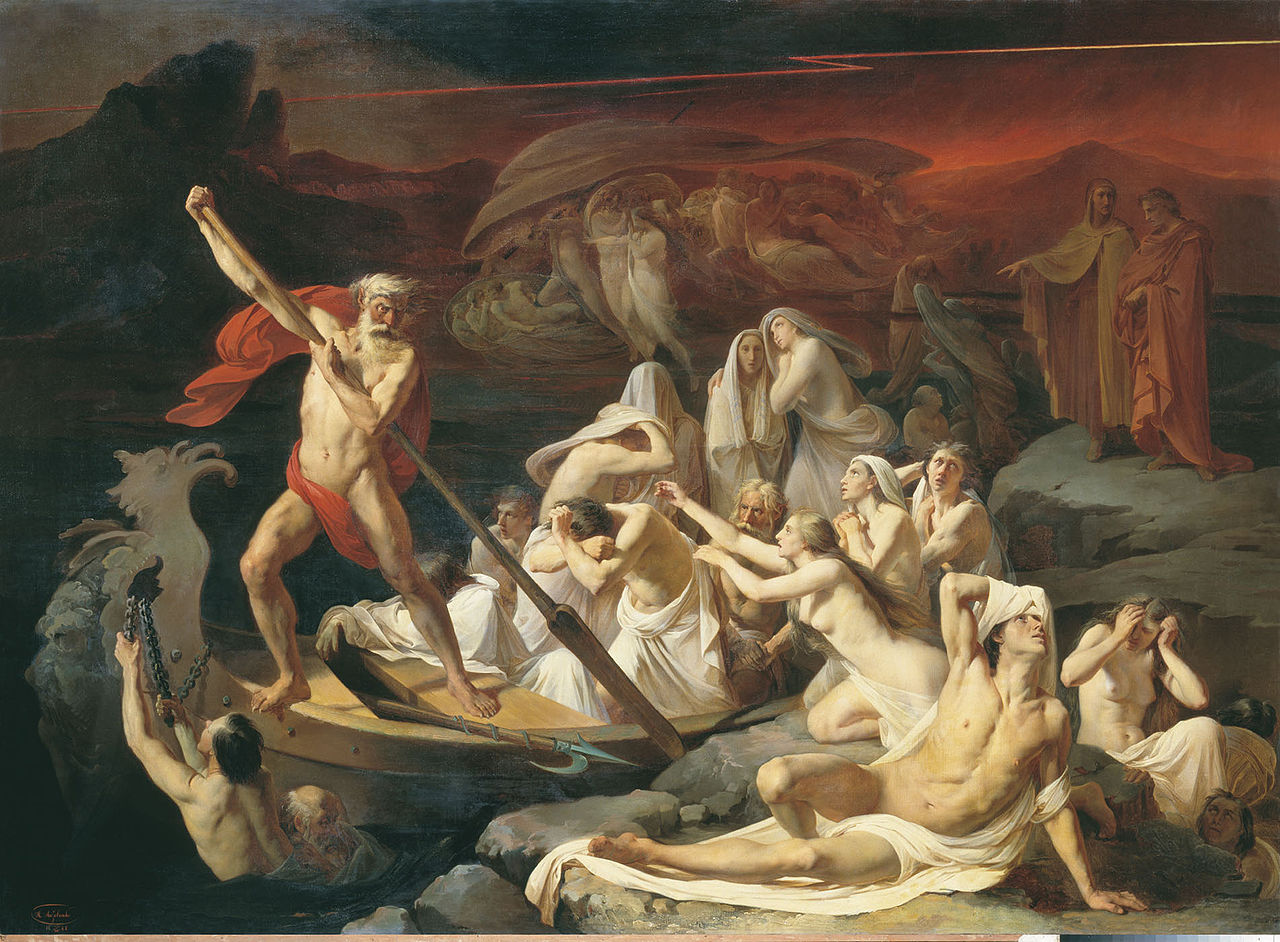
Synchronized Chaos Mid-December Issue: Back and Forth on the River Styx
Welcome to mid-December’s issue!
We encourage you to come on out to Metamorphosis, our New Year’s Eve gathering and benefit show for the Revolutionary Association of Women of Afghanistan and Sacramento’s Take Back the Night. This will take place in downtown Davis, CA, at 2pm in the fellowship hall of Davis Lutheran Church (all are welcome, we’re simply using their room as a community space). 4pm Pacific time is midnight Greenwich Mean Time so we can count down to midnight. Please sign up here to attend.
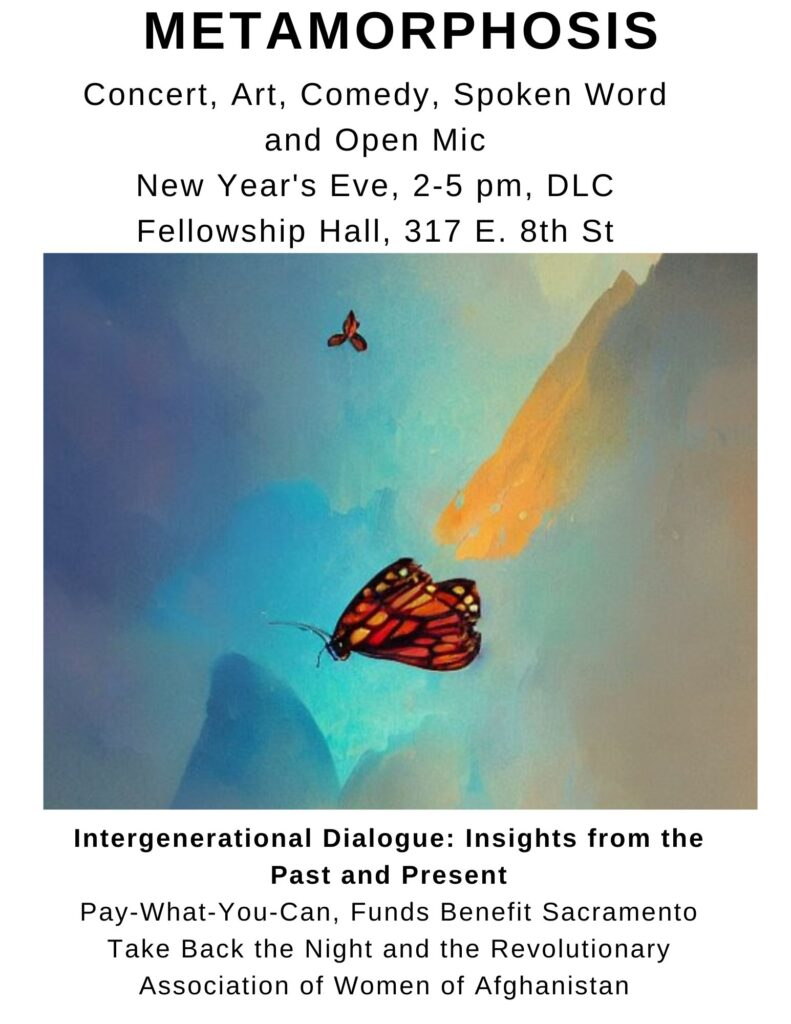
The theme “Metamorphosis” refers to having people there from different generations to speak and read and learn from each other, challenging us to honor the wisdom of our parents and ancestors while incorporating the best of the world’s new ideas in a thoughtful “metamorphosis.” We’ve got comedian Nicole Eichenberg, musicians Avery Burke and Joseph Menke, and others on board as well as speakers from different generations.
Second, our friend and collaborator Rui Carvalho has announced our Nature Writing Contest for 2022.
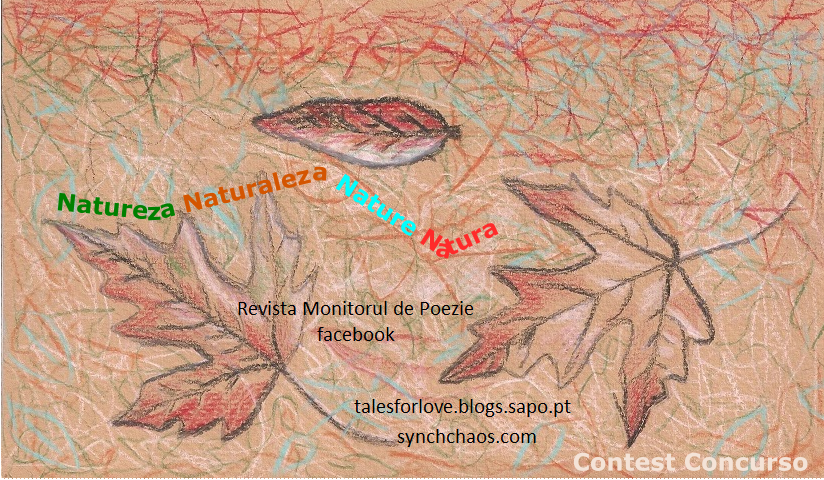
This is an invitation to submit poems and short stories related to trees, water, and nature conservation between now and the March 2023 deadline. More information and submission instructions here!
This month explores various forms of life and death, and how and when we pass through the veil or cross the famed Styx of Greek mythology. Our theme is quite appropriate for the solstice a week after this issue’s release, a time of natural passage from one season to another.
Natasha Leung explores the impermanence of seasons and sensations through a meditation on a burn from a candle. Chimezie Ihekuna’s poem celebrates the festivities of Christmas along with the opportunity for renewal presented by the new year.
Sophia Fastaia shows the sun and moon finding each other’s light in a joyful, childlike encounter.
Mary Croy voyages through the vastness of nebulae in space and also fields and meadows here on Earth. Channie Greenberg presents images of trees, a mashup of vista shots of the whole tree and closeups of a few branches or trunks.

Robert Stephens highlights the power of memory to contain a lush panoply of disparate scenes and to bring life to the dead. Norman J. Olson reflects on appreciating centuries of human history by traveling with his wife.
Lachlan McDougall sends us atmospheric moments of subtle natural or supernatural tension. Fernando Sorrentino crafts a compelling caricature of a man immobilized and slowly decimated by fear.
Ashley Mann’s pieces lament the artificiality of the culture that she sees as replacing whole natural foods and authentic human connection. J.J. Campbell reflects on the ways we anesthetize ourselves in an uncertain world: substances, eroticism, fantasy, perhaps even cynicism itself.
Marley Manalo-Landicho mentally dissects himself, wondering who he really is under the constructions of his ego and his physical body. John Culp’s poem describes the dissolution of ego to make way for loving connection with another person.
Vernon Frazer’s poetry pans out to the edge of human consciousness with a dizzying array of linked words. J.D. Nelson arranges words and syllables to evoke and distill meaning and thought in pieces specifically designed for our publication. Sayani Mukherjee draws on mythology, fantasy literature and nature to conjure a wild dream. Alan Catlin’s characters and settings teeter in and out of sanity, drawing on Ouija boards, psychedelics, fevers and outer space.
Jim Meirose’s surrealist piece draws on a children’s trope, with an anthropomorphized rat and mouse loose in the library, but then goes in a more adult and ludicrous direction. Daniel De Culla contributes his signature earthy humor to the issue, with a story of a gentleman’s bodily functions.
Beth Gulley renders ordinary life in short haiku-like poems, exploring weather, public swimming, and home repairs through wit and careful observation. Damon Hubbs sends up scenes of imaginative speculation and drama within domesticity, characters who stand out in pink earmuffs or flowing robes amid their daily environs.
Peter F. Crowley harnesses only slightly exaggerated humor to describe the end of dysfunctional relationships.
Z.I. Mahmud laments the tragedies of both Creon and Antigone in Sophocles’ famous play, highlighting the quixotic quests of each character for law and order or romantic or familial love.
Exploring family tragedy in a different way, Jaylan Salah probes the power of the calm, understated themes of loss and mortality in Satish and Santosh Babusenan’s new film The Husband, The Wife and Their Dead Sons.
Mykyta Ryzhykh’s poem illustrates how war steals a society’s innocence as well as its people’s lives. Ahmad Al-Khatat’s dark piece also mourns wartime losses, so extensive the sun itself could lose its fire.
Alison Owings’ piece highlights the small and large hopes and dreams people have for a better world. Jeff Rasley looks to the work and lives of gifted but tortured writers and artists to explore how ordinary people might resonate and ultimately find their way to wholeness. Charley De Inspirator shares his journey towards spiritual healing and salvation through religious faith.
We hope that this issue represents a way forward for you, through curiosity, wonder, healing, dreams, connection, or transformation.
Essay from Jeff Rasley
Darkness and Light, Despair and Recovery
In a dark time, the eye begins to see.
Theodore Roethke was born in 1908 and died in 1963. The quote is the first line of his poem, In a Dark Time. Roethke won the Pulitzer Prize for poetry in 1954 for his book The Waking. He won the National Book Award for Poetry twice. Despite the accolades he received for achievements in his chosen craft, Roethke was a tortured soul. “Dark Time” reflects his struggle with madness. It has many allusions to a psyche filled with fear and dread. For example:
A man goes far to find out what he is –
Death of the self in a long, tearless night,
All natural shapes blazing unnatural light.
Dark, dark my light, and darker my desire.
My soul, like some heat-maddened summer fly,
Keeps buzzing at the sill. Which I is I?
And yet, there is a hopeful note in other verses in the poem. Roethke struggled with mental illness, especially depression, but he did not let it extinguish his creativity. The darkness in his poetry is usually overcome by the light of hopeful change. The darkness of despair can be escaped. There is a way out of depression, if the light can be found.
Roethke was a nature lover. He found solace being outside in forests, fields, hills, or dales. But his soul seemed to respond as deeply to the dark side as to the bright side of the natural world. Nature inspired allusions to both darkness and light in Roethke’s poetry. There is the bloody evisceration of prey by the predator, and there is the shimmering surface of a tree-lined brook. Roethke understood that both are inherent in Nature and in human nature. We can’t have light without darkness nor darkness without light. They are yin and yang.
Humans may be unique in our capacity to despair, as well as our ability to recover from it. Another poet, May Sarton (1912 – 1995), in her Journal of Solitude, put it this way:
Does anything in nature despair except man? An animal with a foot caught in a trap does not seem to despair. It is too busy trying to survive. It is all closed in, to a kind of still, intense waiting. Is this a key? Keep busy with survival. Imitate the trees. Learn to lose in order to recover, and remember that nothing stays the same for long, not even pain, psychic pain. Sit it out. Let it all pass. Let it go.
Roethke thought humans must experience the dichotomy of the light and the dark. And so, his mental illness, loss of a professorship, and a failed love affair were dark experiences, but they became challenges essential to making him who he was. Living through those periods of darkness, as claimed in his poem, his eye began to see. And what it saw was light at the end of the tunnel. Roethke ends the poem so:
A fallen man, I climb out of my fear.
The mind enters itself, and God the mind,
And one is One, free in the tearing wind.
In your experience, does light always, eventually, follow darkness? I am sometimes haunted by dark thoughts. They usually come at night, when I wake up from a troubled sleep or I am having trouble falling asleep. I do not consciously welcome these thoughts into my mind. It feels like they come uninvited and unwanted, like they have surfaced from a murky subconscious level. Why am I unable to banish them forever and know they will never return? I don’t know. So far, light has always followed those dark thoughts and every other type of darkness in my life. But that is not true for everyone I have been close to.
Three close friends of mine committed suicide. I know why each one of them did it, and I am sure that two of the three thought that they could not find a way out of the dark place they were in, except through death. I hesitate to judge their decisions, but I think those two friends of mine could have found a way out of the darkness, if they had been willing to put in the time and work to find the light.
I wish Bob would have kept trying to find alternative ways to deal with his bi-polar condition. I wish Byron would have taken responsibility for his deception, accepted his marriage was over, and built a new life. But Bob had tried for over twenty years to find a satisfactory way to live with his mental illness, and finally gave up trying to find a way out of that darkness. I think Byron was so intensely ashamed of himself that he was convinced he did not have the strength to work his way back into the light with his family. He must have felt that he did not deserve forgiveness, so he sentenced himself to death.
If people see a lighted tunnel as they are dying, as some survivors of near death experiences claim, I hope Bob and Byron saw that light and could feel some warmth at the end.
Ray’s case is more difficult, because he killed his life-partner Juan and himself. Juan was an eminent physician and proud man, who lost the ability to control most of his faculties in his mid 80s. He wanted to die. Ray fulfilled Juan’s request and then immediately committed suicide. Ray left his estate to a school for Palestinian children. He let it be known that he preferred his remaining wealth to be spent on that worthy cause rather than dwindle over time maintaining a life he did not want to live without Juan. Ray thought that putting Juan out of his misery and dying at his side was the way out of the darkness that had descended on them when Juan became incapacitated.
I was surprised to learn of my friend’s murder-suicide, because I thought I had talked him out of the plan. Ray told me a week or so before he did it, what he planned to do. I thought I had convinced him to meet with a Quaker “clearance committee” to talk through the issues before he took any action. However, he executed his plan the day before he was scheduled to meet with the clearance committee.
Ray thought that ending Juan’s pain was the way out of the darkness for Juan. And without Juan, Ray thought he would never feel the light again. I know that Ray believed ending their lives together and giving $250,000 to a school for Palestinian children was the right thing to do. He was convinced that putting an end to Juan’s misery and ending his own life was the best way to end the darkness they were experiencing. Ray was an atheist who did not believe in an afterlife, so he did not expect to see any light when his life ended. He just thought it would end.
As for us survivors, whether it is light, darkness, something else, or nothing at all that is at the end of this life, well, that is something we will eventually discover. If physical or emotional pain is terrible, and there is no hope for relief from the suffering, does death hold the only possibility of escape from that darkness into light? Will those who have faith in a lighted after-life be disappointed or rewarded for their faith? Does light always follow darkness, as Roethke implies, or will there only be darkness at the end of a lighted tunnel?
I don’t know the answers to those questions, but I agree with Roethke’s wisdom. There will be periods of light and darkness during our lives. That is natural and inevitable. The challenge is to find a way to use our dark times as opportunities for deep reflection, and then find a way back into the light. If we can find meaning in the darkness, and then find our way back into the light, Roethke’s assurance is that life will be even better. Do you believe it?
The enigmatic artist, M.C. Escher (1898 – 1972) wrote this in a letter to his son: A person who is lucidly aware of the miracles that surround him, who has learned to bear up under the loneliness, has made quite a bit of progress on the road to wisdom. Escher struggled with depression. Although his oeuvre now holds an honored place in modern art and eventually became popular with academic critics and the general public, he felt misunderstood by the critics and the art-buying public. His work was such a unique blend of mathematics, multi-dimensional perspective, optical illusion, fantasy and realism that it was and is weird and confounding. A common reaction to an Escher painting is, How did he do that!? What kept him working at his art, despite feeling unappreciated and misunderstood, was his sense of the miraculous in Nature and in human consciousness. Escher was convinced that, although it was a lonely one, he was “on the road to wisdom.”
May we each find that path.
This personal essay by Jeff Rasley is a chapter from his recently published book, 72 Wisdoms: A practical guide to make life more meaningful, published 2022, Midsummer Books.
Short story from Fernando Sorrentino
Unjustified Fears
by Fernando Sorrentino
(Spanish title: Temores injustificados)
Translated
by Naomi Lindstrom
I’m not very sociable, and often I forget about my friends. After letting two years go by, on one of those January days in1979 — they’re so hot — I went to visit a friend who suffers from somewhat unjustified fears. His name doesn’t matter; let’s call him — just call him — Enrique Viani.
On a certain Saturday in March, 1977, his life changedcourse.
It seems that, while in the living room of his house, near thedoor to the balcony, Enrique Viani saw, suddenly, an “enormous” — according to him — spider on his right shoe. No soonerhad he had the thought this was the biggest spider he’d seen inhis life, when, suddenly leaving its place on his shoe, the animalslipped up his pants leg between the leg and the pants.
Enrique Viani was — he said — “petrified.” Nothing so disagreeable had ever happened to him. At that instant he recalled two principles he had read somewhere or other, which were: 1) that, without exception, all spiders, even the smallest ones, carry poison, and can inject it; and, 2) that spiders only sting when they feel attacked or disturbed. It was plain to see, that huge spider must surely have plenty of poison in it, the fullstrength toxic type. So, Enrique Viani thought the most sensible thing to do was hold stock still, since at the least move of his, the insect would inject him with a definitive dose of deadly poison.
So he kept rigid for five or six hours, with the reasonable hope that the spider would eventually leave the spot it had taken up on his right tibia; clearly, it couldn’t stay too long in a place where it couldn’t find any food.
As he came up with this optimistic prediction, he felt that, in deed, the visitor was starting to move. It was such a bulky, heavy spider that Enrique Viani could feel — and count — the footfalls of the eight feet — hairy and slightly sticky — across the goose flesh of his leg. But, unfortunately, the guest was not leaving; instead, it nested, with its warm and throbbing cephalothorax and abdomen, in the hollow we all have behind our knees.
•••
Up to here we have the first — and, of course, fundamental — part of this story. After that there came some not very significant variations: the basic fact was that Enrique Viani, afraid of getting stung, insisted on keeping stone still as long as need be, despite his wife and two daughters’ pleas for him to abandon the plan. And so, they came to a stalemate where no progress was possible.
Then Graciela — the wife — did me the honor of calling me in to see if I could resolve the problem. This happened around two in the afternoon: I was a bit annoyed to have to give up my one siesta of the week and I silently cursed out people who can’t manage their own affairs. Once over at Enrique Viani’s house, I found a pathetic scene: he stood immobile, though not in too stiff a pose, rather like parade rest; Graciela and the girls were crying.
I managed to keep myself calm and tried to calm the three women as well. Then I told Enrique Viani that if he agreed to my plan, I could make quick work of the invading spider. Opening his mouth just the least bit, so as not to send the slightest quiver through his leg muscle, Enrique Viani wondered:
“What plan?”
I explained. I’d take a razor blade and make a vertical slit downwards in his pants leg till I came to the spider, without even touching it. Once this was done, it would be easy for me to hit it with a rolled‑up newspaper, knock it to the floor and then kill it or catch it.
“No, no,” muttered Enrique Viani, desperate, but trying to restrain himself. “The pants leg will move and the spider will sting me. No, no, that’s a terrible idea.”
Stubborn people drive me up the wall. Without boasting, I can say my plan was perfect, and here this wretch who’d made me miss my siesta just up and rejects it, for no serious reason and, to top it off, he’s snotty about it.
“Then I don’t know what on earth we’ll do,” said Graciela. “And just tonight we have Patricia’s fifteenth birthday party …”
“Congratulations,” I said, and kissed the birthday girl.
“. . and we can’t let the guests see Enrique standing there like a statue.”
“Besides, what will Alejandro say.”
“Who’s Alejandro?”
“My boyfriend,” Patricia, predictably, answered.
“I’ve got an idea!” exclaimed Claudia, the little sister. “We can call Don Nicola and…”
I want it clear that I wasn’t exactly wild about Claudia’s plan and had nothing to do with its being adopted. In fact, I was dead set against it. But everyone else was heartily in favor of it and Enrique Viani was more enthusiastic than anyone.
So Don Nicola showed up and right away, being a man of action and not words, he set to work. Quickly he mixed mortar and, brick by brick, built up around Enrique Viani a tall, thin cylinder. The tight fit of his living quarters, far from being a drawback, allowed Enrique Viani to sleep standing up with no fear of falling and losing his upright position. Then Don Nicola carefully plastered over the construction, applied a base and painted it moss green to blend in with the carpeting and chairs.
Still, Graciela — dissatisfied with the general effect of this mini obelisk in the living room — tried putting a vase of flowers on top of it and then an ornamental lamp. Undecided, she said:
“This mess will have to do for now. Monday I’ll buy something decent‑looking.”
To keep Enrique Viani from getting too lonely, I thought of staying on for Patricia’s party, but the thought of facing the music our young people are so fond of terrified me. Anyway, Don Nicola had taken care to make a little rectangular window in front of Enrique Viani’s eyes, so he could keep entertained watching certain irregularities in the wall paint. So, seeing everything was normal, I said goodbye to the Vianis and Don Nicola and went back home.
•••
In Buenos Aires back in those years we were all overwhelmed with duties and obligations: the truth is I almost forgot all about Enrique Viani. Finally, a couple of weeks ago, I managed to get free for a moment and went to call on him.
I found he was still living in his little obelisk, only now a splendid blue‑flowering creeper had twined its runners and leaves all around it. I pulled a bit to one side some of the luxuriant greenery and through the little window I managed to spot a face so pale it was nearly transparent. Guessing the question I was about to ask, Graciela told me that, through a kind of wise adaptation to the new circumstances, nature had exempted Enrique Viani from all physical necessities.
I didn’t want to leave without making one last plea for sanity. I asked Enrique Viani to be reasonable; after twenty‑three months of being walled up, this spider of ours was surely dead, so, then, we could tear down Don Nicola’s handiwork and ….
Enrique Viani had lost the power of speech or at any rate his voice could no longer be heard; he just said no desperately with his eyes.
Tired and, maybe, a bit sad, I left.
In general, I don’t think about Enrique Viani. But lately, I recalled his situation two or three times, and I flared up with rebellion: ah, if those unjustified fears didn’t have such a hold, you’d see how I’d grab a pickaxe and knock down that ridiculous structure of Don Nicola’s; you’d see how, facing facts that spoke louder than words, Enrique Viani would end up agreeing his fears were groundless.
But, after these flareups, respect for my fellow‑man wins out, and I realize I have no right to butt into other people’s lives and deprive Enrique Viani of an advantage he so treasures.
Poetry from Charley de Inspirator
TESTIMONY
Darkness came upon me like a tsunami
And Scorched away my smiles
Pulling me through the shadows of death
Disassembling my tiles
Ignorance was my buddy,
We wined and dined,
And life that as once shining,
Has not started dimming.
I battled against myself
Cuz I couldn’t flee my fright
Anger reigned over my voice
And darkness was my sight
At some point, I felt the turbulence circulating my veins
The rage of horror parading my scenes
I feared my fears and hid my pains
Pretending freedom but mentally in chains
One day, I felt a man coming my way
No, not just a man but a God
A God who holds the world in his hands
His fragrance overgrown my odor
His presence made the day
And once again I felt I had a savior
He touched me and give my life a meaning
He broke me and gave me a new
beginning
He scorched me so I could bleed away my pains
He baptized me and made me clean again
He give me a new name and purpose
He called me his own though he wasn’t supposed
I knew I wasn’t worthy of him and all his glory but he called me his son; and to me, eternal life he proposed.
I gladly accepted to be his citizen
Rebored of his love
Justified by his blood
and Sanctified by his choice
FOR THIS, I TESTIFY
Because he rectified all my mistakes
Justified me no matter what it takes
Nullify my flaws
Amplified my joy
And Solidify my hope in him
So this is my Testimony
Charles G. Kpan, Jr, is a Spoken Word Poet and goes by the Penn Name: Charley De Inspirator. He termed his writing style as Inspirational Poetry. His work has been featured in Local and Internal Poetry Magazines including: PoetrySoup, We Write Liberia, League of Poets, Eboquils, helloPoetry, All Poetry, SpillWords etc.
Poetry from Natasha Leung
Versions of Heat


with the drip of wax

down a scar on my hand

to replicate a lost spark

i wonder at a candle unaware of an ending

of burning out an only tasting metal

i wonder at a candle

when will it be spring again?

summer may be long and dreary

warmth that suffocates a breath of air

but not the burn

of when your skin has tanned too much and pinches a fiery red

that shouldn’t be possible without wind

until too much blows it out

blows out the red of leaves

the gold (of winning, of shining, and of burning)

into brown

metal can taste different no matter what

but the color will always be dark

opposite of burning
Poetry from Beth Gulley
At A YMCA Swim Meet

The inexperienced,
unsupervised lifeguard
splashed the baby vomit
into the pool.
The mothers collectively gasp.


Last Chance

Last chance sunflowers
Wilt on the table
Winter claims it’s time


Brave World

I was brave today.
I went into the world,
and didn’t take a sweater.


We Find Out

This house
hemorrhages nails.
Where from?
After a big wind
we find out.