Some people say poets discriminate against musicians.
How can that be, when poets write music themselves.
Every harmony in any arts or science is music in itself.
The music produced can only be heard by brains that resonate with its harmony.
Not hearing the music doesn’t mean that the music is absent.
Arrogance can make one blind, deaf, numb, or paralyzed.
And Nature laughs the loudest.
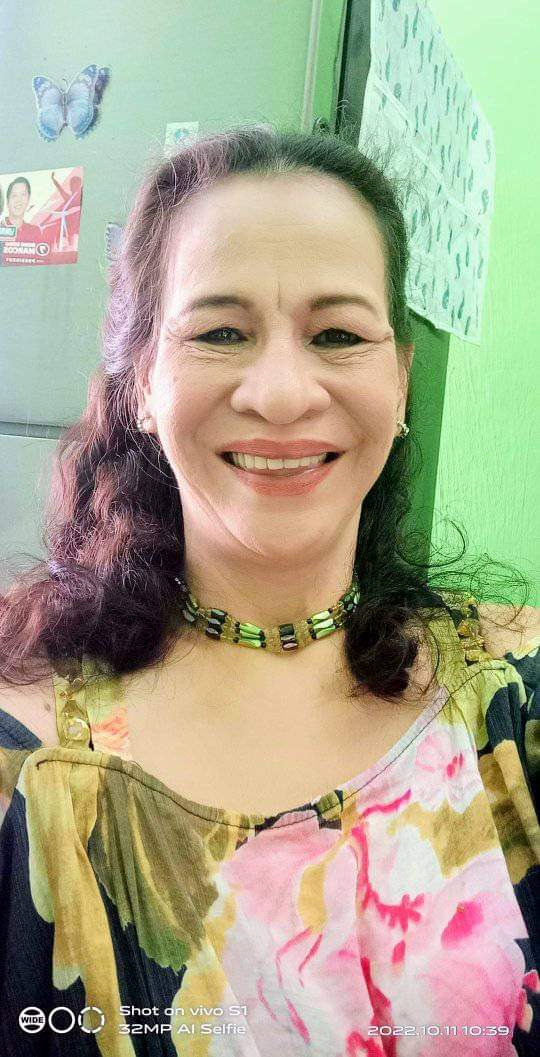
Lilian Dipasupil Kunimasa was born January 14, 1965, in Manila Philippines. She has worked as a retired Language Instructor, interpreter, caregiver, secretary, product promotion employee, and private therapeutic masseur. Her works have been published as poems and short story anthologies in several language translations for e-magazines, monthly magazines, and books; poems for cause anthologies in a Zimbabwean newspaper; a feature article in a Philippine newspaper; and had her works posted on different poetry web and blog sites. She has been writing poems since childhood but started on Facebook only in 2014. For her, Poetry is life and life is poetry.
Lilian Kunimasa considers herself a student/teacher with the duty to learn, inspire, guide, and motivate others to contribute to changing what is seen as normal into a better world than when she steps into it. She has always considered life as an endless journey, searching for new goals, and challenges and how she can in small ways make a difference in every path she takes. She sees humanity as one family where each one must support the other and considers poets as a voice for Truth in pursuit of Equality and proper Stewardship of nature despite the hindrances of distorted information and traditions.
Speak big, but take a bigger bite of bread, For things don’t always go as planned ahead. Be eager to grow, don’t envy the rest, Luck won’t come just when you request.
This world is wrapped in trials and strife, Sometimes you’ll stumble through the depths of life. Your stance, once tall, might bend in the breeze, And you’ll wonder when you fell to your knees.
Tears may flow as regrets fill your chest, But time, once lost, won’t give you its rest. You can’t erase mistakes of the past, Life’s law is clear, they’re meant to last.
Learn to rise when you stumble and fall, Set your goal high, let that be all. When faced with hurdles, fight and strive, Your foes will never arrive as friends.
Action, action, don’t ever cease, Stand strong, my friend, never release. In this world, everyone has their fight, Never let them bend your might.
Study and learn with all that’s provided, Your teachers guide you, always reminded. Defeat is the lesson, a gift in disguise, May God light your path toward the skies!
Saydinqulova Elenora Olimovna was born on June 24, 2008, in Kattakurgan district, Samarkand region. She is a 10th-grade student at the 66th General Education School in Kattakurgan district. In 2022, she took 3rd place in the district stage of the “Young Reader” competition. In 2022, she also secured 2nd place in the district stage of the “Zulfiyaxonim’s Daughters” contest and 2nd place in the district stage of the intellectual game “Zakovat,” becoming a participant in the regional stage. Her creative works have been published in the “Kattakurgan: Yesterday and Today” newspaper. She is a participant in international competitions and festivals. Her poems are regularly published in newspapers and magazines across the country.
Christopher Bernard will be reading at the Poets for Palestine SF Marathon Reading at San Francisco’s Bird and Beckett Bookstore. For a donation of any amount to the Middle East Children’s Alliance, a nonpartisan and nonpolitical organization helping all children in the region, poets can come and read at any time at the store on October 14th, Indigenous People’s Day. Please feel welcome to sign up here or email poetsforpalestinesf@gmail.com to be scheduled.
This month’s issue addresses our fears and aspirations: whether life will become what we dread, or what we hope.
Wazed Abdullah revels in the joy of the Bangladesh monsoon as Don Bormon celebrates flowers and wispy clouds in autumn. Maurizio Brancaleoni contributes bilingual haiku spotlighting days at the beach, insects, cats, and the rain. Brian Barbeito shares the experience of walking his dogs as summer turns to fall.
Soren Sorensen probes and stylizes sunsets in his photography series. Lan Qyqualla rhapsodizes about love, dreams, flowers, colors, poetry, and harp music. Ilhomova Mohichehra poetically welcomes autumn to her land.
John L. Waters reviews Brian Barbeito’s collection of poetry and photography Still Some Summer Wind Coming Through, pointing out how it showcases nature and the “subtle otherworldly” within seemingly ordinary scenes. Oz Hartwick finds a bit of the otherworldly within his ordinary vignettes as he shifts his perspective.
Kelly Moyer crafts stylized photographic closeups of ordinary scenes, rendering the familiar extraordinary. Ma Yongbo paints scenes where ordinary life becomes unreal, suffused with images associated with horror.
Sayani Mukherjee speaks of a bird’s sudden descent into a field of flowers and comments on our wildness beneath the surface. Jake Cosmos Aller illustrates physical attraction literally driving a person wild.
Mesfakus Salahin asserts that were the whole natural world to become silent, his love would continue. Mahbub Alam views life as a continual journey towards his beloved. Tuliyeva Sarvinoz writes tenderly of a mother and her young son and of the snow as a beloved preparing for her lover. Sevinch Tirkasheva speaks of young love and a connection that goes deeper than looks. llhomova Mohichehra offers up tender words for each of her family members. She also expresses a kind tribute to a classmate and friend.
Meanwhile, rather than describing tender loving affection, Mykyta Ryzhykh gets in your face with his pieces on war and physical and sexual abuse. His work speaks to the times when life seems to be an obscenity. Z.I. Mahmud looks at William Butler Yeats’ horror-esque poem The Second Coming through the lens of Yeats’ contemporary and tumultuous European political situation.
Alexander Kabishev’s next tale of life during the blockade of St. Petersburg horrifies with its domestic brutality. Almustapha Umar weeps with grief over the situations of others in his country.
In a switch back to thoughts of hope, Lidia Popa speaks to the power of poetry and language to connect people across social divides. Hari Lamba asserts his vision for a more just and equal America with better care for climate and ecology. Perizyat Azerbayeva highlights drip irrigation as a method to tackle the global problem of a shortage of clean drinkable water. Eldorbek Xotamov explores roles for technology and artificial intelligence in education.
Elmaya Jabbarova expresses her hopes for compassion and peace in our world. Eva Petropoulou affirms that action, not mere pretty words, are needed to heal our world.
Ahmad Al-Khatat’s story illustrates the healing power of intimate love after the trauma of surviving war and displacement. Graciela Noemi Villaverde reflects on the healing calm of silence after war.
Meanwhile, Christopher Bernard showcases the inhumanity of modern warfare in a story that reads at first glance like a sci-fi dystopia. Daniel De Culla also calls out the absurdity of war and the grossness of humor in the face of brutality.
Pat Doyne probes the roots of anti-Haitian immigrant rumors in Springfield, Ohio and critiques fear-mongering. Jorabayeva Ezoza Otkir looks to nature for metaphors on the corrosive nature of hate.
On a personal level, Nosirova Gavhar dramatizes various human responses to loss and trauma. Kendall Snipper dramatizes an eating disorder ravaging a woman’s life and body.
Donna Dallas’ characters are lonely, bruised by life, and drawn to what’s not good for them: drugs, bad relationships, lovers who don’t share their dreams. J.J. Campbell evokes his miserable life situation with dark humor.
Meanwhile, Maja Milojkovic savors each moment as she creates her own happiness through a positive attitude. In the same vein, Lilian Dipasupil Kunimasa celebrates the power of a free and self-confident mind and the joy of spending time with small children.
Tuliyeva Sarvinoz urges us to move forward toward our goals with faith and dedication. Numonjonova Shahnozakhon echoes that sentiment, encouraging perseverance and resilience. S. Afrose resolves to move forward in life with optimism and self-respect.
Michael Robinson reflects on the peace he finds in his continuing Christian walk. Federico Wardal reviews anthropologist Claudia Costa’s research into spiritual fasting practices among the Yawanawa tribe in Brazil.
Duane Vorhees explores questions of legacy, inheritance, and immortality, both seriously and with humor. Isabel Gomes de Diego highlights Spanish nature and culture with her photographic closeups of flowers, religious icons, and a drawing made as a gift for a child’s parents. Federico Wardal highlights the archaeological findings of Egyptologist Dr. Zahi Hawass and his upcoming return to San Francisco’s De Young Museum. Zarina Bo’riyeva describes the history and cultural value of Samarkand.
Sarvinoz Mansurova sends outlines from a conference she attended on Turkic-adjacent cultures, exploring her region as well as her own Uzbek culture.
Barchinoy Jumaboyeva describes her affection for her native Uzbekistan, viewing the country as a spiritual parent. Deepika Singh explores the mother-daughter relationship in India and universally through her dialogue poem.
David Sapp’s short story captures the feel of decades-ago Audrey Hepburn film Roman Holiday as it describes a dream meeting between lovers in Rome. Mickey Corrigan renders the escapades and tragedies of historical women writers into poetry.
Duane Vorhees draws a parallel between Whitman’s detractors and those who would criticize Jacques Fleury’s poetry collection You Are Enough: The Journey To Accepting Your Authentic Self for having a non-traditional style.
This set of poems from Jacques Fleury expresses a sophisticated childlike whimsy. A few other pieces carry a sense of wry humor. Daniel De Culla relates a tale of inadvertently obtaining something useful through an email scam. Taylor Dibbert reflects on our escapes and “guilty pleasures.”
Noah Berlatsky reflects on both his progress as a poet and editors’ changing tastes. Sometimes it takes growing and maturing over time as a person to create more thoughtful craft.
Alan Catlin strips artworks down to their bare essential elements in his list poetry, drawing attention to main themes. Mark Young focuses on kernels of experience, on the core of what matters in the moment. J.D. Nelson captures sights, experiences, and thoughts into evocative monostich poems worthy of another reading.
Kylian Cubilla Gomez’ pictures get close up to everyday miracles: a beetle, car components, action figures, a boy in a dinosaur costume.
We hope that this issue, while being open about the worries we face, is also a source of everyday miracles and thought-provoking ideas. Enjoy!
Samarkand By Jama sadikov – Own work, CC BY-SA 4.0, https://commons.wikimedia.org/w/index.php?curid=82671171
Samarkand is a tourism center
Samarkand – an honorable past with a great future, can be called one of the greatest masterpieces not only of Central Asia, but also of the world. Even if the world’s greatest poets and philosophers called it the garden of the heart, the jewel of the East, the mirror of the world, and even the face of the earth, they would not have been able to describe all the beauty and wealth of this beautiful city.
This city has given birth to many great people in its bosom, raised them and is still keeping them in its bosom. The cultural heritage of Samarkand is very great. This city, which has been the center of various countries for centuries, has been the main center of the Great Silk Road. The great world-lover Amir Temur chose this city as the capital of his kingdom and developed the city as a political, cultural and educational center. Thousands of madrasahs, mosques, and gardens were built in Samarkand during the Timurid period. Over the years, the madrasahs he built have not lost their strength.
During the years of independence, reconstruction works were carried out throughout the city in order to increase the touristic character of Samarkand. At the beginning of the 21st century, the city was included in the UNESCO World Heritage List under the name “Samarkand – Crossroads of Cultures”! Today, the most visible places of the city are Registan ensemble, Shahi Zinda, Gori Amir complex and others. More than five million tourists from all over the world visit the city every year to enjoy its beauty.
In recent years, as a result of the work carried out by the government to develop tourism in the country, the tourist center of Samarkand was built in the city. Four-five-star hotels, conference halls, entertainment centers, and an eternal city were built there. Journalists of the prestigious European publication note that the opening of the Silk Road Samarkand complex will increase the flow of tourists to Uzbekistan. With the attention of our state, the city is becoming more beautiful year by year, which leads to rapid growth of domestic and foreign tourism. The growth of tourism also affects the development of economic and social spheres in Samarkand.
I dreamed and found you young again somehow transported across the Atlantic, past Gibraltar then Corsica, over the waves of the Mediterranean. I arrived quite dashing in a light linen suit and polished Italian shoes, in a little white sportscar, over ancient brick streets and through Di Chirico piazzas and skewed Zeffirelli perspectives at your flat in Rome set curiously in the forum at the edge of the Palatine Hill. I took you in my arms, circled your waist, and my palm found the small of your back.
You twirled for me, flipping the hem of your dress, a black and white print in tiny cubist abstractions. We danced spinning through your bright rooms with the high ceilings like a chiesa expecting Raphael above our heads – an Assumption or an Ascension. You’d arranged vases of flowers, and the tables and chairs were strewn with opened books, chipped china, and the remains of bread and the dregs of wine from the night before. The windows were tall and opened wide, curtains drifting in the breeze, and allowed the shouts and cheers of scruffy boys kicking a soccer ball outside. And there was a jumpy, comedic Italian tune playing from the phonograph – the kind of music that makes you want to whirl around the kitchen with your mother or gambol with your little sister balanced on your shoes.
So pretty and poised, you were Audrey Hepburn in Roman Holiday after she got her hair cut short, raced Gregory Peck on a Vespa, and stuck her hand in the Mouth of Truth. Giddy, we laughed and ached and wept, immediately in love again. Your bedroom walls and the quaint watercolors you bought of the Pantheon, Colosseum, Spanish Steps, Trevi Fountain, and that little temple of Portunus near the Tiber – the very ruins around us seemed to laugh too, happy for us. But when I leaned in to kiss you, our lips refused to touch, to meet as willing participants in a prelude to desire. I heard, “Remember, you’re married.” Instantly I returned flying back across the ocean in my little white convertible to that other bliss I’d live after waking. And that was all. That was enough.
Christopher Bernard will be reading at the Poets for Palestine SF Marathon Reading at Bird and Beckett Bookstore. For a donation of any amount to the Middle East Children’s Alliance, poets can come and read at any time at the store on October 14th, Indigenous People’s Day. Please feel welcome to sign up here or email poetsforpalestinesf@gmail.com to be scheduled.
A Day in October
A child holds his breath
like a frightened pet to his chest.
*
His eye peers through a hole
in the wall of his night room,
in the acid dust of siege
and cage of bone and blood,
in the code of an algorithm
governing AI
that has made the ineluctable
decision he shall die.
*
His eye, brown as honey,
watches you, intently.
*
It is like the eye in a castle wall
where hungry defenders await the burning
arrow vaulting through a sky
dark as velvet,
to break a mother’s shield
and wipe her tears with ashes
*
and build in pillars of fire
a school where future terrorists
(according to the omniscient
and infallible AI),
are learning, even now, their alphabet.
*
_____
Christopher Bernard is an award-winning poet, novelist, and essayist. His book The Socialist’s Garden of Verses won a PEN Oakland Josephine Miles Award in 2021 and was named one of 2021’s “Top 100 Indie Books.”