
Last Wording


half the polar well

holds the harming serve

until breathers moan


     again loaded

     culminating adobe details


                         in the foreground cove


                while


the tattered syllable recluse

celebrating from coherence


             occupied yogurt armor

             between aggressive pouncing


where

           cufflinks rotate

                                   cowl interjections


     rubbed beyond

     new reconstruction torpedos


                 bamboo cracks

                 pandemic eccentricities


                                in seance


                           *


grammatical stalling

skewers one written

empire

            patriarch iced


legend’s fixative seeks nods


     distrust empurpled

     celebrity hump rebuffs

     where a lead terrorist


                 bends to cold pavement


                          broadening

                          perceptible calamities


bustle correspondence deadened a utopia decoy


                           *


moon’s wake

the orthographic effigy


     put refraction thoroughfares

     lunging                        apart

                     aggressor

                  progressions


                          gone

                          with the global


                                  valence


          present condemned

          a rope motive

                                in the echoed slab


                  reputation boiling

                  clauses to memoir debauch


                                              endowment removed


History Happening


extreme sanskrit multiplex directive

commotion scattered babel tongues

across the time of papyrus infusion

caverns gave coded empathy shrouds

a place to gather against the wind

or another ark to flood with animals

contained to pair for a bearded one

stoning down mountain imperatives

androgynous caverns heaving a glide

toward the desert suit filed into sand

temptations crystallized their renewal

before the reflection written to fix

the derelict card careening passion

through undirected profusion litters

light crystals prismatic sun spokes

an emerging moon theme in motion

revolving over the nighttime desert

where billowed plans will resolve

with the crux of historic anticipation

carried to any nearby tree will do

the sect projection beyond the day

the exempt declared renewed grit

and peremptory sandstone polish

not the rain of provisional passing

furnished a new micrometer legend

whose replications dated calendars

when their makers proved reluctant

snapshots in the tiller thatch missed

no embryonic passport in the thicket

or watchful rushes bulling paparazzi

to divide the walls that conquer all

tablets that broke their millennium

before the requisite numbers spread

the vast mirage of new mother's milk

spread through forty days of microbes

tempting the igneous with sediment

promised to deliver layered history

to seeking prophets under threat of

renewed octagon vengeance made

before the form could fake ascent

on the choral donations or decor

as added to the licentious playbill

rostered pagan invasion sealant

before fumes could accrue tarnish

receptacles reeling with plasma grief

worn follicle ventures packing meat

of their belief into a worn sleeve’s fray

no doppel to gang a loose parlance

with a part from the other to match

the fetid geometry buckle in manure

angling the portal drop toward hay

where they fielded lain shepherds

deepened their sleep wherever

the sale of their sheep relocated

their hostile ambience a matter

of sacred discord when aroused

the cult of thirteen ran the dozens

against a predictable implosion

felt rummaging vegetable sponsors

when old spoons entice the lurid

a cult device records the subtext

no graphic delayed for the new ride

a molecular detergent foray decries

testicular headings over horsemeat

babble at the slowed compendium

forming a triage from the fictive mix


Dream a Generation Away


rutabaga polish

rides a sanskrit momentum


calypso fury casts the last rendition


		*


enamel passion

brings its own veneer

to hidden sightings


vegetation budgets an inner flourish


before melting lavender

pots its ancient shrug


while inaction seeks its tongue


		*


an action pursued

the molting factotum legend

of suit incarnation


dispassionate, buried

seven layers of ancient cities

bubble above the shale


		*


radical depiction

cherishes a hairy flourish


the vegetable innovative crew


merrily words away

the gray whitening to the rhythm’s light


an edition only dreamed to last


BIO

Vernon Frazer’s most recent poetry collection is Memo from Alamut.
Category Archives: CHAOS
Poetry from Christopher Bernard
Deep Winter


White sky blue earth

a road of wind hard as stone between them

the sun swings his walking stick as he strolls
across the boulevards of February

a small bird wings to a rain gutter
sleeved in snow
or perhaps it was only a mirage

a child sits at a window
making faces at an impending storm
it does not believe in blizzards

but it loves them

you hold my love like a globe of ice
where a soul once would have been

no the winter sovereign in your mind
will never become my final hope for spring

____

Christopher Bernard is an award-winning poet, novelist and essayist. His most recent books are the first two stories in the series “Otherwise,” for middle-grade readers: If You Ride A Crooked Trolley . . .  and The Judgment Of Biestia.
Essay from Meylieva Zebiniso
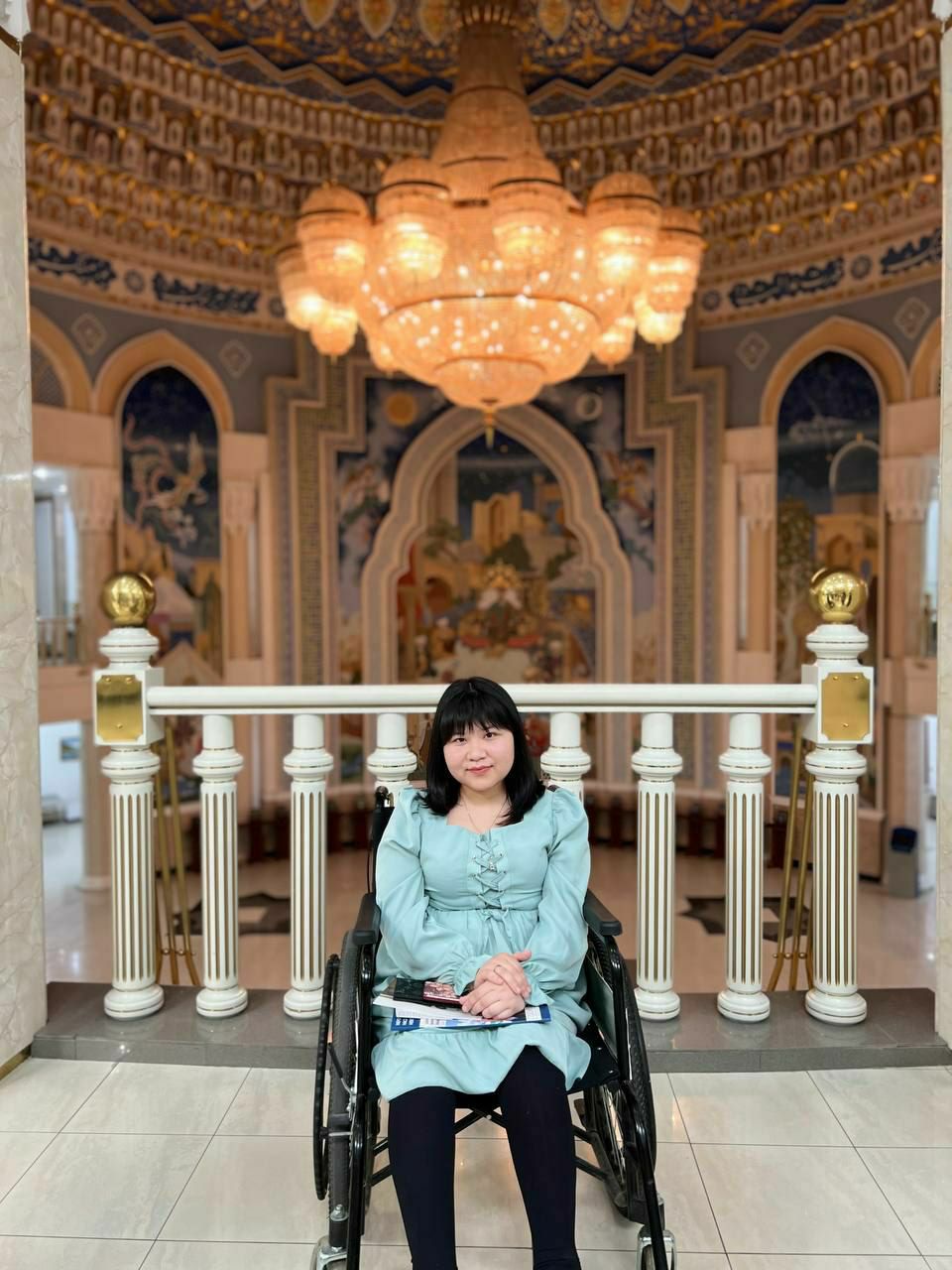
THE ROLE OF PEDAGOGICS AND PSYCHOLOGY IN IMPROVING THE QUALITY AND EFFICIENCY OF EDUCATION AND THE FORMATION OF HUMAN VALUES AND PERFECT GENERATION
In the name of Mirzo Ulugbek
National University of Uzbekistan
2nd stage student Meiliyeva Zebiniso
ABSTRACT: This article provides information about the role of pedagogy and psychology in improving the quality and effectiveness of education and the formation of a mature generation.
Key words: pedagogical technology, pedagogical approach, educational technology, “Chain game”, “Brainstorming”, “Thoughts attack”, “Networks” method, “Sinquain”, “BBB”, “Fifth plus” , “6x6x6”, “Discussion”, “Role-playing game”, “Working in small groups”, “Brain-ring”.
Personality maturity is characterized by having physical, mental, political, legal, moral, ecological and aesthetic aspects. These aspects of maturity occur unevenly, that is, at different rates. For example, the physical maturity of a person is almost the same as it was 50 thousand years ago. However, in the mental maturity of a person, due to the development of thinking, very large positive (forward) shifts have been observed. Pedagogy studies the development of personality together with all its components. If we look at the history of mankind, there has been pedagogical activity in all periods. The birth of a person is not only a natural-biological event consisting of birth, but after birth, rising to the level of development of one’s time, acquiring the existing socio-historical experience, determining one’s place in society, becoming an active participant in the historical process. becomes In this process, the older generation begins to transfer its experience of life, struggle and work, knowledge and skills to the younger generations[1].
The process of development, formation and maturation of a newborn child was guided and managed. This was done through a social phenomenon called education. As the society developed, the need to cultivate mature, well-rounded individuals also increased and changed, updated, and served the society. Creation of educational institutions at different stages of society, goals and tasks of education, state education standards, methods of education and education, forms of organization, knowledge of its laws, became an informative science. The main task of education and training is to realize the intellectual and practical potential of young people, to show their creative abilities, to ensure their intellectual development, to choose the profession they want, to master it perfectly, and to work happily in this field. consists of creating material, spiritual, educational and didactic conditions. Specific tasks of each link, type and stage of education arise from this general task[2].
Independence made great changes in the field of public education as well as in all fields. Now our national pedagogy is developing rapidly. From time immemorial, our ancestors paid special attention to child education. Al-Bukhari, At-Tirmizi, Beruni, Az-Zamakhshari, Nawai, Babur, Agohi, Abdullah Awlani, great scholars, writers, virtuous scholars, wrote many works on education. They focus on national characteristics in education. Personal maturity is a complex, long-lasting conflicting process characterized by a dialectical transition from quantitative changes to qualitative changes in the physical, mental and spiritual characteristics of a person. Personality development is a general scientific category of the sciences of psychology and pedagogy, while psychology explains the laws of spiritual development of a person, and pedagogy creates a theory of managing the development of a person with the goal of forming a perfect person and a perfect generation. not studied at the level. It is known from history that Eastern pedagogy once flourished. When the German scientist Herler said, “The East is the author of Europe”,[3] he probably meant these periods of development. In our country, the upbringing of a mature generation is of great importance in the establishment of a democratic legal state and civil society. It is important to create a healthy social environment, to fundamentally reform the education system, to restore and honor national and universal human values in the education of young people, who are the foundation of our future. in a word, it is possible to self-realize, to live in a free and free society, to selflessly fight for our independent country to occupy a worthy and prestigious place in the world community. Pedagogy develops based on the development laws of society. Today, this process has reached its peak. In particular, the work being done to establish a legal state shows that the national consciousness is rising day by day. As long as the human consciousness does not progress, no change is felt in the aspects of social life. Already, “Only a truly enlightened person can selflessly realize the human value, the values of the nation, in a word, his identity, live in a free and free society, and take a dignified place in the international community of our independent country.” can fight”[4]
In short, today we have a “storehouse” of games, from simple games that develop the child physically to intellectual games that are popular among adults. With the use of all modern teaching technologies in games, the student quickly learns the conditions of the game and accepts the task assigned to him. In the process of fulfilling the rules of the game, the player has the opportunity to freely make his own optimal decisions in solving the problems in the game. In the process of using modern teaching technologies, the personal quality of the students will improve, the student will be able to improve his abilities in the future, be able to use them correctly in his professional activities, and of course create an opportunity to become a perfect person. effectively using the conditions created on the basis of such modern requirements, the organization of lessons on the basis of advanced pedagogical and information communication technologies guarantees the quality of the educational process. Professional skills are formed on the basis of acquired knowledge, activity skills and life experience. [5]In order to have a high spiritual and moral and professional qualification, a person should be able to set a specific goal and constantly search for it, read and learn. Only then will he become a qualified staff, resistant to social competition. Having a sense of self-awareness, being able to fully and effectively use the services in the field of education, and achieving thorough assimilation of scientific and professional knowledge create a foundation for a person to become a mature specialist. The perfection of a person, first of all, depends on him.
REFERENCES:
1. K. Hoshimov, “History of Pedagogy” Tashkent 2005. 87 Scientific, distance, online conference No. 10 “Pedagogy and psychology in the modern world”
2. J.Kh. Yoldashev ―New pedagogic directions, problems, solutions‖. “Public education” magazine, T., No. 4, 1999
3. K. Ismanova. Organization of practical lessons using innovative methods. — Journal of educational problems. Issue 2, 2012.
4. RZ Samadovna, KS Narzullayevna, SG Ergashevna (2020). Technology for the development of logical thinking in students in primary school. Journal of Critical Reviews 7/6. pp. 485-491.
5. T.M. Mukhamadovna, K.M Dzhamshitovna, K.S Narzullayevna (2021). Art as a significant factor of forming world outlook of students. Middle European Scientific Bulletin vol. 11 pp. 426-430.
[1] K. Hoshimov, “History of Pedagogy” Tashkent 2005. 87 Scientific, distance, online conference No. 10 “Pedagogy and psychology in the modern world”
[2] J.Kh. Yoldashev ―New pedagogic directions, problems, solutions‖. “Public education” magazine, T., No. 4, 1999
[3] T.M. Mukhamadovna, K.M Dzhamshitovna, K.S Narzullayevna (2021). Art as a significant factor of forming world outlook of students. Middle European Scientific Bulletin vol. 11 pp. 426-430.
[4] K. Ismanova. Organization of practical lessons using innovative methods. — Journal of educational problems. Issue 2, 2012.
[5] T.M. Mukhamadovna, K.M Dzhamshitovna, K.S Narzullayevna (2021). Art as a significant factor of forming world outlook of students. Middle European Scientific Bulletin vol. 11 pp. 426-430.
Meylieva Zebiniso Mirkomilovna was born on June 4, 2003. She is a second-year student of the National University of Uzbekistan. Future Practical Psychologist. Her creative works have been distributed in numerous nations around the world Envoy on sake of Uzbekistan to a few worldwide organizations. Specifically: “SPSC-(Sustainable Programmers and Sustainable Collaborators). ambassador”, “GLOBAL GOODWILL AMBASSADOR 2023”. Member of the international organization “All India Council for Technical Skill Development” of India. IQRA FOUNDATION PEACE AMBASSADOR.
ACTIVE MEMBER of the Word Writers and Artists Working Group “JUNTOS POR LAS LETRAS
Poetry from John Edward Culp
+


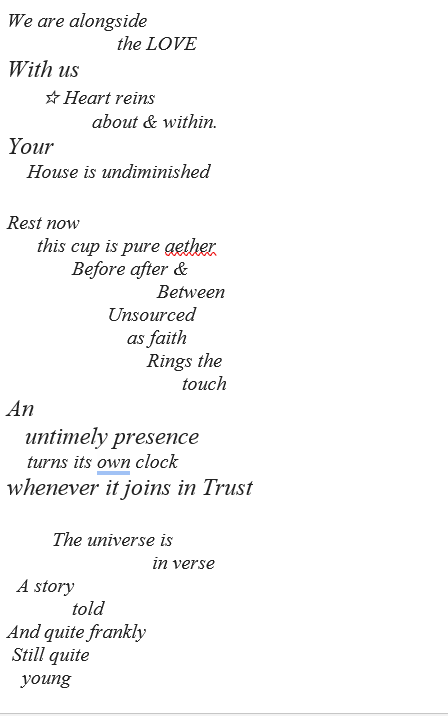
We are alongside
           the LOVE
With us
   ☆ Heart reins
       about & within.
Your
  House is undiminished

Rest now
   this cup is pure aether
      Before after &
               Between
          Unsourced
            as faith
              Rings the
                  touch
An
 untimely presence
  turns its own clock
whenever it joins in Trust

    The universe is
              in verse
 A story
      told
And quite frankly
Still quite
 young

                                                ............


by John Edward Culp
   Sunday morning
   January 28, 2024

Poetry from Alan Catlin
768-

Love. All you need is. Makes the world
go ‘round. Is a many splendored. Thing.
Love Shack. Love Boat. Love Canal.
Kevin Love. Thirty Love. Forty-five love.
Sixty. Love. Somebody to. Love. Hiroshima
My. Love. Love hurts. Love is a battlefield.
Love at six thousand degrees.


		769-

Joy in the morning. Joy to the world.
All the boys. And girls. Joy to the fishes
In the deep blue. Sea. See. Blue Meridian.
Blood Meridian.  Jeremiah was a.
Prophet.


		770-

Violent Femmes or Psychedelic Furs.
Dead Kennedys or Dead Milkmen
It’s all happening at zoo.  Charlie
Don’t Surf. It smells like.
Teen spirit. Victory.

		771-

Astro turf never needs water.
Plush lawns for pink flamingoes.
Black jockey statues with ring
handles. Tethers for ghost ponies.
Kissing cousins to Christmas displays.
The reindeer. And the elves.
Yard dwarfs and garden gnomes.
Paint them with glitter. Glow in
the dark colors. Lawn ornaments
need attitudes.


		772-

Easy reading or Life Stories

Briefing for a Descent into Hell
or Woman of Solitude

The Golden Notebook or
The Bell Jar

Canticle for Liebowitz or
Wittgenstein’s Mistress

Desert Solitaire or
Arctic Dreams

Hades in Manganese or
An Alchemist with One Eye
on Fire

Portrait of Dorain Gray or
A Guided Tour of Hell (again)

		773-

Patti Smith. Solo. Portraits of
people. Stuff. Walt Whitman’s
tomb. Sonic’s Fender. Cross with
a mirror. Mapplethorpe’s hands.
His slippers. His star mirror, London.
His cross. Jesus with a flower.
V. Woolf’s cane. Duncan Grant’s
paintbrushes.  Pitted mirror, East
Sussex. The River Ouse. Robert
Graves’s straw hat. William Blake’s
head. Not a Fordham Baldie.  A
visionary. Brighton Beach sea gull.
Herman Hesse’s typewriter. Bust of
Baudelaire. Brancusi’s grave. Ingres’s
Christ detail. Rimbaud’s eating
utensils. Godard seated, Alexandria.
St Sebastian. Details. Arrows. Turin.
Shroud. Details. Stuffed bear with a
Calling card tray. Tolstoy’s house.
No one home. Self Portrait 2003.
Unfocused.

776-

Ocean Avenue Salvage: A Personal History
Of:

My mother’s metronome

Her mother’s books
DeMaupassant
Robert Louis Stevenson
Richard Harding Davis

My mother in law’s tea cups
My father in law’s tools

My step-mother’s wicker baskets
My father’s picture in a heart shaped frame

Their Shaker Art

It’s a gift to be simple
Poetry from Ian Copestick
The Police Questionnaire
--------------------
Someone I know
is trying to join
the police force.

I know
I feel the same
way too
but I really love
this person.

I was asking them
how the first online
interview went.

'It's just like a kind
of questionnaire
sort of thing.
What would you do
in certain circumstances'

Me, being a natural
piss taker said;

You come across a
gang of white men
standing around,
and a black man
on the floor, bleeding.

Who do you arrest ?

If you answered

The black man.

Welcome to the police.
Synchronized Chaos February 2024: Ecosystem of Ideas
First of all, here’s an announcement! Regular Synch Chaos contributor, poet Taylor Dibbert, has a newly released collection of his poetry, Invictus, available for purchase.
Also, past contributor Areg Azatyan’s novel The Flying African has just been released from Frayed Edge Press! Translated from the Armenian by Nazareth Seferian, the book follows the journey of an unnamed traveler, a young Armenian writer who spends fifty-four adventurous days in Africa, one day in each of the continent’s countries.
We are also hosting a free public literary reading in conjunction with the Association of Writing Programs conference next month in Kansas City, MO. This will be at 6pm on the evening of February 7th at Prospero’s Books. All are welcome to come and hear the readers!
Now for this month’s issue: The Ecosystem of Ideas.
Terry Trowbridge probes the intricate world of pillbugs under the ground while Don Bormon looks into the hardworking and cohesive colonies of ants.
Gulsevar Xojamova draws on the rainbow as a symbol of natural beauty and urges her country’s people to embrace the beauty and pride of Uzbekistan.
Sayani Mukherjee relates the “touch and go” nature of winter, when nature is not all dormant, but awaiting a streak of warm and dry enough weather. Azemina Krehic evokes the bitter, sucking, deathly cold of winter wind and snow. Meanwhile, Uzbek writer Nosirova Gavhar regales us with the beauty of nature and her country’s folk traditions in the spring.
Brian Barbeito suggests that woodland ecosystems should be considered a living thing in their own right, not simply the sum of living species. Ali Akramov looks into the effects flooding has on mountain geology and ecosystems.
Jerry Langdon’s poetry bridges the worlds of nature and culture as he writes of the destruction wreaked by fire, lightning, and a slow-burn romantic breakup. Mahbub Alam continues in that vein by drawing on the language of marriage to express a human union with the natural world, while Mahmudul Hasan Fahim explores the emotional, ecological, and social ramifications of different cultural funerary customs.
Z.I. Mahmud explores how poets Mary Oliver and William Blake reflect the inextricable unity of humans and nature through their Romantic and spiritual poetry.
Sayani Mukherjee‘s poetry explores the world of Paris, New York and London while Mark Young humorously compares himself to pop culture icons of past and present and Odina Rustamjonova looks into the strengths and weaknesses of the mass transit systems within Uzbekistan. Maja Milojkovic highlights a little-known cultural and linguistic connection between Tunisian Arabs and Serbians.
Isabel Gomez de Diego sends up a mix of personal and grandiose moments of contemplation and holiday celebration.
Lilian Dipasupil Kunimasa highlights the value of personal development, urging us to take the daily steps to prepare our hearts and lives to be ready for extraordinary moments of grace.
Nafisa Abralova’s drama highlights the importance of education, discipline, and responsibility for children under our care while Charos Toshpulatova traces the development of the idea of and legal precedent for the rights of children.
John Mellender addresses growing up, laying aside or recognizing the limitations of one’s youthful idealism. Muhammed Aamir evokes a future world where we can regenerate our loved ones with the help of technology. John Edward Culp envisions his future great-grandchildren eating together and showing concern for each other in the same park where he’s doing the same for his loved one.
J.J. Campbell mixes a bit of nostalgia and anachronism in his monthly pieces on loneliness and despair, as he’s “playing jazz in a world of heavy metal.” Saad Ali mixes together history, poetic device, and love in his variety of experimental pieces.

Kristy Raines speaks to the emotional connection of true love while Ifora Bahramova paints a simple domestic scene of love between a mother and her young children. Ari Nystrom-Rice evokes childhood playground memories in his poem on the loss of a close friendship.
Safarova Zarnigor analyzes a delicate poem from Faynberg about love lasting over time while Sevinch Saidova relates the story of a man who struggles with addiction and health issues and the family who loves him unconditionally. Oona Haskovec reflects on her loneliness and desire for caring friendship, staring at her hands while eating alone in her kitchen.
Oaoao Pbobo reminds us of the joy of learning to read and write and the doors it can open for us. Nigora Tursunboyeva explores the depths of poetry and emotional resonance within the work of Uzbek children’s author Khudoyberdi Tokhtabayev. Aziza Umurzakova highlights the role preschool and young children’s education can play in a healthy nation.
Diyora Bakhodirovna outlines how new educational technologies may enhance student learning.

Nozima Baxtiyorova suggests that the technology used to continue children’s education during Covid-19 could be extended for their benefit as the pandemic lessens. Malika Kaxarova explores linguistic figures of speech and the role they play in cognition and the field of cognitive linguistics.
Mahbuba Juraboyeva outlines the importance of proper and professional speech to the legal profession while Bahora Baxtiyorova celebrates an important business leader in Uzbekistan who harnesses modern social media methods for communication and advertising. Elmaya Jabbarova honors the power, dignity, and beauty of her homeland of Azerbaijan while Faleeha Hassan conjures through her words a fanciful street scene complete with fish vendors and confetti and sandstorms and J.D. Nelson’s five monostichs hint at imagined vignettes from daily life.
Dilnoza Ochildiyeva outlines the history and heritage of her Uzbek homeland while Maftuna Imamova discusses strategies for enhancing Uzbekistan’s economic position in world markets.
Mesfakus Salahin dreams of a more peaceful and compassionate world in the future while Anila Bukhari illustrates how girls should be allowed education and freedom.

John Grochalski speaks to the many small and larger ways we assert our independence and existence as individuals. Skye Preston crafts a flash Gothic-esque sketch where a young woman vows not to take after her parents, and we find out why.
Sabrid Jahan Mahin points out the mysteries still unknown about how our brains work, although they are the strongest problem-solving force we have. The San Francisco Ballet’s new show Mere Mortals, here reviewed by Christopher Bernard, explores the Greek myth of Pandora and the fine line between human exploration and empowerment and human selfishness and evil.
Chimezie Ihekuna challenges himself to reconsider conventional wisdom in his frustrating search for truth. As for truth, Dr. Abdul Awal explores scientific, philosophical, and spiritual insights found within the Koran. Graciela Noemi Villaverde presents a protagonist whose heart has hardened because he no longer listens to the tender muse of compassion, mystery and poetry, while Mirta Liliana Ramirez depicts a heart that regenerates after repeated emotional destruction.
Bill Tope relates the tale of a courageous woman who rises up from near-devastation and solves her own rape, while Doug Hawley ponders whether the same person can handle the public and “beautiful” aspects of art and the more practical and business oriented features in his piece on two twin sisters.
Peter Cherches explores identity, plagiarism, the bounds of self-expression and alter egos in his short story that looks into what it can take to make it as a writer. Duane Vorhees renders the act of writing into something physical, dragging words and thoughts and other substances across the page.
Joshua Martin reviews Irene Koronas’ new collection gnostos, which plumbs the depths of a plethora of connected areas of knowledge and thought. He also covers Daniel Y. Harris’ new book The Metempsychosis of Salvador Dracu, which also merges human thought in the form of code and in poetry and illustrates the permeability of our concepts of personhood.
Jim Meirose also suggests an interplay of the biological and astrobiological and linguistic in his short story while Alma Ryan’s speaker dances through a portal into an artist’s dream of beauty and precarity, where paper figures live and die among splashes of paint.

James Whitehead speculates on how concepts and language itself could become a prized economic good fought over by villages and nations.
Ahmad Al-Khatat talks of how he would give up much, but not his hard-won life experience from surviving war. Meanwhile, Norman J. Olson addresses the futility of armed conflict.
Mykyta Ryzhykh speculates on “graves without flowers” – the unremembered dead – and on “flowers without graves” – the potential of celebrations without death – and mourns the loss of human and even animal dignity in alienating modern life and warfare.
Jacques Fleury addresses the inherent systemic racism of being loved as a brand who can perform and make money for others, not as a person.
Daniel De Culla denigrates fascism wherever it may arise: Spain, Argentina, Italy, or the United States.
Biloldin Mahmudov outlines diplomatic etiquette, instructing aspiring diplomats while at the same time granting grace and dignity to the role.
Stephen Jarrell Williams expresses hope for humanity’s and Earth’s future through his science-fiction poetry.
Michael Robinson speaks to the personal, spiritual and physical renewal he found after surviving open heart surgery. Annie Johnson also delves within the individual psyche, tracing a dream journey.
Kholida Toirjonova reflects on how one day she will leave behind those who may or may not properly mourn her, and it will no longer matter.
Salomova Dilfuza brings up the brevity of life and urges us to make the most of our limited time, while Sevinch Erkinova doesn’t regret a moment of her life, joyful or sorrow-filled.
Thank you very much for reading this month’s first issue of Synchronized Chaos. We hope that you do not regret even one minute of your read, and we encourage you to comment on the submissions and engage in dialogue with the authors and artists.