From the Mists of the Moon

From the mists of the Moon I was born
Avalon remembered in a silky dawn
Riding side saddle out of the Sea of Tranquility
Soft, soft, pale silver light riding
Shimmering silent and still.
Oh, soul of the pale echoes
The forgotten dreams of waves,
Of motion, of eddies, the whirlpools
Of becoming will.
Carry me golden sea horse
Into the valley and over the hill
Galloping against the head wind, wayward
With wild hair flying,
Send me cascading downward
From bright rainbows mounted
Atop my bright majesty, dump me
Into the sluice of sunbeams
Rising to meet me
Careening homeward to Earth
In my quickening dreams.

From the mists of the moon I come
Riding the waves homeward
Alee of my dreams breaking shoreward
In the shadowy wake of morning.
Homeward, homeward in dreams
Of dawn and sunshine spreading
Like a mantle of gold
Worn only for best-day;
Adorned with ribbons of stars
All dripping of midnight
I stretch out to dry on the beach
Of high noon reality and breath.
From the mists of the moon I come
Giddy and girl-like, tiptoeing home
Long after midnight, dreamily disheveled
Hair tangled with the taste of night
And the songs of a lunar prom
Lingering on rose petal lips -
I enter the house of day
Pregnant with moonlight.


Annie Johnson
Annie Johnson is 84 years old. She is Shawnee Native American. She has published two, six hundred-page novels and six books of poetry. Annie has won several poetry awards from world poetry organizations including; World Union of Poets; she is a member of World Nations Writers Union; has received the World Institute for Peace award; the World Laureate of Literature from World Nations Writers Union and The William Shakespeare Poetry Award. She received a Certificate and Medal in recognition of the highest literature from International Literary Union for the year 2020, from Ayad Al Baldawi, President of the International Literary Union. She has three children, two grandchildren, and two sons-in-law. Annie played a flute in the Butler University Symphony. She still plays her flute.
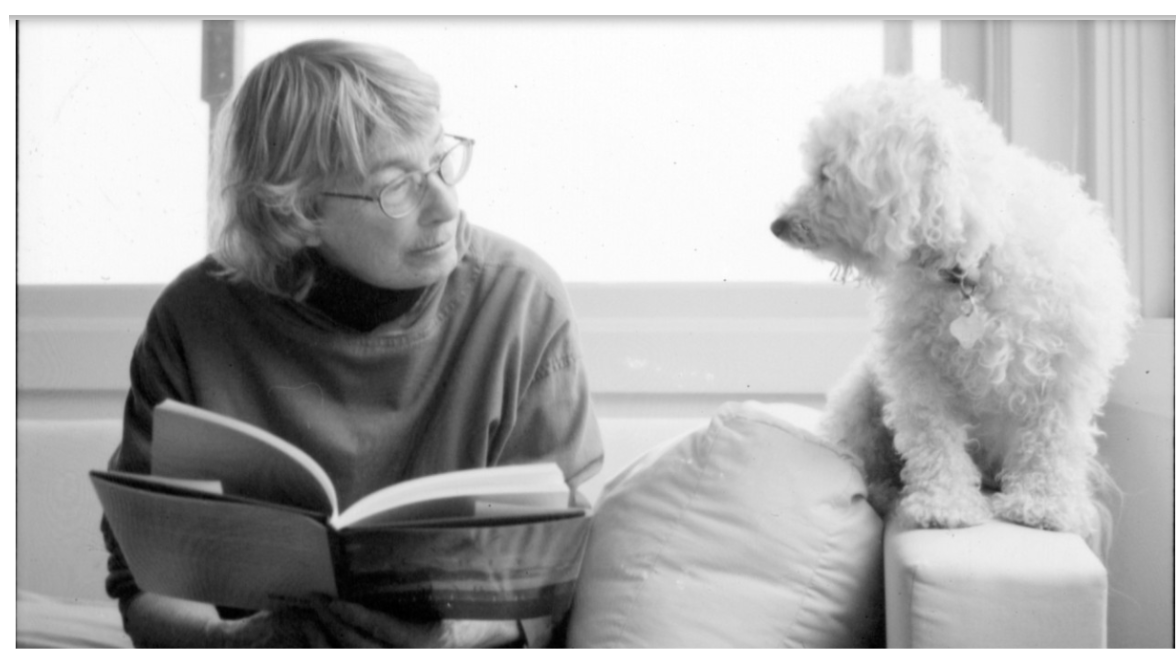
Examine Mary Oliver’s Sleeping in the Forest, Twelve Moons with critical commentary.
“The special puzzle of Romanticism is the dialectical role that nature had to take in the revival of the mode of romance. Most simply, Romantic nature poetry, despite its long critical history of misrepresentations, was anti nature poetry […] Romantic or internalized romance […] tends to see the context of nature as a trap for the mature imagination.” Harold Bloom’s The Internalization of the Quest Romance
“It is the destiny if consciousness […[ to separate from nature, so that it can not only transcend not only nature but also its own lesser forms.” Georey Hartman’s Romanticism and Anti Self- Consciousness
Bloomian and Hartmanian tradition of Mary Oliver’s romantic nature poetry dichotomizes the antitheses between nature and self, body and soul, consciousness and unconsciousness, subject and object, nature and culture, language and muteness, death and immortality, imaginative speaker and immature child, transcendence and immanence. The speaker of the poem recollects the mystical closeness and amity with the natural world as suggested by the ritualizes camp trip sojournings in the forest floor of the maternal earth engulfs her like “as if she feels in water”. Herein the poet laureate superimposes the visionary selfhood upon “a stone on the riverbed”; because her drowsiness is not a blankness but the labyrinthine “lichens and seeds”.
The poet and the speaker impersonate Wordsworthian philosophical mind and Yeatsian Artice of Eternity through mimetic imitation of rocks, stones and trees of Wordsworth “A Slumber Did My Spirit Seal”. Witches, spinsters, crones and mother nature begin to speak for themselves, they transvalue their romantic forefathers’ mythic assessments as they defy the doom of muteness placed on all these female others who inhabit masculine poetic landscapes. Mary Oliver’s poetic revolutions embody mystical consciousness and experience of renewal. From the core of the heart’s engravings, Oliver’s everlasting bonding with nature in the face of sober truth memorializes the unity of the natural despite forsaking the association of supernatural eternity; her poems follow the cycles of the seasons to image loss and the possibility of renewal. Linda Gregerson reviews noteworthily, “She is not so much moved by the works of man, and she somehow contrives to love the world more than she loves language, no common feat for an artisan who works in words.”
Gratitude and reverence of the lyrical naturalist’s ardour of romantic nature poetry proclaims testimonial “I am sensual in order to be spiritual” amidst postmodern milieus. There is a fusion of Transcendental, Buddhist and Christian imageries grounded firmly in the earth, which Oliver views as God’s corporeality. Contemporary mystic of American poetry Mary Oliver stalks the edges of the marshes, journeying deep into the forests to open her breast to the known and the unknowable “as if the edge of sweet sanity” where “wild blind wings open” to interrogate nature of the soul, about its relation to the earth, about the damage of dualism it seeks to separate soul from body, body from earth and earth from the ultimate mystery of the immeasurable and unutterable nature of God heralded by Enlightenment.
Mary Oliver’s rapture with the nature such as the creatures of the wood and the sea, birds of the air, plants of the elds, trees of the forests—this is the liturgy of living things that the poet consistently dwells with and upon the elusiveness of the never-ending rosary.
Further Reading Janet McNew’s [St. John University] Mary Oliver and the Tradition of Romantic Nature Poetry, Contemporary Literature 1969, Volume. 30, No. 1, pp. 57-77, University of Wisconsin Press Journals Division Todd Davis’s The Earth as God’s Body: Incarnation as Communion in the poetry of Mary Oliver Christianity and Literature, Summer 2009, Volume 58, No. 4. Pp. 605-624
Mary Oliver
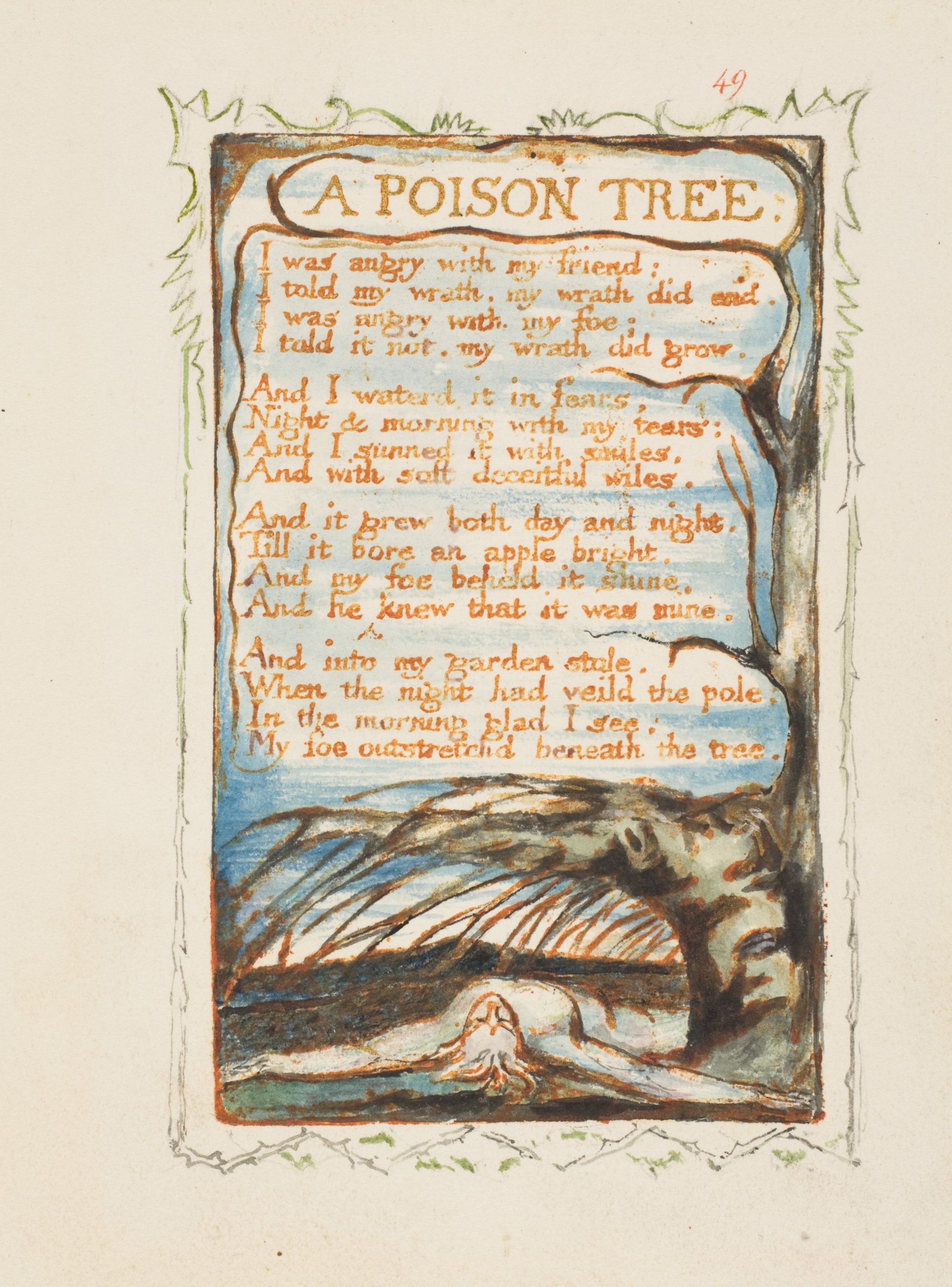
Examine William Blake’s A Poison Tree with critical commentary.
“A Poison Tree” is a counter myth which expresses the Biblical narrative of the Fall as a tree burlesquing the “Tree of the Forbidden Fruit”. Forbearance of the Wrath of God is anticipated in the allegorical symbolism of the poisoned tree as poetic vehicle, abstraction of human situation [repressed anger]. “I was angry …;/…my wrath did end.” propositional content and grammatical structure clash with substantiation of adjectival noun from angry towards wrath or indignation manifested as seven deadly cardinal vices that these lyrics implied in the metamorphosis of the whole poem. “I was angry with my foe, /I told it not, my wrath did grow.”——this couplet’s propositional content concerns the intensification of emotion, a subject now reinforced by the shift from angry to wrath. The shift is mediated by the pronoun “it”, which is indeed in this lyric Janus-faced part of speech; wrath can be cultivated following the verbs “watered” and “sunned”: “And I watered it in fears/ Night and morning with my tears;/ And I sunned it with smiles;/And with soft deceitful wiles.”——–
Wrath is watered and sunned with fears, tears and soft deceitful wiles; water’s alkalinity provides nourishing nutriment for the sustenance of the poison tree as the language oscillates between the conceptual and the phenomenal to provide a tangible equilibrium between the tenor and the vehicle. “And it grew both day and night/Till it bore an apple bright” —–herein the intense cultivation of anger culminates in literal incarnation which the poem’s conclusion is the incredible transformation despite the occurrence that cannot be gainsaid: “And my foe beheld it shine/And he knew that it was mine/ And into my garden stole/ When the night had veiled the pole/ In the morning glad I see, /My foe outstretched beneath the tree.”
Blake intends us to take the embodiment of deep malice and disdain to be the literalization of Milton’s Satanic forbearance from the forehead by the conceiving of sin. Objects become extensions or projections of the human agency as exploratorily examined in “A Poison Tree” in which the correspondence between human and the natural is […] pronounced […] “the apple bright of the poem” suggest [ing] […] a process where intense emotion repressed, because of binding social codes, is rendered into a tangible symbol.” The power of mind transcends that of the power of the matter in Blakean perspectives and poetic appreciation anthropomorphizing the inanimate and insensible to be personified symbolism of realistic living forms rather than mere poetic device of similitude.
Since […] “These poets knew that “All deities reside in the human breasts and their poetic tales or mythologies were imaginative account of imaginative reality and thus true” In other words, that the virtue of Christian forbearance is the psychological repression mythopoetically. For Blake the truth behind Genesis is that emanates anciently—and paradigmatically ——-a sneaking serpent of a man sought in the vested venture of vengeance blossoms into a fascinating macabre of incarnational narrative within hermeneutic tradition.
Further Reading Phillip J. Gallagher’s [The University of Texas at El Paso] The Word Made Flesh: Blake’s “A Poison Tree” and the Book of Genesis, Studies in Romanticism, Spring 1977. Volume 28, No. 2, William Blake 1757——-1827, Spring 1977, pp. 237—–249.
Liza is 9 years old. She lives in a big house. She has an enormous room. She has too many toys and she has a lot of friends But Liza is not happy. She has a secret. She does not want to tell anyone about her secret. She feels embarrassed. The problem is that if nobody knows about it, there is no one that can help her.
Liza doesn’t write her homework. When there is an exam-she gets sick .She doesn’t tell anyone, but the truth is she can’t read and write. Liza doesn’t recollect the letters of the alphabet.
One day Liza’s teacher finds out she sees that Liza can’t write on the board.
She calls her after class and asks her to tell the truth. Liza says, It is true. I don’t know how to read and write. The teacher listens to her. She wants to assist Liza. She tells her “That’s OK. You can read and write if we practise and try together”.
So Liza and her teacher meet every day after class. They rehearse together. Liza works hard. Now she knows how to read and write.
Today, one of my favorite people is “I chose Abdurazzak Khanvov.”
Despite his young age, Abdurazzoq has achieved a number of achievements (I’ll try to write it in a simple way). Abdurazzoq Khanov was born in Uzbekistan in 2006. He can be an example to the younger generation. Abdurazzoq scored 7.0 in the International IELTS test at the age of 15 and 8.0 at the age of 16. And now his IELTS score 8 (triple scores of eight)
Teacher of more than a thousand students and founder of online courses, author of valuable and useful books on IELTS.
In addition, Abdurazzok Khanov is engaged in marketing. Almost every month, he holds free seminars, trainings, master classes for his students in Uzbekistan, and shares his knowledge.
It should be mentioned that Abdurazzaq is a book lover, a well-rounded person and a good teacher for his students.
I wish Abdurazzoq Khanov, a native of Uzbekistan, only and only high flights.
“May all your goals and dreams come true Abdurazzak”
Author Bakhora Bakhtiyorova was born on March 21, 2006 in the Republic of Uzbekistan.
Journalist, monologist of international American and Kenyan magazines.
Tiny Eschers After Rain

If one of these unrolled pillbugs looked up,
glassy, beaded dew would refract the light
from the sky and bend their world of vertical green lines
into spheres of shining blue.

Even if the pillbugs were too nearsighted
to see the geese above them
arrowheading their way north,
the potato bugs could hear them.

Honking-honked birds with their straight necks
crissing one season, crossing the next:
for centuries they’ve been stitching the north and south together
so that pillbugs can have a whole world
beyond their tiny patch.
Lilian Dipasupil Kunimasa was born January 14, 1965, in Manila, Philippines. She has worked as a retired Language Instructor, interpreter, caregiver, secretary, product promotion employee, and private therapeutic masseur. Her works have been published as poems and short story anthologies in several language translations for e-magazines, monthly magazines, and books; poems for cause anthologies in a Zimbabwean newspaper; a feature article in a Philippine newspaper; and had her works posted on different poetry web and blog sites. She has been writing poems since childhood but started on Facebook only in 2014. For her, poetry is life and life is poetry.
Lilian Kunimasa considers herself a student/teacher with the duty to learn, inspire, guide, and motivate others to contribute to changing what is seen as normal into a better world than when she steps into it. She has always considered life as an endless journey, searching for new goals, and challenges and how she can in small ways make a difference in every path she takes. She sees humanity as one family where each one must support the other and considers poets as a voice for truth in pursuit of equality and proper stewardship of nature despite the hindrances of distorted information and traditions.
Before I sat down today, I scored an orange, a cross over the green stem, and I wrestled with the peel to force it away from the flesh. I trimmed my nails last week to keep myself from picking at my raw fingertips, and I thought it was helping, until today when I felt a dampness on my skin. I looked down to see a bit of blood seeping into my cuticle. Not enough for it to be a problem, but it made my heart sink a little, because I thought I was past this. Now, when I plunge my thumb beneath the orange peel, between the seam I made, the acidic citrus leaks across the cracked skin and my hand pulls itself to my mouth to draw out the pain. The rawness has nearly migrated to the middle of my thumbprint, where it spirals into itself. I’ve been wondering, if I keep this up, will I get a new fingerprint? Will my one claim to individuality be rewritten? Maybe this is my chance for a new beginning. My fingers have been shaking all week and I do not know what to do to stop it. It’s not that I am anxious, I think it’s just something fundamentally wrong in my brain these days. I think that I am so lucky to have written evidence of the decline of my brain in this past week, but it makes me so sad. I could blame the start of the Spring Semester, or I could blame myself, but I think that it is both. Phoebe Bridgers in my headphones is not helping.
I think I have moved on from the idea that growing up is causing all my problems, and it’s the sole reason I have been so sad. I think that I just need to get new friends. I need to wipe myself clean and maybe swim in the ocean and paint myself with sunshine, and wait for the good people to come to me. As it is right now, I love my friends so deeply it is killing me, and I cannot sit and wait for them to like me more. I think that the longer I wait, the harder it will be to say anything. What a bad sentence. I bet 300,000 people have said that sentence today. Today I stood in someone else’s kitchen, she made mac and cheese with the person that all of these things have been about, and I stood, in complete silence, wedged between the end of the stove and the wall. I have been making a habit of making myself small recently, and I am worried that it’s becoming an issue. I sit on the floor between two people I have known forever, and I shrink my legs down as small as they go. I sit in the darkness in the back of the car, listening, and not paying attention to my surroundings. When I go to say goodnight, what I hear from him is “I wish I was with my other friends instead of you.” Maybe that’s the real stupid sentence here. Or maybe both seem stupid because they are too much of the truth all at once. I have said all the wise things there are to say, I have made all the best, most thought out points ever said about one’s inner workings of the mind, and I think I have talked it all out. I am now left with the blind wondering. The silence that comes not from trying to think of an answer, but being without a question. That’s a good sentence.