Summer

Trees without leaves
stripped bare like bikini bottoms
at the beach.
Summer is naked, unclothed and bare.
Mosquitoes and flies arrive-
bloodsuckers sucking the life
out of innocent victims,
burning on the beach of life.


In Sync

From chaos comes order.
Dancers form a line-
gliding in motion.
Cicadas hum in the background.
Flowing rhythm in sync
as the night continues.


Solar Lanterns

Solar lanterns
In the sky,
Lights the way for all mankind.


Night Warbler

Night Warbler, your song continues
Throughout the day, during the chaos and the fray.
There is mayhem on every corner
as you continue to sing,
bringing a pleasant melody of comfort
as my heavy eyelids close.
Mary Bone has been writing poetry and short stories since childhood. Some of her most recent poems can be found at Literary Yard, Best Poetry, Visual Verse and BlogNostics.
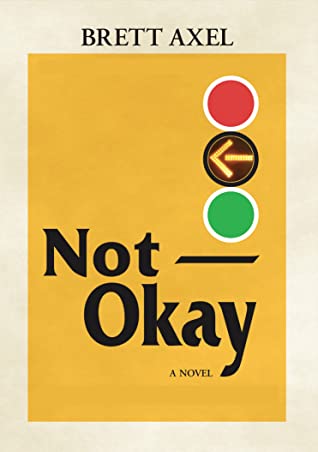
‘I’m not OK. Uncle Will was not OK. The only reason I think the frozen lemonade girl is OK is because I don’t know her. No one is actually OK.’
Peter, the articulate, troubled narrator of Brett Axel’s novel Not Okay, reconsiders and rejects popular 1970s self-help advice while figuring out his own way to recover from child sexual abuse. The strongest part of this title is his voice, how he reasons everything out to himself in full sentences, upfront about his trauma and his shortcomings. He’s got the nonchalance of a survivor who knows he can’t be upset about what happened all the time if he’s going to function, but who knows how to navigate systems to attempt to access the help he needs by letting on about some of his past at opportune moments.
The darkly humorous construct of this book is that the narrator, who survives a truly horrific experience, only has self-help platitudes designed for people with smaller, ‘regular’ problems for guidance. That’s a valid critique even today of some aspects of ‘wellness culture’ that haven’t caught up with the issues facing modern society. I remember wondering, after the police murder of George Floyd, how as a white woman I could be ‘okay’ and ‘enough’ and ‘confident enough to not apologize for taking up space’ while simultaneously holding myself accountable to confront my role in violent and oppressive systems.
We see Peter evolve as a character as he figures out that women he dates, and his female partner, have minds and traumas of their own, and how to have more equal relationships. In one memorable scene, he realizes that if he can handle revenge, he can most likely handle cleaning the apartment. Later on, he struggles with moral questions of how to treat abusers who are genuinely sorry and with the unreliability of memory and his own fallibility.
The plot moves along quickly enough, and I was surprised at times that characters who broke the law could escape detection for so long, but then remembered that it was the 1980s before we had such advanced surveillance technologies.
The setting gave a good sense of NYC/upstate NY/New Jersey in the 1980s, showing our country and all its little quirks and imperfections, such as the ‘F’ in ‘Freedom’ bursting after the rest of the word in a Fourth of July fireworks display. We see the benefits and pitfalls of mental health care, parking and driving in a big city, first jobs and first loves, and making your own sense in a world that offers little direction.
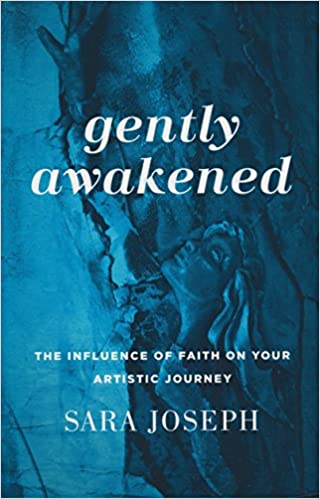
Sara Joseph’s Gently Awakened, reviewed by Cristina Deptula
Sara Joseph discusses apprenticeship in her memoir Gently Awakened, about how her career as a visual artist is infused with and an outgrowth of her Christian faith.
Historically, the apprentice to a great artist wouldn’t always have lessons in the craft, but would instead assist with chores around the studio while watching the artist at work. This would give the apprentice a chance to pick up attitudes and methods that couldn’t be easily explained in a lecture or demonstration.
Sara views her faith journey in a similar way, participating with God and joining the work He’s already doing. This means that rather than worrying about how her whole artistic life will take shape, or completely filling her schedule, or taking it on herself to preach through her art, she steadily develops her technique while following inner promptings.
Advice from non-religious business coaches for creative professionals are now saying similar things: don’t commit 100 percent of your time and other resources so that you can follow your intuition and be open to opportunities as they arise.
And the most meaningful opportunities that Sara finds, the most memorable and nuanced parts of Gently Awakened, are the small and humble stories of how her artwork encourages people. In one case, a portrait she reluctantly paints of a plain-looking woman becomes a chance to uncover her subject’s deeper beauty. Another time she echoes an inspiring vision a struggling widow experienced, helping her find the strength to continue. These are things that happen along the way, God-orchestrated connections for Sara, rather than big moments of drama or career success.
She also learns to let go of avenues for her work just as gracefully as she accepts them, such as a personal studio in an artists’ collective, which she excitedly rents, then gives up when her oldest child moves away to college and vacates his room. This gentle grace and dignity is a hallmark of her book, and of the artwork interspersed between each chapters, mostly watercolors of people and natural still life.
Sara touches on themes familiar to the lives of many artists: figuring out whether one should really be an artist, learning the craft, locating time to create and cash for supplies, finding inspiration, handling disappointments, and developing a personal, unique style. She handles that last point in a different way: seeking and following personal faith-based guidance on how to proceed with each work and letting her style form naturally, rather than specifically setting out to be original.
Overall, Sara Joseph’s Gently Awakened presents an artist committed to living out her beliefs and who humbly seeks to serve others and a higher purpose with her work.
For You

I’ve made worlds for you,
But you refused them.

I’ve written poems for you,
But you didn't understand them.

I’ve expressed my feelings a thousand times for you,
But you never felt them.

I’ve spoken using new languages for you,
But you didn't try to translate them.

I’ve knelt down many times for you,
But you didn't even notice them.

I’ve cried a lot of tears for you,
But you didn't want to wipe them.

I was waiting for your hands and you,
But you didn't come for them.


Celebrating Your Birthday

Although lots of blessings in this life,
I'm only blessed with you and yourself.

For me, On your birthday,
"you mean the world" is all that I want to say.

Blow out the candles of your birthday cake,
Don't be afraid, I won't leave you in the dark.

I pray, may God be always by your side,
I want you to always lift up your head in pride.

You have a good, honest and true heart,
You're my bestie, and my soulmate.

Happy birthday to you from someone who truly appreciates you,
Happy birthday to you for all the good work that you always do.


“Forever”

Okay, WE are NO longer together,
But, What happened to “FOREVER”?

My heart is now in so much pain,
My tears are falling like cats-and-dogs rain.

I can no longer sleep a full night,
You broke my heart and we’re torn apart.

No one can save me from the dark's might.
Now, there is no light.

Kindly know that
I loved you, I love you still
I promise, I always will.

I still don't know why you said your goodbye
but still I know that I'll love you till the day I die.

My heart is broken, but hope is still there
That One day, we might get back together
Maybe next time, it will be FOREVER.
Moustafa Hamoud Dandoush is a writer with a degree in English Literature and Language at Syria’s Tishreen University. He enjoys reading poetry, novels and plays as well as writing.