DAYBREAK, MONTSERRAT

Morning splinters into shoal reefs.

We waken to graves,
A tide of weather and early hair,

A window of volcanoes,
Purple blue mist,
A seal cackling near driftwood.


CRAWDADS

--This year we vacationed from home and traveled a couple of dozen miles away (2020)

Sunlight rises into fire,
early dawn,
yellowing itself into flame,
a blossoming as beautiful
as yesterday morning,
my wife and I,
my son, his wife and new born daughter
not on a Florida beach,
along the Gulf of Mexico,
but in Mid-Missouri,
Barnard Bruns Conservation Area,
Getting our feet wet for crawdads,
the forest a grand wall beyond the river,
the sky sky blue,
a whisper of cloud
cotton candied.
Nothing can feel as beautiful as this,
not the sun rising in the east,
not the birds of the beaches,
not the bent cedar on the cliff ledges.
Beauty is my family in a river,
the end of summer nearing,
and both my son’s wife and my own
against a backdrop of forest and river,
of sky with strings of sugar
digging through rock and stone for crawdads.
.My family on its banks,
a bright breeze and cool shadows,
and even though we catch nothing,
we have found the milky silk of love.
A few weeks ago I bought The Association album Birthday. Prices for used albums are $1.00 a piece, or three for $2.00 where I volunteer at Booktique, a charitable used bookstore three blocks from me in Lake Oswego. I have a huge music collection of 120,000 songs, and normally this album wouldn’t be to my taste.
The reason I wanted it was that The Association started with Brian Cole on bass. In 1965 or 1966, Brian was hanging out with my best high school and college buddy Gary and I at Gary’s place. Brian had been a year ahead of us in high school, where I had been vaguely aware of his existence. I inferred that he was in the in crowd, but other than that knew little about him. Both Gary and Brian were involved with music and art whereas I was a math and science guy.
Brian had moved to Los Angeles and gotten into the music scene. He was hanging out on the Sunset Strip and catching popular acts of the time, like Johnny Rivers. He was a part of a group called The Men, as he explained it, to separate them from mixed gender groups like The Mamas and Pappas. Later I found out that the group had changed personnel and name to become The Association. After that, I never saw Brian again in person, although I saw them on the Smothers Brothers show in 1967 and 1968. One of them was quite silly with the group wearing deliberately bad wigs. Clips are available on YouTube.
The Association was one of the first folk-rock bands. Their first big hit, Along Came Mary was considered a reference to marijuana, which was not unusual for rock music at that time. Their other big hits were Cherish, Windy and Never My Love, all of which were fairly sappy love songs.
After a very few popular albums and songs, The Association sank back into obscurity, although their big hits are remembered and played today. Our local community band, The Lake Oswego Millennium Band, in which my wife and editor (same person) plays bass clarinet, has played Cherish.
August 2, 1972 Brian Cole was found dead of a heroin overdose. Because he wasn’t Jimi Hendrix or Janis Joplin, I didn’t find out until many years after, even though we lived in Los Angeles at the time. From reading biographies of Keith Richards and Ginger Baker, I know that heroin was hugely popular in rock circles on both sides of the Atlantic.
The Association continues in some form with one of Brian’s sons in the band.
Birthday was a big disappointment for me. Gary died a few years ago.
Because there have been so many true horror stories in rock’s history, as a reaction I wrote the cheerier fictional “Eagle” which was serialized in the defunct AWS and will appear in Scarlet Leaf.
The Socialist’s Garden of Verses

By Christopher Bernard

is not of poems made
alone. In man and woman
are hearts of earth and water
where roots of roses tangle
with carrot, yam, potato,
the veins of peach and apple
and the red sweet plump tomato,
the fruits of earth from which all
humanity is made:
faith and hope and charity,
and love of truth and kindness,
belief in good and beauty:
these are the pleasing verses
from which is made the garden
of hope you will engender
after you have closed
this book and put it away.

The dragonfly awaits you,
the beetle, ant, and butterfly,
the sun is high over the garden,
the fragrant grasses call to you.
Our work is just beginning,
the earth and sky are waiting.
Take my singing with you
out into the day.

_____
Christopher Bernard is founder and co-editor of Caveat Lector (www.caveat-lector.org).
“The Socialist’s Garden of Verses” comes from the collection of the same name, which will be published in December 2020 through Regent Press.
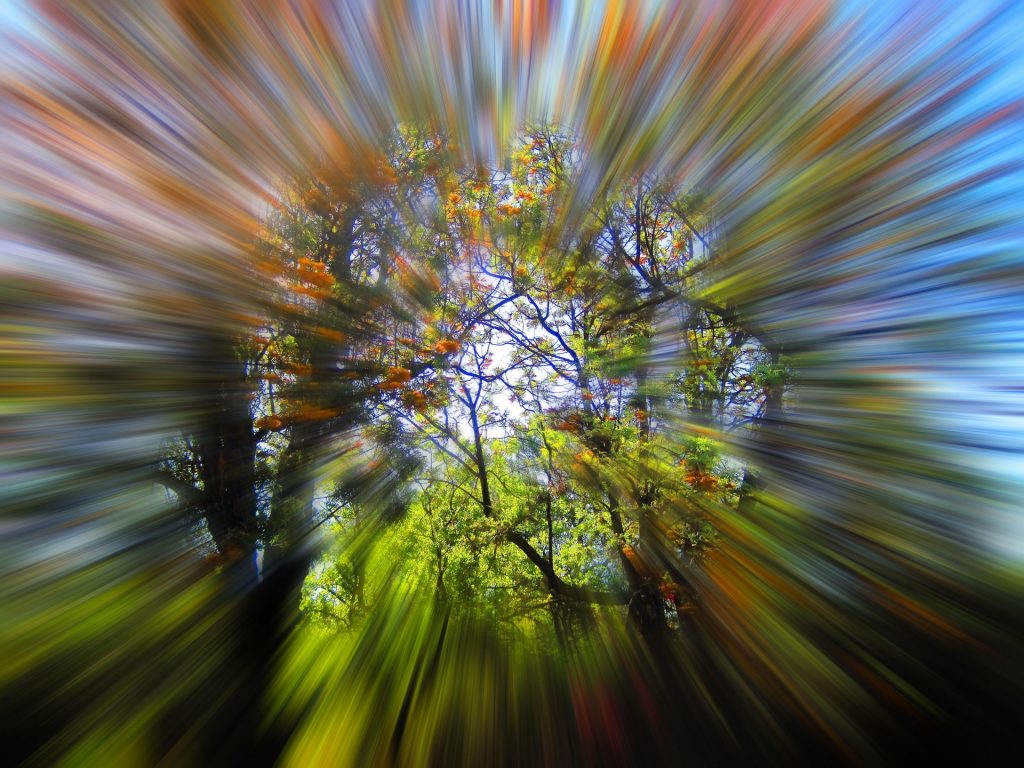
This month’s title is a double entendre – many of us are literally ‘zoomed out’ after too many online Zoom meetings.
However, ‘zooming out’ is also a metaphor for an important psychological practice, putting ourselves in perspective by stepping back and thinking of the larger picture.
Bangladeshi poet Mahbub’s pieces mention human misdeeds towards each other but set them against a background of a much larger universe that includes gentle romances, flora, fauna and the stars. This juxtaposition makes human cruelty seem absurd, that whatever people fight over is small in light of the rest of the world.
Other writers link nature, or the non-human physical universe, to philosophy or human psychology.
Emilie Mayer describes her synesthetic experience of tasting, smelling and feeling poetry, linking her creative act to the growth within her environment. Hazel Clementine also references synesthesia in her surreal work involving her grandmother, dancing, punctuation and preparing oatmeal with cinnamon. Words become something basic, comforting, nutritive, yet challenging and sticky.
Some contributors look outward to other people as a means of expanding their focus.
Italian actor Federico Wardal offers a tribute to the generous and graceful spirit of singer and actress Juliette Greco. And another to Rudolph Valentino in the form of a dramatic script, where he imagines himself about to perform, under pressure to revise his show away from his personal vision, when Valentino emerges and speaks with him before he goes on stage.
Eva Petropolou expresses her love and gratitude for her mother as well as the disembodiment and emptiness of heartbreak, losing part of oneself as well as another person.
Christopher Bernard also writes of the absence of a relationship, that of his children, as he decided not to be a parent. Yet, absence can be another kind of presence, when the lack of someone inspires thought.
Two contributors focus in on the attitudes we need to maintain a healthy perspective. John Culp urges us towards the courage to try new adventures and of the joy we can find in the world, while Ahmad Al-Khatat illustrates the negative effects of staying stuck in pride and letting oneself stagnate rather than asking for help when needed, and the contrast of that attitude with true, mutual love.
Mark Young’s artwork is bold, thoughtful and expressive, with nets of intertwined lines and splashes of contrasting color.
And, finally, Charles J. March’s art piece, with the timeless words of the 23rd Psalm cut apart and scattered over a notebook, reminds us of our searches for wisdom within faith and tradition.