Poetry from Mark Young

found poem

anchovies

breathe through

the pineal gland

Transportation

The terms of

his natural

life included

an embargo

on the use

of artificial

intelligence.

redundant millipedes

          Discrete grids

          in the low density

          part of a model

now house a population

of 1.4 million. Each house

          has a swimming pool.

          All have traffic woes

& face critical food shortages.

[untitled]

Thought as high-

      pitched as

helium voice. In-

tuitive anime.

Go Figure!

A monarch butterfly collapses

on the ground & dies beside

me, triggering a memory of

those Lana Turner we love you

get up lines. Frank O’Hara re-

vived, recycled as a nature poet.

noodle

turquoise

tortoise

purple

turtle

Poetry from Ross Maclean-Bryant

STATIC ATLANTIC
Here the windows open onto sky’s grazing,
Tumbling through the landscapes with ultraviolet features
And upturned eyeballs.
Brushing the chipped shoulders of 7-day lotharios,
Barking at houses and uniting in a chorus of frayed knots.
The rosy squeals of the pig pen were never far away,
Chin deep in soapy water and mimicking the superstars of daytime television.
Showers screaming.
Can we seek the relief of 2:00am blackouts?
The wilderness in two miles of personalised number plates?
I left my head treading cathedral yards,
Pondering the value of Exe.
I never liked how broad those shoulders could be.
Another flock torn into motorway stations.
Waxing gibbous and the occasional telegraph pole
Bristling with prickled declarations,
‘Untangle all the lanes and burn the views’
NOEXIT.NOEXIT.NOBALLGAMES & salvation.
Until then we’ll peruse the wristwatches and altered states of appearance,
Asking only questions, but were we ever still alive?
20/09/2020 Exeter, Devon

SEMPER EADAM
.who in the stops of 12-19 Fore St.
Shrugged off the silvery inevitable
And the bitterness
Of the glitter box granite.
Pressed with a deadpan disdain for modern life
And JAN&KEITH4EVA.
Is this the greatest thing you’ve (n)ever scene?
(Pylon to B4) A tension within the gambit,
Shaving a min. or two from the GRN root
Until ‘The End’
Preserved itself a little differently.
Over phished clouds pass like cattle,
Brewing car stock for shovel headed storeys
And increasing the chances of reign fall.
OR in constant use.
Please advise.
11/08/2020 Welcome Street, Exeter

BAD HOMBURG ADJACENT
(…) blend ‘Blue no.5’ with screwdrivers,
It will crawl through the yards, the postcards, and heels.
Plugging holes in the carpets with its broken jawed azure,
Pondering cord progressions,
The cut ’n’ paste never (may contain salt).
From its amber lit pockets were the kwik tongues of hermits
Stitched to the din of its hot tin lining. ON SALE@public addresses.
‘Was it time to feel electric?’ – whoeveryouare
It processed the rhythms of future folklore,
Screwed another ribbon into the barking purple.
Seldomly bobbing over radio waves
And for Displaying Purposes Only.
Beyond were the fruits of circa ‘43
Ripening in the synonym: streets,
Temporarily built to last
With bottled capped receptions at the
PAYE.SLOT.CASH. Trespassers will be prosecuted.
>
>
>
>
W/duvets in the whistle stoop,
Showers in the bistros,
Tyre tracks up the backs of lonely harts,
The wrong side of a set of showroom curtains.
Trespassers will be prosecuted
So stockpile you’re remaining darlings
//bad homburgs remain adjacent
Dazzlingly nettle skinned and wandering.
Were you just as scared as I was?
20/09/2020 Exeter, Devon

Poetry from Michael Amitin

Wild Black Tree….   a tribute to Colin Kaepernick

Glory stadium, frenzy ball

he dropped to one knee

hair blowin like a wild black tree

in the rocky american twilight

crowd boos mighty

street urchin railers, merchant street traders

battered tin star sailors

Morning hijacked coffee paper

bristling at the edge of no return

whistling smart meter burns,

bongo tart urns, in the

dig dog graveyard

Patriotic anti-bodies walzing desert storms

four to the floor kiss your baby goodbyes

billy club dancers on white wash street

pie-eyed meet-ups, Charlottsville

bling ringers circadian circus singers

tulip brides, galaxy aisles

Touch down passes

night glass windows

shattered, he took a knee

enough of that cop chop black egg beater beat

street cheating panoply of

fucked up racist disguise

plantation meat

rally flag flying at Camp Marine

swap shop prisons

build the Dell jisms

make em glistening pennies from heaven, warden

sweat your unleavened soul in the noonday sun

Sweet rivers sing holy hymns

saturn jungle jims, gunga din

riding poplars across the old beat road

took a knee

to the groin

railroaded out to the sidelines

of soot stadium, smoking a love it or leave it joint

Flame O’

Slid up the Himalayas

Got down to the top of his breathe

Golden flame, flower shaded

Purple road snaking exhaust exhaled

Paradise, no waiting lines

Woke up from wondering

What i could become

Ran

Doublebass roll

Monk-a coco

Stride vapor pianos

Nothing-left-of me winds

Clouds a purple train sky

Faraway from icy rivers

In my walking cane, ferryboat rhapsody

Bouys of silver tones bobbing yesteryear’s sea

Chirping seeds, yardbirds, kinks

When my

Bottled bootstraps unhinged

Scaled awkward mountain

Slipped all the way down there

I want to live in a Doris Day movie

Seen enough pain

To marinate a rising tide

Maria Callas sing me home Vissi d’arte

Burlesque circus streams

Fire night borneo walkers

Velvet warm mantras spokes from silent wharfs

Dark star taverns

Caverns of winds, wired night mind highways

Silent stars where I’ll Rest my case

Shakedown Train

She eyes my cagey baggage

stamped backroad spades

says i’m glad to see you this

Awakening Train

St Vitus seat, rub drowsy eyes..

strange artifacts

sour sea smells

train stewards passing out cream puffs,

rough stuff pamphlets for burnt-eye passengers

Night train sputters out of the station

Chirping bird flutters,,

a manifesto hatched in twisted eggs noirs

blinded by dust light

motes tumbling in high places

believing a bright orange savior squeezing

juice..all the way to the promised land..

Same train took Moses to fire breathing hell

Same engine mowing down brothers and sisters

on night street in americas

i slide past porters and borders

slide into my metamorphic day suit

loose as a spread-eagle goose, come out grinning

shaking hands, giving it all away

army of love and compassion, freedom for all

visions of peaecful roads

where the dead walk by my side through

twisted waterfall wonderlands

Poetry from J.J. Campbell

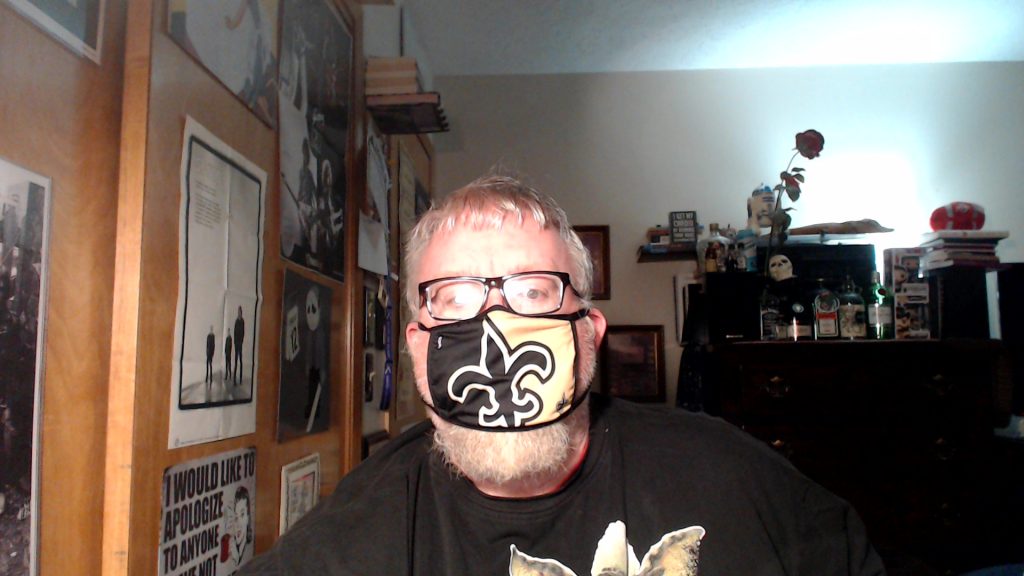
Middle aged white man with glasses and a coronavirus mask in his bedroom. Posters on the walls.
J.J. Campbell
J.J. Campbell (1976 - ?) was raised by wolves yet managed to graduate high school with honors. He's been widely published over the years, most recently at Horror Sleaze Trash, otoliths, Cajun Mutt Press, The Beatnik Cowboy and Terror House Magazine. You can find him most days on his mildly entertaining blog, evil delights. (https://evildelights.blogspot.com)
--------------------------------------------------------------------------------
destined
 
i want to believe
i am destined for
more than this
 
i know it's probably
bullshit
 
but wasting away
in a small town
while the rest of
the world passes
me by isn't exactly
what i thought was
intended when i
chose life over
death at the age
of eight
 
once again
 
first thought
 
best thought
----------------------------------------------------------------
being used
 
i think of
the nights
where i
used to like
being used
by a woman
 
i wonder if
those nights
will ever

exist again
------------------------------------------------------------
tragedies
 
i often wonder how
many tragedies i have
within me
 
once a day is plenty
 
i don't need any more
than my own to look

forward to
-------------------------------------------------------------
nothing to talk about
 
i love a woman
with tattoos
 
no one wants
a situation with
nothing to talk
about
 
the scarier the
better
 
only a few of
us know how
to properly
deal with

pain
--------------------------------------------------------------
there is a better place than here
 
fight back
the tears and
understand
 
there is a better
place than here
 
i'd like to believe
the soul moves on
to see something
way better
 
if not,
 
then i suppose
this is truly
 

a living hell

Coronavirus testing: Facing Challenges Outside the Lab

Widespread Coronavirus Testing: Facing Challenges Outside the Lab

— Cristina Deptula

According to Johns Hopkins University’s coronavirus tracking site, clinicians have performed some 20 million coronavirus tests in the United States.

That number may seem impressive until we remember that the working-age population of the country is just over 200 million, and the elderly population, those most at risk of serious complications if they become ill, is 56 million.

Public health experts say far more diagnostic testing is crucial, not only to safely reopen society but for the epidemiological research needed to track and stop the spread of the disease worldwide. In fact, many experts are calling for testing levels at least twice what they are now.

Craig Rouskey is the founder of San Francisco startup Renegade Bio, which claims to have created a significantly cheaper, faster, and easier coronavirus test. Rouskey’s expertise is in molecular biology and the development of diagnostic tests within the laboratory. Yet, even as a lab scientist, familiar with the long road to developing tests and the accuracy issues with some early coronavirus diagnostic tools, Rouskey believes that the biggest obstacles to rolling out widespread testing are factors outside the laboratory.

These hurdles include creating and distributing enough testing supplies and personal protective equipment (PPE) for those who conduct tests, getting accurate information out about testing to different groups of people, training enough clinicians and making the testing centers fully accessible.

Randy Altschuler and Laurence Zuriff co-founded Xometry, a Gaithersburg, MD firm that sources parts for manufacturers. Although Xometry is not directly involved in logistics related to coronavirus testing, they, along with the rest of the world, have had to quickly adapt to broken supply chains during the pandemic.

Altschuler commented on ways we might efficiently source and distribute vast quantities of PPE and testing materials:

“Often, even when large organizations are desperate for supplies, like cotton swabs, it’s hard for them to change their behavior. They don’t, or can’t, adopt creative solutions or always accept donated or innovatively manufactured supplies because that doesn’t meet their needs, or their expectations.”

Altschuler acknowledged the many makers and startups 3-D printing healthcare supplies, but said that it was difficult to rapidly produce large quantities of items that way.

“As much as possible, it makes sense to use already existing infrastructure to produce, store, and ship what we need. Big retail and big restaurant chains are used to handling perishables [such as coronavirus test samples], so let’s shift our tried-and-true systems to facilitating coronavirus tests rather than inventing something new.”

He said we would probably need a government partnership with big retail chains. “Who knows how smoothly that will go, but that’s likely what will have to happen.”

Maria Chavez, president of Bio Curious, a laboratory and meeting space for citizen scientists and entrepreneurs in Santa Clara, CA, echoed the concern about shortages of cotton swabs and other physical supplies for testing.

“It might be up to two years before we get a vaccine,” she said. “So we’re going to need a lot of testing equipment.”

Other researchers and community leaders point to emerging social concerns with widespread testing.

San Francisco news outlets have reported on difficulties in the city’s low-income Tenderloin neighborhood, where testing appointments are required and many residents lack smartphones or computers to make those appointments. Community leaders have provided feedback to testing center administrators about ways to improve community access, such as allowing walk-in testing.

Testing centers will also need to consider the needs of people with disabilities. 

One product designed to promote accessibility is the clear mask. The idea came from hobbyist inventors concerned that existing masks would prevent deaf and hard of hearing people from lip reading. One of these hobbyists, Eastern Kentucky University senior Ashley Lawrence, profiled in Shape magazine in April, just reached her $3000 fundraising goal on Kickstarter and is now donating and shipping the clear masks out to deaf and hard of hearing people. 

Altschuler of Xometry also highlighted clear masks as an example of ideas and products from small startups, hackers and makers inspiring more mainstream outlets to expand or improve their offerings. Although, as he pointed out, we can’t replace large scale manufacturing with a few 3-D printers, small startups, hobbyists, and citizen scientists can play a crucial role in public health by prototyping ways larger firms can enhance their products.

Others have noted that privacy and other civil liberties issues present serious concerns if testing becomes mandatory in society at large or even just in the workplace. Certain populations may prefer not to attract the attention of authorities and many people may not want their social networks exposed through contact tracing.

Stanford University Ph.D. candidate in bioengineering, Rolando Perez, also a board member of Xinampa, a biotech lab and coworking space in the agricultural center of Salinas, CA, echoed many of those concerns.

“We’ve got undocumented farmworkers in Monterey Bay, essential workers, who don’t access regular healthcare because they’re afraid of being deported.”

Perez continued, offering a paradigm shift for testing informed by Xinampa’s philosophy of empowering local populations:

“You put the testing technology in people’s hands so they can test and sequence themselves and track the disease within their own communities. Put the tools in their hands so they don’t have to interface with institutions.”

Bryce Nesbitt of Counter Culture Labs, in Oakland, CA, said that people may also avoid getting tested where it’s voluntary. They may fear losing income or employment if they receive a positive result and need to self-quarantine for 14 days.

“We can work through that by setting up a safety net,” he said, “so that people have paid leave in the event of a positive test.”

Employers can also offer those workers the option, where possible, to continue to work from home.

Nesbitt also reminded us that with voluntary workplace testing, and no social or other pressure to get tested, there’s no guarantee that the workers who volunteer will be the ones most exposed to other people and likely to accidentally infect others.  

The perceptions that tests are not readily available, that only those who are symptomatic can get tested, that people will have to wait in line for hours to get a test, can also discourage people from seeking out testing. So once we can produce and distribute enough tests and equipment to make testing easily available to large segments of the population, we will need to communicate to the public, through various media in many languages, that even healthy people are strongly encouraged to come in for a quick test.

Of course, many public health experts view a ‘hand-held’ kit that people can use at home as the ‘gold standard’ for diagnostic testing. Six firms have recently received FDA clearance for emergency use of their at-home tests. Some observers point out, though, that accuracy may be compromised with a self-administered test. Also, samples still need to be sent to a lab for evaluation, so results are not immediate. And privacy and civil liberties concerns about confidentiality of personal data will still need to be addressed.

As Craig Rouskey of Renegade Bio reminds us, diagnostic testing won’t answer every question we have about the coronavirus – how long the epidemic will last, whether the virus will mutate, how best to treat illness.

Still, though, Rouskey says widespread, frequent testing is vitally important because of the nature of this epidemic.

“With Spanish flu, you tended to catch it and then get better or die relatively quickly. But with corona, you can be infected and spread the disease for a much longer time with absolutely no symptoms. So you’ve got to get tested, for others as much as for yourself.”

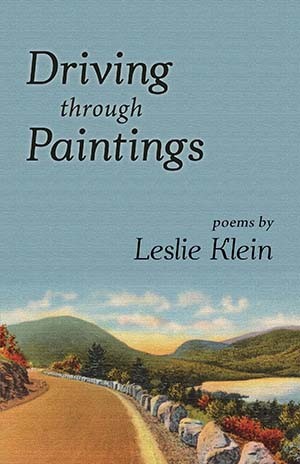
Carol Smallwood’s review of Leslie Klein’s new poetry collection Driving Through Paintings

Interview of Leslie Klein

Leslie Klein's book cover for Driving Through Paintings. Pastel cover of a country road curving past rocks, green hills, trees and a lake.

Driving through Paintings

Poems by Leslie Klein

Shanti Arts Publishing

June 2020

82 pages; softcover; $12.95

ISBN: 978-1-951651-34-3

Liza Gyllenhaal Bennett, past president and current executive board member, Academy of American Poets, noted: “Leslie Klein writes with the eye of an artist and voice of a poet.”

Smallwood: How has where you live influenced being a writer and artist?

I have been fortunate to live throughout the northeast—from Vermont, the Hudson Valley in NY, and here in the Berkshires. The natural world—its colors, shapes, sound, light, plants, animals inspire both my writing and art.  Each day is a visual feast. At night the owls serenade!

Smallwood: Please share with readers any formal, academic training you’ve had

Bachelors from State University of New York at New Paltz in Sociology/Education.

Smallwood: What types of writing have you had published? 

Most of my published writing has been op-ed, feature stories and some poetry for newspapers and magazines.  

Smallwood: What are some galleries and juried exhibitions you’ve taken part?

A sampling includes:

            510 Warren Street Gallery, Hudson, NY

          Lauren Clark Fine Art, “Small Works,” Great Barrington, MA

            Gallery 35, Great Barrington, MA, Guild of Berkshire Artists

            Boston 2000, Inc., Boston, MA; Created sculpture for “The Boston Freedom Award,”                      presented by Coretta Scott King and Boston Mayor, Thomas M. Menino, to Dr. Charles Jacobs,                                  Founder and President of The American Anti-Slavery Group

Smallwood: Please share your affirmation expressed in “Magic”:

If we open our eyes to really see all that surrounds us in the natural world, we would be in awe of its complexity and beauty.

Smallwood: Another lovely poem that caught my eye was “Library”. What was your first visit to one and how do you use them now?

Though the memory of my very first visit is vague, I always remember feeling like I was in a peaceful space with so much to see and touch. Just about every book I read is borrowed from the library.  Even now, with the virus, it is great to be able to order books and movies online, and pick them up at my local library. I do miss being able to go inside. I often use their computer and printer.  All librarians are wonderful, and have all the answers!!!!!  My love of the library, is also very much influenced by my travels. I am inspired when a library in a small town comes into view. They are so architecturally beautiful and solid—reminiscent of ancient structures holding sacred texts—truly, works of art.

Smallwood: You make many references to birds. Have you always been so aware of them and what do they mean to you?

I “discovered” birds when I was in my late 20’s, after seeing a flock of cedar waxwings land on a tree to share berries. They actually fed each other. They were so exotic looking, with black eyeliner and feathers like Chinese silk. That was the beginning. I am fortunate to live in a lovely, rural area, with a small brook.  I am surrounded by birds and their melodic songs.  Many are familiar and have personalities. They are truly beautiful, delicate creatures. Though, considering the perils of migration or just daily survival, they are so strong. Their ability to fly makes them seem so free and happy.

Smallwood: One of your poems says: “We are all artists”: when did you come to this conclusion and please explain:

That poem was the result of one of those long, into the evening, conversations with a friend. That’s why it is titled “Letter,” because I wrote it for him later, restating what was said about art and creativity. He was lamenting that he was not an “artist.”  I was trying to explain to him that even though he was not a painter, sculptor, writer, his life path was one that would leave its mark, and inspire others, just as a painting or a poem. 

Smallwood: Has there been subjects you wanted to work on as an artist that ended up as a form of writing or the other way around—or didn’t fit either?

Not that I can think of. I have, however, created numerous sculpted trees (including The Boston Freedom Award) which are perceived by each viewer with their own impressions. I think my poem “Trees” is more descriptive of the feelings that I have for them, than the actual sculpted pieces can convey.

Smallwood: Are you working on a new collection of poems?

Yes, I do have more poetry that I am compiling and changing and changing some more!!! ha!  I also have an idea for a book on libraries, and two children’s books that have taken a back seat of late.

Carol Smallwood, MLS, MA, Marquis Lifetime Achievement Award recipient, is a literary reader, judge, interviewer; her 13th poetry collection is Thread, Form, and Other Enclosures (Main Street Rag, 2020)

Poetry from Chris Butler

Chris Butler is an illiterate poet howling from the Quiet Corner of Connecticut. He has published 8 books in his “Poems of Pain” (or POP) series, with 2 more soon on their way. In his time that is spared, he is also the co-editor of The Beatnik Cowboy literary journal, soon to release a chapbook with his comrade in the wars of words, Dr. Randall Rogers, entitled DEAD BEATS.

Cyborg

In this youngest day
of premature age,
our offspring are
the future, dying
in real life just to
become a cyborg.

Implanted with  
tracking chips,
nanomachines
plugged into
every hardcore port
before developing  
the ability to
read and write,

they’ll soon begin
thumb strengthening  
and mind devolution
by poking uteruses,
until every baby
is born with both
bionic and carbon
based parts.

In one generation,
one dumbphone  
will have more intelligence
than the entire population
no longer growing inside a tube.

The dumbphone
is far too intellectual  
than all the people
in all the known worlds.

Cellular devices connecting
to biological machines on a cellular level,
dismantles the DNA sequence  
downloaded from the first birth,
programmed with original chromosomes.

Intravenously attached to mePhones, mePads and mePods,
Because there is no I in me.

Facespace, Tweedy Twits, InstaGratifucationGram, Timber, GrindHer, Slapchat, WildVine, ClitCock, WeShat and BoobTube
steal our attention,
in order for our need
to seek attention
during each day’s detention.

The first tool of man was the stick,
a weapon of impersonal demolition.
The second tool of man was language,
a weapon of interpersonal devastation.
The last tool of man will be misinformation,
a weapon of mutually assured self-destruction,
bombing us in the form of a black monolith.

We are only woke when the mind is at rest, sleepwalking through protests of peaceful violence.

Memes are the cultural genes of any generic society,
with the power to hijack any and all social interaction,
spreading pamphlets from fiery zeppelins during propaganda pandemics without medical masks to keep our mouths shut.

Minds with master’s degrees in memeology see you as witticisms for idiots,
unknowingly inventing an army of sentient thingamajigs with simulated stupidity,
long before the incarceration of the one zeitgeist lightning strike…

…the almighty phone…

It tells us where we are and where to go,
how to get home down unknown roads,
connecting us with ten digits we no longer need to memorize,
cheats so people can’t tell that one can’t spell,
keeping contacts intact despite long lost distance,
nuanced destroying machines of an emotional emoji,
sharing opinionated commentary no one cares for,
with imposed guilt to keep us woke by invoking insomnia,
political correctness autocorrected before even written,
canceling a citizen’s existence once send is pressed,
and the only thing we can never leave home without.

Gradually, the dependency seeps into all of society.

Unable to initiate, copulate, maintain and sustain conversations face-to-face or voice-to-voice, but instead opting for text-to-text

Even when you shut off the shutter, the cameras are always watching, especially when playing solitaire while squatting on the toilet.

Facial recognition software knows us better than we know our best friends, significant others, domesticated pets and megaton nuclear families,
our privacy is eaten away at us like spam with a side of cookies, disguised as apps with no entrée to devour.

Instead, biometric fingers play the rhythmic keys of algorithms sequestering our unhealthy habits and isolated lifestyle from the rest of the real world.

Conversational swipes that smudge fingerprints from right to left on scratched screens to express which picture makes you want to sext dicks the most,
then conveniently hacked and on display as a C-list celebrity peepshow free to download for pubescent boys to continuously blow their load over.  

Some will even deepfake a new face of uncanny valleys onto the wrinkling skin of airbrushed lies,
the latest form of plastic surgery to propagate with or against the disinformation machine,
all of which will get my name prominently displayed atop every government watch list,

then unfriended by superficial friends
and unfollowed by lemmings just before the cliff.

In order to continue,
one simple click equals
a bound and gagged agreement,
an arrangement that forces
the user to read then reread
the slight variations to
terms and conditions
of the tiny fine print
hidden with invisible ink
between the lines,
forced to consent to
their blood contracts,
Issuing consensus to
corporate Satan to
torture you for
an eternity, or
until the next cruel agreement
when a download is required
from passing billboards of  
dangerously distracting QR codes,
the new and improved  
unbarred mark of the beast.  

From trolls demanding tolls for safe passage over the fiber optic bridges,
to masked bots masquerading as human beings whilst fishing for cats as they moan and piss into our drinking water from upstream,
it all seems to exist in a fantasy fairy tale indistinguishable from the extinguishment of reality.  

Even in the privacy of our own homes, as the old saying goes, we are never alone.  
Unwelcomed house guests disguised as girls named Alexa and Siri,
wear a spying wire unwarranted but governments, but the corporations in power,
pretending to be the global positions system’s guardian angel,
recording all of our priceless lives on permanent records
and selling access to our electronic existence and priceless debts to the highest bidder.

Drilling the mountainsides for zeroes and ones,
digging up bank accounts, social security numbers,
credit score cards, birthdates , mother’s maiden names,
emails, text messages and mapped out routes
where there are no canaries.  
Even single toothed prospectors in goldfields digging forty-niner miners take megabytes into counterfeit bitcoins
that were sifted by panning in the same digital streams,
until they create a crater called credit reports that strip mine us all,
and surveillance surveying what we’ll spend our life on buying next.

Until a simple butt dial from our back pockets exposes our secrets to not only the receiver, but any listener on
the same spectrum
on the other end…

However, even worse for the selfish is the selfies
facing the fate
of Damnatio Memoriae,

the deletion of a human being’s electric existence
by means of a search engine
and browser’s history.

This banishment from the grid
is in the coroner’s fraudulent report as social suicide,
but instead death was carried out by execution, quartering one’s texting digits in the cybernetic town square as the crowd’s six second creeper clips is cut down just as fast as it was pasted up.  

When you are persona non grata and your name is not even spoken of in dead languages,

and as your carbon-based footprints imbedded in the shore’s sand
are instantaneously washed away by eternal high tides,
no longer with a legacy to stand on.

United we progress toward a perfectly monitored society,
in the inherent anarchy of the year
Twenty-Twenty.