JD DeHart reviews Chimezie Ihekuna’s upcoming novel Santa in Two Worlds
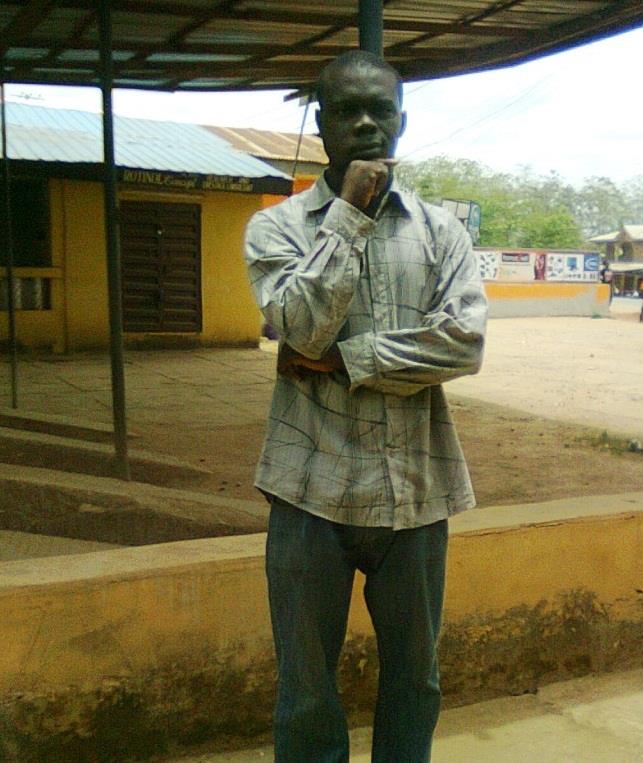
A Note on Santa In Two Worlds by Mr. Ben (aka Chimezie Ihekuna)
written by JD DeHart, author of poetry anthology The Truth about Snails
As you may tell from the synopsis below (provided by the author), this is a strong story of crime. It is interesting to read a poet who writes prose and poetry, and what I noted here about that transition is the way the story breathlessly uses descriptive phrases to convey its meaning.
There is much creativity at work here. There is crime, certainly, and violence, of course…but there is also a nice sense of silver lining to the book.
Synopsis
Santa’s world was in shambles. Just released from prison, having spent over a year, he was always the talk of the entire Santiago town. His long criminal records of stealing and drug-trafficking were reasons the 22-year-plus-old-man was always on the lips of every Santiagoan. Santa walked the length and breadth of the town in confidence but asked himself: “Why in the world are people of Santiago keeping me at arms length, whereas I don’t mean any harm, I want a change but this addictions of crime wouldn’t help matters?!”
Like the old saying: “blood is thicker than water”, Santa’s family was an epitome of crime. His father was said to have died in a gun-battle with the popularly known Men of Peace, The Santiago Police Force after an unsuccessful robbery operation, three months before Santa was born. His mom, the prostitute and drug addict, was a happy-go-lucky woman; flirting with any man she is on the streets of Santiago and beyond in exchange for drugs and money. Santa, having being raised by single-handedly, grew up to embrace crime wholeheartedly. Santa thought of turning a new leaf; change for good and for the better. He craved for a sense of belonging and acceptance by the people. Santa looked forward to when the people of Santiago would embrace him like their brother. How to go about it was very confusing… There was no he could confide in. Maria knew next to nothing! Her life was all about prostitution, drinking, smoking, despite being hospitalized at the Santiago Maternity Home.
In his ‘blur’ quest for the desired change and to avoid being ridiculed by people of the community—young and old, Santafoot-matched to the forest to the San-Amazona forest, Santiago’s most interior part to think about his life. There, he encountered a strange-looking plant but remembered what his mom would tell him about anything he saw as strange…The Tree of the gods. He chewed the leaves very well and swallowed them. Santa’s sudden weakness turned him to sleeping on the floor, under the canopy of the ever-green Tree of the gods.
Santa saw one thing he has never known—The unknown world of nature—where he saw exactly him in another world under a different situation but one thing connected them: CHANGE! Though they couldn’t get to see each other physically, both of them got what they wanted.
It was a world that would translate as: Santa in Two Worlds.
Poetry from Joan Beebe
Christopher Bernard’s novel installment – Amor I Kaos
Christopher Bernard’s “AMOR i KAOS”: Seventh Installment
It could be a lifetime. Between the screed and the admonition, the command and the oath. Your followers lined up like soldiers on a ridge gazing down at the ignorant city. The horses neighing as they slip on rocks wet with dew. The dawn treacherously beautiful and cool, as if carrying, clutched in its hand, the message that will never reach them. Stop. Do not attack. We have surrendered, the war is over. And they descend, silent, to a pointless destruction. It could be like that. Or it might be briefer, a sojourn over a weekend or no longer than a summer of one’s youth. Remember that? It feels like yesterday. But it was a lifetime ago. It might be a gentler doom, more quiet, discreet, causing damage to only two people, bruised and aching and left for dead on the indifferent battlefield of love, cruelest of tyrants, your gauntlets bloody, your banners torn and fluttering in the dust-filled wind.
xxxxx
He closed the book and gazed at her gravely.
—I don’t know whether to laugh or cry, she said. You hopeless romantic!
His mouth smiled. Which looked strange since his eyes were so bleak.
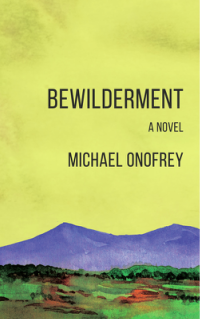
Novel excerpt: Bewilderment by Michael Onofrey
It is a long stretch of flat roadway through terrain that is
dry and in need of trees, shoulder of the road dusty with
orange silt that lifts in the draft of passing trucks, but there
aren’t many trucks and traffic in general is sparse. It is hot,
and the sun dwells in a lightly hazed sky that is whitish
blue, tires of their bicycles gummy on the macadam that
runs beneath their moving shadows while they pedal side
by side as if in the ease of companionship.
Up ahead and on their left and set back from the road’s
shoulder there is a tree and in the tree’s shadow there
appears activity, and near that activity a pile of large rocks
sits in the sunshine, and since Wade and Herta are
traveling on the left side of the road, as does all traffic in
India, they will pass very near that activity, and in this way
discover its nature.
Between Herta and Wade there is no conversation
because they are too tired for conversation. Rivulets of
sweat gather airborne dust to streak their arms and legs
and necks with reddish slime. Their legs move as if on
automatic, yet at the same time there is this continuous
pushing feeling even though they are not on an incline,
nor is there a headwind.
Essay from Patxi Perier
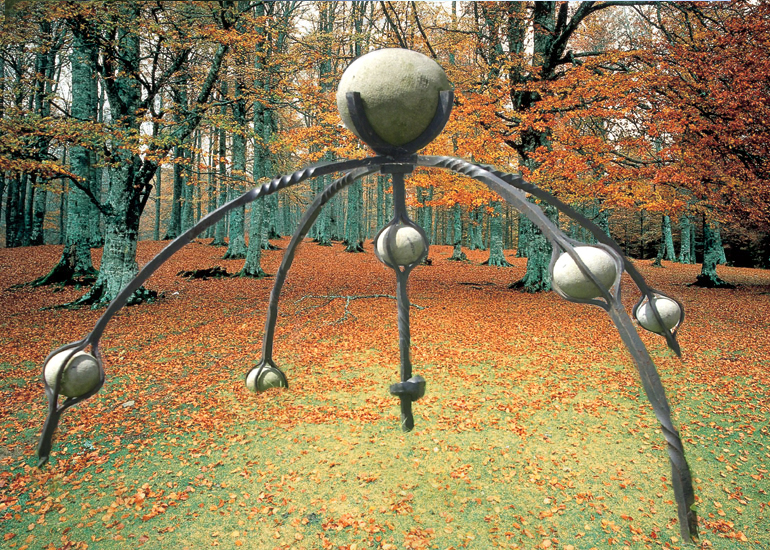
Basque mythology is the set of myths typical of the original population of Euskal Herria. The myths have a direct relationship with the ways of acting, thinking and feeling, which constitute the common heritage of a society that through the ages transmits from generation to generation the distinctive signs and the uniqueness of a people. The existence of myths is linked to factors of antiquity and tradition. The permanence, at least since the Neolithic, in the territory they occupy is the origin of the Basques. A peculiar town that is the oldest in Europe that allows us to deduce the importance and identity that Basque mythology has historically and culturally in its roots.
Amalur is the name in Basque that means “Mother Earth.” In the legends of the Basque people, Earth, Ama-Lurra, is the main deity. The Earth appears as carrier of all living beings, possessing own vital force that created our natural environment. The Earth is a huge vessel, an unlimited receptacle, where the souls of the dead live and most mythological characters. Faith in Ama-Lurra is very old in prior to the invasion of the Indo-European peoples Basque people. Teluria is related to the Earth cult, energies that come from inside the earth, come, circulating and continuously emanating from the earth’s surface and subsurface, being closely related to the energy variations of the geo-magnetosphere, the electro-conductivity gravito-field and magnetic influences of the Sun and the rest of the planetary system.
Vijay Nair reviews Ihekuna Chimezie’s multi-genre written works
A Dictation of Pure Soul

Writing is one method for revising Mr. Ben’s outlook on life and observing the world and one’s place therein from an altered perspective. This Nigerian writer changes his worldview by examining fragments of our historical and biological content and by considering the context of human reality from multiple perspectives, which in turn provides him with a more enlightened understanding of human existence. By perceiving the world and humankind’s march into civilization from a more perceptive vantage point, he is more likely to appreciate all aspects of life including the beauty of nature and the historical struggle for human existence. Along with greater understanding of both nature and human history, he gains a more comprehensive understanding of himself, and grasps the futility of despising all of his human failings. Perceiving the self from a proper vantage point enables him to establish a premeditated and reasoned way to live, set modest personal goals, realizes that struggle, loss, and failure are inevitable, while comprehending life is nonetheless worthy of living. His works cut across almost very literary category to help improve the cause, shape and existence of humanity; sexuality, science, home affairs, marriage, relationships, friendship, self-help, gender issues, life matters, motivational and inspirational interests, educational/academic matters and many more.
Life is a collection of memories and feelings for him. Memories and imaginations allow him to enter the womb of creation, devise the lens through which he translates his surroundings, and creates the spectrum that transliterates his experiences. Experience is the catalyst for all great stories. Mawkish urges Mr. Ben to engage in artistic overtures, he yearns to share with other people a melody of rudimentary experiences and respond to a stabilizing tune strung together with a shared ethos. He walks in parallel strides seeking out equivalent affirmations of his being. He longs to shout out to the world that he once walked this earth; he seeks to leave in his wake traces of his pithy habitation. His unfilled longing propels him into committing senseless acts of self-sabotage and then he desperately seeks redemption from his slippery selves by building monuments to the human spirit. He employs a bewildering blend of conscious and unconscious materials to construct synoptic testaments to his temporal existence. He labours on the canvas of his choosing to scrawl his inimitable mark, fanatically toiling to escape a sentence of total obliteration along with his impending mortality.
Storytelling is an ancient art. The lucent vibes of stories express what we cannot articulate directly. When we hear someone’s story, we respond to the spark of humanness within ourselves that seeks to come out in the light and greet the world. When we tell the stories of our lives, we give voice to people bereft of speech, we make the persons whom we love or loved immortal, and we pass along our familiarity with the natural and physical world. Mr. Ben succeeded here for establishing his identity by constantly reshaping layers of his inner world by reconnoitering his thoughts, opinions, emotions, observations, and sentiments. Through an act of self-will, a writer builds a sincere world that attends the influx of the spirit. Investigating a person’s innermost feelings on paper allows Mr. Ben to dispel his fears, expands the depth of his soul by thoughtfully enduring pain and sufferings, spread love and compassion, quantify personal expectations of a mortal being, and face death without remorse and regret. Mr. Ben is simply taking dictation from his soul. For him writing is more about telling other peoples’ stories than his own.
You will never learn how to write well if you don’t learn how to edit. We write, edit, and rewrite the story of our own life employing descriptive words, metaphors, and symbols. Our lives are full of symbols including those supplied by nature and religion, which touch upon the mystical and spiritual aspects of life. Symbols inspire enduring hope by formulating idealist expectations. When we go through Mr. Ben’s writings whether it is fiction or non- fiction we can identify that he recreates moments to spend in introspection and in reflection. These moments make him pensive and help him write his thoughts with clarity. A life of devotion to one’s passion gives us meaning to our life.
A good plot is like a well-crafted puzzle. Each piece is vital to the bigger picture, connecting to each other to tell the larger tale. If a plot is a novel’s skeleton, and characters are the muscle, then theme is its soul. Mr. Ben’s almost all prose fictions like A Successful Marriage, Maya: Initiate 39: The Long Walk to Destiny, Life In Space, The broken mirror, One man’s Deep word, portray his honest approach towards life. The artistic creation of the writer is a reflection of the artist’s inner world. The agenda of consciousness that spurs all forms of art is not to represent the outward appearance of things, but to portray its inward significance to the creator. A great poem and written composition fully express what the creator feels, in the deepest sense, about the distinctively depicted image that captured his imagination.
Human beings innate complexities resist reduction into simple sentences and neat paragraphs. The stories that come nearest to expressing the ambivalent nature of people are textured and occasionally inconsistent and express waves of inner uncertainty. This inconsistency and uncertainty are Mr. Ben’s strength in his composition in many of his titles like ‘The Christian Matrix’, ‘Christmas Time!’, ‘Journey to Love’ e t c. A simile and a metaphor are not literally true. A figure of speech, symbols, and allegories are mere expressions that when interlinked with other text assist explain facts, ideas, and emotions. Useful facts are elusive; we must look for them, and then express them using whatever mechanism proves most authoritative. We can never directly describe emotions; we resort to metaphors to describe emotions and other illusive thoughts. Ideas by virtue of their untested nature are often untrue or at best rough approximations of truth. Mr. Ben’s task is to discover the liquidity of a passionate inner life that provides the hot breath to our steamy humanness. In this task he achieved a greater position in the literary arena through his masterful works.