Poetry from Michael Robinson

Mirror 

Have you seen my soul? Do you see what I see when I look into the mirror? Seeing my soul is seeing the woodpecker at the feeder with its black and white body nesting in the morning sun.
Newness 
He wanted to write a poem of the mountains only to describe his own success for words created on the page. Each letter, each word, and sentence was a reflection of newness found.
Salvation
The winter snows did not freeze my awareness of being a Fresh Air kid. My essence has been refreshed by the summer sun. Only the mountains could have restored my yearning for salvation.

Obsession 

He noticed her perfume smelled of love,

Her eyes floated like waves in distress.

In the shadow of the moon,

He saw her soul dancing.

Narrative essay from Todd Wiggins

A Father’s Purpose

ToddWigginsSon

My name is Roozario Wiggins Sr. I’m a native Louisianan born and raised. Proudly, the first of my mother’s children to graduate high-school and college. While attending college in Wyoming the reality of culture shock hit me hard. Big open space, mountains and cattle were quite the opposite of my upbringing (low-income housing neighborhoods, crime and the sounds of gunshots every other hour).

Wyoming showed me I can be proud of the things I’ve accomplished, that your environment doesn’t determine your outcome or automatically hinder your future success. The world can be a frightening place when you’re alone. I know this fear first hand and became well acquainted with it as I grew up fatherless. The moment RJ came into this world I knew I was ready to make any and every sacrifice needed to assure he wouldn’t grow up ever experiencing the loneliness I did as a child and still experience to this day at the age of 25.

Continue reading

Film review from Rui Carvalho


Cinema Critique: Les Délices de Tokyo by Rui M. Carvalho (30 May 2017)
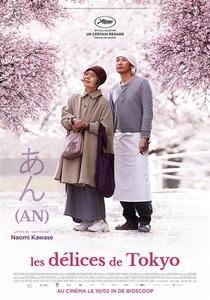
an_les_delices_de_tokyo_film

Full of poetry, Les Délices de Tokyo, a movie directed by NAOMI KAWASE, is a film that imprisons us inside the screen. Gradually we forget everything around us, until we almost refuse to be confronted with the end of this wonderful piece of art.

At first glance the story seems trivial: one Spring’s day, Tokue, a 76-year-old woman approaches Sentaro, the chef of a small restaurant. Sentaro mainly sells dorayaki, a small cake filled with red-bean (azuki) jam and Tokue explains him that she always wanted to make them, she implores him to let her have that life opportunity. He tells her “no” but she leaves a small sample… and he finally accepts.

Aditionally, there’s a teen named Wakana, a very perceptive person, a regular customer, who ultimately also applies to work at the shop. Together they are a family, Tokue, as the mother of Sentaro and Wakana, and a “mystic” member who seems to glue together all the feelings of these characters.

We can’t imagine a possible end to this story, but Tokue gives us very subtle clues, for example, when she speaks of the natural world in a way that might seem strange to us because she’s much more aware of nature than most folks inside a city… There’s a sense of being different, being isolated inside the grey walls of buildings in open air. Tokue’s eyes emanate compassion in a mysterious way.

We are only able to understand them when the owner of the restaurant learns that Tokue is a patient who lives in a leprosarium… and demands Sentaro fire her, something he refuses but must accept at the end.

When Sentaro and Wakana visit Tokue, for the first time, at her home, the leprosarium, the vivid Wakana alerts him that he will be seeing people with deformed faces. When they meet the patients, the lepers are talking together, smilling, happy despite their reality: they are also a family. That’s the power of being accepted as we are… despite our differences, our different ways to  see the universe and the different ways others see us.

Also, there’s no victory against nature here ; the nature of disease. On the contrary, Tokue determinedly accepts everything… especially without words, simply with the way she looks to cherry blossoms. She sees herself as a piece of the natural world, destined to live and to die. Maybe the fact that the actress deals with cancer in real life helps her with this role.

At the end, we remember the moment when she explains she had to release the canary Wakana gave her… he asked her to do so… and this, combined with the fact that she confesses that after her death, through a cassette recording, leaves us a final thought: a timeless reminder that our mind wants to forget that we are sick for awhile so that we can be happy during all moments of life. That’s certainly the secret of her azuki jam.

This movie explains the human condition in depth: the capacity of small things to change our lives; the importance of simple ordinary people; the power of chance that can transform small moments into important parts of history. The photographic look of the film’s scenes additionally help the director with this therapeutic message. The random bubbles of the boiling beans and Tokue’s coat, with colors resembling cherry blossoms, look like living creatures. Visually, even minor background objects come to life.

This is a movie about the most important people: the simple people.

Poetry from Joan Beebe

UNIVERSAL ONENESS
When one thinks of the Universe,
It seems to be a vast ocean of time and space.
A nothingness that is an entity having no effect
On we humans living on our own planet Earth.
But as we live our own lives, there is something
Of which we may not be aware.
That is the Oneness that binds we humans together.
Whether we live in different countries and have
Different cultures, still there is an unknown fact
To many of mankind – and that is – the way we think
About ourselves and others.
This is the motivating thoughts that emanate from our minds.
This is the way we perceive others, taking care of ourselves and family,
Interactions with many people and think day to day of our responsibilities.
Man was given that great gift of thought and it is that gift that brings
 a “Universal Oneness.”

Continue reading

Poetry from Mahbub


To Have a Finger In Every Pie


It was summer’s rain

You came to me blowing soft wind

I became cold from burning coal

Firing and the body was burning

The world seemed to be hazy

Mind crazy

It is you who came to me

Gift me a life

My eyes got power to see

When you kept your eyes on me

Hold me my body tight

made me soft and mild

my heart to beat high

I was trembling with joy

I saw through the whole world

When you fully started to —-

I saw nothing but the colourful —-

It was you my love, my sense,

That I had a finger in every pie.


Continue reading

Cristina Deptula reviews San Francisco State University’s 2017 Personalized Medicine Conference

sfsu-2017-personalized-medicine-100-has-changed-yo-54

Amy Lynn Santiago’s three-year-old son Nicholas Volker was suddenly, terribly ill. Problems that had started with a fever and an abscess that would not heal now trapped the boy in the hospital for years. He endured multiple surgeries, chemotherapy, dangerous and powerful drugs, and the permanent removal of his colon. Finally, as Nick’s care exceeded the family insurance’s two million dollar lifetime benefits cap, the physicians in his Milwaukee hospital decided to sequence his genome.
Upon discovering that he had two rare genetic diseases, they were able to successfully treat them with a bone marrow transplant. However, Nicholas, now 11, lives with long-term side effects from his ordeal, including PTSD, learning disabilities, social issues from living in near isolation for four years, and a permanent ileostomy.
His parents believe that gene sequencing could have saved him and others from much of what he went through, and advocate for this sort of personalized medicine through their nonprofit One in a Billion Foundation.
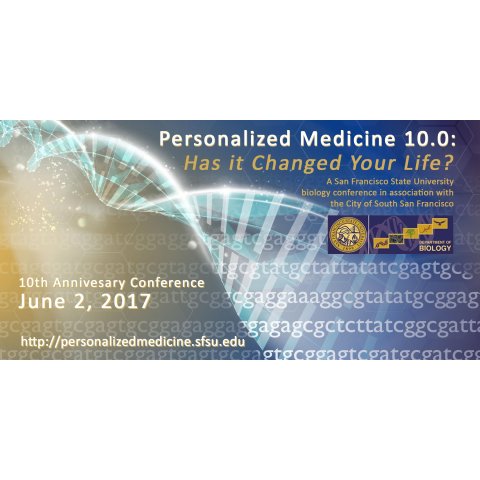
Dr. Michael Goldman and the San Francisco State University Department of Biological Sciences also see the promise of personalized genomic medicine, and hosted a one-day conference in South San Francisco June 2nd to highlight developments in the field.

Continue reading