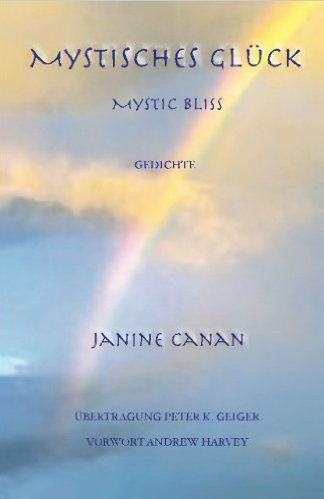
Jaylan Salah reviews Janine Canan’s book Mystic Bliss

Mystic Bliss: Janine Canan’s Mysterious Skin

Janine Canan's Mysterious Bliss

Janine Canan’s Mysterious Bliss


On her newest poetry collection “Mystic Bliss”, Janine Canan continues to shine through her dedication to Earth –and my humble self, on my signed copy only- her reflections on life, the self, the damage done to women and how they can rise above.

The collection is bilingually translated to German, which mirrors Canan’s devotion to a pan-cultural presence, and a more solid sense of self through her universal meditation on women, God and humanity.

In her sharp, abrupt use of imagery, Canan’s language seems heavily influenced by the Dickinsonian style. Canan is not generous with her words. She uses the shortest form of the written verse to express the meaning she tries to convey. Her meanings, profound as they are, carry the syntax which she masterfully desires. The abundance of layers makes up for the more intentional themes viewed as unfavorable forwardness in some poems such as “Prayer” and Streams”.

Canan’s poems vary from simple, mundane expressions of monotone feelings “Sorrow”, “Stages of Woman”, “Mirror” to the more mysterious ones, laden with complex meanings and oozing with thousand methods for deciphering the subtext. Among those that shine is “Consciousness” in which she ends the poem with a bang;

before we know

we are god

There’s also the emotionally-charged “Headless” which is a testament to the violence women face on a daily basis, or “Idiot’s guide to survival” which mourns the destruction of Earth by the hands of men.

Despite the eerie feelings Canan’s poetry could evoke in you, she always ends on a high note. Like a prophetess her message was not to be a warner, but a herald of glad tidings onto people who will listen to her. So listen closely to what she has to say, for her words would definitely be

inscribed on your soul

in lasting Light

Janine Canan’s Mysterious Bliss is available here.

Poetry from William Blome

WOONSOCKET

Little Woonsocket, little Woonsocket, you’re still figuratively bigger
than a Pomeranian or an Indigo Bunting,
and plumbers here a century back moved out
on horse-drawn carts and carried decent rubber plungers
underneath their hairy arms, and they sported rubber boots
that many-a-time father made to double
as waders come Rhode Island’s snarking trout season.

Little Woonsocket, little Woonsocket, I screamed into town this morning
as two rippling, chunky women were doing boom-box calisthenics
at the end of the open road, up against the city’s lesser gates,
and the only thing I had in my car to barter oral pleasure
was a one-third empty jeroboam of Carlo Rossi red,
though as shit and sweet fortune would have it,
that was more than enough to spear the black girl’s thong
for later framing and ridiculous mounting
as high as I can reach up walls in daddy’s fireplace-d den.

Continue reading

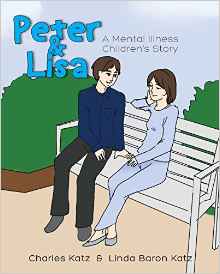
Lewis Mark Grimes reviews Linda and Charles Katz’ children’s book Peter and Lisa

Peter and Lisa by Linda and Charles Katz
peterandlisa
Thank you for the opportunity to read this prescriptive children’s book. I was impressed. This is a difficult subject to undertake. It’s necessary writing and important. As a genre, there may be a terrific need for books for children like this. I don’t ordinarily read this category. Therefore I may be a poor judge or at least irrelevant. I did sell some children’s lit as an agent, so I’m not without some credibility.
I loved the illustrations. They are moody and evocative. The idea was interesting. I wondered if the authors had shown their text to any pediatric psychiatrists? I raise this in response to the choice to describe depression by other phrases. If we as adults have attached stigma to a word such as depression, why would we want to reinforce that in possibly the first book a child might reach for?
I also wondered if the authors had shown the book to librarians in the juvenile room? Since I am not reading juvenile literary works any more, let me just part by saying there is a positive need for books like this. I hope Peter & Lisa leads the pack.

Poetry from Patrick Ward

AUTUMN’S RAIN

There’s a certain time of year that the rain drops take on different colors.
Instead of falling from the sky, it falls from the trees.
Taking on the form of leaves, with the whistling wind,
driving them in the direction that it wants them to go.
Drifting away in a rapid dance,
they float into the middle of nowhere.
Until the rain of many colors.
reaches their final resting place.

*****

MINGLED GESTURES

The voices of careless words pollute the air.
Someone who is sensitive might happen to be there.
Among the crowd some gesture, while others stare.
Somewhere in the midst of the crowd is a hidden snare.
Tender hearts sometimes are misplaced.
Wounded gestures received in the memory can’t be replaced.
In the mind of the sensitive they’re hard to erase.
It’s difficult when confronted face to face.
Senseless gestures fill the soul.
As negative thoughts roll.
By the act of the will.
Gestures are removed, and joy is fulfilled.

*****

Continue reading

Elizabeth Hughes’ Book Periscope

villageofbones

The Village of Bones, by Mary Mackey, is a fantasy that is definitely a must read. it is the prequel to the Earthsong series. It is the story of Sabalah who is a young woman who desires more than anything to conceive a child. She is given a vision she will conceive a magical child; however, she must leave her village and everyone she loves there. So, Sabalah and her lover leave. What follows will keep you on the edge of your seats to the very last page. This is definitely Mary Mackey at her best.

Book is available here.

Essay from Donal Mahoney

A Gathering of Generations
 
An old man, a poet of the generation of Kerouac, Corso and Ginsburg, is at the lectern tonight in the auditorium of a small college nestled in the Ozarks of Arkansas. Although widely published for many years, both in the United States and abroad, he has never done a reading of his work. He attended a reading once, back in the Fifties. It was held in San Francisco and given by Gregory Corso. All the literati of the day were there, a number of them under the influence of one thing or another. But the reader tonight was so bored he swore he would never do a reading himself.
 
Not one to fraternize with other writers, the poet usually stays home with his African Grey parrots and Scarlet macaws. He writes at an old roll-top desk in what a romantic might call a garret, which he says is just a drafty attic over his old garage, part of an estate he inherited from his parents. He writes, off and on, day and night because he sleeps very little–two hours here, two hours there. He disdains liquor and dope but is a souse when it comes to milkshakes.
 
Tonight his friend of many years, an old professor at a local college, has asked him to read. The professor, almost as old as the poet, assumed the man had read his work often at various venues. The old poet for some reason agreed to do the reading. Maybe the money was attractive, although the honorarium was small. Long ago the poet’s four books had been remaindered and now money in any amount helps. Seed for the parrots and macaws adds up. He lives on Social Security and an annuity given to him by his parents long ago because they figured he would never be able to earn a living. They were right.
Continue reading

Synchronized Chaos August 2016: Storms of Change

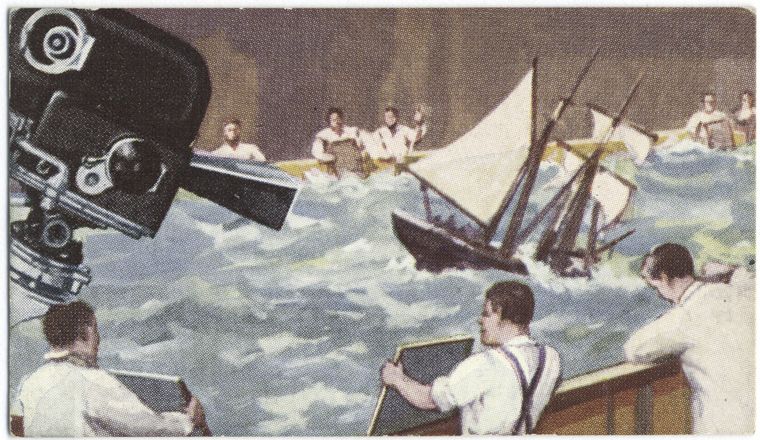
storm at sea

(Photo above courtesy of the free digital archives of the New York Public Library, which you can access here. Just enter a search term—like “storm”—or terms, & see what comes up, it’s so fun!)

Good evening, this is guest editor Tony Longshanks LeTigre.

We are all disaster survivors at the moment of one kind or another, it seems. Someone asked once if had PTSD. I replied, “I’m alive, so yes.”

The sense of being caught up in an impending disaster seems common to people all over the world at the moment, & it is reflected in the submissions for Synchronized Chaos for this month. The only sensible thing to do seems to be to declare the theme of August 2016 Storms of Change. (I hope that doesn’t sound too presidential & platitudinous.) Painful storms brewing, evolution facing obstacles, growing unhappiness & backlash against unhappiness from those satisfied with the status quo or desirous of protecting their wealth, & their illth, to use a word suggested by English art critic & social critic John Ruskin. The submissions we’ve received for August are riddled with discontentment, primal screams of anguish & outrage growing louder, pressure building up to a major earthquake, a drumbeat in the distance growing louder, adverse branching futures from which a path will emerge (whether it likes it or not) in time, the sense of homelessness, of belonging nowhere, of being  or being treated as an alien legally & otherwise, a eulogy that asks “impossible questions,” nature hallowed & nature besieged (whether we are nature’s besiegers or her fellow sufferers hard to say), our distraught predicament as humans seemingly mirrored by various other creatures across species lines.

At least, that’s what I see. Maybe I’m just being a paranoid drama queen or something.

Prerna Bakshi, an Indian writer, poet and activist based in Macao, sends us three poems pertaining to the partition of India / Punjab. “I belong to the family of refugees and have been deeply moved by what’s taking place in the world at the moment.”

Redolent with sadness is Christopher Bernard’s eulogy for Adelle Foley, a writer married to an accomplished poet. “At times like this / I ask impossible questions.” Bernard reviewed Adelle’s husband’s chapbook Eyes for Synchronized Chaos back in December 2013.

Developing the catastrophic theme, Hanoch Guy treats us to several poems about a series of natural disasters, including the tragicomic image, “A glacier sails away carrying a family  of polar bears.”

Next we have a poem from Colin McCandless in alliterative / Beowulfian style about the “balancing act” between prey & predator.

We are always happy to have submissions from Jaylan Salah. This month she gives us an edifying interview with up-&-coming Australian actor Jackson Gallagher. “The Man Who Roamed the World.”

Yours truly offers an excerpt representing the first chapter of a new novel-in-progress, & a long, excellent review of a long, excellent book, Douglas Hofstadter’s 1980 Pulitzer Prize winner, Gödel, Escher, Bach.

Donal Mahoney has been asked by non-writers many times, “Why Did You Write That?” That forms the title of his essay in which he describes his habit of accumulating words until he has enough for a poem. “Next I try to determine what the poem, if anything, is trying to say. And that’s not always easy.”

Like determining the theme of Synchronized Chaos!

Michael Robinson offers a timely reminder that black lives matter with a series of short essays or prose poems. No shield exists here between the reader & savage realities of life as an oppressed person in a warlike scenario of feeling under attack at all times. “Have you witnessed the pain and heartbreak of black mothers when they learned that their son has been killed in the streets?” he asks, & cries out, “I don’t want to end up like Emmett Till,” an African-American teenager who was lynched on suspicion of flirting with a white woman in Mississippi just 61 years ago.

A trio of poems from returning contributor Joan Beebe find solace & nourishment in the sun, & bewilderment in those “times when life seems to overwhelm us” with a broken heart. She wakes up to a new day & faces the question, “Where is the joy that should be part of this day?”

I. W. Rollins sends poetry describing “a timid shrimp of a
middle aged man,” a young who “eats this love he doesn’t deserve,” & his memory of getting drunk for the first time, when “the bottle’s kiss was a kiss / the other boys couldn’t have, / it was all my own / just like my sadness.” He closes with a poem about being trapped by capitalism into a kind of pleasant slavery.

And we have poems from J. K. Durick examining that possibility “that Under all / this fuss and noise we live through, we walk around with, / We dedicate our days to, there may be nothing at all.”

Good luck weathering the storm, my literary comrades & fellow human beings.

Tony “LongShanks” LeTigre
Portland, OR, USA
August 2016

*****************************************************************************

Reminder for everyone that author Rui Carvalho and administrator Sara Rodriguez Arias invite all writers here to enter a literary contest.

Details, deadlines and entry form available through the link.

INTERNATIONAL LITERARY CONTEST: NATURE 2016: “Tales for the Ones in Love” in partnership with The Book Park & Arts & Literature. https://lnkd.in/dSgN7uq http://www.thebookpark.com

COMPETITION ADJUDICATOR: Janine Canan.

Janine graduated from Stanford University cum laude and from New York University School of Medicine. She is a passionate champion of women’s equality, and a devoted follower of Mata Amritanandamayi.
http://www.janinecanan.com/
http://www.janinecanan.com/pages/order_books.html
Photography by George Hodan

Photography by George Hodan