Poetry from Michael Robinson

Dreams beyond the Grave

Many dreams drift from cloud to cloud. Dreams of peace without the sounds of gunfire or the cries of death. I watch the moon as it sinks behind the horizon, and I wonder, when will my nightmares of living in the inner-city end? Watching the peacocks’ feathers blooming, I lie quietly in my grave — and peace has found me.

*     *     *

Black Boys II

Angry at life and angry at a system that keeps them incarcerated to a promise of a life without body piercings and tattoos; but hope is lost from a life spent avoiding the police. Mothers addicted to crack cocaine lie upon urine-strained mattresses. Some escape this life, and climb and climb and climb, and finally reach the safety of the mountains. And it is there that love flourishes; there that sanctuary is found. Beyond the stars that glow at night. A soul no longer thirsts for the safety of home: no longer in the heat of the streets.

*     *     *

Mother II

I want to send flowers to my mother, but she has passed away. I would like to visit her her grave and let her know that I have finally found the better side of life. There is a place on earth which reflects heaven. No longer do I cry into my pillow.

*     *     *
Essay from Rui Carvalho

Cinema Critique: The Revenant by Rui M. Carvalho (28 March 2016)

revenant1

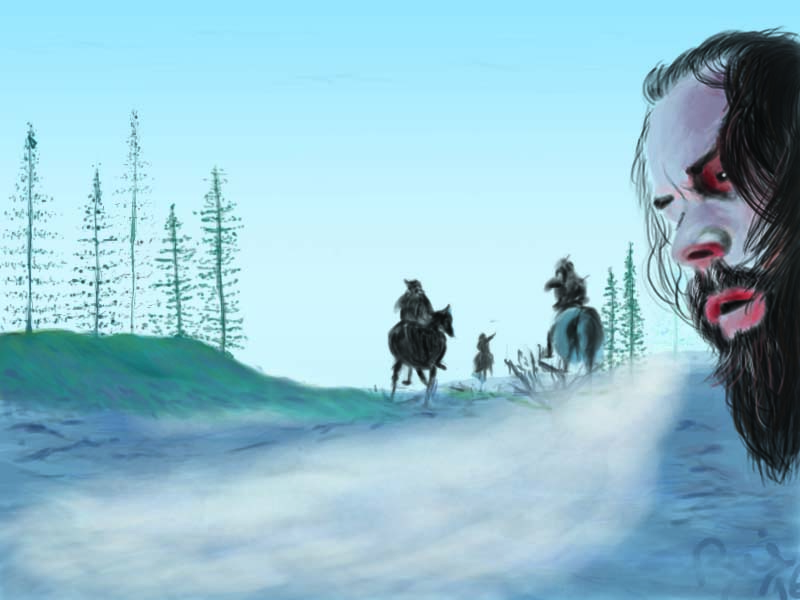
Inspired by true events, The Revenant, a movie directed by Alejandro Iñárritu, is an example of a film whose trailer alone makes us feel it has a significant message to transmit. Visually, it might be considered almost a new genre of western, which we might call the “frozen western.”

The sentence “I’m not afraid to die any more, I done it already” surely creates on us a deep first impression, expressing the idea that there’s no turning back: only a landscape in front, and a shadow behind the speaker. This dramatic first impression is further emphasized by the contrast between ice — dominant, mostly blue and grey — and, sometimes, small dots of fire, mostly yellow and orange. A human tragedy plays out in the course of the movie, in which divers persons confront the meaning of their lives; this being especially obvious during one of the last scenes, in which the aggressor, played by Tom Hardy, speaks with the hero (or surviving victim, if you please), played by Leonardo Dicaprio, and confronts us all with deep questions: What is justice for? What types of justice are there and what are the ones we want? Should justice be a constructive process?

This type of reasoning is an example of what some cinematic theorists consider to be the psychological role of film: as a tool to give new significance to reality, to educate and influence the citizenry. The Guardian asserts that cinema can be valuable for children’s and young peoples’ learning and cultural experience (The Guardian, 28 March 2016). And this can be seen as a detail of a big process of civilization, which “is not linear and conscious” (Cultural Studies Now, 28 March 2016).

Continue reading

Review from Tony Longshanks LeTigre

What is mathematics?
Review of The Mathematical Experience, by Philip J. Davis & Reuben Hersh (1981)

By Tony LongShanks LeTigre


Several years ago, during a period when my life had taken a strange turn & I began delving into physics books as an inquiry into the deepest ontological & philosophical questions, the question above began to interest me. One book I read was Murray Gell-Mann’s The Quark & the Jaguar, in the course of which he posed the question of whether mathematics was or was not a science in itself; if so, he states, it is “more fundamental than any other.” Gell-Mann deserves some credit for being open-minded enough to even pose the question, for some physicists—as well as logicians, & computer scientists, & engineers, & various others—hold a reductive or belittling view of math as merely a tool or language for other sciences. The more I read about physics, the more fascinated I became by the way that equations like those involved in Einstein’s theory of relativity could tell us things about the nature of the cosmos, could predict things & point to answers of mysteries that would otherwise lie far beyond our present grasp. I didn’t want to do mathematics—solving equations, measuring angles, formulating convergence proofs—but to read about the subject itself in a detached way; if math is the science of numerical abstraction, you could say that I had an abstract interest in an abstract science. I wanted to find a book that would explain the nature of mathematics & mathematical philosophy, if such a thing exists. It turns out it does—or did—& I found the perfect introduction in the form of The Mathematical Experience, by Philip J. Davis & Reuben Hersh, published in 1981.

Who knew the history of math could be so fascinating, so entertaining, even? Davis & Hersh trace that history from its beginnings with Thales (circa 600 BC), Pythagoras, Euclid, & Archimedes in the classical Greek era; into the relative darkness of the Middle Ages, followed by the enlightenment of the 1600s with Kepler, Galileo & Newton; & thence forward via Lagrange, Euler, Gauss, etc. to the modern era.

Continue reading

Essay from Kristen Caven

Take A Walk in My Scarpa

When one travels to Italy, one luxuriates over leather goods, namely shoes. And anyone who knows me knows I’ve had a thing or two to say about footwear. Alexa took me to two markets and a shoe store to indulge my lust for shoes. She showed me how to look at labels to find the real leather, and to determine which were made here and which were made in China. At one market, we were greeted by a sea of seconds and last season treasures, with leather boots for only 10 Euro (About $15). Alas, they were only as large as a 37, and I start at a 38.

One can hardly afford NOT to buy them!

But we did find a few crazy stylish pairs that fit the parameters. There is no room in Alexa’s legendary shoe closet, but what’s a girl to do when one finds pointy gold leather booties wrapped with little belt things for only seven Euro?

The thing is, I couldn’t get my head around the Italian word for shoes: Scarpa.

I mean, in the country that is known for buttery soft, elegant footwear that fits so comfortably style can be a part of every step, the country that is literally shaped like footwear, and where the most musical of all Romance languages is spoken, why wouldn’t there be a more mellifluous word for shoe? SKARpa. Scar. (ew.) puh. (ugh.) The word has sharp edges and a spitting quality, calling to mind how painful shoes can be. What were Steve Martin’s Cruel Shoes with the right-angle turn and the embedded razor blades, if not scarpa?

I needed some help to understand the magic of this word, and asked Davide (Dáh-vee-day), the Vesuvian Cowboy, to illustrate. Sure enough, when a dashing Italian man says this word, one wants to slip one’s stockinged foot into whatever he happens to be holding in his hand at the moment….

My trophies: a pair of soft grey wedgie boots; some sleek leather Beatle booties; a pair of whimsical felt t-straps with a crocheted flower on the toe, dangerous six-inch heels and red soles (Alexa found a matching pair of pumps in her size… we really need to do an act, right?); and the perfect pair of first pumps for my niece’s Bat Mitzvah. (The girl is smart. She knew just what to ask for as a souvenir.)

And now for some shoe porn. 
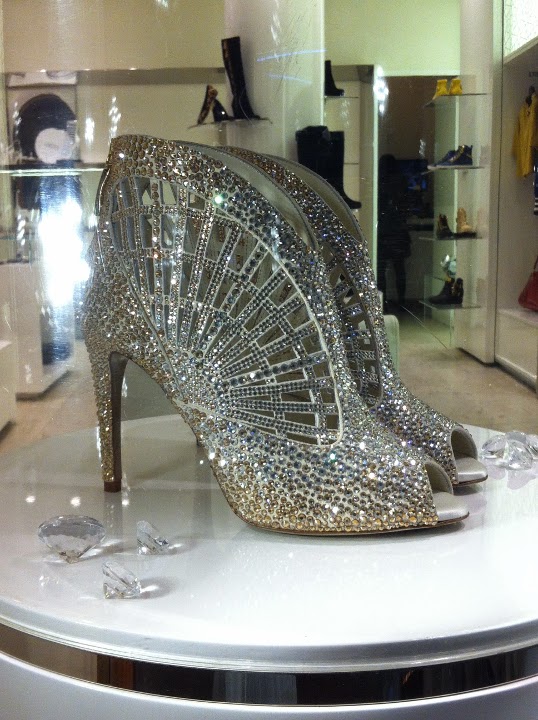
The high holy grail of Cinderella shoes appeared in a window in Venice.
(I may have to rewrite my novel around them.)

Continue reading

Poetry from Christopher Bernard

What Is a Poem?

By Christopher Bernard

Writing it:
a moment of pity, plus a little skill, plus an absolutely absurd pride.

Reading it:
echoes, echoes, echoes of the dead.

*

Words and cats:
proud seductive minds.
Writing it,
like herding cats
who just happen to be on fire.

Reading it,
on the other hand,
like listening in on a convention
of drunken, but supremely eloquent, dogs.

Continue reading

Poetry from Joan Beebe

The Rising and Setting of the Sun


   A new day dawns and there is an eerie silence around us.

We wonder as we look at the darkened sky

And we perceive a tiny sliver of gold appearing.

With a shimmering afterglow that gives one a feeling of

Being in another time and place.

Now the rays of the sun shine bright upon the earth

Our senses awake more intensely

We are one with the panorama before us:

There is a freshening of life upon the earth.

Slowly but steadily we watch the morning sun appear.

It has beauty as shades of pink

 begin to stretch out across the sky.

  In the quiet of this new day,

 we reflect on the gifts of this sun

Our spirits are lifted and we are happy

We are thankful for the warmth and nourishment it provides.

As the day ends, we watch the slow setting of the sun.

The sky becomes a canvas of red, pinks and gold with

Streaks of light clouds blending in so beautifully that

It becomes a palette of colors across the sky.

It is now the quiet time of the night and we rest.

Poetry from K.C. Fontaine

A Slow Suicide

I.
the pakistani painter’s studio
a shrine to her lost self

the finer things
glossed resistance
depressed days
blunted nights

II.

the darkest corner
of
her dust-laden studio
whisper
brighter
daysze.

untitled