MY COUNTRY

He took the purple color from the blood of the martyrs and created chaman in the chest of this land.
Infatuated with your incomparable beauty, I love you as my admiration, Motherland.

Hokingta is a mixture of grandfathers' love, a song that is engraved in the hearts of mothers.
Your arms are as warm as my mother's arms,
I love you, my country.

You are the propeller that spins in Tegram,
May your child rest in peace. You caress my head, brave yourself,
I love you as my power, Motherland.

Your body is full of enthusiasm, and your eyes are always refreshed.
Excitement in my heart, wonder in my eyes,
I love you as my paradise, Motherland.


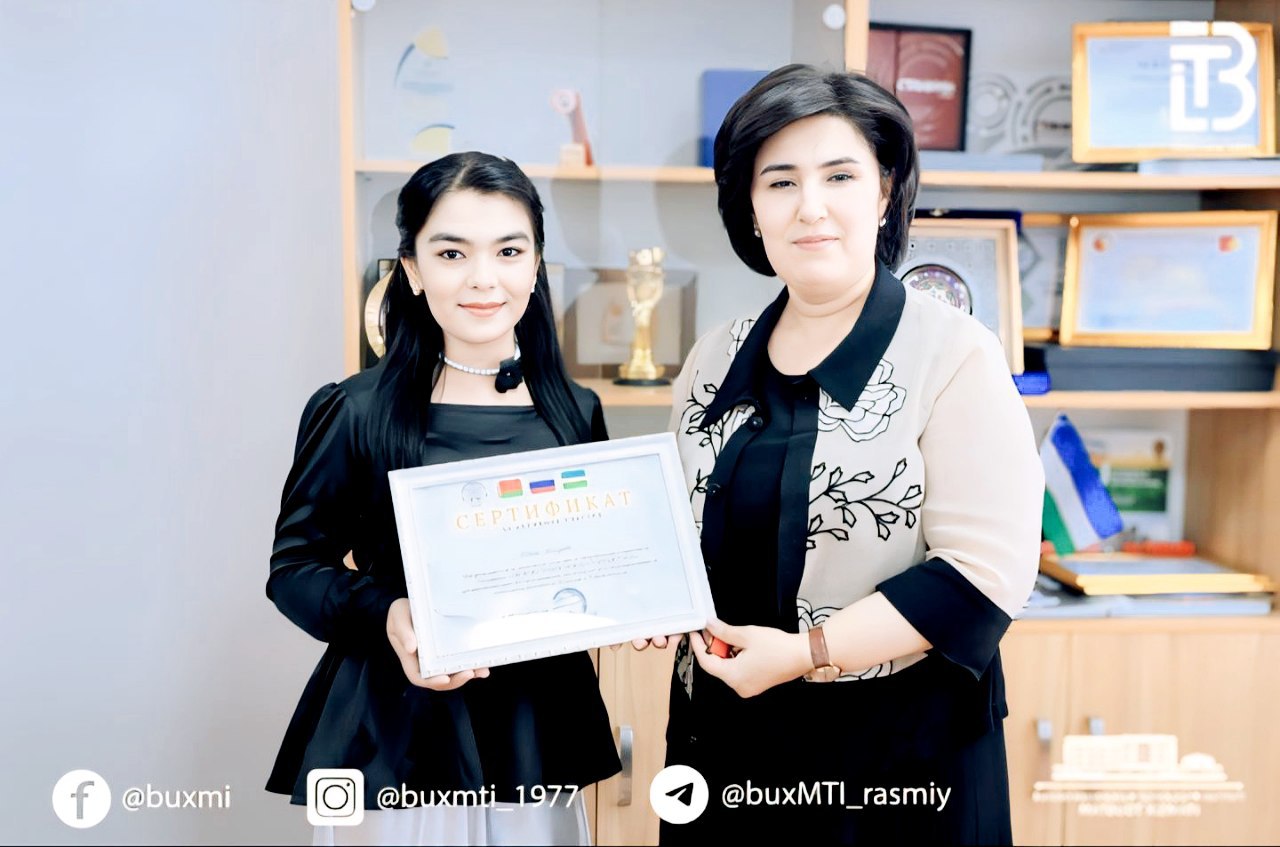
Nodira Jorayeva is a 3rd-year student of Bukhara Engineering-Technology Institute, Faculty of Technological Process Management Systems, Department of Information Systems and Technologies.
Born on March 15, 2002 in Jondor district of Bukhara region.
He graduated from the 29th general secondary school of Zhondor District, Bukhara Province.

During his school years, he stood out among his peers as an initiative, demanding and creative student. He graduated from school with excellent grades. "My contribution to the development of the country" in the district stage of the competition of creative works of the project "Great children of my motherland." Creative works published in periodicals. "first-class diploma in the nomination, organized by the Faculty of History and Cultural Heritage of Bukhara State University, announced on the official channel of the "Flight Mega Project" and held under the hashtag "Bag and Me" as the "Most In addition to actively participating in the "good video" nomination and getting a high score, he was awarded a second degree diploma by the head of the channel for showing examples of aspiration, at the youth festival held under the slogan "Why do I love Uzbekistan"? The third place in the "Storytelling" category. The first place in the Prose category "Best Story Author" category of the "Green Leaves" online competition held among creative young people, Bukhara Institute of Engineering and Technology "Bahor" came to question you" and won the third place in the poetry evening and many other competitions.

A very creative student who works in prose, poetry, journalism. He is the winner of Zhondor District, Bukhara Region and Republican contests. Party affiliation, National Revival Democratic Party.
He is the author of prose and verse books "DREAM STOP", "TEST OF FATE", "SPRING OF MY HEART". The author of many articles published in "Voice of Zhondor", "Bukhara evening", "Spiritual shock", "Bukhara youth", "Bekajon" newspapers. He was admitted to the Bukhara Institute of Engineering and Technology in 2021!
Uzbekistan is a great country. Many famous scholars, poets and great generals have grown up in Uzbekistan. Nowadays, the children of Uzbekistan are among them.
Uzbekistan is a country rich in history, its historical monuments historical cities, historical objects and manuscripts are still currently, they are preserved libraries, and most importantly in the museums of foreign countries.
Nowadays, many tourists visit the territory of Uzbekistan. At the same time tourism in Uzbekistan is developing in the city of Samarkand. There is a famous Ragistan square in the city of Samarkand it has Tillaqori, Sherdor, Uluğbek madrasahs.
Guests from faraway countries are visiting to see this. You will also enjoy these things if you come to Uzbekistan.
A person grows up in his mother's body before he is born. When a mother is upset, she is upset. If he is happy, he will be happy. When he comes to the world, he grows up with the warm love of his mother and the love of his father. Parents are the only people who cheered him when he was happy, cried when he cried, stood by him in any situation, encouraged him, gave their life, love and everything.

However, some people forget how they grew up and those blessed people who gave their lives to take care of them when they were unable to do anything. This is a sad situation. Or, life time is not worth it. On the contrary, after his death, he remains in a vortex of a thousand regrets. That's what they say about time. A person should make good use of his time and appreciate his parents. It is a very right decision for him to give the love and attention that his parents gave him. My parents are my wealth. Because of them, I can get out of any situation. They are my people who have always helped me and taught me their life experiences.

Up to this age, no matter what day I had, my parents always came to the first aid. They were happy and proud of me when I succeeded, and when I faced difficulties, they advised me to learn from my mistakes. They tried to make me study, even if it was hard for them. "Learn first. The rest will slowly come to you." - they said.

If every person has two wings in front of him, that is, his parents, then he is a strong person. Regardless of the situation, a person should always move forward. Because he should never forget that his parents are behind him, trusting him and watching him.

Our greatest wealth is the presence of our parents. Therefore, my dear person, appreciate your parents. Give them the love they give you. Appreciate your time and make the most of it, knowing that it's a treasure. Always try to make them happy by taking their blessings.

Oblokhulova Maknuna was born on July 18, 2003. 3rd year student of Termez State University. Likes to write creative works. The main goal is to always learn and never stop giving.
Kaizen

The autumnal Bliss
Collecting paper flowers
A marlboro bough
Cherry blossoms in a night travelled road
Dark like night sheets
Rooted deeply in parks
Funeral coats are funny
Dusts to dusts
While counting each moments
Loose ends
Piano players are happiest
Yeats was right
So were Poets
Fool's paradise
Dark rhythms I conceive you
My Muse of torpedo blue
Little Bluebird of my chainmail desks
My autumnal pinings
La Vie en rose
Gold hearts get noticed
Poets are happiest
In a sense
Paradise eden
Lean in art's bosom.
I summon my Autumn.
Christopher Bernard will be reading at the Poets for Palestine SF Marathon Reading at San Francisco’s Bird and Beckett Bookstore. For a donation of any amount to the Middle East Children’s Alliance, a nonpartisan and nonpolitical organization helping all children in the region, poets can come and read at any time at the store on October 14th, Indigenous People’s Day. Please feel welcome to sign up here or email poetsforpalestinesf@gmail.com to be scheduled.
This month’s issue addresses our fears and aspirations: whether life will become what we dread, or what we hope.
Wazed Abdullah revels in the joy of the Bangladesh monsoon as Don Bormon celebrates flowers and wispy clouds in autumn. Maurizio Brancaleoni contributes bilingual haiku spotlighting days at the beach, insects, cats, and the rain. Brian Barbeito shares the experience of walking his dogs as summer turns to fall.
Soren Sorensen probes and stylizes sunsets in his photography series. Lan Qyqualla rhapsodizes about love, dreams, flowers, colors, poetry, and harp music. Ilhomova Mohichehra poetically welcomes autumn to her land.
John L. Waters reviews Brian Barbeito’s collection of poetry and photography Still Some Summer Wind Coming Through, pointing out how it showcases nature and the “subtle otherworldly” within seemingly ordinary scenes. Oz Hartwick finds a bit of the otherworldly within his ordinary vignettes as he shifts his perspective.
Kelly Moyer crafts stylized photographic closeups of ordinary scenes, rendering the familiar extraordinary. Ma Yongbo paints scenes where ordinary life becomes unreal, suffused with images associated with horror.
Sayani Mukherjee speaks of a bird’s sudden descent into a field of flowers and comments on our wildness beneath the surface. Jake Cosmos Aller illustrates physical attraction literally driving a person wild.
Mesfakus Salahin asserts that were the whole natural world to become silent, his love would continue. Mahbub Alam views life as a continual journey towards his beloved. Tuliyeva Sarvinoz writes tenderly of a mother and her young son and of the snow as a beloved preparing for her lover. Sevinch Tirkasheva speaks of young love and a connection that goes deeper than looks. llhomova Mohichehra offers up tender words for each of her family members. She also expresses a kind tribute to a classmate and friend.
Meanwhile, rather than describing tender loving affection, Mykyta Ryzhykh gets in your face with his pieces on war and physical and sexual abuse. His work speaks to the times when life seems to be an obscenity. Z.I. Mahmud looks at William Butler Yeats’ horror-esque poem The Second Coming through the lens of Yeats’ contemporary and tumultuous European political situation.
Alexander Kabishev’s next tale of life during the blockade of St. Petersburg horrifies with its domestic brutality. Almustapha Umar weeps with grief over the situations of others in his country.
In a switch back to thoughts of hope, Lidia Popa speaks to the power of poetry and language to connect people across social divides. Hari Lamba asserts his vision for a more just and equal America with better care for climate and ecology. Perizyat Azerbayeva highlights drip irrigation as a method to tackle the global problem of a shortage of clean drinkable water. Eldorbek Xotamov explores roles for technology and artificial intelligence in education.
Elmaya Jabbarova expresses her hopes for compassion and peace in our world. Eva Petropoulou affirms that action, not mere pretty words, are needed to heal our world.
Ahmad Al-Khatat’s story illustrates the healing power of intimate love after the trauma of surviving war and displacement. Graciela Noemi Villaverde reflects on the healing calm of silence after war.
Meanwhile, Christopher Bernard showcases the inhumanity of modern warfare in a story that reads at first glance like a sci-fi dystopia. Daniel De Culla also calls out the absurdity of war and the grossness of humor in the face of brutality.
Pat Doyne probes the roots of anti-Haitian immigrant rumors in Springfield, Ohio and critiques fear-mongering. Jorabayeva Ezoza Otkir looks to nature for metaphors on the corrosive nature of hate.
On a personal level, Nosirova Gavhar dramatizes various human responses to loss and trauma. Kendall Snipper dramatizes an eating disorder ravaging a woman’s life and body.
Donna Dallas’ characters are lonely, bruised by life, and drawn to what’s not good for them: drugs, bad relationships, lovers who don’t share their dreams. J.J. Campbell evokes his miserable life situation with dark humor.
Meanwhile, Maja Milojkovic savors each moment as she creates her own happiness through a positive attitude. In the same vein, Lilian Dipasupil Kunimasa celebrates the power of a free and self-confident mind and the joy of spending time with small children.
Tuliyeva Sarvinoz urges us to move forward toward our goals with faith and dedication. Numonjonova Shahnozakhon echoes that sentiment, encouraging perseverance and resilience. S. Afrose resolves to move forward in life with optimism and self-respect.
Michael Robinson reflects on the peace he finds in his continuing Christian walk. Federico Wardal reviews anthropologist Claudia Costa’s research into spiritual fasting practices among the Yawanawa tribe in Brazil.
Duane Vorhees explores questions of legacy, inheritance, and immortality, both seriously and with humor. Isabel Gomes de Diego highlights Spanish nature and culture with her photographic closeups of flowers, religious icons, and a drawing made as a gift for a child’s parents. Federico Wardal highlights the archaeological findings of Egyptologist Dr. Zahi Hawass and his upcoming return to San Francisco’s De Young Museum. Zarina Bo’riyeva describes the history and cultural value of Samarkand.
Sarvinoz Mansurova sends outlines from a conference she attended on Turkic-adjacent cultures, exploring her region as well as her own Uzbek culture.
Barchinoy Jumaboyeva describes her affection for her native Uzbekistan, viewing the country as a spiritual parent. Deepika Singh explores the mother-daughter relationship in India and universally through her dialogue poem.
David Sapp’s short story captures the feel of decades-ago Audrey Hepburn film Roman Holiday as it describes a dream meeting between lovers in Rome. Mickey Corrigan renders the escapades and tragedies of historical women writers into poetry.
Duane Vorhees draws a parallel between Whitman’s detractors and those who would criticize Jacques Fleury’s poetry collection You Are Enough: The Journey To Accepting Your Authentic Self for having a non-traditional style.
This set of poems from Jacques Fleury expresses a sophisticated childlike whimsy. A few other pieces carry a sense of wry humor. Daniel De Culla relates a tale of inadvertently obtaining something useful through an email scam. Taylor Dibbert reflects on our escapes and “guilty pleasures.”
Noah Berlatsky reflects on both his progress as a poet and editors’ changing tastes. Sometimes it takes growing and maturing over time as a person to create more thoughtful craft.
Alan Catlin strips artworks down to their bare essential elements in his list poetry, drawing attention to main themes. Mark Young focuses on kernels of experience, on the core of what matters in the moment. J.D. Nelson captures sights, experiences, and thoughts into evocative monostich poems worthy of another reading.
Kylian Cubilla Gomez’ pictures get close up to everyday miracles: a beetle, car components, action figures, a boy in a dinosaur costume.
We hope that this issue, while being open about the worries we face, is also a source of everyday miracles and thought-provoking ideas. Enjoy!
J. D. Nelson is the author of eleven print chapbooks and e-books of poetry, including *purgatorio* (wlovolw, 2024). His first full-length collection is *in ghostly onehead* (Post-Asemic Press, 2022). Visit his website,MadVerse.com, for more information and links to his published work. Nelson lives in Boulder, Colorado, USA.